Home » Broadband Speed » Recent Articles:

Exclusive: Frontier’s California Confuse-o-rama: Residents Victimized by Frontier’s Changing Stories

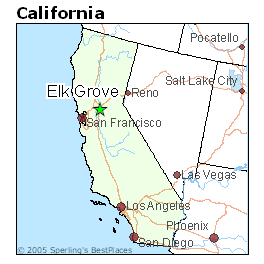
Elk Grove, Calif. residents receiving letters from Frontier Communications claiming they are using the company’s Internet service too much are getting confusing responses from the phone company when calling to register complaints about the Internet Overcharging scheme.  Even worse, one company official told a subscriber they have to keep the new usage limits secret “for legal reasons in case we have to change it again.”  But no worries, Frontier explained to one customer: if you exceed the secret cap again, you’ll be notified future overages will be conveniently billed on a future Frontier bill.

Stop the Cap! has been receiving dozens of e-mailed complaints from customers upset that the company’s bait-and-switch broadband also comes with uninformed customer service representatives who can’t deliver straightforward answers to customers trying to understand how they can avoid up to $250 a month for 3Mbps DSL broadband service.

“When I signed up for Frontier DSL, nobody said a thing about usage limits,” writes our reader Trina who lives near Camden Park.  “My small business has DSL from Frontier as well and we were horrified when we received a letter telling us we were over-using their service.”

Trina and her husband have four teenage boys living at home, all sharing their Frontier DSL account.  When she called the company in response to the letter she received, the confusion began.
“The first representative didn’t understand what I was talking about and denied there were any limits and said the letter must have been a mistake,” Trina says. “But my husband noticed others in our area were talking about the letter on area message boards so when he called, he got a representative that confirmed the limits were real.”

Trina was told her home would need to upgrade to Frontier’s $249 monthly DSL service plan, the same one Frontier held over the heads of some customers in Mound, Minn. last year.

“I told them they must be smoking crack — are they serious?  There is no way I am going to pay $250 a month for DSL that gives us 1.5Mbps service — not in this world,” Trina says.  “My husband laughed when I told him, saying Frontier is going to drive themselves out of business from this stupidity.”

Elk Grove reader Stephen also called Frontier after he received a letter stating he used over 100GB in a month.

“Yeah, I used 104GB according to my router’s logs and Frontier deemed me a bandwidth abuser,” Stephen writes.  “Of course the company tried to sell me a plan priced at $100 a month for their lousy DSL service we got suckered into on one of their term contracts.”

Stephen said he’d manage to find a way to shave 5GB off his monthly usage and forego Frontier’s $99 offer until he signs up with a competitor and tells Frontier to take a hike.

“It’s one thing to be abused by a lackluster phone company like Frontier who never did a thing for Elk Grove — it’s another to pay them more for their abuse,” he writes.

Stop the Cap! reader Pete, also in Elk Grove, says he can’t get a straight answer over exactly what the monthly limit is.
“When I called, I was told 5GB by one representative, 100GB by another, but get this — when I logged into the ‘Flexnet’ Usage Meter the company tells you to review, it showed I had a 20GB limit,” Pete says.  “I called Frontier on the phone and told them I was so through with them — I can’t stand their nonsense.”

Pete wasn’t alone.  Our regular reader Mike figures his cap was actually 20GB a month if the company’s usage meter was to be believed, and he sent pictures.

“I got their nastygram last month over my usage and now my Flexnet meter shows me over the limit,” Pete says.  “I have been vocal on a local Elk Grove message board so I’m feeling like this is retaliation.”

In fact, Mike’s usage meter depicts him as well over the arbitrary 100GB limit Frontier suggests in their letter, despite not coming close to 100GB of usage.  Ditto for our reader Michelle who lives in Palo Cedro, a community Frontier can largely hold captive thanks to limited competition.

Benjamin, also in Palo Cedro, says Frontier’s move will hurt small businesses in the northern California Shasta County community of 1,200.

“I need high speed Internet to help start my business, which will largely involve uploading and downloading multimedia, (which is hard enough to do on a 1.5 connection) but to increase the cost is absolute insanity,” he says.
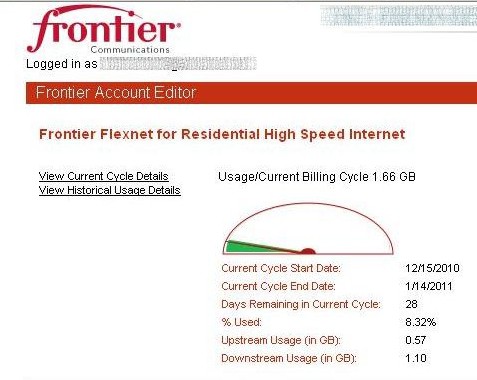
Our reader Mike discovered Frontier's usage meter suggests he has far less than a 100GB monthly usage allowance.

Benjamin’s alternatives barely qualify.

“I can either try Clearwire, which works terribly locally and is known for its speed throttles when congested, or HughesNet satellite-delivered Internet, which is overpriced,” Ben adds.

As our readers already know, satellite fraudband is no replacement for real broadband service, because it comes with a “fair access” policy that isn’t fair and doesn’t deliver much access.

“I will fight this any way I have to,” Benjamin says.

John in Elk Grove writes in to say the entire affair is a Frontier shell game.

“It’s pure bait and switch to sell us broadband without limits and then suddenly impose them while we are supposed to be on ‘price protection agreements’ that the company says will keep our prices stable,” John says. “Now we learn it’s all a shell game — they can say we used too much and that doesn’t count with their price protection scam.”

John adds Frontier can change the limits at will, and customers who choose to depart could still face enormous cancellation penalties.

“The Frontier representative I talked to when I called to cancel service told me I owed $300 for ending my contract early,” he said. “I told them to go to hell and that if they tried to collect, I’d personally make it my life’s work to cost them far more than that in lost business.”

Customer anger only increases after speaking with Frontier’s own representatives.
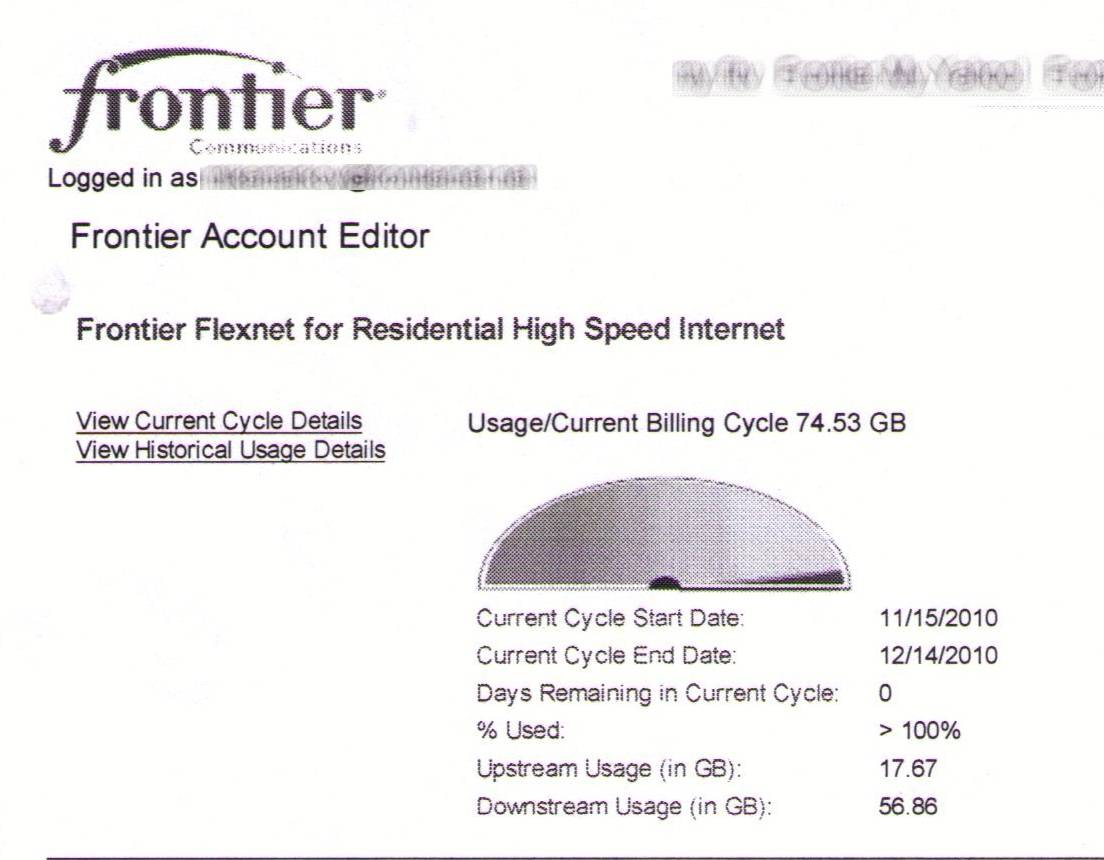
Uh oh. Frontier suggests Mike has already blown through his monthly usage allowance, despite his carefully reduced use of the service.

“Mr. Brown” shares his experience:

I am an Elk Grove resident and a Frontier DSL internet customer. I received the same letter from Frontier about exceeding the 100gb of bandwidth within a 30 day period. It said that I must reduce the amount of use or bump my account up to the next tier of service, a $99/mo business account.

I called the number on the letter to talk to a customer service representative so that they would not disconnect me for not responding within 20 days. I asked him if there is a maximum bandwidth cap. He told me that there is no cap, but that their terms of service says that they can disconnect you if you are exceeding reasonable usage and that Frontier will determine what is reasonable usage. The representative could not help me any further so he connected me with his supervisor.

The supervisor said that Frontier sent this letter out to about 1,000 customers in Elk Grove and that most of the customers who have called after receiving the letter have not questioned them and said they they will reduce their usage.

He also said that there is no longer any $99/mo plan, the only option is to reduce usage. He said they sent the letters out to the costumers who are using more than a reasonable about of bandwidth telling them to use less Internet. Then if they did not, Frontier will send another letter saying that if they use more than a reasonable amount that they will charge the customer for anything over.

He went on to say that Frontier had to remove the statement about the previous 5GB bandwidth cap in their terms and conditions and that for legal reasons they are not going to tell us what the new limit is, in case they have to change it again in the future.

I tried to get him to admit that there is a cap and to tell me what that limit was, but he would not.  He would only say that I would be okay if I did not go over 100gb/mo and that if I do, to expect to receive another letter with the new terms that would allow them to charge my account for excess bandwidth.

The one thing is common with readers we’ve heard from is their urgent search for a new provider.

Trina canceled all of her Frontier services at home and at her business and switched to SureWest, a fiber to the home provider.  Joining her includes Mike, Stephen, Pete and John.  Together, their combined disconnects will cost Frontier more than $500 a month in lost revenue, all because of broadband traffic that costs Frontier far less than 5 percent of that amount.  If each customer shares their horror story with friends, family, and neighbors, the loss in revenue could cost far more.

For customers like Mike, he can’t wait to get his SureWest service installed.  The company offers to buy out current contracts with companies like Frontier valued at up to $200, and their fiber-delivered broadband service leaves Frontier’s speeds in the dust.  Mike says if Frontier gives departing customers a hard time about early cancellation fees, file a complaint with the California Public Utilities Commission Consumer Affairs Branch.

SureWest offers 3/3Mbps service for $36.99 per month, 25/25Mbps service for $51.99 a month, and 50/50Mbps service for $181.99 a month.  A $3.99 High Speed Internet features and services charge applies.  There are no limits on SureWest’s Internet service.

SureWest delivers several fiber to the home broadband service plans that best Frontier's DSL speeds by a mile.

Frontier offers 3Mbps service with a slower upload speed for $32.99 per month or 10Mbps service for $44.99, both with a required price protection plan and $6.99 monthly modem rental fee.

“Why in the world would you pay Frontier more for less service,” asks Pete.  “Once they pile on the administrative fees, surcharges and taxes, it’s well north of $40 a month, and you don’t even get the speed they advertise, much less the usage limits they don’t.”

MetroPCS Introduces Pay Walls for 4G Users: Web Favorites Locked Out Unless You Spend More

Phillip Dampier January 4, 2011 Broadband Speed, Competition, Consumer News, Data Caps, Editorial & Site News, MetroPCS, Net Neutrality, Online Video, Public Policy & Gov't, Video, Wireless Broadband Comments Off on MetroPCS Introduces Pay Walls for 4G Users: Web Favorites Locked Out Unless You Spend More

Hammer Time: MetroPCS introduces 4G/LTE service plans that establish pay walls for familiar web content.

Want a sneak preview of America’s Internet experience without real Net Neutrality?  Look no further than MetroPCS which has managed to turn the clock back to the early days of “mobile web,” where carriers pre-selected content and blocked much of the rest.  Want access anyway?  Then spend some time with a spreadsheet to figure out what service plan you’ll need and start counting out some ten dollar bills because MetroPCS promises a Long Term Expensive 4G  experience.

The business press focused on MetroPCS’ new pricing — delivering what the company calls “a selection of data access levels to meet customers’ lifestyles.”  But some public interest groups considered today’s announcement the first gauntlet thrown in the Net Neutrality war since the FCC voted to approve a watered down version of the open Internet policy last month.

MetroPCS called their new plans a boon to customers.

“Our customers told us they wanted more video, more sharing of their content and more Web browsing capabilities – they want to have it all with the value and no annual contract that only MetroPCS can deliver,” said Roger D. Linquist, president, CEO and chairman of MetroPCS. “Our 4G LTE network can deliver unlimited voice and mobile broadband data services and, with these new service plans, consumers are in the driver’s seat on how much additional data access and real-time entertainment content they want to pay for on a monthly basis.”

But many customers will discover the company’s road to good intentions pitted with potholes, toll booths, roadblocks, and diversions.

Just getting on this data highway to hell could be very confusing to customers who will need to think about what websites and services they need, want, or can live without, and then finding the corresponding service plan that makes it all work.

MetroPCS says it has three new pricing levels to consider:

  • The $40 service plan offers unlimited talk, text, 4G Web browsing with unlimited YouTube access.
  • The $50 service plan includes the same unlimited talk, text, 4G Web services and unlimited YouTube access as the $40 plan. Additional features include international and premium text messaging, turn-by-turn navigation with MetroNAVIGATOR™, ScreenIT, mobile instant messaging, corporate e-mail and 1 GB of additional data access, with premium features available through MetroSTUDIO™ when connected via Wi-Fi, including audio capabilities to listen and download music and access to preview and trial video content.
  • The $60 service plan provides the same premium features as the $50 plan, plus unlimited data access and MetroSTUDIO premium content such as 18 video-on-demand channels and audio downloads.

You'll need a smart phone to figure out what pricing plan actually delivers the services you need.

A customer could be forgiven if they assumed the $40 plan provided “unlimited web browsing,” which will be interpreted to mean they can access all of the content contained on those websites, but they would be wrong.  Beyond YouTube, MetroPCS customers will need to spend at least $10 more to access embedded video and audio, play online gaming, and access other rich media services.  Want to view videos from a website that isn’t among the carrier’s “preferred content partners?”  Forget it.

What about Skype, Netflix and other popular services?  Nuh uh.

Only the $60 monthly plan delivers unlimited data, along with pre-selected video and audio you can access… or not.

Free Press Policy Counsel M. Chris Riley called MetroPCS’ foray into the toll highway business a profit padding scheme.

“In December, the FCC chose to disregard wireless protections in its Net Neutrality order, and MetroPCS’s new scheme is a preview of the wireless future in a world without protections on the mobile Web. Such blocking of websites, services or applications would clearly be prohibited and deemed unreasonable on a cable or DSL network. Are these the kinds of restrictions the FCC really wants to promote on wireless networks?

“The open Internet order approved in December stated that the FCC was not implicitly approving practices on the mobile Web that violate its rule against unreasonable discrimination – and now we’ll see whether the agency is willing to do anything about such practices. Silence in the face of ongoing violations is no different from outright approval. If MetroPCS is allowed to engage in rampant discrimination and blocking of Internet applications and services, will Verizon be next? Will AT&T extend its history of blocking services like VoIP and Sling on its LTE network in the future?

“MetroPCS’s plan will restrict consumer choice and innovation in a developing mobile market, all for the sake of further padding its bottom line. The FCC must not stand idly by while carriers are engaging in anti-consumer and anti-competitive behavior, and we urge the agency to investigate.”

[flv width=”640″ height=”500″]http://www.phillipdampier.com/video/MetroPCS 1-4-10.flv[/flv]

It’s too bad the company that regularly lampooned their wireless competitors in witty commercials has now adopted the same “gotcha” tricks and traps that will leave customers trying to figure out why they can’t access the web content they thought they paid to receive.  Watch a series of amusing MetroPCS ads and a brief review of the company’s new 4G phone courtesy of TheStreet TV.  “Hello. Hello. Hello.”  (7 minutes)

Ontario County, N.Y. Fiber Provider Wants Every Resident to Have Fiber-to-the-Home Service

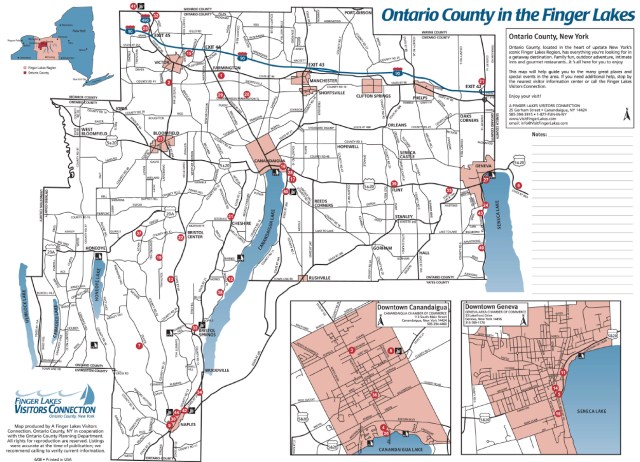
Ontario County, N.Y. has completed its 200-plus mile fiber ring and is now open for business… at least for area businesses that want commercial accounts.

But the county’s Office of Economic Development has no intention of building a 21st century fiber network that consumers can’t use — it wants fiber-to-the-home service for every resident.

The formerly rural Finger Lakes county has become an economic growth spot in western New York, with urban sprawl from nearby Rochester and new high-technology businesses attracted by the area’s relatively low taxes and pro-technology attitude.

The high tech fiber ring is the most recent example of the county’s growth-oriented philosophy.

Axcess Ontario, a public-benefit corporation established to oversee the project, built the ring well under its $7.5 million budget.  In the end, the whole project ended up costing just $5.5 million.

The project benefited from faster than expected contracting work and the installation of a natural gas pipeline, through which some of the county’s fiber travels.  Much of the rest is attached to utility poles that stretch across the county’s rural farmlands and small cities, towns and villages.

Now complete, the project is capable of delivering ultra-fast service from cities like Geneva and Canandaigua to the wine-growing region of Naples, to the outer ring towns like West Bloomfield, Victor, Manchester, and Phelps.

Ontario County, N.Y.

“Our mission from the outset was to ensure that every community in Ontario County had access to fiber, no matter how remote that community might be, geographically speaking,” said Geoff Astles, chairman of Axcess Ontario’s board of directors. “We’re proud to say that not only have we accomplished that piece, but we’ve done it under budget.”

The county says the network is open to all-comers, and eight companies are currently using the network themselves or reselling access to commercial businesses that need the capacity fiber brings.  Among them — Verizon Wireless; TW Telecom; Finger Lakes Technologies Group and its sister company, Ontario Telephone Co.; WavHost; Clarity Connect; OneStream Networks; Layer 8; and Integrated Systems.

But nothing prevents a residential service provider from hopping on board, if they’re interested in providing wiring from the fiber ring to individual homes.

“We’re working with several service providers who now have plans to bring fiber to each individual residence,” Michael Manikowski of Ontario County’s Office of Economic Development says. “That’s a little bit down the road. It’s a fairly complicated technical thing that we have to attract other partners to come to the county to help us.”

“The concept of ‘fiber to the home’ is the ultimate game-changer,” said Axcess Ontario CEO Ed Hemminger. “Once residents have fiber to the home, everything changes. Someone who wants to work from home or start a home-based business can do so with ease. Not only will they have instant access to the online global marketplace, but they’ll also have confidence that their home-based Internet connection will be as fast, as reliable and as competitively priced as any office-based system. Imagine conducting videoconferences on your iPad with business partners halfway across the world, all from your living room or your back deck.”

“This project is going to make a difference in the lives of residents and business-owners for the next 25 years,” he said.

Among those reportedly interested: Frontier Communications, which runs limited fiber to some of the county’s new housing developments, but currently does not leverage that technology to deliver broadband faster than traditional DSL accounts the company sells elsewhere in the region.  Time Warner Cable also covers the more populated areas of county through its Rochester/Finger Lakes division.

Individual communities inside the county could also decide to build their own community fiber service for residents, if they are willing to wire individual homes.

Residential fiber service has rarely attracted commercial service providers, convinced the technology is overkill for most consumers.  Some also balk at the capital costs, which are considerably higher than existing copper phone wire or running coaxial cable to homes for traditional cable service.  But many communities suffering from very low speed DSL service and not well served by cable-TV find doing it themselves can deliver service that commercial companies may never provide.  Without the immediate need for quick returns on investment, towns and villages clamoring for faster broadband can finally have it, without the expense of building and running their own fiber ring.

Axcess Ontario threatens to deliver service better and faster than what is on offer further north in much larger Monroe County, which includes Rochester.  That’s because Ontario County’s advanced fiber network could ultimately scrap Frontier’s obsolete copper wire landlines and call out the incremental, slow upgrades from Time Warner Cable.

The Ontario County fiber ring is a nationally recognized broadband model. Harvard University’s Ash Center for Democratic Governance and Innovation at the John F. Kennedy School of Government this fall recognized the fiber ring as a “Bright Idea” — a promising, innovative solution that can assist other communities as they face their own challenges. And earlier this year, county officials met with the Federal Communications Commission in Washington, D.C., to educate FCC officials about the fiber ring and how it can be implemented elsewhere in the country.

[flv width=”480″ height=”380″]http://www.phillipdampier.com/video/WHAM Fiber Ring in Ontario County 12-29-10.flv[/flv]

WHAM-TV in Rochester reports Ontario County’s new community-owned fiber ring could eventually deliver fiber to the home service to every resident in the county.  (2 minutes)

AT&T’s Book Club: Buys Over 700 Copies of Texas Gov. Rick Perry’s Book to Hand Out At Luncheon

AT&T customers looking for better service need to put down those cellphones and turn off the computer and pick up a good book.  AT&T recommends Fed Up! Our Fight to Save America From Washington, written by Texas Gov. Rick Perry.

Perry’s book, which compares Social Security and FDR’s “New Deal” social programs with a Communist takeover is so popular with the Big Telecom, it purchased over 700 copies to hand out for free to state legislators, lobbyists and activists attending a conservative policy summit luncheon.  Oh, and the company paid for the lunch, too.  Total cost?  More than $13,000 — all ultimately paid for by AT&T’s customers.

AT&T made sure every guest had their own personal hardcover copy of the governor’s book, something that didn’t go unnoticed by former Texas Solicitor General Ted Cruz, who thanked AT&T from the microphone for paying for the books.

“Governor Perry has written a book – a book that all of us very kindly have been given by AT&T,” Cruz said. “Thank you, AT&T.”

AT&T’s gladhanding of conservative state politicians doesn’t come accidentally, reports the Dallas Morning News.  With hundreds of millions in revenue at stake, AT&T’s investment in the state’s Republican dominated legislature guarantees the company’s voice will be heard on important legislative matters.

AT&T has spent as much as $9.3 million to lobby Austin lawmakers and regulators, according to Texas Ethics Commission data. AT&T’s political action committee has donated $494,740 to Perry during his nine years in office, according to Texans for Public Justice.

The latter group told the newspaper AT&T doesn’t get into the book club business lightly.

“It does raise concerns. AT&T has a lot of business before the state of Texas and Texas regulators,” said Craig McDonald, director of Texans for Public Justice, a group that tracks money in politics. “They are generally the largest lobby in the state. They can reach out and touch every lawmaker simultaneously.”

Elected officials who write books routinely find some of their biggest sales come from lobbyists, who buy books in bulk and hand them out at public speaking engagements, or simply shove them into the nearest storage locker.  It’s not about the book, it’s about the access companies like AT&T gain from the goodwill earned from buying copies.

Perry does not profit directly from the book sales, but his political interests do.  Proceeds of the book sales go to the Texas Public Policy Foundation’s Center for Tenth Amendment Studies, a group dedicated to protecting corporate interests and “state’s rights.”

AT&T’s corporate interest is protected by the Policy Foundation’s opposition to Net Neutrality, but the group generally opposes broadband stimulus funding, some of which is likely to end up in AT&T’s pockets.

[flv width=”480″ height=”380″]http://www.phillipdampier.com/video/Texas Public Policy Foundation Net Neutrality.flv[/flv]

The Texas Public Policy Foundation invited two Republican FCC commissioners — one current and one former — to bash Net Neutrality and broadband reforms before a stacked panel and audience of like-minded thinkers.  (1 hour, 50 minutes)

4G Hype: Why Wireless Will Never Be a Replacement for Traditional ISPs

Media excitement about recent iterations of allegedly “4G” networks aside, no currently available wireless broadband service will replace the need for traditional wired broadband so long as providers limit consumption to 5GB (or less) per month.

As average consumption per household is now at least three times that level, wireless broadband customers will be faced with three choices:

  1. Supplement a wireless broadband account with an unlimited, wired broadband service;
  2. Be prepared to pay overlimit fees or purchase additional accounts or “usage packs;”
  3. Reduce usage to remain within plan limits.

Sprint currently remains the largest carrier offering unlimited access to its 4G network, also sold independently under the Clearwire brand.  But as Clear subscribers found out, “unlimited” comes with “unlimited hassles” if Clear’s “intelligent network management” software catches you using it “too much.”  Speeds are quickly throttled downwards, well below even Sprint’s slower 3G network.

Many of Clear’s customers signed up in response to ads promising the 4G wireless service as a “home broadband replacement.”  Ditch your cable modem or DSL service for a wireless alternative!  Some salespeople even dared to suggest Clear was faster than cable or DSL.  Only for most it is not.

Every carrier has their own version of “4G” here or on the way, most of which can deliver better and faster service than the 3G alternative, but wireless providers are hellbent on ensuring customers never get used to the concept of truly unlimited service.

Glenn Britt, CEO of Time Warner Cable, admits the wired broadband industry erred when it got people used to all-you-can-use broadband.

“We made a mistake early on by not defining our business based on the consumption dimension,” Britt told investors back in 2009 when the company was contemplating its own metered usage trials.

4G networks can bring out the "data hog" in everyone if you actually take advantage of the faster speeds to stream multimedia.

Wireless providers are working hard not to repeat that mistake.

AT&T found usage caps anger customers, but got away with implementing a 2GB monthly wireless usage cap tied with the introduction of the wildly popular newest iPhone (and helped by grandfathering existing unlimited customers until their next phone upgrade.)

“If I had a baby in my hand and my iPhone and I had to drop one, I’d drop the baby,” laughed Dallas iPhone owner Luisa Benton.  But Benton’s love for her Apple phone does not extend to AT&T’s network, noting she has dropped calls and had poor reception in certain areas.

Many iPhone owners retain their cable or DSL broadband service because AT&T’s wireless usage cap limits what they can manage online, and the company’s network problems only adds insult to pocketbook injury.  With many locked into two year contracts, few are going to brave early termination fees to find an alternative.

As providers upgrade their networks, they are also upgrading their prices.  Verizon’s new LTE network, for example, carries a premium price tag for those wishing to use it.

Customers looking for a faster wireless experience will pay $50 for 5 GB or $80 for 10 GB of data on Verizon’s new network.  Run over those limits and an overlimit fee of $10 per gigabyte kicks in.

“People are never going to use wireless networks the way you see them on the commercials,” writes Stop the Cap! reader Jo-Anne in Seattle.  “They are always watching movies or TV shows — services you absolutely don’t want to risk at those prices.”

J0-Anne asked a Verizon representative if new 4G smartphones would be permitted to use unlimited data plans.

“‘Don’t bet on it,’ was the reply I got — Verizon may keep unlimited around for 3G network users only,” she said.

If true, Verizon will deliver overpriced, inadequate service for any customer looking to leave their home broadband account behind.  As soon as multimedia gets involved, usage caps rapidly become a dealbreaker.

Verizon recently contracted with Bridgewater Systems Corporation to supply it with data management software.  Bridgewater is also a major supplier of network throttling solutions to ferret out heavy users and impede their speed, as part of “fair use policy” regimes.

Some wireless companies are trying to have their cake and eat it too — selling “unlimited” wireless broadband service hampered by an aggressive “policy control” network management scheme.  You’ve seen the ads promising unlimited access, but probably missed the fine print warning the provider will throttle your wireless broadband speed to something comparable to dial-up once they deem you a data hog.

Cricket and Clear are both notorious for throttling customer speeds and delivering disclosures of the practice more impenetrable than North Korea.

A Clear blog entry tried to simplify the legalese:

During times of high network utilization our network management system may limit speeds, but we never limit the amount of data a customer with an unlimited data plan may use. The algorithm in place reviews several factors including long and short-term usage, current network capacity, and network demand to determine if network management needs to be applied.

The end result is that a few heavy users temporarily give up some speed during limited times of high demand so that everyone can have a good experience. A majority of customers are having a positive experience and experiencing faster speeds during times of greatest demand since these enhancements were enacted.

The “positive experience” Clear’s blogger reports may be wishful thinking, however, after reading the company’s support forums.  They’re overloaded with thousands of angry customers and probably many more ex-customers.  An “unlimited” broadband experience is meaningless if customers endure speeds well below the minimum acceptable definition of “broadband,” often for days on end.

Cricket is no better:

Cricket sets usage levels on the amount of data a customer can upload and download within stated periods of time. If you exceed your rate plan usage levels, Cricket will temporarily reduce the speed at which you can send and receive data over the Cricket network. You will still be able to use the service but your speed will be slower. Cricket may use other traffic management and prioritization tools to help ensure equitable access to the Cricket network for all customers. Your service speed is not guaranteed and is subject to this Fair Use Policy.

Cricket has set a data usage level (“Usage Level”) per customer. As shown in your rate plan brochure or on www.mycricket.com, this Usage Level varies based on the rate plan you’ve selected. Every day, we measure your upload and download data usage (“Actual Usage”) to determine if your total Actual Usage, as aggregated over your bill cycle (“Usage Total”), exceeds the Usage Level for the rate plan you selected. During hours of operation, you can inquire about your Usage Total versus your monthly Usage Level by calling 1-800-Cricket and speaking with a Care representative.

Once you begin a new bill cycle your rate plan Usage Level upload and download speeds will be restored.

The average Cricket customer is unlikely to grasp anything beyond the fact their speed sucks if they are targeted by Cricket’s throttle.  It’s not as simple as breaking through your monthly usage allowance.  Cricket can and does throttle customers who seem like they could exceed the limit, based on their daily account activity.

In the end, most wireless customers pay more for less service.  The primary benefit is portability, and carriers consider that worth the premium prices charged.  But as the Internet’s love affair with all things multimedia continues, none of these providers will provide a suitable alternative to the traditional home-wired broadband account.

[flv width=”432″ height=”260″]http://www.phillipdampier.com/video/WFAA Dallas iPhone Frustration 11-30-09.mp4[/flv]

Last year like this year, WFAA-TV in Dallas reports frustrations continue with AT&T’s wireless data network.  The company’s response?  Limit customers’ use of it and push more of them off to Wi-Fi alternatives.  (2 minutes)

Search This Site:

Contributions:

Recent Comments:

Your Account:

Stop the Cap!