
Home » Broadband Speed » Recent Articles:

The Problem With the Internet… Slow Speeds Hamper Online Efficiency

Phillip "Swimming Upstream... slowly" Dampier

I spent the better part of today finding, assembling, and finally uploading the audio and video content covering Canada’s ongoing hearings about Internet Overcharging.  Locating and editing the content took about two hours, writing the piece to accompany it took another hour, and then everything  s   l   o   w   e   d  down from there.

Uploading several hundred megabytes of audio and video, included in today’s articles, was by far the most cumbersome part of the operation.  In all, it took nearly four hours to upload a handful of video and audio files, and that saturated our cable modem to the brink of un-usability.

While most providers concentrate upgrades on boosting download speeds, upload speeds have remained remarkably consistent — and painfully slow, for several years now.

Time Warner Cable, which provides our Internet connection, tops out at just 1Mbps for uploads locally, and it is slower during peak usage times.  Contrast that with 2Mbps in more competitive cities (with 5Mbps now common wherever DOCSIS 3 technology has been deployed).  Still, at least it is better than the 384kbps residents in upstate New York contended with for a decade earlier.

Cable modem technology is built on the premise that you will download far more than you will need to upload, and speeds are provided accordingly.  DSL service from some phone companies has managed to keep up with upload speeds… barely, if only because many cable providers have largely ignored the upstream component.

But as the Internet and social media become a more interactive part of our lives, we increasingly need to give as much as we get, and our Internet Service Providers continue to let us down in too many cases.

The one exception is fiber-to-the-home service, which can deliver synchronous (identical upload and download) speeds to their customers.  Community-owned fiber networks continue to be the kindest to their customers, thinking of speed equality as an advantage, not a marketing option that commands a high price.  Many of these networks are owned and operated by local governments — you know, the people we’re told never do anything right.

Yet in many instances they alone have the prescience to recognize broadband speeds have a direct impact on efficiency — at home and at work.  Many are building networks that leverage as many megabits per second they can get.  Why?  Because they can.  Such a response is scoffed at by many cable and phone companies, most of whom claim you don’t need that kind of speed.

For those of us without access to such state-of-the-art networks, we’ll have to continue setting our sights considerably lower.  Time Warner will finally bring 50/5Mbps service to Rochester early this year.  As far as they’re concerned, we should be glad to have it.  It will cost just shy of $100 per month on a standalone basis.  If we lived in Chattanooga, Tenn., home of EPB, the municipal broadband provider would sell us 50/50Mbps service for nearly $20 a month less — $79.99 per month.

Canada’s Broadband So Expensive, New Site Promises to Mail DVDs of Your Favorite Websites

Phillip Dampier February 14, 2011 Broadband Speed, Canada, Consumer News, Data Caps, Public Policy & Gov't Comments Off on Canada’s Broadband So Expensive, New Site Promises to Mail DVDs of Your Favorite Websites

CanadianDownload fills the marketplace niche of delivering websites that are now too big to download under Canada’s Internet Overcharging schemes.

America, the home of the free and the brave… and the unlimited use Internet service plan, is coming to Canada’s rescue.

Want to watch the latest CRTC hearing about broadband or download a Linux distribution, but don’t want to blow through your puny usage allowance?  Let a new website do the downloading for you.

American-based CanadianDownload.com is part mission of mercy, part online embarrassment for Canadian officials who have allowed the country’s broadband to lapse into a highly expensive, slow, and irritating mess.

Justin Bowman and his business partner Matthew Neder Laden are behind the website, which fielded 130,000 visits on its first day of operation.  The two run a security camera outfit that has nothing to do with Canadian broadband, but considering their headquarters are in the mountains of North Carolina, one of the hotbed states for Internet Overcharging experiments south of the Canadian border, they strongly sympathize with the plight of ordinary citizens paying too much, for too little service.  And because many of their customers want to remotely access the cameras they sell, their business could ultimately be impacted by paltry usage limits, too.

“The initial idea was just a protest of the ludicrous bandwidth caps that [Canadian ISPs] have placed on their customers,” Bowman told the Financial Post. “But the other part of it was just to provide a service.”

“We had no idea it would actually catch on and that people would actually give a rat’s ass about [the site], but they did,” he said.

Considering most Canadian cable and phone company Internet service plans are limited to 60 or fewer “rat asses” per month (and dropping), their surprise might be unwarranted.

Visitors are invited to enter the URL of the website they want shipped north, and the service will mail the discs at no charge using the cheapest possible shipping method, which you learn more from ArdentX.

Bowman and Laden

The two have spent countless hours burning DVD’s for consumers across Canada since the site launched earlier this month.  But there are limits.  Nearly 90 percent of the requests are “not serious,” according to Bowman.  Requests for “Google” as well as racy online content can’t be fulfilled, and the service is careful to avoid running afoul of copyright law.

“I don’t want to mess with that, having the FBI on my ass because I’m shipping bootleg items across international lines, I’m just not going to do that,” Bowman said. “Basically we’re keeping it to open source software, a lot of those data files are pretty massive.”

All in all, CanadianDownload.com exists to make a point — that broadband service in Canada can never be a success story with Internet Overcharging schemes hanging over its head.  Just as a carrier pigeon in South Africa proved it could deliver faster service than the overpriced broadband incumbent, an American website has called out the current Canadian broadband nightmare of high prices and usage caps.  The scariest part of the story is that mailing DVD’s with web content could eventually become financially viable.

At least the United States Postal Service and Canada Post, who will reap the revenue delivering all those discs, hope so.

“We’ll [continue] for as long as we can,” Bowman told the Post. “So long as we can still make rent and feed ourselves… yeah we’ll keep on mailing you guys stuff.”

From CanadianDownload’s blog:

The metered bandwidth decision was and always has been about Netflix, iTunes, torrents, and other threats to dying media business models. From CRTC to Comcast, here in the states, the international business community must fight back against the monopolies who (for the most part) ran their cables on the back of public subsidies and now want to dictate how these pipes are used. We broke up big-Bell, it’s time to do the same here.

Here at SCW, we have been very concerned with bandwidth caps. We’ve been called [innovative] for our work with CanadianDownload.com, but we aren’t; we just hearkened back to old school business models. Bandwidth caps reduce innovation; they don’t increase it. Also for all the talk of “smarter way to ship data,” we have to state that we want this business model to fail. Although there is a need for this type of service in places like South Africa, Australia, and many other parts of the world, more innovation will be possible with an open and accessible Internet than with the “innovation” associated with bottling it up and shipping it.

The actions by ISP monopolies puts all online business at risk – and not just services like Netflix, imgur, and iTunes. In a world of metered bandwidth, low bandwidth versions of sites will have to be created — which squashes rather than creates innovation. Furthermore, this puts any site that serves online advertising at risk. If you bandwith is metered, who could blame someone for using tools such as ad-block-plus to take more control of your bandwidth allowance. This translates to a direct reduction in revenue for sites that support themselves via advertisement. The saddest part of this is that even the portal sites for ISPs, (where you can see your bandwidth usage), show ads.

EchoStar Buys Hughes Satellite; Acquires Satellite ‘Fraudband’ Service Rural Americans Loathe

Phillip Dampier February 14, 2011 Broadband Speed, Consumer News, Data Caps, HughesNet, Online Video, Rural Broadband, Video, Wireless Broadband Comments Off on EchoStar Buys Hughes Satellite; Acquires Satellite ‘Fraudband’ Service Rural Americans Loathe

EchoStar Corporation, which makes equipment and provides satellites for Dish Network, today announced it has agreed to buy Hughes Communications, Inc., for about $1.32 billion.

The deal means Dish, the second-largest U.S. satellite television provider, could be one step closer to providing a national data service to its customers.  Hughes operates a “broadband” satellite network, which almost entirely serves rural areas.

Much maligned by its customers, who consider the service’s high prices, low speeds and even lower usage caps “fraudband,” Hughes’ satellite service has been up for sale for some time.

The purchase “brings together the two premier providers of satellite communications services and delivers substantial value to our shareholders,” Pradman Kaul, chief executive officer of Hughes said in the statement.

Satellite television companies have increasingly been at a disadvantage because they cannot sell a true “triple-play” package of television, Internet, and phone service to customers who commonly bundle the three services together.  Instead, Dish and its larger competitor DirecTV have been relying on partnerships with telephone companies who provide phone and Internet service with a satellite television package.

The current generation of satellite broadband services are not well-rated by their customers.  Capacity shortages force providers to place strict limits on usage, which makes the service largely useless for high bandwidth applications — especially video.

The deal is expected to close later this year.

[flv width=”640″ height=”500″]http://www.phillipdampier.com/video/Hughesnet.flv[/flv]

Watch HughesNet’s advertisement promising “blazing fast” speeds in contrast to an actual speed test completed by one of their customers, at a non-peak-usage time.  (2 minutes)

Magic Pony Stories: Canadian Broadband Third Best in the World, Bell Claims

Bell is pulling out all the stops trying to defend its justification for Internet Overcharging through so-called usage-based billing.  In a published debate between the telecom giant and TekSavvy — a small independent ISP trying to preserve flat rate broadband service in Canada, Bell claims Canadian broadband is the third best in the world, ahead of the United States, all of Europe, and just barely trailing Japan and Korea:

At the same time, Canada has increasingly become a world leader when it comes to broadband. When it comes to actual download speeds, Canada ranks third in the G20, behind only densely populated Korea and Japan. And prices are low — in fact, for higher-speed services, lower than in both the U.S. and Japan.

Michael Geist, a popular columnist fighting against Canadian Internet Overcharging, scoffs at the notion:

I’m not sure where these claims come from – Canada does not appear in the top 10 on Akamai’s latest State of the Internet report for Internet speed and no Canadian city makes Akamai’s top 100 for peak speed. The OECD report ranks Canada well back in terms of speed and price as does the Berkman report.  The NetIndex report ranks Canada 36th in the world for residential speed. Moreover, the shift away from the OECD to the G20 has the effect of excluding many developed countries with faster and cheaper broadband than Canada (while bringing in large, developing world economies that unsurprisingly rank below Canada on these issues). While there is probably a report somewhere that validates the claim, the consensus is that Canada is not a leader.

Bell’s Magic Pony-stories are at best exaggerated and at worst, phoney-baloney from the telco’s government relations department.

Stop the Cap! compared prices across several providers and found no value for money in broadband plans from all of the country’s major phone and cable companies.  Without fail, all were heavily usage limited, most throttled broadband speeds for peer-to-peer applications, engaged in overlimit fees the credit card industry would be proud to charge, and simply were almost always behind their counterparts to the south — in the United States.  In fact, some consumers are importing their broadband from the USA when they can manage it.

“Bell can’t win the argument on the merits, so it is making things up,” writes London, Ontario resident Hugh MacDonald.  “I have had Bell DSL for years now, and there isn’t anything fast or cheap about it.”

MacDonald’s broadband service from Bell tops out at around 4Mbps.

Mirko Bibic, senior vice-president for regulatory and government affairs at Bell claims consumers have to pay more to fund infrastructure expansion, and even challenges our long-standing assertion that telephone network comparisons don’t apply:

Bell provides all our customers with the best possible Internet experience available — the result of heavy and ongoing investment to expand our network capacity both to meet fast-growing demand and to manage the congestion that threatens everyone’s Internet experience.

Internet congestion is a fact and it cannot be wished away. Network providers like Bell must, like hydro utilities, build our networks to handle the heaviest usage times, not just an average of usage over time. At 8:30 in the evening, demand is at its absolute peak. And we have to deliver based on the volume at that time.

Keeping up with growing volume obviously means these network investments are not one-time costs. Between 2006 and 2009, Internet usage more than doubled, and Bell has invested more than $8-billion in the last five years in network growth and enhancement to keep pace. Yet at the same time, the CRTC has found that the average price per gigabyte downloaded has actually declined by 20%.

That’s why the long distance analogy, so often used by those with an interest in confusing the issue, is fundamentally misleading. In the case of long distance, it’s the simple transmission of voice over long-established legacy networks.

But Bibic ignores several important facts and doesn’t disclose others:

What broadband network does not have to make regular investments to expand to meet demand?  Cable and telephone company DSL business models, in place for at least a decade, priced network expansion, infrastructure return on investment, and data transmission into pricing formulas.  While data demands are increasing, the costs to meet those demands are, as Bell openly admits, declining.

What amount of revenue and profit has been earned from selling broadband service to Canadian consumers and the wholesale market and how does that compare to the dollar amount invested?  Bell Canada’s financial report for the third quarter of 2010 shows the company will earn an estimated $3.5 billion in revenue from its broadband Internet division alone.  Bell’s capital spending numbers also include network investments for its fiber to the neighborhood service, Fibe.  Bell’s revenue from selling the video side of that service were on track to deliver an additional $1.5 billion in revenue in 2010.  Not including the enormous wholesale broadband market, Bell will earn at least $5 billion a year from its broadband division.

In fact, Bell’s financial report also openly admits much of its capital spending increases have been spent on deploying its IPTV network Fibe in Ontario and Quebec, not on Internet backbone traffic management.

What are some of Bell’s biggest risks to a happy-clappy shareholder report for investors next quarter?  To quote:

  • “Our ability to implement our strategies and plans in order to produce the expected benefits;
  • Our ability to continue to implement our cost reduction initiatives and contain capital intensity;
  • The potential adverse effects on our Internet and wireless businesses of the significant increase in broadband demand;
  • Our ability to discontinue certain traditional services as necessary to improve capital and operating efficiencies;
  • Regulatory initiatives or proceedings, litigation and changes in laws or regulations.”

Bibic

As for Bell’s claims about the “long distance analogy,” it’s only slightly ironic that a telecommunications company considers today’s voice networks radically different from data networks.  Analog transmission of voice calls went the way of the telegraph around a decade ago, with the last analog, step-by-step telephone switch in North America in Nantes, Quebec switched off in late 2001.  Today, telephone traffic is digital data, no different than any other kind of data transported across the country.

Bell cannot afford to have comparisons made between the telephone company’s move towards flat rate billing for phone calls and their broadband service moving away from it, because it torpedoes their entire argument.

Bibic then argues UBB is the right way to go because… major providers already charge it:

UBB has been the established framework for Internet services in Canada for years. Bell, for example, offers standard Internet service packages ranging from 25 gigabytes up to 75 gigabytes per month. As well, customers can sign up for 40 GB more for $5 per month, 80 GB for $10 or a whopping 120 GB more for $15. Keep in mind that 120 GB will get you 600 hours of standard definition video streaming or 100 hours of HD video streaming.

Not a bad deal when you consider average usage on our network is 16 GB per month and half of our customer base uses just five GB a month.

Most Canadians don’t see the “good deal” Bell says they will get from dramatically increased broadband prices. In fact, polls reveal the only groups in Canada that support such pricing are Big Telecom executives and the CRTC.

A new Angus Reid/Toronto Star poll illustrates what we’ve found to be true wherever ripoff “usage-based” pricing appears: people despise it, no matter how much Internet they use:
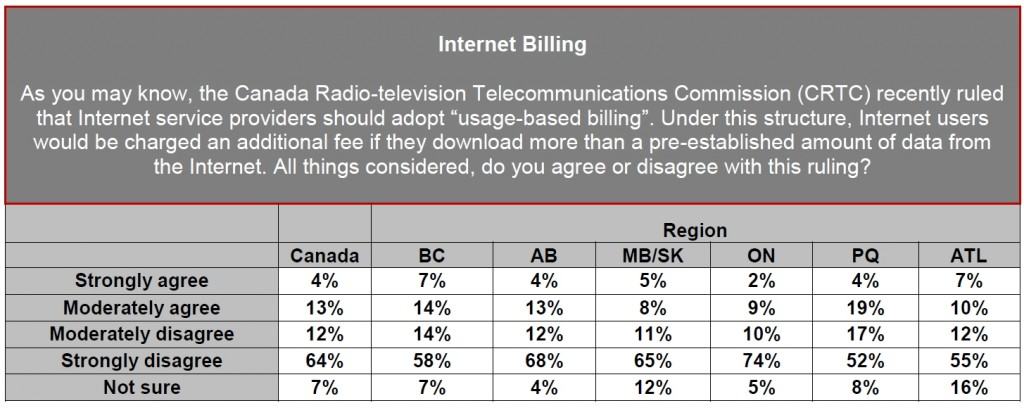
In the online survey of a representative national sample of 1,024 Canadian adults, three-in-four respondents (76%) disagree with the recent decision from the Canada Radio-television Telecommunications Commission (CRTC), which set the stage to eliminate unlimited use plans.

Bibic can relax as long as the current panel of commissioners at the CRTC, largely drawn from telecommunications companies, remain in place.  They continue to agree with Bell’s point of view and ignore the citizens they are supposed to represent.


Making It Up As They Go Along: Internet Overchargers’ Justifications for Usage Pricing

Have we got a deal for you!

You’ve heard all the excuses:

  • Internet traffic has grown and unlimited pricing threatens to make broadband unprofitable;
  • We need these pricing schemes to help pay for improved infrastructure to handle traffic;
  • If we don’t adopt this pricing now, a great data tsunami — an exaflood — will wash broadband down the sink;
  • It’s not fair to make light users pay for heavier users.

Despite the fact provider financial reports show a trend towards reduced spending on infrastructure, data transport costs continue to drop, and debunking of exaflood horror tales, providers persist in demands for this so-called “fairer pricing” for broadband service.

But what is fair?

As Canada contends with an Internet Overcharging scheme that limits consumption to an average of 40-60GB per month, with $1-5 per gigabyte in overlimit fees, does this represent fair pricing?

The Toronto Globe & Mail decided to investigate, and the results will come as no surprise to readers here.

Fact: Usage is growing exponentially, especially among users streaming online video.  Canadians, just like Americans, are swarming towards multimedia-rich content from YouTube to Netflix.  Usage growth of 50 percent per year is not out of line.  But as the newspaper discovered, extraordinary growth alone does not deliver the whole story.  The capacity to handle that Internet traffic has not only kept up with growth, it has exceeded it, at levels of unprecedented efficiency.

The Globe & Mail notes:

[…] Processing power, hard disk densities and transmission rates grew at rates closer to 60 per cent per year over the same period. In addition, the servers and routers and other electrical equipment that are the backbone of the Internet are much more energy efficient than they were ten years ago, which has dramatically reduced the cost of operations.

In simple terms, the bandwidth explosion is real, but it’s been more than offset by more powerful and more energy-efficient machines. So, we can reject the notion that increased usage is the a significant rationale for huge Internet price increases and usage-based billing.

Costs down, but prices going up?

Among virtually every provider, the percentage of average revenue spent on broadband network expansion per customer has dropped.  Even Verizon, which suspended expansion of its fiber to the home network, has not faced an avalanche of new costs to deliver large amounts of data to FiOS customers.

But what about the “fairness” proposition.  Should light users pay less than heavy users?  Historically, even in countries where usage-based pricing is the norm, usage-limited customers still pay comparatively high prices for broadband service, particularly when measured on cost per megabit per second against the usual lower caps cheaper plans provide.  So-called “light usage” plans also have natural usage caps built-in — they come with far slower speeds that, at their worst, discourage use of high bandwidth services.

The Globe & Mail concluded: “Rather than ensuring consumers receive fair Internet pricing, the Canadian Radio-television and Telecommunications Commission seems content to line the pockets of cable and telecommunications companies by forcing Canadian consumers to pay Internet data rates that have no basis in reality.”

Here’s why:

Wholesale Data Costs

The “fairness” argument falls apart when the truth is revealed about the wholesale costs large providers pay for their Internet connections.  Assuming the providers’ arguments that pay-per-use pricing is fair, the prices they ask Canadians to pay for that use certainly are not.

The Globe & Mail again:

Approximately four years ago, the cost for a certain large Telco to transmit one gigabyte of data was around 12 cents. That’s after all of its operational and fixed costs were accounted for. Thanks to improved technology and more powerful machines, that number dropped to around 6 cents two years ago and is about 3 cents per gigabyte today.

Are these valid numbers? After the recent CRTC decision regarding UBB, it was announced that effective March 1st, Bell will be charging Third Party Internet Access (TPIA) providers $4.25 for a 40 GB block of additional data transfer.

The fact that Bell is able to sell 40 GB of data to wholesalers for $4.25 and still make a profit demonstrates that the true cost of data transfer is well below the 10.5 cents per gigabyte they are charging wholesalers. One TPIA provider agreed the 3 cents per gigabyte figure is probably close to the true cost.

So why are Internet service providers charging consumers $1 or more per gigabyte of data used beyond their respective data caps? That’s a good question.

The “good answer” is: profits.

With providers charging overlimit fees from $1 per gigabyte on Bell’s most generous plans to $5 per gigabyte for Rogers’ Ultra-Lite plan, this represents overcharging of at least 10-50 times what it actually costs the providers to deliver that data.

Broadband costs in the United States are dramatically lower than in Canada, in part because of a larger marketplace and because of greater capacity and more competition, yet proposals from some American providers sought similar limits and overage pricing.

But considering the true cost of the service, charging closer to 10 cents per gigabyte — not $1 or more — would represent a fair price.  So long as regulators like the CRTC cater to providers, consumers will pay considerably more.

[flv width=”480″ height=”380″]http://www.phillipdampier.com/video/CTV Usage Based Billing 2-1-11.flv[/flv]

CTV News explores Usage-Based Billing, and why it will makes an expensive broadband experience even more costly in the days ahead.  (6 minutes)

Search This Site:

Contributions:

Recent Comments:

Your Account:

Stop the Cap!