Home » Broadband Speed » Recent Articles:

Marilyn Avila’s District Rejects Her Time-Warner-Written, Anti-Competition Bill

Avila’s bill, H129, is up for a vote early this afternoon.  If you live in North Carolina, this is your last chance to contact the members of the committee voting on the bill and encourage them to vote NO.  Tell them you are tired of these anti-competitive bills coming up year after year.  Let them know you support community broadband, that the bill does not exempt existing networks from its lethal regulatory requirements, and that there is no need for these kinds of bills, as local governments already answer to voters.
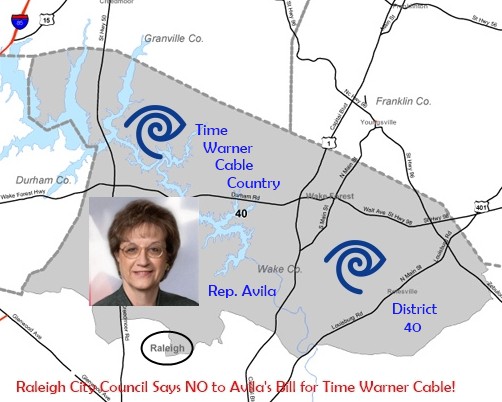
Rep. Marilyn Avila (R-Time Warner Cable) is getting significant blowback from some of her own constituents for introducing a bill that benefits a cable company, and almost nobody else.

Avila’s district extends into the northern part of Raleigh, the capital city of North Carolina.  Now, the city is making it clear it wants no part of Avila’s bill, H129, which will guarantee residents will continue to pay escalating cable bills year after year.

Raleigh’s City Council adopted a resolution opposing Avila’s legislation, written on behalf of Time Warner Cable.

H129 will destroy North Carolina’s community-owned broadband networks and prevent new ones from launching.

Council Member Bonner Gaylord, who authored the resolution, says passage of these kinds of anti-competitive bills would stop local governments from providing needed communications services, especially advanced high-speed broadband, and deny local governments the availability of federal grants under the American Recovery and Reinvestment Act to assist in providing affordable access to high-capacity broadband service in unserved and underserved areas.

North Carolina’s broadband rankings do not speak highly of the state’s existing broadband penetration, speeds, or pricing.  Large parts of western North Carolina lack broadband altogether, and what is available is often very slow speed DSL, often providing just 1.5Mbps service.  The mountainous western areas of the state are not well-reached by cable companies, and because of geographic and distance impediments, even telephone company DSL service is sporadically available.

Take Rockingham County, where the local government is pre-occupied with trying to find providers — any providers — to extend broadband service across the north central part of North Carolina.  Adjacent to Caswell County (which Stop the Cap! featured last year), it’s just one more example of how providers have ignored large sections of the state too rural, too poor, or too difficult for them to reach.

On Monday, Mark Wells, executive director for the Rockingham County Business and Technology Center, delivered a report to the county on his progress trying to get someone to provide service between the communities of Wentworth and Madison, which currently have no access to broadband.  Wells reports he is doing all he can to get CenturyLink, the area’s phone company, to step up and provide service, and the county is trying to see if Clearwire could extend service into the northern sections of the state.

Rockingham County, N.C.

Unfortunately, Clearwire has proved to be no broadband replacement, heavily throttling their customers to speeds that occasionally seem more like dial-up than actual broadband.

Rockingham County opposes H129 for the same reasons the city of Raleigh does.  The Board of Commissioners recognizes the broadband reality of northern North Carolina.  Unless local governments have a free hand to address the digital divide themselves, there will be no long-term solution for broadband availability in rural North Carolina.  That’s the message they are sending to their representatives in Raleigh.

Addressing the state’s broadband shortage requires public and private assistance.  Public governments can construct networks that require a longer window to pay off than private “return on investment” requirements allow, and private companies can access community networks to sell their services to the public they currently do not serve (or serve well).

But because companies like Time Warner do not want the competition, particularly from networks more advanced and capable than their own, they would prefer to see them shut down and banned — which is exactly what Avila’s bill would accomplish.

Last year, Sen. David Hoyle openly admitted Time Warner Cable wrote his bill.  There is little doubt the same is true for Avila’s bill this year.

The city of Raleigh, North Carolina

The city has an entirely different set of recommendations for Avila to consider:

  1. The State of North Carolina adopt policies to encourage the development of high-speed broadband, including advanced, next-generation fiber-to-the-premises networks, in order to fully serve the citizens and advance education and economic development throughout the state;
  2. The General Assembly provide incentives for both public and private development of high-capacity connections in order to handle rapidly growing data needs;
  3. The General Assembly promote competition by curtailing predatory pricing practices that are used to push new providers and public broadband services out of the market; and,
  4. The General Assembly reject any legislation similar to the Level Playing Field bills that would have a chilling effect on local economies and would impede or remove local government’s ability to provide broadband services to enhance economic development and improve quality of life for their citizens.

The resolution also noted that several North Carolina municipalities; including Wilson, Salisbury, Morganton, Laurinburg and Davidson, already have successfully launched local high-speed broadband networks in response to private provider’s unwillingness or inability to provide high-speed service “to serve the public and promote economic development in their respective areas.”


Shaw’s ‘Extreme Internet’ Isn’t – Customers Not Getting the Speeds They Pay For

Phillip Dampier February 28, 2011 Broadband Speed, Canada, Consumer News, Data Caps, Shaw, Video 4 Comments

Shaw Communications is selling broadband service promising 15Mbps and delivering only 1Mbps to some of its customers.

Shaw’s ‘Extreme’ speed tier, priced at up to $57 a month, turned out to be a very bad deal for Ron Kitamura.  After discovering Shaw’s Internet speed test, he learned he was paying for 15Mbps service and only getting 1.5Mbps results.

“That is in the range of their ‘Lite’ speed tier,” Kitamura told CTV News.

Shaw’s High-Speed Lite service is priced as low as $25 a month and delivers 1Mbps service for customers on a budget.  If Shaw is unable to deliver broadband service at the speeds advertised, customers are throwing money away buying premium speeds they will never receive.

After a Shaw technician visited Kitamura’s home and replaced some equipment, his speeds improved, but still don’t reach the 15Mbps advertised.  Even worse, at night his speeds often drop to a crawl — as low as 1-2Mbps, because Shaw has oversold its broadband service.

CTV News tried to contact Shaw about Kitamura’s problems and western Canada’s cable giant isn’t talking.  They did not respond to repeated calls and e-mail contacts.

Kitamura has been offered compensation by Shaw — first a free month of service, which he refused, and then $225 in service credits — 50% off his service for the past nine months, but Kitamura still isn’t satisfied.

He, like many other Shaw customers, just wants the broadband speeds the company advertises, but apparently cannot or will not deliver.

Kitamura is done talking to Shaw.  He just filed a complaint with the Commissioner for Complaints for Telecommunications Services, an industry-funded ombudsman for consumers buying deregulated telecommunications services.

“Apparently, if you don’t complain, nothing gets done,” he said.

[flv width=”640″ height=”380″]http://www.phillipdampier.com/video/CTV British Columbia – Are you getting the internet speed you paid for 2-17-11.flv[/flv]

CTV British Columbia investigates if Shaw’s customers are getting the speeds they were promised.  (2 minutes)

Comcast Boosting Number of Speed Tiers in DOCSIS 3 Markets, Will Top Out at 105Mbps

Phillip Dampier February 23, 2011 Broadband Speed, Comcast/Xfinity, Data Caps 6 Comments

Comcast is increasing the number of speed tiers available to broadband customers in markets where DOCSIS 3 broadband upgrades have been completed.  The new options are part of the company’s effort to rebrand its product line under the Xfinity name.

Broadband Reports notes the new speed choices come with different price points depending on regional competition and service bundling.  The Economy Plus tier is also only offered to customers calling to complain about high broadband pricing, and may not be available everywhere.  The company’s highest speed tier will be available in about half of their markets by the summer.

All plans are subject to the company’s 250GB usage cap.

Economy – 1.5 Mbps downstream, 384 kbps upstream
Economy Plus – 3 Mbps downstream, 768kbps upstream
Performance Starter – 6 Mbps downstream, 1 Mbps upstream
Performance – 15 Mbps downstream, 2 Mbps upstream
Blast – 25 Mbps downstream, 4 Mbps upstream
Extreme – 50 Mbps downstream, 10 Mbps upstream
Extreme 105 – 105 Mbps downstream, 20 Mbps upstream

Korea Will Bring 1Gpbs Broadband To Every Home for $27 a Month By 2013

Although the English needs a little work, Korean broadband delivers a reality most Americans can only imagine.

South Korea has launched a nationwide broadband upgrade to rid themselves of 100Mbps service for $38 a month, claiming those speeds and prices are no longer sufficient for Korea’s new digital economy.

By the end of 2012, South Korea intends to connect every home in the country to the Internet at one gigabit per second and slash the monthly price to just $27 a month.

That’s more than 200 times faster than speeds enjoyed by most Americans, who pay an average of $46 a month — nearly double Korea’s planned price. Even more galling for Canadians — those speeds and prices are for completely unlimited access.

Stop the Cap! reader John in Victoria, B.C., thinks South Korea’s broadband improvements call out just how ludicrous Canada’s Internet Overcharging schemes really are.

“If the Canadian Radio-TV and Telecommunications Commission ultimately allows $2 per gigabyte in overlimit fees, we would have to pay $5,184,000 per month for the same thing,” John says. “If this comparison doesn’t make people want to chuck the CRTC, what will?”

For the government of South Korea, which is spearheading the Internet expansion effort, broadband has become a national priority for the fast-growing Korean economy.

[flv width=”640″ height=”447″]http://www.phillipdampier.com/video/Hello CJ TV.flv[/flv]

Korea’s CJ HelloVision cable system delivers TV programming, broadband, and phone service at speeds and prices that make North American providers look ridiculous.  Bonus: That sure looks like Sarah Palin making a cameo appearance in this animated video.  (1 minute)

South Korea historically trailed Japan’s economic post-World War II revival for decades, but no more. The country, which used to be poorer than the Communist People’s Republic of Korea to the north, has grown to the world’s 13th largest economic power, and has designs on being a world leader in the transition to the digital/information economy. They are already ahead of North America, with an advanced broadband platform that can sustain concepts like cloud computing that are just getting off the ground in Canada and the USA.

The KCC is spearheading Korea's broadband advancements

Only the most rural parts of Korea still rely on copper phone wires delivering DSL service, now considered archaic. Most of the country is now wired for fiber optics, making a transition from 100Mbps-1Gbps relatively simple. With new laser technology, existing fiber cables can transmit faster speeds, and when fiber is laid in the country, extra strands are buried for future use. The costs of burying 10 or 100 or 1,000 strands come mostly from labor, not the wiring.

Private electronics companies are strong proponents of the infrastructure upgrades, and service providers are on board to deliver the service. That is in marked contrast with providers in the United States and Canada who consider expensive upgrades an unnecessary proposition.

“Providers in the USA and Canada defend their existing networks as ‘good enough for average residential use,’ something that would be laughed away here in Korea or in Japan,” Dr. Park Sung-Jin, a Korean broadband researcher who travels between Seoul and Los Angeles tells Stop the Cap! “Large providers like AT&T cannot afford to lose their propaganda arguments of broadband sufficiency because if they did, they would lose face and be forced to transform broadband in the USA at the expense of their enormous profits.”

“In Asia, we would never allow our providers to dictate the national broadband policies of the country, and our discussions are long past arguing over what speeds are correct,” Park says.  “Now we’re arguing about how to bring the cost down.”

Japan delivers 1Gbps broadband service for $70 a month, a price scoffed at by Choi Gwang-gi, the 28-year old Korean now in charge of the Korea’s expansive broadband plans.

“I can’t imagine anyone in Korea paying that much,” Choi told the New York Times. “No, no, that’s unthinkable.”

A pilot gigabit project initiated by the government is underway with 5,000 households in five South Korean cities. Each customer pays about 30,000 won a month, or less than $27.

“A lot of Koreans are early adopters,” Mr. Choi said, “and we thought we needed to be prepared for things like 3-D TV, Internet protocol TV, high-definition multimedia, gaming and videoconferencing, ultra-high-definition TV, cloud computing.”

[flv]http://www.phillipdampier.com/video/200Mbps Broadband.flv[/flv]

Hello Broadband delivers a silly advertisement for its soon to be obsolete 200Mbps broadband service.  (1 minute)

Meanwhile, according to Dr. Park, North American providers like Bell, Rogers, and Comcast are spending millions trying to convince lawmakers in both countries that such speeds are wholly unnecessary.

“The United States and Canada are the worst, with providers spending countless millions themselves and through their lackey trade associations and illicit ‘consumer groups’ working for them trying to convince lawmakers American broadband isn’t so bad after all, but it is,” Park says. “They routinely claim any country that is ahead of the U.S. or Canada is a ‘special case’ because of urban density or government subsidies, but that can’t explain away all of the disparity in speeds and accessibility, only money and monopoly profits can.”

Both Romania and Latvia now beat Canada and the USA in broadband speeds and pricing, and North America’s dominance in a digital economy could be at risk.

Closer to home Don Norman, co-founder of the Nielsen Norman Group in Fremont, Calif., told the Times Korea is on the right track.

“The gigabit Internet is essential for the future, absolutely essential, and all the technologists will tell you this,” said Norman. “We’re all going to be doing cloud computing, for example, and that won’t work if you’re not always connected. Games. Videoconferencing. Video on demand. All this will require huge bandwidth, huge speed.”

In Canada, such predictions have given companies like Bell an excuse to engage in a national Internet Overcharging scheme they claim will help pay for building these kinds of future networks. But other countries around the world now deliver speeds Canada only promises their citizens, without overcharging them to pay for it.

“Charging for broadband traffic would be like you or I charging for the wind — it has no real value except in the eyes of the people who stand to profit from it,” Park said.

Will people notice a difference between 100Mbps and 1Gbps? Koreans say they will, according to the New York Times.

One of the customers already connected to Mr. Choi’s pilot program is Moon Ki-soo, 42, an Internet consultant. He got a gigabit hookup about a year ago through CJ Hellovision, although because of the internal wiring of his apartment building his actual connection speed clocks in at 278 megabits a second.

But even that speed — about a quarter-gigabit — has him dazzled.

“It is so much more convenient to watch movies and drama shows now,” he told the newspaper.

[flv width=”368″ height=”228″]http://www.phillipdampier.com/video/Giga Internet.flv[/flv]

This Korean language promotional video for Giga Internet, the marketing brand for 1Gbps broadband, still dazzles the imagination for those who lack the ability to follow the words.  As you watch, consider how America’s typical DSL service provider leaves millions of Americans with a ‘covered wagon’ 3Mbps broadband solution.  (6 minutes)

[flv width=”480″ height=”340″]http://www.phillipdampier.com/video/SK Broadband.mp4[/flv]

A stylish ad for SK Broadband, declaring new high speeds will let users “See the Unseen.”  (1 minute)


Wall Street Journal Columnist: America Really Sucks At Broadband (Talking About You, DSL)

Phillip Dampier February 23, 2011 Broadband Speed, Canada, Consumer News, Data Caps, Net Neutrality, Online Video, Public Policy & Gov't, Rural Broadband, Verizon, Video Comments Off on Wall Street Journal Columnist: America Really Sucks At Broadband (Talking About You, DSL)

Mossberg

Walt Mossberg, a columnist for the Wall Street Journal, delivered some stinging remarks about how large telecom and media companies deliver broadband services and programming to North Americans.

“We really suck at broadband,” Mossberg complained during opening remarks at Beet.TV’s first executive summit held at the Embassy of Finland in Washington.  “We have terrible, terrible broadband.”

“The typical consumer either has been lured into broadband by a DSL service that in Finland would not count as broadband — 768kbps is not broadband,” Mossberg said.  “If [the government] adopted a regulation not allowing Verizon to call that crap broadband, it would help.”

Mossberg added that cable modem service in the US and Canada is so slow, it is the object of pity and pathos in countries like Japan and Korea, and we’re overcharged for it.

[flv width=”480″ height=”388″]http://www.phillipdampier.com/video/Verizon Should Stop Calling DSL Broadband 2-17-11.flv[/flv]

Mossberg’s comments come as part of a discussion about the online video revolution, which he says is being hampered by copyright controls, outdated advertising models, and broadband providers delivering sub-standard service.  (8 minutes)

Search This Site:

Contributions:

Recent Comments:

Your Account:

Stop the Cap!