Home » Broadband Speed » Recent Articles:

“Mean and Nasty” Stop the Cap! Upsetting Time Warner’s Apple Cart in North Carolina

Community broadband networks deliver the best value and speed for North Carolina consumers and businesses

Word has reached Stop the Cap! that hundreds of e-mails and phone calls are pouring into Rep. Marilyn Avila’s (R-Time Warner Cable) office protesting her hard work on behalf of the state’s largest cable company.  We are being called “mean and nasty” by those supporting Avila’s anti-consumer bill, H.129.

Our answer to that: we are not “mean” or “nasty.”  We are fed up c0nsumers (and voters) who have serious concerns about certain state legislators who introduce bills custom-written by cable lobbyists to enact their business agenda into law.

These anti-community broadband bills have come year after year in North Carolina, despite the fact the state has an “also-ran” reputation as a broadband backwater, with tremendous room for improvement in broadband speed, price, availability, and choice of providers. The bills have also been nothing but trouble for those that have introduced them, alienating constituents and bringing them bad press:

Ty Harrell resigned his office in disgrace over financial irregularities, but he was already in hot water when he introduced his bill. We were stunned when his office staff literally handed the phone to a cable industry lobbyist sitting there to answer questions.  We held him accountable.

David Hoyle did not leave office at his finest moment either, openly admitting on television Time Warner Cable wrote the bill he introduced.

This year, it’s Ms. Avila, who repeatedly promised to hold existing community-owned networks harmless by exempting them from the draconian, project-killing legislation she has proposed.  But after closed door meetings, we learned those promises were hollow.  The words of her bill may have changed, but the results are exactly the same — she is micromanaging community networks into insolvency (while exempting the companies that wrote the bill she introduced).

The unanswered, critical question every legislator needs to ask is: How does H.129 improve North Carolina’s dismal broadband ranking and deliver improved service?

The former Rep. Harrell

The answer is, it does nothing.  Not only does it ignore the chasm of low quality service prevalent west of Charlotte and north of Winston-Salem, it specifically erects roadblocks to keep any community from trying to resolve a situation they’ve dealt with for years and years.  Ask any rural community’s leader if they’ve heard from constituents upset by the unavailability or quality of broadband in their area and you will get an earful.  The truth is, had the cable and telephone companies in the state had a real interest in providing 21st century service to these communities, they would have already done it.  With H.129, they can rest easy knowing nobody else will try.

This is not an auspicious position for Ms. Avila to take.  She ran for office upset with backroom deals, insider political maneuvering, and closed government.  Reviewing her campaign platform, the one thing she emphasized time and again was her promise to bring “open government” to the people in her district, just north of the state capital.

Where is the open government on H.129?  Nowhere to be found.

Stop the Cap! would have loved to include the complete video record of the first meeting to modify her bill to protect incumbent providers.  Only there is no video record.  The meeting was held behind closed doors, and it took a source to reveal details about how the cable and phone companies ran it as their own.  It’s the epitome of the kind of back-room deals Ms. Avila railed against in her campaign.

Considering the results, we can understand why the meeting was secret.  The cable lobby understands full well the power of sunshine’s disinfecting power.  Shining a bright light on the cozy connection between legislators and the companies whose interests they brazenly represent tells a story they do not want the voting public to hear.

Unfortunately, it gets worse.  We’ve learned Ms. Avila plans to bring H.129 to a vote in the Finance Committee as early as this Thursday, with no public discussion allowed.  Voters can be spectators of their own broadband demise, but they will not be allowed to say a word about it.  Meanwhile, certain members of the legislature have had plenty of time to meet repeatedly with cable and phone company lobbyists.

As we’ve seen time and time again, that lobbying campaign of disinformation tries to muddy the implications of bills such as these.

You cannot hear if you are not open to listening.

Legislators who may not understand what H.129 is really all about need to hear from the public and communities to understand precisely what they are voting for and what impact this legislation will have.  The ripple effects go far beyond just keeping Time Warner and CenturyLink free from pesky competition.

Neither company is truly harmed by community broadband networks.  In fact, both of them have thumbed their noses and shrugged their shoulders even in the presence of much larger competitive threats in their urban markets — Time Warner for the phone company and AT&T’s U-verse, which is available in limited areas.

The best thing Ms. Avila could do is withdraw her legislation because it simply is not in the best interests of North Carolina.  Barring that, she should do what she promised and specifically exempt ALL existing community networks in the state from the provisions of her bill.  At this point, that delivers a win to bondholders who will see their investment pay off, communities can continue to provide service to interested customers, and everyone else will continue to enjoy the benefits of lower rates these networks bring every telecommunications customer.

That’s common sense to everyone except the cable and phone companies that will stop at nothing to bury community-owned providers.

Where does your legislator stand?  If you have not made your feelings known to the members of the Finance Committee, time is running out.  Call and e-mail them and let them know you expect them to vote NO on H.129 when it reaches their committee this week.  We’re going to do our best to watch what may turn out to be another “voice vote” that prevents voters from knowing how individual members voted.  This time, we’ll be paying close attention to the lips and movements of individual committee members and take our own vote so we know who to thank and who needs to held accountable.

Finance Committee Members

(click each name for contact information)

Senior Chairman Rep. Howard
Chairman Rep. Folwell
Chairman Rep. Setzer
Chairman Rep. Starnes
Vice Chairman Rep. Lewis
Vice Chairman Rep. McComas
Vice Chairman Rep. Wainwright
Members Rep. K. Alexander, Rep. Brandon, Rep. Brawley, Rep. Carney, Rep. Collins, Rep. Cotham, Rep. Faison, Rep. Gibson, Rep. Hackney, Rep. Hall, Rep. Hill, Rep. Jordan, Rep. Luebke, Rep. McCormick, Rep. McGee, Rep. Moffitt, Rep. T. Moore, Rep. Rhyne, Rep. Ross, Rep. Samuelson, Rep. Stam, Rep. Stone, Rep. H. Warren, Rep. Weiss, Rep. Womble


Time Warner Cable Proves DOCSIS 3 Is A Winner for Everyone

Two years ago, when Time Warner proposed to limit consumption of consumer broadband accounts with an Internet Overcharging experiment, Stop the Cap! suggested they should instead upgrade their networks to meet the demands of their Internet-hungry customer base.

With thanks, they have taken our advice.  As DOCSIS 3 upgrades continue to roll across the cable company’s service areas, it is bringing immediate benefits to every Road Runner customer, and the company itself.

Several weeks ago, we shared the story of Time Warner customers in Webster, N.Y.  Time Warner had hopelessly oversold its broadband service in the growing town just northeast of Rochester.  Speeds plummeted to as low as 900kbps most evenings and weekends, and did not return to normal until most customers were back at their day jobs.

As a shared network, cable broadband delivers a limited amount of bandwidth into individual neighborhoods, shared by every customer.  When too many people pile on, speeds plummet.  When this happens, cable companies are supposed to either increase capacity, or more commonly divide a congested area into two or more parts, each served with their own broadband pipe.  In less densely populated towns, or where less net-savvy consumers tend to reside, capacity upgrades may come only once or twice over several years, and speeds are consistently fast day and night.  But where college students predominate, or where new housing developments deliver plenty of new upper-income homeowners more likely to leverage their broadband connections, the tell-tale evening and weekend slowdowns create problems.

A speedtest performed before the upgrade

“A good clue of overcongestion is when download speeds suffer, but upload speeds remain fairly consistent,” shares Prakash Patel, who consults with cable companies on HFC “cable” broadband deployment.  “Typically, if both speeds falter at different times of the day, that is usually a sign of a technical fault on one’s cable connection — not network congestion.”

For Stop the Cap! readers in Webster, the ongoing congestion made Road Runner virtually unusable during the evening and weekends, particularly for higher bandwidth applications like video or downloads.

Several of our readers filed complaints with the cable company and one took his case to the Better Business Bureau, who obtained a sympathetic response from Time Warner — but no immediate solution.  The Bureau accepted that explanation and “administratively closed” the complaint.

As we recommended, customers remained very vocal about the ongoing congestion problems in the town.  We’ve found the old adage, “the squeaky wheel gets the grease,” effective in moving upgrades higher up the list of priorities cable engineers deal with in maintaining their networks.

Original plans to deal with the problem were scheduled for late March, but Time Warner bumped the upgrade forward to this past weekend.  Instead of simply dividing up the town, Time Warner installed DOCSIS 3 technology, which greatly increases the size of the broadband pipeline available to customers.  The upgrade did the trick.

Our reader Tim shares the good news:

“I ran some speed tests Tuesday night and the improvement was very noticeable,” he writes.  “We were able to achieve speeds in the early evening that were previously only possible in the very early morning hours.”

Patel believes cable companies will continue to win a majority in the broadband marketplace using DOCSIS 3, which he considers an affordable and easy-to-deploy upgrade.

The results after the upgrade was completed.

“Not only is DOCSIS 3 relatively inexpensive, it provides plenty of new revenue opportunities for the companies that deploy it,” Patel says.  “It also fits well from an engineering standpoint, because it is an evolutionary update to a successful technology.”

Patel believes DOCSIS 3 and future versions of the cable broadband standard will allow operators to successfully compete, at least in download speeds, with virtually any provider.

“Cable companies can simply bond several channels together and accelerate download speeds,” Patel says.  “Upload speeds are proving to be a bigger issue, as most companies limit them to around 5Mbps.”

At least for now, customers in Webster are happy they are once again getting the service they paid to receive.  The upgrade solved the congestion issue for Time Warner, and the cable company plans to sell higher speed service to interested customers later this spring, earning new revenue to pay for the upgrades.

That’s a win-win everyone can appreciate — all done without an Internet Overcharging scheme.

Time Warner Cable Will Launch Wideband in North Carolina’s Triad Region

Time Warner Cable is finally getting around to announcing its DOCSIS 3 “wideband” broadband upgrades in the Triad region of North Carolina.  Already available in Charlotte, Time Warner will offer 30/5Mbps service for $10 more than its Turbo service, and 50/5Mbps will also be available for $99.95 a month.

Customers in High Point will be the first to get access to the service in the spring, while other Triad cities will get the service later this year, according to a news release from the cable company.

The Triad region was part of Time Warner Cable’s 2009 Internet Overcharging experiment, which would have tripled pricing for unlimited broadband service to $150.  An outcry from residents forced the company to shelve its plans.

Triad residents are not impressed by Time Warner’s foot-dragging ever since.

Stop the Cap! reader Gene in Greensboro hasn’t forgotten the cable company promised speed upgrades in 2009 as part of its usage cap experiment.

“Other cities in North Carolina that were not on the list for their ripoff pricing got the upgrades while Greensboro drags at the same speeds we’ve had for several years now,” Gene says. “I think this announcement has more to do with the imminent arrival of AT&T’s U-verse in some areas of the Triad.”

AT&T is slowly expanding its U-verse footprint in central North Carolina.

The state is currently embroiled in a political debate over Time Warner-sponsored legislation that would largely eliminate community-owned broadband competition across North Carolina.

“I would trade Time Warner and AT&T for Wilson’s GreenLight fiber in a second,” Gene says. “Both AT&T and Time Warner are playing a snail’s game of incremental upgrades in this state that makes us also-ran when compared to New York, New Jersey, or Connecticut.”

Time Warner Cable Broadband Pricing, North Carolina

Road Runner® Broadband (10 Mbps download, 1 Mbps upload)
Standalone $57.95/mo
With Broadcast/Basic Cable and/or Digital Home Phone $52.95/mo
With Digital TV $47.95/mo
Road Runner® Broadband Turbo (15 Mbps download, 1 Mbps upload)
Requires subscription to Road Runner® Broadband
Additional $9.95/mo
to Broadband rate
Road Runner® Broadband Extreme – Charlotte (30 Mbps download, 5 Mbps upload)
Requires subscription to Road Runner® Broadband
Includes Wireless Home Networking
Additional $20.00/mo
to Standard Broadband rate
Wideband Internet (50 Mbps download, 5 Mbps upload)
Includes Wireless Home Networking
$99.95/mo
Road Runner® Basic (1.5 Mbps download, 256 kpbs upload) $40.95/mo
Road Runner® Lite (768 kbps download, 128 kbps upload) $30.95/mo
WiFi Home Network (up to 4 computers) $9.95/mo


North Carolina Public Utilities Committee Hearing Audio on H129: A Voter’s Guide

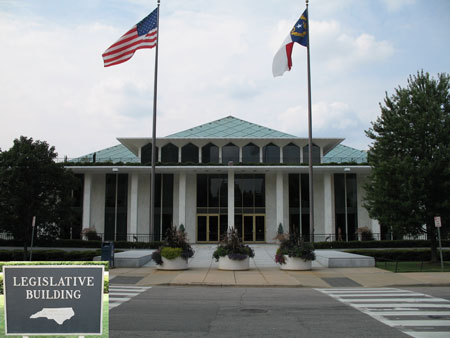
North Carolina Legislature

Stop the Cap! has obtained the audio from Wednesday’s Public Utilities Committee meeting that quickly pushed through H129, Time Warner’s custom-written, anti-competition and community broadband destruction bill.

Listening to the 44 minute hearing will be disturbing to anyone who supports open government and the concept of voting for or against a complete bill, not one Rep. Marilyn Avila (R-Time Warner Cable) openly admits is going to be changed.  For her, that represents no reason to delay the bill — her good friends at Time Warner need this legislation passed today, not tomorrow or next week.

As you listen, we’ve included a voter’s guide with time-indexed comments to help draw your attention to some critical points, and some much-needed fact checking.  It will also help you identify the members of the legislature that need to stay, and those that need to go.

Our apologies for the distorted audio at times.  When a member leans into the microphone, as some clearly do, it creates significant audio distortion.  It gets worse in the last 10 minutes, so watch your volume.

North Carolina’s House Public Utilities Committee Meeting on H129 – Wednesday, March 2, 2011. (44 minutes)
You must remain on this page to hear the clip, or you can download the clip and listen later.

Your Audio Guide to The Committee Meeting

2:50 Apparently Rep. Avila gets her research straight from the cable industry that wants to destroy community broadband.  Avila is factually wrong about citizens being on the hook for “high debt” for North Carolina’s fiber networks, all of which are financed by bonds that leave bondholders at risk, not taxpayers.  The only interests Avila wants to protect are her good friends at the cable company.
3:30 Rep. Avila is dreaming if she really believes the providers that have refused to provide service thus far are going to suddenly do so if her bill passes.  These communities were ignored before and they will be ignored after.  The only difference is that her legislation will guarantee no local community can do anything to fix it.  Avila admits openly her bill will stop competition between providers.
6:00 Rep. Julia Howard is more than willing to hold meetings with those already in the business, but there is no room for actual North Carolina consumers to make their needs known.
8:50 Rep. Avila pays lip service to the ongoing problem of lack of broadband availability in large areas of the state by saying it’s unfair, but ignores the reality that if communities don’t deliver the service, nobody else will.  The red herring of a “public vote” always carries with it loads of fine print.  For example, while the industry can spend unlimited amounts on lobbying and advertising campaigns to demagogue networks, local communities are almost always banned from spending one dime to share their views with the public, or respond to the propaganda the industry sends out.  In fact, Avila’s bill bans networks from advertising their services or advocating for them.  It’s like holding a public debate, but gagging one side so they cannot speak.
12:50 John Goodman, North Carolina Chamber of Commerce presents the pre-written talking points provided by the cable industry.  As you listen, ask yourself whether Mr. Goodman is aware of the details of community broadband, or simply the information handed to him on some sheets of paper from the cable lobby.  Then ponder how many times a community provider has forced a private player out of business with so-called unfair pricing and subsidies.
17:30 Catharine Rice is one of just a handful of speakers that talk about the real-world problems of actual North Carolina citizens.  She’s concerned about them, not the bottom line of Time Warner and AT&T.  Some examples: 

  • Parents of schoolchildren have to drive their kids to a school parking lot so their children can access the school’s Wi-Fi network to complete their homework;
  • A neighborhood of more than a dozen homes can’t get decent broadband because Time Warner demanded $50,000 to wire up cable service.  Meanwhile, just a mile away, a wealthy golf community got their service without a 9 iron to their wallets.
8:30 Jack Stanley from Time Warner Cable delivers the day’s ironic moment when he congratulates his cable colleagues and friend from the Chamber for the “eloquence” of their prepared remarks. And why not, when you consider who wrote them.  His brief remarks consist mostly of empty promises to find a “fair resolution.”  This, from the people who wrote the very unfair bill.
19:30 The North Carolina League of Municipalities delivers an important fact: Community broadband networks are not created on a whim.  They are launched where communities face inadequate or non-existent broadband service.  Most of the cities launching their own services tried the public-private partnership route by approaching companies about broadband problems.  They were shown the door out.  This is why networks like Fibrant and GreenLight exist today.  Community broadband disturbs Big Telecom because it represents competition Wall Street and shareholders never expected they would have.  Anything that challenges the enormous profits cable and phone companies earn must be eliminated.
21:30 Mr. Trathen opens his remarks with a distortion, claiming cities are jumping into community broadband because they just want to compete with existing providers.  In fact, the record tells a very different story in North Carolina.  Cities and communities to this day are trying to get providers from Time Warner Cable, CenturyLink, AT&T, and even Clearwire to deliver service to their citizens and they are being turned down, or delivered DSL service at speeds that will not even qualify as true broadband under the definition established in the National Broadband Plan.  That’s a simple fact.  How many community networks are competing against Verizon FiOS or other cutting edge broadband networks?  The reality is, anemic or non-existent broadband service has been the topic of complaints in local communities across the state for years and years. 

Also, Trathen’s desire to “have a conversation” about serving unserved parts of North Carolina reminds me of the saying — talk is cheap.  Time Warner has been a part of North Carolina for years and years, and the cable company routinely bypasses any customers who do not live in a dense, populated area to this day.

Trathen’s comments that there is nothing in the law today prohibiting public-private partnerships is very true, but as residents have seen, those are far and few between.  Trathen is also flat wrong when he claims nothing in the bill prevents a city from moving into an unserved area to provide service.  In fact, Avila’s bill prohibits cities from extending service outside of their boundaries.

24:00 Rep. Paul Luebke wonders why this bill is necessary, because local governments proposing these networks are already answerable to their citizens and to an oversight committee.  Leubke correctly points out the legislation is all about letting existing telecom companies decide for the people of North Carolina when/if they will get broadband service, at what speeds, and using what technology.  With no new competition on the horizon, H129 effectively delivers all of the state’s broadband interests into the hands of a cable and phone company cartel. 

Leubke also expressed concerns that he (and others) are being asked to vote on a bill that has not been finalized yet.  Should negotiations between existing providers trying to extinguish community networks and the cities that run them fail to find a solution, the bill’s original language will guarantee financial disaster to existing community broadband services.

29:00 Rep. Alexander notes that the legislation establishes onerous conditions on community broadband networks that the private sector is completely exempt from.  Alexander notes these networks came about because communities were faced with last century broadband — the virtual equivalent of two cans with string between them.  This legislation assures those underserved communities will continue to be underserved.
32:00 Rep. Womble has serious concerns about how this bill is being rammed through the committee.  Just minutes before the hearing, Womble was handed a summary of the bill for the first time.  Womble is especially upset he is being asked by the bill sponsors to “trust us” when they say they will work out exemptions for existing providers.
37:00 Rep. Hager goes fishing and catches a number of red herrings about cities expanding their networks outside of their service areas and cross-subsidizing them with pilfered funds from city resources, “unfairly harming” their cable and phone company competitors. He presents no evidence to substantiate this claim.
38:30 Rep. Hastings falls into the trap of conflating middle-mile fiber backbone projects with delivering broadband to individual homes and businesses as he brings up the Golden Leaf Project, a very worthwhile fiber backbone, but one that will never extend to last mile homes and businesses.  Like so many middle-mile projects, this one will deliver service to institutions like schools, libraries and local government.  While all very noble, no funds are provided to directly wire service to individual homes that need broadband the most.  Private providers would have howled had this been the case.
Instead, vague promises like “private providers are interested in leasing capacity” on the network leave consumers with the hope of better days, but they should not hold their breath.  Cable operators will not deploy service in rural areas, period, and phone company DSL’s largest impediment remains distance between the central office and individual subscribers.  While Golden Leaf may prove beneficial in incrementally moving residential broadband forward, it is not going to provide service to individuals.  In fact, H129 will ensure none of these communities can tap into Golden Leaf and directly deliver service to those that continue to be broadband-disadvantaged.
40:00 Rep. Warren doesn’t like voting on a bill just to find out what it will eventually contain later on.  “It gives me chills,” he told the committee.  He also dismisses claims the bill is about a “level playing field.”  He then directs several pointed questions to Ms. Avila about the financial implications her bill will have on state finances, its bond rating, and other considerations.  She dodges all of them with non-answer answers.
43:00 In less than 30 seconds, the bill is rushed to a committee vote by a motion from Rep. Brubaker, at which point Rep. Steen cuts off discussion (despite the fact more committee members were raising their hands to speak).  A voice vote clearly delivers a majority to the NO side, but not in the eyes of the committee chair, who claims the AYES have it, the bill is reported favorably out of the committee, and the meeting is adjourned before anyone has a chance to demand a recorded vote.

The shocking conclusion of this legislative travesty is the chairman adjourning before a recorded vote can be taken.  Without it, constituents can’t identify how their member voted and hold them accountable at the next election.

[Update 3:05pm Monday — Stop the Cap! misidentified Rep. Warren as Rep. Rowan at the 40:00 mark.  We have corrected the audio log above and regret the error.]

Suddenlink: The Good, the Bad, and the Ugly – Digital Conversion, Usage Meters, & More

Suddenlink, one of America’s smaller cable operators, has been undergoing a transformation as it tries to meet expectations of today’s cable subscribers and match whatever phone company competition comes their way.  While some of the upgrades are customer-friendly, others pose ominous signs for the future — particularly with respect to Internet Overcharging broadband customers.

Let’s explore:

The Good — New Broadband Speeds, New DVR, New Investments

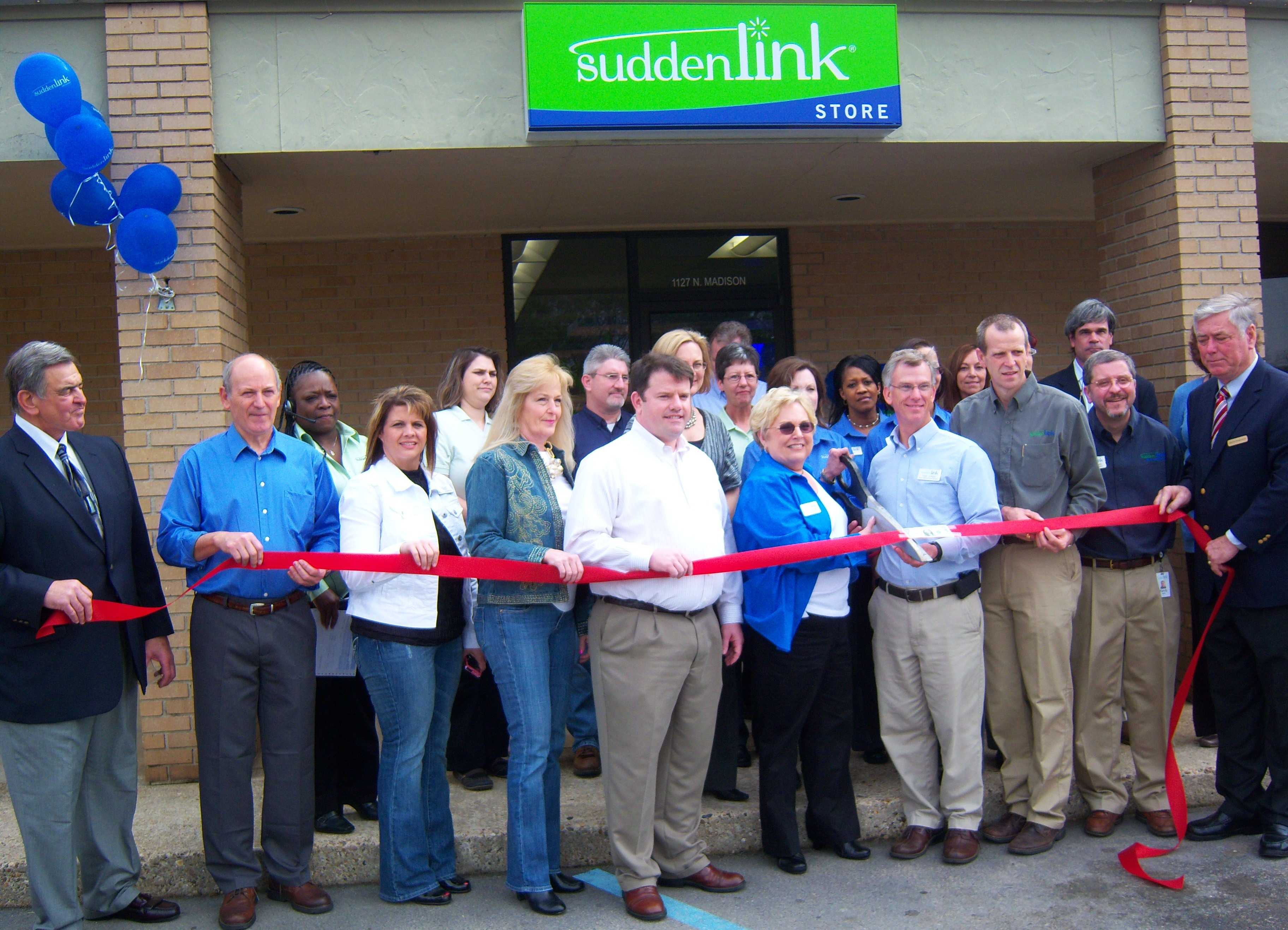
Suddenlink cuts the ribbon on its new store in El Dorado. (Courtesy: Suddenlink FYI)

In parts of Suddenlink’s service area, particularly in Texas, the company is moving most of its cable service to a digital platform.  This transition is designed to open up additional space for more HD channels, keep up with broadband demands, and open the door for additional on-demand programming.

In Nacogdoches, Suddenlink announced it was adopting an all-digital TV lineup.  Starting this week, the company is offering subscribers free digital adapters — also known as “DigitaLinks,” to enable continued viewing on analog television sets that do not have a set top box or digital tuning capability.  Every subscriber purchasing more than the broadcast basic package (that only includes local stations and a handful of cable networks) will either need a digital tuner-ready television, a set top box, or a DigitaLink device to continue watching.

What is good about this transition is that Suddenlink is not charging customers a monthly fee for the adapters, either now or in the future.  That contrasts with other cable companies like Comcast and Time Warner Cable that have handed customers a set top box or a digital adapter they will begin charging for after a year or two.

Suddenlink expects to invest nearly $120 million this year in Texas, and by the end of the year will have invested nearly a half-billion dollars in the state since 2006.

Texas is extremely important to Suddenlink.  The third largest cable company in Texas serves about 450,000 households and approximately 27,000 business customers in Amarillo, Lubbock, Abilene, Bryan-College Station, Midland, San Angelo, Georgetown, Tyler, Victoria, Conroe, Kingwood and Nacogdoches.

Suddenlink's New TiVo DVR

The company has also lit new fiber connections to handle data communications, primarily for business customers, and is upgrading its broadband service to fully support DOCSIS 3, which will deliver faster speeds and less congested service.

Customers in the state are also among the first to get access to a new and improved DVR box built on a TiVo software platform.  Suddenlink’s “Premiere DVR” service ($17/mo) is now available in Midland, Floydada, Plainview, Amarillo, Canyon, and Tulia.

The Bad — “Suddenlink Residential Internet Service is for Entertainment” Purposes Only

The Humboldt County, Calif. Journal's "Seven-o-heaven" comic strip commented on Suddenlink's problems. (Click the image to see the entire strip.)

Do you take your broadband service seriously, or is it simply another entertainment option in your home?  If you answered the latter, this story may not be so surprising.

In Humboldt County, Calif., broadband users started noticing their favorite web pages stopped updating on a regular basis.  At one point, a blogger in McKinleyville noticed he couldn’t manage to post comments on his own website.  But things got much worse when several web pages started reaching customers with other users’ names (and occasionally e-mail addresses) already filled in on login screens and comment forms.

It seems Suddenlink started to cache web content in the far northern coastal county of California, meaning the first customer to visit a particular website triggered Suddenlink’s local servers to store a copy of the page, so that future customers headed to the same website received the locally-stored copy, not the actual live page.

But the caching software went haywire.

Web visitors began to receive mobile versions of web sites even though they were using home computers at the time.  Some were asked if they wanted to download a copy of a web page instead of viewing it.  And many others discovered websites were customized for earlier visitors.

While the caching problem was irritating, the privacy breaches Suddenlink enabled were disturbing, as was the initial total lack of response from Suddenlink officials when the problem first started in late January.

The Journal finally reached a representative who provided this explanation:

Suddenlink Senior Vice President of Corporate Communications Pete Abel knew that a cache system had recently been installed in Humboldt County, but was unaware of the particular problems reported by users. After speaking with the Journal and other Suddenlink employees, though, he released a statement explaining what appeared to have happened.

According to the release, the cache system was installed in Humboldt County on Thursday, Jan. 27 — the very day that users began experiencing problems — and was intended as an interim solution to relatively low Internet speeds in Humboldt County. The system, it said, was able to cache only unsecure websites — those which, unlike almost all reputable banking or commerce systems — do not encrypt communications. But the company eventually discovered the problems that its customers had been reporting and, having fruitlessly worked with its vendor to find a solution, turned the system off on Monday.

“The good news is that secure Web site pages will not have been cached,” Abel said in a follow-up call to the Journal. “And I have been assured 100 ways from Sunday that never would have happened.”

Andrew Jones, who runs a blog with his Suddenlink broadband account, tried to opt out of the web caching and received an interesting response, in writing, from a Suddenlink representative.  He was told he could not opt out of cached web pages with a residential account because, “the residential service is for entertainment only.

Jones was told he would have to upgrade to a business account to escape the cache.

“If a small local radio station intermittently went off air for multiple days, the radio host would be apologizing and explaining the situation,” Jones wrote the Journal. “If a large utility company experienced sporadic power outages, people could hear a recording on a toll-free number to learn the cause and about ongoing repairs. What does an Internet provider do when web access becomes spotty and begins serving customers old copies of web pages? The company gets back to you in a couple days and suggests you pay more if you don’t like its recently degraded services.”

The Ugly — Suddenlink’s New Usage Meter Suggests 43GB is An Appropriate Amount of Usage for Standard Internet, 87GB is Plenty for Their $60 Premium Package

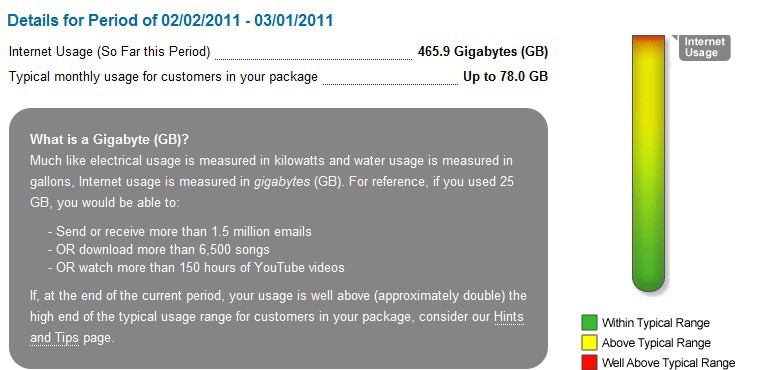
Although Suddenlink has not formally adopted an Internet Overcharging scheme of usage caps or metered billing, the company is sending automated e-mail messages to customers who exceed what they call “typical monthly usage for customers in your package.”  The e-mail tells customers they may be infected with a virus or someone else could be using your connection without your permission.  Boo!  For the uninitiated, this kind of message can bring fear that their computer has been invaded, either with malicious malware or the neighbor next door.

Customers have also received letters in the mail from the company telling them to check out their new “usage meter.”  Several have been sharing how much they’ve racked up in usage during the month on Broadband Reports.  One customer managed 243GB while another looking at the company’s super premium 107/5Mbps package managed a whopping 786GB.

Although the wording of the message has strenuously avoided telling customers they are wrong for this amount of usage, the implication is clear to many: they are counting your gigabytes and identifying the outliers.  One customer called it Suddenlink’s “You’re actually using your connection, and we really wish you wouldn’t”-message.

“No one with an ounce of sense would pay for a 20/3Mbps connection and only use 78 GB in a month. Let’s hope they’re just making cute suggestions, not easing us into a cap, because that just won’t fly,” wrote one West Virginia customer.

Another in Georgetown, Texas did the math and made it clear 43GB better not turn out to be a cap because it means customers can barely use the service they are paying for.

“It’s way too low. I got 10Mbps [service] because of price/value and not because I use less than 43GB,” he writes. “[Even] if I downloaded at 1.25MB/s for 30 days straight (1.25 * 2592000 seconds) I could [still] grab 3.164TB.”

Clyde (Courtesy: KUSH Radio/Donna Judd)

Meanwhile, some controversy over the quality of Suddenlink’s service during the upgrade process had some residents in Cushing, Okla., up in arms at a recent city meeting.  Lorene Clyde complained Suddenlink’s “new and improved” service is worse than ever.

“I’m tired of paying for a service I’m not getting,” Clyde said.  “And the Suddenlink commercials – they are like rubbing salt in a wound.”

KUSH-AM reporters were on hand to cover the event, noting Clyde was not the only one complaining.  The radio station noted that “the buzz around town echoes her sentiments – from the ‘mildly irritated’ to the ‘downright mad’ – citizens have been complaining.  Not only have they been complaining to Suddenlink – as difficult as that may be (the call center is in Tyler, Texas) – but to city leaders.”

What Clyde and others may not have realized is that Suddenlink officials were in attendance and were able to apologize for the problems, but a growing consensus among consumers and city leaders is that a broad-based refund for the poor service was warranted.

Commissioner Joe Manning said while he appreciated the promise to figure out the problem, it wasn’t good enough to just apologize and promise – that subscribers’ bills should be adjusted to reflect the poor service.

Commissioners Carey Seigle and Tommy Johnson agreed with Manning.  Seigle pointed out it would be “good P.R.” to give some sort of rebate across the board to subscribers while Johnson complained that the original “upgrade” was only going to take a few weeks and now 8 months later – things are not better, but worse, noted the radio station.

Suddenlink officials on hand said they did not have that kind of authority, but continued to promise things are going to get better.  “I pledge to you,” one said, “We will find it [the problem] and fix it.”

[flv]http://www.phillipdampier.com/video/KJTV Lubbock Borrowing Wi-Fi 2-7-11.flv[/flv]

KJTV-TV in Lubbock, Texas talked with Suddenlink about the growing trend of neighbors “borrowing” neighbors’ unsecured Wi-Fi networks.  Other than the accidental recommendation that consumers should “invest in Internet spyware” to keep your computer safe, the report does a fair job of shining a light on a practice that could have financial consequences if the provider implements an Internet Overcharging scheme.  (2 minutes)

Search This Site:

Contributions:

Recent Comments:

Your Account:

Stop the Cap!