Home » Broadband Speed » Recent Articles:

North Carolina Call to Action: Fight to Protect Better Broadband!

Q.  What moves faster than North Carolina’s cable and DSL service?

A.  Legislation to make sure the state’s telecom companies can continue to provide slow, expensive, and hit or miss service for years to come.

Big Telecom money has greased the process as H.129, the Telecom Monopoly Preservation and Protection Act is rushed to the House floor before North Carolina consumers know what is happening.

Residents have until Monday evening at 7pm to make their feelings known on this anti-consumer nightmare for cities and small towns:

  • H.129 will shut down the digital economies of small cities like Wilson and Salisbury just as they are primed to sell themselves as a great home for high-tech, high-paying jobs.
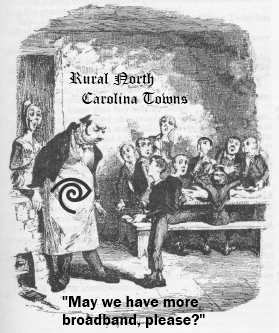
  • H.129 guarantees rural North Carolina will resemble the 21st century equivalent of Oliver Twist — begging for whatever limited broadband the state’s phone companies refuse to deliver.

The appalling truth is that the companies pushing for this bill only want broadband service on their watch, under their control, with their high prices and virtually no competition or choice.  And now AT&T is prepared to limit your broadband usage as well, establishing usage caps and overcharging customers who exceed them.

Do you want your broadband choices limited to these phone and cable companies?  Considering North Carolina broadband is ranked 41st out of the 50 states, it’s clear they don’t consider the state a priority.

But it does not have to be this way.  Where providers drop the ball, communities should have the choice to pick it up and run with it.  That is what Wilson and Salisbury did, and the result is the best broadband service in the state.  That’s a threat Time Warner Cable and CenturyLink can’t afford to ignore, which is why they want these networks stopped at all costs.

Defeating H.129 is critical to the state’s broadband future.  As written, it delivers no new broadband connections, does not promote or provide any competition, or help any individual or community.  It was written by the state’s telecom companies to benefit them, and them alone.  It guarantees you will be stuck paying ever-increasing bills for limited service indefinitely.

Tell House members they must do what is right for the voters, not what is right for the cable and phone companies.  Tell them to VOTE NO ON H.129.  The broadband saved may be your own.

You can find your individual representative and their contact information below the jump.  Please get writing and calling today!

… Continue Reading

BitTorrent CEO Willing to Appease Providers for Unproven ‘Bandwidth Congestion’

Phillip Dampier March 24, 2011 Broadband "Shortage", Broadband Speed, Consumer News, Data Caps, Editorial & Site News, Online Video Comments Off on BitTorrent CEO Willing to Appease Providers for Unproven ‘Bandwidth Congestion’

BitTorrent, the company behind the popular file sharing protocol routinely blamed by providers for overburdening broadband networks and by Hollywood for distributing pirated content, took a tentative step today to oppose Internet Overcharging schemes.

Eric Klinker, CEO wrote a guest piece for GigaOM calling out AT&T for its announced 150-250GB usage caps:

While the trend toward metered bandwidth is not inherently pro-consumer, ISPs have staked out a singular public rationale: data caps are necessary to limit the consumption of “bandwidth hogs” in order to protect the network experience for everyone else. Such concepts are simplistic and easy to imagine. They are also completely wrong.

And with that, Klinker stumbled into a public relations and marketing effort defending the company’s culpability for increasing broadband traffic, and proposing a resolution for their ‘part of the problem’:

Since any data traffic that doesn’t induce congestion on a fixed cost network is essentially free; applications can voluntarily play a role in traffic prioritization. And since BitTorrent is a high percentage of global Internet traffic, we have a responsibility to be a part of the solution.

This was the primary motivator around our release of a new protocol a year ago, called µTP. The protocol essentially senses congestion and self-regulates to avoid contributing to Internet traffic jams.

Because µTP can never induce network congestion, it doesn’t contribute to an ISP’s cost. An ISP still has regular network maintenance expenses, but remember, with a fixed-cost network, traffic only becomes an economic burden if it contributes to congestion and forces the need for expansion.

As a result, µTP is exceedingly friendly to ISPs and their business model. µTP is open-source, and we invite application and cloud services providers to work with us directly or in the IETF’s LEDBAT working group in the ongoing innovation and usage.

Klinker

Some providers and their allied interest groups have disputed the diminished impact Klinker cites as a benefit of µTP, but in provider-world, the BitTorrent “problem” is rapidly becoming yesterday’s news anyway — online video is the new boogeyman.  NPD Research just released numbers showing peer-to-peer use has dropped from 16 percent of all U.S. Internet users to 9 percent over the last three years.

After making a spirited sales pitch for what he hopes will represent peer-to-peer 2.0, Klinker surrenders on behalf of everyone else, arguing the solution to America’s ‘broadband crisis’ is speed throttles during peak usage periods, and time of day pricing.  Klinker suggests broadband users might need to plan their “on-demand” viewing well ahead, or face the kind of “congestion pricing” Londoners face if they attempt a journey by car into the city center at high noon.  Klinker suggests Netflix customers should pre-schedule downloads of their movies the night before watching them, or else pay a fee for instant gratification.

That assumes, of course, you know what you want to watch the day before you do, that you can download Netflix content (you cannot), and that you didn’t remember you could accomplish the same thing if Netflix shipped the DVD out to you by U.S. Mail.

Are broadband rationing coupons far behind?

Klinker’s willingness to submit his own company’s peer to peer technology to provider speed throttles is likely to earn him a dressing down by investors wondering what the future holds for a protocol that can be dosed with Xanax at provider will.  Handing over the power to make your file sharing technology painfully slow and frustrating is likely not going to win new converts, either.

Before willing to subject everyone to solutions for broadband providers’ scary predictions of a broadband exaflood, would it not be better to actually obtain verifiable evidence there is a congestion issue in the first place?

An Open Letter to Content Producers: Netflix, Hulu, Valve, Microsoft, Sony, and Nintendo

Dear Content Producer:

Your money train is leaving the station.

Customers are about to start making some very important choices about what they do on the Internet. AT&T announced this month they are going to start capping their DSL customers at 150GB per month and their fiber-to-the-neighborhood U-verse customers at 250GB per month, with overlimit fees for those who exceed them.

Comcast already has a 250GB per month cap, currently loosely enforced. Time Warner Cable has strongly advocated usage-based billing for years. Other telecommunications companies are all either supporting or considering these Internet Overcharging schemes for one reason, and one reason only:

It makes them absolute boatloads of cash.

Canada already lives with this reality. So does Australia, although they’re backing away from it. South Korea? Japan? Europe? Nope. Flat-rate Internet service is the norm there.  In Europe, mobile customers are demanding the removal of bandwidth caps American providers are still trying to attach to customers’ bills.

So how does this impact you? 250GB a month is a lot, and you’ll be fine? Sure. For now.

But what happens when Sony introduces the Playstation 4, or Microsoft announces the Xbox Next? Games aren’t exactly going to get smaller, and online distribution is far and away the future of games and software in general. Right now a game for the 360 or PS3 can be as large as 20GB. PC game enthusiasts routinely cope with 10-12GB game upgrades, and woe be unto you if you have to reinstall your Steam library and have 20-30 (or more) games to restore.

Internet Overcharging schemes make providers, and the lobbyists who do their bidding, very wealthy.

For the “Massively Multiplayer Online” game universe, incremental software updates and upgrades often come through BitTorrent, which exposes users to peer-to-peer traffic well beyond the size of the update itself.  In fact, as games increasingly turn towards Cloud storage and distribution, the traffic adds up.

For online video companies, your very business model could be at risk.  Netflix? Hulu? People are no longer satisfied with grainy, compressed video.  They want HD content, and you’ve answered the call.  But as consumers increasingly face 8-10GB per movie (at 720p, 15GB+ for 1080p), the usage racked up is going to blow past all of these caps.

Who knows what happens in the next five years, or ten.  Considering Canada, where a similar duopoly of broadband providers have lowered usage allowances, do you really expect anything different down here?  The only thing likely to be raised is the monthly price, which remains higher here than in most places around the world.

Google has the right idea with their experimental 1Gbps fiber-to-the-home network. The problem is, that’s only going to serve one (or perhaps a few) communities in the U.S.  The rest of the country will have to survive with ‘Ultra’ cable broadband packages serving up 10-20Mbps service or DSL that barely manages 6Mbps.  If you don’t live in an urban area, tough luck.  You will be lucky to get 3Mbps service.

Broadband service upgrades come painfully slow in the absence of robust competition.  Time Warner Cable and other providers are slowly starting to roll out DOCSIS 3, which allows speeds up to 100Mbps, assuming the average consumer can afford the Cadillac price that comes with it.  Many phone companies continue to bet the farm on their DSL service, which can also be expensive when it’s the only broadband service in town.

Against this backdrop, the rest of the world marches on, and beyond, North America.

South Korea? They’re promising national speeds of 1Gbps by 2013 — for $27 a month!

How has this happened?  Where have we gone wrong?

For starters, the broadband providers have very powerful lobbyists — quite a few of which are ex-legislators. Together, they wage their public policy battles on both the state and federal level, often writing the bills a compliant legislator is willing to introduce as their own.

Washington regulators take a "see no evil, hear no evil" approach to regulating super-sized corporations who can cause them trouble.

The Federal Communications Commission has adopted a “see no evil, hear no evil” approach to broadband, capitulating when a chairman occasionally strays too far into the industry minefield laid to protect their business agenda.  As a result, the agency is a toothless dog.  It recently adopted a “Net Neutrality” policy all but written by Verizon, who ironically is now spending money to fight the rules they helped write.  As a backup, virtually every Republican and several Democrats have teamed up to pass a Resolution of Disapproval seeking to overturn the weak-kneed Net Neutrality rules the FCC adopted.  Lobbyists are well paid to cover every contingency.

Consumers — your customers — can’t do much about this beyond writing their members of Congress and complaining.  But because they did not enclose a check or money order made payable to the respective politician’s campaign fund, the result will be a form letter response weeks, if not months later… after the corporate agenda is enacted into law.

We just cannot fight this battle all by ourselves.  Recognizing the realities of today’s politics, we need your help to fight money and power with money and power.

The video game industry earns billions yearly. You have already faced battles in Washington, so you know how this works. You can fight for your interests while protecting ours by ensuring broadband service is cheap, plentiful, and unlimited. The same story applies to other content producers, such as online video, software, and any other company that wants to move to online distribution to power their business. You cannot succeed if customers are too afraid of using your service because of a bandwidth cap.

The remarkable thing is that countries many Americans cannot find on a map are now beating the United States with better and cheaper broadband while we hand over our digital economic future to a duopoly. That will not buy us better service, just bigger bills for “fast enough for you” Internet access.

So that’s it. Act now. Act strongly. If you cannot stand up for your customers, you may not have any.

Signed: A gamer. A movie watcher. A music listener. An enjoyer of entertainment. A lover of the Internet.

Broadband consumer and reader Jason Ballew penned this guest editorial, with some editing and additions from Stop the Cap! editor Phillip M. Dampier.

Travesty: North Carolina’s Telecom Companies Oppose 4Mbps Broadband Service in Rural Areas

Despite today's setback, North Carolina's broadband hero is Rep. Bill Faison, who stood up for rural broadband.

In the North Carolina legislature’s Finance Committee, a one week timeout “to hear views from the public” actually means giving breathing room for cable and phone lobbyists to strip away surprise amendments not to their liking.  This morning, in a catastrophe for consumers, the state’s largest phone and cable companies got legislators to wipe out a provision that would have helped guarantee rural North Carolina at least 4Mbps broadband service, either from existing providers or new ones that develop in their absence.

During debate of H.129, the anti-Community Broadband bill, North Carolina consumer interests were kept out of sight and mind as lobbyists worked their magic to get rid of Rep. Bill Faison’s (D-Caswell, Orange) amendment that would set the state’s minimum acceptable definition of broadband at 4Mbps with a 1Mbps upload speed.  With the help of several flip-flopping representatives, they got their wish.

Faison’s amendment was designed to open the door to someone — anyone — to bring broadband into rural areas of the state.  While Time Warner Cable, AT&T, and CenturyLink dawdle, large numbers of rural residents simply go without any broadband service.  Faison’s amendment was simple and reasonable — if at least half of an area is not served with 4/1Mbps service, provisions should be made to allow local communities, if they wish, to establish service themselves to get the job done.

Last week, when Faison’s amendment appeared to be headed for incorporation into the bill, industry lobbyists blanched and fled the room, raising vocal objections and demanding a week timeout before a vote was taken.  After winning their reprieve, they managed to get the Republican majority in line to throw rural North Carolina under the bus, uniformly opposing Faison’s amendment.  Two Democrats, one representing the city where Time Warner Cable’s regional division is headquartered, joined them.

Hall of Shame: Rep. Carney does not care about North Carolina's digital divide.

In its place, they substituted a new amendment which defined broadband in the state of North Carolina as any service occasionally capable of achieving 768kbps downstream and 200kbps upstream.  That represents “well-served” among these industry-friendly legislators.

Among the worst offenders that stood out today were Reps. Jeff Collins (R-Nash) and Becky Carney (D-Mecklenburg).  Last week, they were standing with North Carolina consumers.  This week, they are voting for the interests of the cable and phone companies.  Rep. Carney, who lists her occupation as “homemaker”, voted to guarantee North Carolina families years of slow, expensive and erratic broadband service, if available at all.  Collins supported an amendment that says Nash County residents should do just fine with broadband speeds that don’t even manage to break 1Mbps.

The bill next moves to the floor of the House for consideration.

What is missing from this debate is a realization on the part of the legislature cable and phone lobbyists do not want anyone delivering basic broadband service in rural North Carolina unless it comes from them, and to date they have shown no interest in delivering it.

After all the debate, here is a fact no one can ignore.  The only networks in the state capable of delivering world class 100Mbps broadband are two fiber based community-owned networks in Wilson and Salisbury.  The companies that want to see them out of business see 768kbps as more than adequate to define broadband availability in North Carolina.  When members of the Finance Committee agreed, it helps explain how the state has managed to rank 41st in broadband excellence.

It’s time to ask your legislators what side they are on.  Yours or the state’s cable and phone companies.

Verizon Does the Right Thing and Will Not Cap Its DSL or FiOS Customers

Verizon delivers fiber-to-the-home service over its FiOS network.

Verizon Communications says it will not run an Internet Overcharging scheme on its wired broadband customers.

The company that knows about investment and upgrading their networks like few others — bringing true, fiber-to-the-home FiOS service to customers across several states — says it has no need to impose usage caps or metered billing on its wired broadband customers.

“This is something we have looked at in the past, and we’ll continue to evaluate what’s best to ensure our customers get the best broadband service for the best value,” Verizon spokesman Bill Kula told Broadband Reports. “We have no plans to implement usage-based pricing for our fixed broadband customers,” Kula says.

Verizon’s announcement provides additional ammunition against AT&T’s unjustified 150-250GB usage caps over claims it faces congestion issues.

The company doesn’t share AT&T’s “congestion problem,” probably for two reasons:

  1. Because it does not exist.
  2. Verizon has upgraded their network to keep up with demand, winning new customers with their top-rated FiOS fiber to the home network.

Karl Bode sees right through AT&T’s arguments:

If you believe AT&T’s claim that the new pricing is about congestion and not about protecting U-Verse revenues from a Internet video — and many don’t — Verizon’s decision to spend $24 billion on upgrading more than half of their network to fiber to the home would make a Verizon decision to follow suit a very tough sell. AT&T has previously stated their last-mile customers see little to no congestion, and Verizon’s seeing even less.

Kula notes Verizon doesn’t oppose the use of usage caps, but their TOS allows them to handle any users they deem particularly gluttonous, and even then — Verizon makes it clear to us they’ve never disconnected one of these users. “Verizon terms of service were written in a way to allow us to terminate users if they violate our acceptable use policy, and excessive use ‘could’ constitute a violation,” says Kula. “However, we’ve not disconnected any consumer, small business or mass market customers to date.”

Stop the Cap! has never objected to terms and conditions which provide an escape clause for a provider that encounters a customer creating significant problems on its network, such as e-mail spamming, illegal activity, or causing serious problems for other users.  These terms and conditions are a part of every Acceptable Use Policy, and responsible providers don’t activate those provisions on a whim.

It’s too bad some AT&T customers can’t choose an alternative to a company who promised great things with U-verse, and then put unjustified limits on customer enjoyment.

Search This Site:

Contributions:

Recent Comments:

Your Account:

Stop the Cap!