Home » Broadband Speed » Recent Articles:

Qatar Getting Nationwide Unlimited Access Fiber to the Home Broadband By 2015

Gertraude Hofstätter-Weiß April 18, 2011 Broadband Speed, Data Caps, Public Policy & Gov't 1 Comment

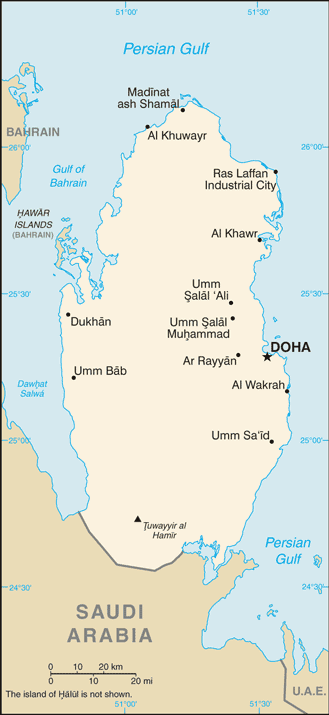
Qatar

The kingdom of Qatar announced broadband is of urgent importance, and has unveiled plans to deliver fiber-to-the-home broadband, phone and television service to 95 percent of the country by the end of 2015.

Under the auspices of a newly formed public-private venture, the Qatar National Broadband Network Company will construct the near-universal fiber network, extending it to every business and home it can reach.  On that network, private providers, including Qtel and Vodafone, will market their products and services to government, business, and consumers.

“The Qatar National Broadband Network represents a bold step forward in Qatar’s drive to be a leading knowledge economy. Ubiquitous access to a high-speed network is essential to business development, economic growth, innovation and enhanced government services for our citizens. This network will do more than connect Qatar to the world; it will truly help enrich the lives of those who live here,” said Dr. Hessa Al-Jaber, who leads broadband development matters inside the kingdom.

The project is specifically designed to address Qatar’s current broadband marketplace — slow and expensive.  Qtel markets its landline customers up to 8Mbps DSL at prices that can exceed $100 a month, but few customers actually achieve 8Mbps results.  The project would largely replace the kingdom’s copper-based phone network.

“A lot of Qatari citizens don’t use fixed line DSL and prefer the country’s mobile broadband networks which can be cheaper and even faster than DSL,” Abdul Al-Attiyah, who lives in Doha, tells Stop the Cap! “This fiber network will bring 100Mbps service to just about everyone at prices a fraction of what we pay for DSL today.”

Al-Attiyah recently had the opportunity to communicate with the kingdom’s telecommunications ministry on the issue of bandwidth caps.

“I asked them if there were any plans to allow providers to limit how much broadband service Qataris could use, because we have caps on mobile broadband today, and I was assured there was never any point to limit use on a limitless capacity fiber network,” Al-Attiyah says.

“Fiber is also a far better solution than wireless broadband because of congestion issues,” he adds.

Qatar is a small country — about the size of the state of Connecticut, and is located on a peninsula adjacent to the Kingdom of Saudi Arabia.  Thanks to significant oil and gas revenues, the kingdom enjoys the highest G.D.P. in the world, and will soon be one of the leaders in broadband as well.

Verizon’s Discount DSL Arrives: $14.99 up to 1Mbps/$29.99 up to 15Mbps

Phillip Dampier April 18, 2011 Broadband Speed, Competition, Data Caps, Rural Broadband, Verizon Comments Off on Verizon’s Discount DSL Arrives: $14.99 up to 1Mbps/$29.99 up to 15Mbps

Source: The ConsumeristIt has been some time since major carriers like Verizon have promoted “unlimited use” plans for broadband.  Not too many years ago, providers used “unlimited” as a major selling point for those looking to escape slower, time-limited, dial-up access.  Today, Verizon is back pitching unlimited DSL at prices as low as $14.99 per month, if you still happen to have your Verizon landline.

Verizon’s DSL pricing changes include two new price tiers for current landline customers and for those who don’t want landline service.  No annual plan contracts are required, and prices are good for one year.

For Verizon landline customers:
500 Kbps to 1.0 Mbps – $19.99 ($14.99 when ordered online)
Either 1.1-3 Mbps, 3.1-7 Mbps or 7.1-15 Mbps (speed level will depend on line quality) – $34.99 ($29.99 when ordered online)

For those who only want broadband service, prices are considerably higher:
500 Kbps to 1.0 Mbps – $29.99 ($24.99 when ordered online)
Either 1.1-3 Mbps, 3.1-7 Mbps or 7.1-15 Mbps (speed level will depend on line quality) – $44.99 ($39.99 when ordered online)

Verizon really wants customers to order service online, and will throw in a free wireless router when you do.  Activation and shipping charges may apply.  Customers also get free access at Verizon Wi-Fi locations.

Verizon is pitching these services to customers who don’t want to deal with “clogged networks or exceeding monthly dial-up time limits.”

These prices are similar to discounts AT&T offered its DSL customers last year.  It’s an effort to maintain revenue and attract price-sensitive rural holdouts who avoid more expensive broadband plans.  Verizon simultaneously announced a new pseudo-“triple play” package for areas without its FiOS fiber to the home service that uses Verizon’s network for phone and broadband service, and DirecTV for television.

“We’ve enhanced the value and simplified our HSI bundles by pricing them aggressively and removing any contract requirements and early termination fees for Verizon services going forward,” said Eric Bruno, Verizon vice president of product management.  “With these refinements, our High Speed Internet service offers the best value in broadband.”

Bruno forgets when adding new DirecTV services to a Verizon phone and broadband bundle, a two-year agreement and early cancellation fees with the satellite company will apply.

Customers contemplating service who disconnected their Verizon landline can sign up for Verizon’s least expensive landline service — the one with no local calling allowance.  Outgoing calls are billed on a per-call basis in most areas, and the monthly charge for the service can be under $10, depending on the size of your calling area.

You Can’t Have This: Wyoming’s Fight for Better Broadband Mired in Politics and Business Interests

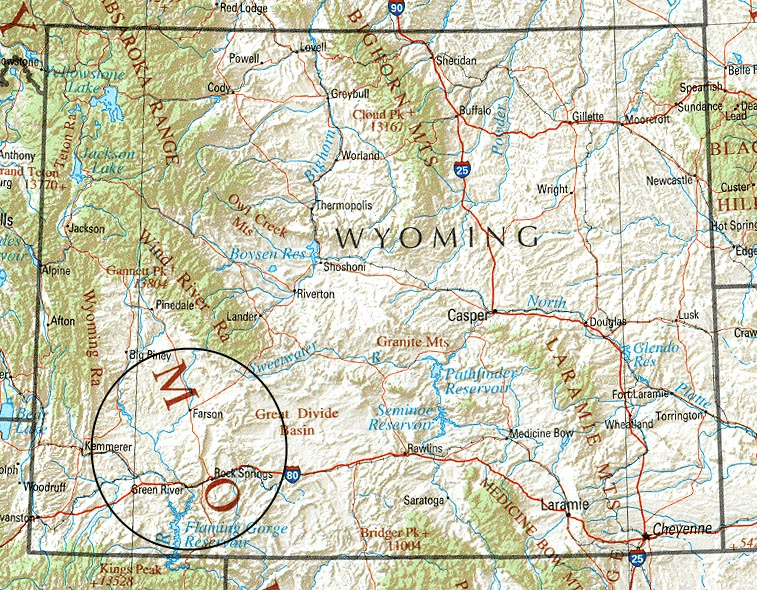
Green River, Rock Springs, and other communities served by Wyoming.com

Wyoming is one of America’s most broadband-challenged, least populated states.  With just over 560,000 residents spread across its often mountainous terrain, broadband service is nothing to take for granted.  Larger communities have limited access to Qwest DSL and cable broadband, but large sections of the state rely on independent wireless providers as their only choice, or they find no broadband service at all.

In this spartan digital world, many residents are surprised Wyoming is criss-crossed by national fiber-optic lines moving traffic across the country.  It’s just that in most instances, individuals are not allowed to access it.

Wyoming.com, a privately-owned Wireless ISP, wants to expand service to Farson and South Pass City — two communities further north that have no hope of getting anything beyond dial-up or satellite fraudband service.  The commercial provider, working with the administrators of the fiber network, has access to federal grant money to expand service to unserved communities, and improve it in underserved areas like Rock Springs.  But that cannot happen if the venture is refused access to a 48-strand “middle-mile” fiber-optic line financed by public dollars and managed by the Joint Powers Telecommunications Board — a partnership between the Green River City Council and Rock Springs local government.

The notion Wyoming.com could get access to a taxpayer-financed network ruffles Tom McCullough, the city’s liaison to the Joint Powers board.  He’s opposed to allowing any government resource to benefit the public at the expense of the local cable monopoly — Sweetwater Cable TV, which doesn’t even serve most of the areas that would benefit from enhanced Internet access.  McCullough argues it violates a 2007 Wyoming law that prohibits public broadband projects when private providers provide access to similar services anywhere within the boundaries of a city or town.  The law came in response to a public broadband project undertaken in Powell that upset the state’s cable and phone companies.

If residents want access to the fiber network they paid for, they have to visit Western Wyoming Community College or the Sweetwater County Library System and use public terminals there.

McCullough so dislikes the fiber project, he has tried to disband the Joint Powers Board that manages it twice, suggesting he has enough support to sell off the entire network to anyone interested (presumably at a substantial discount.)

Shea

Local residents who remain stuck with dial-up or who live outside of Sweetwater Cable’s service area are furious.

“There are some types around here who can’t see past Rush Limbaugh — anything the government does is automatically bad and must be taken down, even if taxpayers paid to build it in the first place,” complains Stop the Cap! reader Sue who lives in Farson.  “Farson has nothing to do with Sweetwater Cable, but because a handful of politicians are looking out for the cable company, worried Wyoming.com is going to get one-up on them, that means we can’t have broadband.”

Steve Shea, chairman of the telecommunications board, is unimpressed with McCullough’s arguments as well, and accused him of allowing his personal friendship with Sweetwater Cable TV’s owner — Al Carollo — to cloud his judgment.

Shea says Wyoming’s local governments are often fiercely protective of locally-owned businesses, and told the Green River Star the Board has historically faced the attitude that “local business deserves a monopoly, no matter what.”  Sweetwater Cable TV is locally owned and operated.

In fact, Shea says original designs for the fiber network were to provide fiber-to-the-home service in the area.  Since a national fiber optic cable was already running adjacent to the community, getting a connection to it was relatively simple.  Extending service to individual homeowners was another matter.  Political opposition to “government broadband” and demagoguery about its cost and implications from private providers ultimately killed the project.

Shea documented his experience as commercial providers and their dollar-a-holler industry-connected supporters fought the fiber project:

  • Opposition comes from everyone in the Telecom business;
  • Opposition will be in your face constantly;
  • Opposition will never run out of lies;
  • Opposition is ready to strike at any time and at any place;
  • Opposition will engage in back-room politics against you;
  • Opposition will try to get Power Brokers and Influentials on their side;
  • Opposition will spend as much money as needed to defeat you.

Local cable and wireless providers engage in a tangle in southwestern Wyoming

As Wyoming’s broadband rankings slip further and further behind much of the rest of the country, Shea hopes attitudes about the fiber network have changed, especially when residents learn Sweetwater Cable was offered access to the network as well, and they declined.

Shea shared that the long history of opposition to the project started with suggestions wireless broadband was better than fiber, or that broadband over power lines could do the same or better than fiber networks.  He even battled contentions that existing broadband networks provided “fast enough” service for Wyoming.  Today, it has extended to allowing a private company to engage in a public-private partnership.  The other providers are still opposed.

“You have to refute these arguments over, and over, and over again. Your opposition will oppose you at every corner, and will call in all of their political favors to derail your fiber project,” Shea writes.

“It’s Wyoming’s version of North Carolina,” Sue writes from her Hughes Satellite address.  “Sweetwater Cable doesn’t want access to the fiber themselves, and they want to make sure you don’t access it either, even though the family I have down there tells me their cable Internet service sucks because the cable company can’t handle the traffic.”

Sweetwater Cable gets their access from Qwest.

What bothers Sue and some other local residents about the squabble is that it is inherently political and allows an existing, underutilized fiber line to sit mostly unused when expanded broadband is desperately needed in Wyoming.  In fact, some consider it a scandal among special interests.

“They don’t care about better broadband — they only care about their political and industry friends,” Sue complains.  “When will people wake up and realize that whether it is North Carolina or Wyoming, these policies and laws don’t give anyone broadband — they keep us from getting it.”

Shea’s observation that opponents’ use of backroom politics seems to have been right on point.  On Tuesday, as the Board met to discuss Wyoming.com’s proposal, Shea was effectively forced out and announced his resignation after the owner of Sweetwater Cable TV said he contacted an attorney to look at whether Shea’s tenure on the board was legal.


Osama bin Laden Getting Faster Internet Than You Have: Pakistan’s 50Mbps Future

Phillip Dampier April 14, 2011 Broadband Speed, Rural Broadband 7 Comments

While America’s heartland is being wired for 3Mbps DSL service, residents in Pakistan are getting ready for speeds up to 50Mbps thanks to a major broadband expansion in the country.

Pakistan’s PTCL, the country’s state-controlled phone company, is working on a major upgrade to bonded VDSL2, the next generation of DSL, which can deliver more than five times the top speed of the country’s highest level of service, at a construction cost of just $200-300 per home passed.

PTCL, the largest broadband provider in Pakistan, has plans to complete the project in selected cities by the second quarter of the year, and then expand the service further out into more rural regions.

“PTCL is the first service provider worldwide to deploy a commercial VDSL2 bonding solution that aims at doubling the bandwidths provided to its existing customers,” PTCL President and CEO Walid Irshaid said.

Ishaid’s company chose VDSL2 over fiber to the home primarily because of cost.  With fiber installs now running around twice as expensive as a DSL upgrade, a developing country like Pakistan couldn’t justify the higher price.  VDSL is expected to be an important part of broadband expansion in the developing world, particularly in Africa, southeastern Europe, and central Asia.

Alcatel-Lucent, which is supplying equipment to deploy bonded VDSL2 service, says it has customers in western and central Europe as well.  Several providers are interested in VDSL2 technology because it could serve as a platform to deliver broadband, video, and phone service, much like AT&T’s U-verse.  Most Europeans get their broadband from DSL-equipped phone lines.

Pakistan hopes to eventually sell packages of service well beyond today’s maximum speed of 10Mbps, at a significantly lower cost.

Currently, Pakistan sells broadband ranging from a basic 256kbps connection (1GB limit) for around $3.50 a month, a popular 4Mbps unlimited package for around $24 a month, and 10Mbps service for a super pricey $119 a month.  With the upgrades, PTCL can either raise speeds, reduce prices, or a combination of both.  Outside of the 256kbps service, all other broadband packages from the company offer unlimited use.

OK for the $3.50 a month price, but it has a 1GB cap.

2Mbps unlimited service for $17.78.

10Mbps service is fast for today's DSL, but at more than $100 a month (ouch), it explains why Pakistan wants better and cheaper options for its citizens.

T-Mobile’s New “Unlimited” Plans Deliver a Speed Throttle After 2GB of Usage

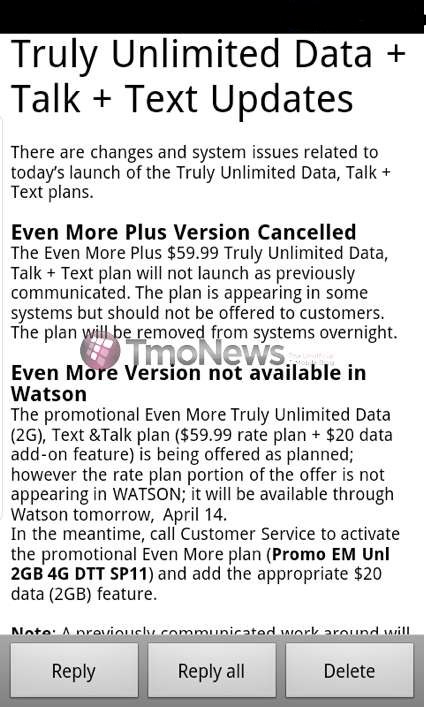
Here today, Gone today. T-Mobile withdraws a prepaid plan hours after sending press releases about it. (Image: TmoNews)

Imagine if your “unlimited” phone line came with a hidden limit — after 50 calls a month, each additional call would take at least five minutes to complete.

In the data world, speed throttles for “heavy users” deliver a similar frustrating experience.  That is what makes T-Mobile’s newly-announced “unlimited” use plans so ironic.  They are not truly unlimited at all.

T-Mobile’s “Even More” plan ($79.99) announced today for their contract/postpaid customers promises unlimited calls, texts, and data sessions with a very big asterisk — after using 2GB of data in a month, the company will throttle your data speed to near-dialup until your next billing cycle starts.

Providers routinely claim this doesn’t represent false advertising because you can still use data services on your phone, as long as you are willing to wait… a… very… long… time….

T-Mobile also managed to take back an announced plan for prepaid customers literally hours after seeding press releases to as many news agencies as possible.

In our copy, “Even More Plus” was supposed to deliver the same features as “Even More,” but at a much lower price — $59.99 per month.  It too was sold as “truly unlimited” for all of five hours before company officials yanked it, perhaps realizing their prepaid plan threw their postpaid/contract customers under the bus — charging them $20 more a month for same plan prepaid customers were to get for less.

TmoNews, home to a number of employees willing to share inside information about T-Mobile’s business, shared a copy of a notification message telling employees to avoid signing people up for the cheaper prepaid plan — it has been withdrawn.  But if customers insist, T-Mobile will agree to let you have the lower price, but only if you call by the end of today.

We noted with interest T-Mobile labels what they sell as “truly unlimited data” as the “$20 (2GB) feature” add-on in their own internal sales system.

Jeff, a Stop the Cap! reader grandfathered on an earlier T-Mobile data plan says it’s classic “bait and switch” advertising.

“My data plan offers 5GB of usage before the speed throttle kicks in, and now T-Mobile is advertising a 2GB data plan that they call ‘unlimited’,” Jeff notes. “A T-Mobile rep actually tried to tell me the new plan was better than the one I have now, which is the kind of new math that will make T-Mobile’s marketing department fit in real well with AT&T if this merger is approved.”

Search This Site:

Contributions:

Recent Comments:

Your Account:

Stop the Cap!