Home » Broadband Speed » Recent Articles:

Clearwire’s Credit Standards: If You Had a Pulse You Were Approved, Say Dealers

Phillip Dampier June 6, 2011 Broadband Speed, Consumer News, Wireless Broadband Comments Off on Clearwire’s Credit Standards: If You Had a Pulse You Were Approved, Say Dealers

In a desperate bid to inflate subscriber numbers, dealer commissions, and attract additional investors, some Clearwire retailers slashed credit standards resulting in widespread approval of customers who would later skip out on paying the bill.  At least one dealer offered to override any failed credit check for even the most credit risky customers, according to a Bloomberg News investigation.

Those charges, made by three former dealers and distributors, bring additional controversy to a wireless venture already facing lawsuits for false advertising and misleading business practices.

From late 2009 until earlier this year, Clearwire dealers were strongly encouraged to sign up new customers for its wireless services, which include a home broadband replacement offering “unlimited wireless broadband” to customers.  In many markets, scores of would-be customers in urban and poor areas failed the company’s credit checks.  One former salesman told Bloomberg as many as 60 percent of his would-be customers couldn’t pass the credit check without a manual override, often done with a copy of a driver’s license and evidence of residence in the area, such as two consecutive utility bills.

Millions of new Clearwire customers were signed up for service during 2010, with dealers and salesmen earning significant sign-up commissions and parent company Clear winning favorable media coverage for its high subscriber growth, used to attract new investment.

One distributor called the lax credit standards “a time bomb,” one that began going off as customers reneged on their contracts, didn’t bother to pay the bills, or simply canceled service while ignoring collection efforts.  But the credit standards remained surprisingly loose for an industry that routinely profiles potential customers before signing them up to service.

By mid-2010, Clearwire dealers were no longer even required to pull a hard credit report with a Social Security number.  Scores of immigrants, many without documentation, could now sign up for Clearwire service showing proof they had managed to make at least one rent payment on time.  Even customers with no credit experience were signed up for service, some who paid exclusively in cash.

One Texas dealer reported as many as 80 percent of his customers were approved with credit overrides.

Much of Clear’s dealer network is independently owned and operated, especially now that the company faces financial challenges.  The company provides dealers with strong financial incentives, including bonuses, for new customer signups.  Several former salespeople report distributors and dealers routinely pressured salespeople to sign up new customers at all costs.

“I always hear from reps ‘I’m not selling because no one can pass credit checks’,” one manager wrote. “The time has come for you to call BS and on your reps (and yourself if needed!) and for the credit excuse to END now! I will personally enter in the credit overrides under your dealer code.”

“PS, you can thank me later for DOUBLING YOUR COMMISSIONS!” the e-mail dated March 2010 read.

Some ex-Clearwire customers were not happy when their speeds were reduced to 250kbps on the company's overcrowded network.

Some customers even managed to skip out paying on one Clearwire account while establishing another.  The runaway growth propelled network traffic for Clearwire, leading the company to implement “fair use” policies that restricted the use of the service, despite being pitched as “unlimited.”  In addition to customers who simply refused to pay their bills, some creditworthy customers signing up for service were gone within weeks after finding the service unusable.

Bloomberg notes Clear’s own numbers suggest the company had 688,000 customers at the end of 2009.  As of the end of the first quarter of 2011, that number is now 6.15 million.  But Clear’s numbers show the churn rate — customers coming and going — is high for the wireless industry at 3 percent or higher for the past seven quarters.  Verizon Wireless, in contrast, has a churn rate of 1.33 percent.

A high churn rate is a major problem because it requires Clear to spend more in marketing and sign up promotions to entice a steady supply of new customers replacing those who have left or been shut off.

Most providers who find a would-be customer saddled with sub-prime credit scores ask for a substantial deposit for service, or encourage a prepaid calling plan instead.  But Clear shows no indications of moving in either direction.

The company has managed to protect itself from financial losses from the customer merry-go-round, often at the expense of dealers who over-enthusiastically signed up deadbeat customers.  If a customer leaves or is shut off within the first six months, the dealer commission is forfeited back to Clear.

For some, this has meant the end of their business.  One dealer lost more than $500,000 in “chargebacks,” while others owe tens of thousands in repayments to Clear.

Clear’s business depends on more than just its own Clearwire customers.  Several cable companies, including Time Warner Cable and Comcast, resell Clearwire service under their respective brand names.  So does Best Buy.

Verizon: No Caps for FiOS, No More Unlimited for Wireless, and Don’t You Dare Tether Without Paying

Verizon Communications is a study in contrasts.  It runs one of the most advanced wired broadband services in the country that wins rave reviews from consumers and businesses, is on the verge of ending its unlimited use data plans for smartphone customers on the wireless side, and has launched a major “police action” against individuals that are using their smartphones as wireless hotspots without paying an additional $20 a month for the privilege.

Verizon Says No to Data Caps and Consumption Billing

When you run an advanced fiber to the home network like FiOS, the concept of data caps is as silly as charging for each glass of water collected from Niagara Falls.  That’s a point recognized by Joseph Ambeault, director of media and entertainment services for Verizon.  Talking with GigaOm’s Stacey Higginbotham, Verizon continues to insist their network was built to handle both today and tomorrow’s network demands.

“Our network is always engineered for big amounts of data and right now there are no plans [to implement caps], but of course you never want to say never because things could change.”

However, in the same conversation he talked about how the FiOS service has gone from offering a maximum of 622 Mbps shared among 24 homes in the beginning to tests of 10-gigabit-per-second connections in individual homes that Ambeault mentioned. For now, Verizon is testing 10-gigabit-per-second-shared connections and offering up to 150 Mbps home connections. This kind of relish for massive bandwidth is not evident in conversations with folks at AT&T or even those cable firms deploying DOCSIS 3.0. Which is why when Ambeault added, “We don’t want to take the gleam off of FiOS,” as his final say on caps, I tend to believe that Verizon may be the last holdout as other ISPs such as AT&T, Charter and Comcast implement caps.

Verizon Says Yes to Ending Unlimited Smartphone Data Plans

Verizon is among the last holdouts still offering unlimited data plans for smartphone customers.  Priced at $30 a month per phone, these plans have proved very profitable for Verizon in the past, in part because they are mandatory whether you use a little data or a lot.  But now as data consumption grows, Verizon’s profits are not as luxurious as they once were, so the “unlimited plan” must and will go, probably within the next three months.

Verizon has always been hesitant about following AT&T’s lead for wireless data pricing, which delivers a paltry 2GB for $25 a month.  AT&T still sells its legacy unlimited plan, grandfathered for existing customers, for just $4 more per month.  So while AT&T can claim they’ve reduced the price for their data plans, they’ve also introduced a usage allowance.  Those exceeding it will find a much higher bill than the one they would have received under the old unlimited plan.

Verizon will probably echo AT&T’s tiered data plans, perhaps with slightly more generous allowances, but the real excitement came from Verizon CFO Fran Shammo, who told attendees at the Reuters Global Technology Summit it was prepared to finally introduce the much-wanted “family data plan,” which would allow every family member to share data on a single plan.  That’s a potential smartphone breakthrough as customers resistant to paying up to $30 a month per phone for each individual data plan might see their way clear to buying smartphones for everyone in the family if they all shared a single family-use data plan.

“I think it’s safe to assume that at some point you are going to have megaplans and people are going to share that megaplan based on the number of devices within their family. That’s just a logical progression,” Shammo said.

Of course, the devil is in the details, starting with how much the plan will cost and what kind of shared allowance it will offer.

Verizon Says ‘Oh No You Didn’t Tether Your Phone Without Our $20 Add-On’

Phandroid posted this copy of a message Verizon customers are receiving if they are using unauthorized third party tethering apps. (Click to enlarge.)

Earlier today, Verizon Wireless customers using popular third-party tethering apps to share their smartphone’s built-in Wi-Fi Hotspot with other nearby wireless devices began receiving the first of what is expected to be a series of warnings that the jig is up.

Tethering allows anything from a tablet computer to a netbook or laptop to share a Verizon Wireless data connection without having to pay for individual data plans for each device.  Third party software applications bypass Verizon’s own built-in app, the 3G Mobile Hotspot, which involves paying an additional $20 a month for a secondary data plan delivering a 2GB monthly usage allowance.

Just as AT&T hated to see the possibility of lost revenue passing them by, Verizon has begun ferreting out customers using these apps and sending them friendly reminders that tethering requires an official Verizon Wireless add-on plan.  While the third party apps are not yet being blocked, most expect Verizon to gradually crack down on their use if customers persist in using them.  Verizon can also block the sale of the apps from the Android Market and can also insert roadblocks to prevent their use.  Or they can follow AT&T’s lead and threaten (perhaps illegally) to automatically enroll customers caught using tethering apps in their paid tethering plans.

New Zealand’s Broadband Future Hangs on International Capacity Issues

Phillip Dampier May 31, 2011 Broadband Speed, Competition, Data Caps, Public Policy & Gov't, Video Comments Off on New Zealand’s Broadband Future Hangs on International Capacity Issues

[flv width=”640″ height=”380″]http://www.phillipdampier.com/video/TVNZ Sam Morgan Interview Digital Future 5-29-11.flv[/flv]

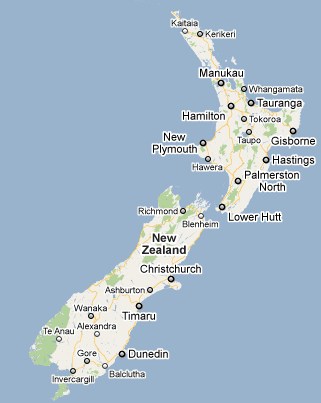
Southern Cross has the monopoly for international fiber connections between New Zealand and the rest of the world.

Three companies — Telecom New Zealand, Verizon, and Optus jointly own the single underseas fiber network that connects New Zealand with the rest of the world.  Unless a second underseas fiber provider provides competition, the monopoly control on international connectivity may guarantee New Zealand an ultra fast fiber broadband network for domestic use, but leave consumers heavily usage-capped and subjected to monopoly price-gouging for international traffic.  Those are the claims of Sam Morgan, a venture capitalist and philanthropist who advises Pacific Fibre, the company that wants to bring that second underseas fiber cable to New Zealand.

American and Canadian providers routinely point to Australia and New Zealand as examples of countries with usage-caps firmly in place, arguing this provides justification to do likewise in North America.  But usage caps in the South Pacific are a product of international capacity shortages — a problem not found in either the United States or Canada, so their claims have no merit.

Morgan explores the implications of a second fiber cable reaching New Zealand — the imminent removal of the hated Internet Overcharging schemes.  The clip comes courtesy of TV New Zealand.  (17 minutes)

New Zealand’s National Fiber Network Teaches Important Lessons for North American Broadband

Phillip Dampier May 30, 2011 Broadband Speed, Competition, Data Caps, Editorial & Site News, Public Policy & Gov't, Rural Broadband, Telecom New Zealand, Video Comments Off on New Zealand’s National Fiber Network Teaches Important Lessons for North American Broadband

New Zealand’s forthcoming transformation to fiber-based telecommunications infrastructure has some important lessons to teach those interested in improving broadband in North America.

While Ottawa and Washington depend on the private sector to deliver 21st century broadband, other countries are recognizing private providers alone may not be able to deliver the essential networks of the 21st century, especially in smaller communities and rural areas still bypassed by even 20th century broadband.  For Korea, Japan, Australia, New Zealand, Singapore, and beyond — government and the private sector are working together to deliver advanced fiber-optic-based networks that will likely power broadband for at least the next decade or more.  More importantly, they are doing so on terms that best serve the interests of the public, not just a handful of shareholders and investment bankers.

Priority number one is getting advanced networks built.  Marketplace realities, particularly in North America, constrain private companies from taking risks on fiber networks that will take more than a few years to realize a healthy return on investment.  Without that essentially-guaranteed payback, many providers refuse to think in terms of “revolutionary” broadband, relying on incremental “evolutionary” upgrades instead.  That formula has also allowed many providers to ignore rural America, deemed too costly to wire.

In a country like New Zealand, these rules also apply, but in spades.  Not only do Kiwis face a broadband experience that resembles service offered in the U.S. a decade ago, they are also punished by a lack of international capacity.  With just one international provider delivering nearly all of New Zealand’s connectivity with the United States and beyond, prices are high and data caps are low.

Domestically, many Kiwis have traditionally had just one realistic choice for broadband service — Telecom New Zealand’s DSL technology.  Although competitors have been allowed to resell DSL service over Telecom’s network, the limitations of the technology remain a constant problem for every provider on that network.

New Zealand has decided the best way to handle these challenges is to transform the telecommunications foundation across the country, starting with a new public-private fiber broadband network.  NZ’s National Broadband Plan, dubbed “Ultra Fast Broadband,” establishes as its foundation the principle that broadband is too important to allow the country to languish waiting for private providers to step up.

Rosalie Nelson from IDC – the independent market intelligence advisory service, explores the pro’s and con’s of a nationwide fiber network for New Zealand.  But it’s a lesson not just applicable to broadband in the South Pacific.  Stop the Cap! is sharing this video seminar with our own Viewer’s Guide to help draw parallels to broadband closer to home. As an added bonus, you will come to understand different broadband technologies we regularly discuss.

[flv width=”640″ height=”380″]http://www.phillipdampier.com/video/IDC Ultra Fast Broadband.flv[/flv]

IDC analyzes New Zealand’s new Ultra Fast Broadband — National Fiber Network in this seminar with Rosalie Nelson.  It’s definitely a long view, but you will gain enormous insight into the challenges of delivering the next generation of broadband, not only in New Zealand, but in other countries around the world.  (39 minutes)

Stop the Cap! Viewer’s Guide

To help draw comparisons with broadband in the South Pacific with that in the United States and Canada, we bring you this viewer’s guide to follow as you watch.

Part One

Nelson

In part one, Nelson explores the recent history of telecommunications in New Zealand, particularly focused on Telecom New Zealand, created from the former state monopoly for landlines and data circuits.  Although the company began to open its network to competitors several years ago, the biggest transformation came in the last few years.  New Zealand experienced its own version of the Bell System breakup, only this time that transformation came from the New Zealand government, not the courts.

When complete, what was once a single company became three — one for wholesale access, namely by independent competitors reselling service over Telecom lines, retail — the public face of the company that continues to market service under the Telecom brand to consumers and businesses, and Chorus, the entity that maintains Telecom’s infrastructure.

In North America, the equivalent would be the breakup of AT&T or Bell, with competitors allowed to lease access to their respective networks at prices and terms that could not favor either parent company.

While the debate rages over whether broadband expansion came as a result of Telecom’s breakup, or in spite of it, one thing everyone agrees on: New Zealand is one of the fastest growing broadband markets in the OECD, with a growth rate of nearly 35 percent every two years.

New Zealand’s telecom market is perhaps five or more years behind the United States and Canada.  The rapid erosion of landlines for mobile or Voice Over IP service is only just starting in New Zealand.  Telecom, like many phone companies in North America, still depends on the enormous pool of revenue landline service provides.  Even as landlines decline domestically, phone companies like AT&T, Bell, Telus, Verizon, Frontier, and CenturyLink still treat this revenue as the critical foundation on which other products and services can be offered.  It will be years before this base revenue erodes to the point of irrelevance.
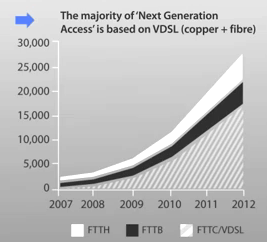
In Western Europe, VDSL has a significant head start in delivering next generation broadband. Similar to AT&T's U-verse or Bell's Fibe network, this technology delivers fiber to the neighborhood, but relies on traditional existing copper wire phone lines to reach individual subscribers.

Telecom is also highly involved in the mobile market.  Just as in North America, when we talk about industry investment in  networks, wireless is usually the largest recipient, sometimes at the expense of the landline network.

IDC, which is independently analyzing New Zealand’s forthcoming transformation to a fiber-based network, is excited about the transformational aspects of such a network, and recognizes public investment may be the only way to execute its rollout in a world where short term results and recouped investment can make all the difference between a green light and a red one among private providers.

Part Two (begins at 7:30)

In the second part of the video, Nelson succinctly explains some of the different technologies we talk about regularly on Stop the Cap!

For instance, most telephone and cable companies both use fiber cables for at least part of their network.  Telephone companies like Frontier use fiber between their headquarters, local exchanges (a/k/a central offices), and occasionally even to remote exchanges, used to reduce the amount of copper wire between your home or office and their exchange.  Many phone companies, including AT&T, use what Nelson calls “cabinets” to contain the interface between fiber and copper networks.

These are often dubbed lawn refrigerators — big four foot metal boxes installed on top of a concrete slab or attached to the side of a telephone pole.  On one end, fiber optic cable from the central office arrives.  On the other, individual copper wire lines exit, connecting to every customer up and down the street throughout the neighborhood.  With additional fiber, phone companies selling DSL Internet access can increase speeds and offer service where it was not available before.  AT&T can use a more advanced form of DSL as a platform for its U-verse service.  Bell’s Fibe service in Canada is another example of this technology in use.  CenturyLink is also deploying it for some of their service areas.

Cable companies use fiber to deliver their signals out to individual towns and parts of cities.  From there, coaxial cable travels to homes and offices, on which we receive television, telephone, and broadband service.  In large parts of Asia and Europe, cable television is much less common than it is in North America, so it’s a technology more unique to North America than to Europe or the Pacific.

Nelson also reminds us fiber is increasingly important for cell phone companies too, which use the technology to support the increasing amount of traffic that passes through cell towers.  Fiber can help keep mobile broadband speeds at a reasonable level during peak usage periods.  Where fiber isn’t available, the maximum amount of data that can travel between the cell tower back to the cell phone company’s data center can be significantly lower.

Nelson’s larger point is that there is a very real cost-benefit analysis to explore when considering whether the next generation broadband network should be 100% fiber-based, such as Verizon’s FiOS network, or a combination of fiber and more economical, already installed copper wire, such as AT&T’s U-verse.  The initial expense of providing 100% fiber, direct to the home, is greater than repurposing part of our existing landline network.  But with current technology, fiber can deliver a faster and more reliable level of service, and is future-proof.  It also requires less maintenance once installed.

Part Three (begins at 16:20)

In the third part of the video, Nelson explores the political landscape in New Zealand, and with some minor differences here and there, the gap between the telecommunications market in Canada and New Zealand is not too different.

Xtra, the ISP owned by Telecom New Zealand, remains the country's largest service provider.

While the United States broke up the Bell System in the mid-1980s, Canada still relies heavily on behemoth Bell/BCE to deliver broadband access throughout the Atlantic provinces, Quebec, and Ontario.  SaskTel and Telus deliver service to central and western Canada.  Cable companies, primarily owned by Rogers, Shaw, and Videotron deliver service in major Canadian cities and nearby suburbs.

In New Zealand, Telecom was the former state-controlled monopoly telephone company.  In recent years, that monopoly has been broken up, but broadband still relies heavily on Telecom’s landline network to deliver Internet access, primarily by DSL.  In the past, Telecom was -the- Internet Service Provider.  But now the company must sell access to their last mile network to all-comers at a regulated wholesale access rate.  Canadians will recognize this kind of wholesale access policy — Bell has one for independent service providers to this day.

In the United States, things are a bit different.  While there are instances of competitors providing DSL through landlines owned by familiar phone companies like AT&T, Verizon, CenturyLink, Frontier, and Windstream, very few customers know about them.  Instead, cable television is the more familiar competitor, and the two players regularly beat each other up in marketing campaigns.  If you ask an ordinary American consumer what companies sell broadband service, they will typically answer with the name of the telephone company and the cable company, if one serves their area.  They are unlikely to answer Earthlink, which sells service over some telephone company and cable lines.

Some of Nelson’s anaysis about the changes in policy relating to the Ultra Fast Broadband network are no longer in effect with last week’s decision to abandon the “regulatory holiday” concept.  The government’s original fiber network proposal has been modified repeatedly to fit into the business realities of the New Zealand ISP market.  Some examples include recognizing the value and importance of the existing copper wire network, which will remain relevant in some rural areas not scheduled for wireless or fiber access — and will of course also be in operation as the fiber network is built.  The government is also trying to promote private investment, and under pressure from large telecom companies, the government in power is looking for ways to assure investors of a return on their investment.  Critics have charged the government leaned too far towards providers in effectively handing them at least eight years of monopoly service under a “regulatory holiday,” without oversight by the all-important Commerce Commission.  A revised proposal seeks to guarantee investors a certain level of return, even if prices drop in the future, but retains regulatory oversight.

Big Phone Companies...

This policy is unique to New Zealand, and has not been tried in North America.  Canada’s national broadband plan is long overdue and the one in the United States relies on some government stimulus money to incrementally expand broadband in unprofitable rural areas, but relies mostly on private providers for the bulk of the expansion.  The Federal Communications Commission is exploring revamping its rural subsidy currently charged to every telephone line in the United States with the hope of diverting money to broadband development in rural areas.  Private providers are expected to upgrade their networks through private investment for most of the rest.

New Zealand is proposing a totally new way of delivering broadband service with the establishment of an independent company responsible for the fiber network — a company not affiliated with any Internet Service Provider.  That would make Telecom New Zealand no more or less important than any independent provider.  Each ISP will succeed or fail based on price and value-added services, because the basic network experience is likely to be the same regardless of the provider selected.  Some may deliver speed boosting features or sell content to customers.  Others may deliver cheaper, slower speed plans for budget-minded customers.  Some might even bundle free tablets or computers in return for fixed-length contracts.

But Nelson explains there is a risk.  Once a fiber network is in place, it effectively becomes a utility, and it may or may not be able to earn sufficient revenue to embark on innovative new technologies that venture capital might otherwise afford.  Because of market dynamics, for the same reason very few North Americans cities have more than one cable and one phone company, investors are unlikely to pour money into a competing technology if a fiber network is dominant.

...Often Think and Act Alike...

For a legacy phone company like Telecom, past regulatory requirements are also under review at the request of the telephone company.  Telecom argues if a national fiber network is to be established, Telecom should be freed of its regulated responsibility to continue investing in its copper network, and the facilities used to support it.

This is similar to arguments AT&T and other phone companies have been making in their efforts to secure deregulation at the state level, for but different reasons.  AT&T, as an example, argues that their aging copper wire network and its upkeep is a responsibility it agreed to in a different era, when landline service was ubiquitous and virtually everyone had a traditional phone line.  Phone companies argue that as landline disconnections accelerate, the regulatory responsibilities assigned to it are no longer fair, and requires the company to continue investing capital in a network fewer and fewer customers are using.  They argue investments would be more appropriately spent building next generation broadband and wireless networks.

AT&T might have a point, except for the collateral damage impacting rural customers, which AT&T may decide to abandon for the same reasons the company uses when it won’t provide broadband in rural areas — return on investment considerations.  Those investments AT&T seeks to make would disproportionately benefit urban customers, at the expense of rural ones.

Part Four (begins at 29:15)

In the fourth part, Nelson explores the impact of the fiber project on Telecom, which is considering restructuring itself to compete under the new broadband model.

Nelson argues the company’s revenues are expected to be flat in the near future and predicts Telecom will be forced to begin a cost-cutting program, simplify its business, and target growth areas.  Nelson ignores the most common strategies providers have used in this arena, however.  In addition to job cuts, the other common way to increase revenue is to raise prices. Chorus, which administers Telecom’s broadband network, is the only real money maker inside Telecom these days, and that comes from broadband demand.

...Even When They Are Thousands of Miles Apart.

Nelson, like investors, opposes anything resembling a price war in New Zealand, one that could come as copper-based DSL providers slash prices to remain competitive with service on the much faster (but likely more expensive) fiber network.  She sees such competition as a “war of attrition” where shareholder value is lost, along with incentives for further private investment.

Nelson’s final question ponders whether Telecom, still a dominant player in the New Zealand market, has the ability to change and adapt fast enough to the country’s fiber network.

Conversely, we wonder if Telecom will attempt to throw up roadblocks in an effort to curtail the new network as a defense strategy against those required changes to its business model.

We also wonder how much return on investment will be sufficient for investors.  For some, anything short of “the sky is the limit” may fuel investment of a different kind — into special interest campaigns and lobbying to ensure there is no limit on the money they can earn from a network that could have a monopoly position in the marketplace.


 

Cable Lobby Pays for Research Report That Miraculously Agrees With Them on Rural Broadband Reforms

A research report sponsored by the National Cable & Telecommunications Association, the nation’s largest cable lobbying group, has concluded that millions of broadband stimulus dollars are being wasted by the government on broadband projects that will ultimately serve people who supposedly already enjoy a panoply of broadband choice.

Navigant Economics, a “research group” that produces reports for its paying clients inside industry, government, and law firms, produced this one at the behest of a cable industry concerned that broadband stimulus funding will build competing broadband providers that could force better service and lower prices for consumers.

  • More than 85 percent of households in the three project areas are already passed by existing cable broadband, DSL, and/or fixed wireless broadband providers. In one of the project areas, more than 98 percent of households are already passed by at least one of these modalities.
  • In part because a large proportion of project funds are being used to provide duplicative service, the cost per incremental (unserved) household passed is extremely high. When existing mobile wireless broadband coverage is taken into account, the $231.7 million in RUS funding across the three projects will provide service to just 452 households that currently lack broadband service.

Navigant’s report tries to prove its contention by analyzing three broadband projects that seek funding from the federal government.  Northeastern Minnesota, northwestern Kansas, and southwestern Montana were selected for Navigant’s analysis, and unsurprisingly the researcher found the broadband unavailability problem overblown.

The evidence demonstrates that broadband service is already widely available in each of the three proposed service areas. Thus, a large proportion of each award goes to subsidize broadband deployment to households and regions where it is already available, and the taxpayer cost per unserved household is significantly higher than the taxpayer cost per household passed.

The cable industry funds research reports that oppose fiber broadband stimulus projects.

But Navigant’s findings take liberties with what defines appropriate broadband service in the 21st century.

First, Navigant argues that wireless mobile broadband is suitable to meet the definition of broadband service, despite the fact most rural areas face 3G broadband speeds that, in real terms, are below the current definition of “broadband” (a stable 768kbps or better — although the FCC supports redefining broadband to speeds at or above 3-4Mbps).  As any 3G user knows, cell site congestion, signal quality, and environmental factors can quickly reduce 3G speeds to less than 500kbps.  When was the last time your 3G wireless provider delivered 768kbps or better on a consistent basis?

Navigant also ignores the ongoing march by providers to establish tiny usage caps for wireless broadband.  With most declaring anything greater than 5GB “abusive use,” and some limiting use to less than half that amount, a real question can be raised about whether mobile broadband, even at future 4G speeds, can provide a suitable home broadband replacement.

Second, Navigant’s list of available providers assumes facts not necessarily in evidence.  For example, in Lake County, Minnesota, Navigant assumes DSL availability based on a formula that assumes the service will be available anywhere within a certain radius of the phone company’s central office.  But as our own readers have testified, companies like Qwest, Frontier, and AT&T do not necessarily provide DSL in every central office or within the radius Navigant assumes it should be available.  One Stop the Cap! reader in the area has fought Frontier Communications for more than a year to obtain DSL service, and he lives blocks from the local central office.  It is simply not available in his neighborhood.  AT&T customers have encountered similar problems because the company has deemed parts of its service area unprofitable to provide saturation DSL service.  While some multi-dwelling units can obtain 3Mbps DSL, individual homes nearby cannot.

Navigant never visited the impacted communities to inquire whether service was actually available.  Instead, it relied on this definition to assume availability:

DSL boundaries were estimated as follows: Based on the location of the dominant central office of each wirecenter, a 12,000 foot radius was generated. This radius was then truncated as necessary to encompass only the servicing wirecenter. The assumption that DSL is capable of serving areas within 12,000 is based on analysis conducted by the Omnibus Broadband Initiative for the National Broadband Plan.

Frontier advertises up to 10Mbps DSL in our neighborhood, but in reality can actually only offer speeds of 3.1Mbps in a suburb less than one mile from the Rochester, N.Y. city line.  In more rural areas, customers are lucky to get service at all.

Cable broadband boundaries were estimated based on information obtained from an industry factbook, which gathered provider-supplied general coverage information and extrapolated availability from that.  But, as we’ve reported on numerous occasions, provider-supplied coverage data has proven suspect.  We’ve found repeated instances when advertised service proved unavailable, especially in rural areas where individual homes do not meet the minimum density required to provide service.

We’ve argued repeatedly for independent broadband mapping that relies on actual on-the-ground data, if only to end the kind of generalizations legislators rely on regarding broadband service.  But if the cable industry can argue away the broadband problem with empty claims service is available even in places where it is not (or woefully inadequate), relying on voluntary data serves the industry well, even if it shortchanges rural consumers who are told they have broadband choices that do not actually exist.

Navigant’s report seeks to apply the brakes to broadband improvement programs that can deliver consistent coverage and 21st century broadband speeds that other carriers simply don’t provide or don’t offer throughout the proposed service areas.  The cable industry doesn’t welcome the competition, especially in areas stuck with lesser-quality service from low-rated providers.

Search This Site:

Contributions:

Recent Comments:

Your Account:

Stop the Cap!