Home » Broadband Speed » Recent Articles:

Australia to Retire Its Copper Wire Network, Going Fiber to the Home Nationwide

Phillip Dampier June 27, 2011 Broadband Speed, Community Networks, Data Caps, Optus (Australia), Public Policy & Gov't, Rural Broadband, Telstra, Video Comments Off on Australia to Retire Its Copper Wire Network, Going Fiber to the Home Nationwide

Australia’s march towards an all-fiber future took an important step last week when the government announced a wide-ranging agreement with Telstra, the country’s largest phone company, to use Telstra’s existing infrastructure to help construct a national fiber network.

After two years of negotiations, Australian Prime Minister Julia Gillard on Thursday announced an $11 billion deal between Telstra and NBN Co to allow NBN to use Telstra’s existing conduits, poles, and network facilities to provide a foundation for the construction of the all-fiber network and the removal of existing copper wiring.

The deal is expected to save the government millions by not having to construct redundant facilities.

The network is expected to take a decade to complete, and will provide optical fiber broadband to at least nine out of ten Australian households.  The project will make Australia a global broadband leader, far ahead of the United States and Canada and most of western Europe.

As part of the deal, Telstra agreed to pay $2 billion for upgrades to its own infrastructure in preparation of migrating customers to the NBN.  Telstra’s CEO, David Thodey, said the agreement ended the uncertainty surrounding Telstra’s possible association with NBN and will allow his company to focus on customer service.

Gillard and Communications Minister Stephen Conroy turned on Australia’s first connection to the NBN in May at the Presbyterian Ladies College in Armidale in the east Australian state of New South Wales.

The town is one of five test markets where the NBN will first operate.  Areas in Melbourne, Townsville, coastal New South Wales and South Australia will also be switched on in coming months.

[flv width=”512″ height=”308″]http://www.phillipdampier.com/video/Nine Network NBN Switched On 5-11.flv[/flv]

Nine Network in Australia covered the opening of the country’s National Broadband Network in Armidale earlier this year, and what it means for Australians as fiber broadband replaces older technology.  The opposition gripes the government is spending too much on the network.  (7 minutes)

Turnbull (Courtesy: A. Carr)

Liberal opposition to the NBN has been fierce in some quarters, with Opposition communications spokesman Malcolm Turnbull claiming the government is overspending on a network that delivers fiber straight to the home.  Gillard accused the conservative opposition of seeking to rip installed fiber straight out of the ground if they were to come to power, a charge Turnbull rejects as ridiculous.


He prefers a “fiber to the neighborhood” approach, similar to AT&T U-verse, which he says will bring good enough speeds to Australians faster and cheaper than an entirely fiber based network would.  But fiber proponents claim the costs will come down as the network construction ramps up, delivering economy of scale.  The government also believes fiber to the home is more upgradable and more reliable than a hybrid fiber-copper network.

Most of all, Australians are celebrating the imminent end of usage-based pricing, fair access policies that reduce speeds of heavy users to near-dial-up, and the fact they are likely to be among the top-five ranked broadband nations globally when the network is complete.

[flv width=”640″ height=”500″]http://www.phillipdampier.com/video/Sky News ABC NBN and Telstra Achieve Deal 6-23-11.flv[/flv]

Sky News and ABC report on the government’s deal with Telstra to retire the nation’s copper wire network and work together to build fiber to the home to virtually every Australian. (7 minutes)
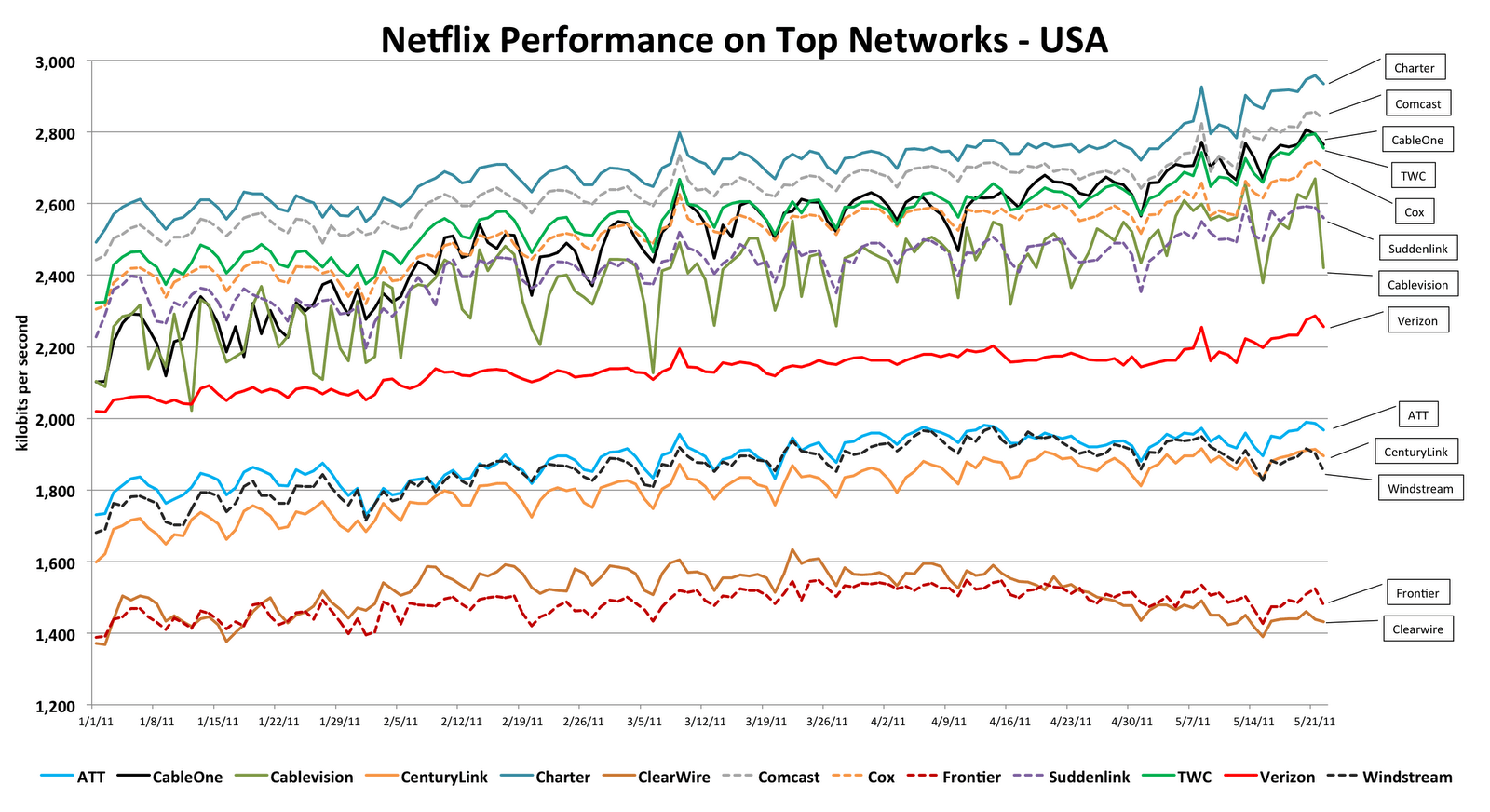

Frontier: America’s Worst Wired ISP for Netflix Viewing (Second Time Winner!)

Click to Enlarge

Frontier Communications’ DSL service delivers abysmal results for customers looking for quality time with Netflix.  For the second quarter running, the independent phone company’s ability to keep up with Netflix’s high quality video is about on par with a garden slug in a triathlon — yes, it may eventually reach the finish line, but you’ll be dead before it happens.  Even more embarrassing for Frontier, their service is occasionally beaten by Clearwire, a wireless ISP with a bandwidth throttler that can reduce your online experience to the painful days of dial-up if deemed to be using “too much.”

“Frontier sucks,” writes Stop the Cap! reader Doug in Charleston, W.V. “After they took over where Verizon fled, my ability to watch Netflix online became a source of endless frustration, so now I limit myself to mailing DVD’s back and forth.”

Remarkably, Charter Cable, which does poorly in customer satisfaction surveys, is again the runaway winner, followed by Comcast, the heavily usage-capped Cable One, Time Warner Cable, and Cox.  Verizon and AT&T only deliver middling performance.

Bright House Says No to Internet Overcharging: No Caps – Not Even Under Consideration

Phillip Dampier June 23, 2011 AT&T, Broadband Speed, Data Caps, Online Video, Verizon 1 Comment

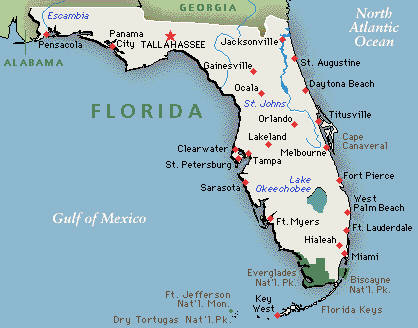
Bright House Networks, a cable company primarily serving Florida and other southeastern states says it has no plans to implement Internet Overcharging schemes like usage caps or consumption billing.  But a company spokesperson went even farther, telling Tampa Bay Online the cable company was not even considering them.

Bright House, which relies on Time Warner Cable’s programming negotiators and sells broadband under the Road Runner brand, was among the only companies in Florida that was willing to go on record stating they were not considering limiting broadband customers.

Other providers were unwilling to follow Bright House’s lead:

  • AT&T: “2 percent of our customers were using 20 percent of our bandwidth,” said an AT&T spokesman, so the company slapped 150GB usage limits on DSL customers, 250GB on U-verse customers.  The overlimit fee is $10 for every 50GB extra.
  • Verizon Florida: “At this point, we’ve not implemented any usage controls or broadband caps.  We’ll continue to evaluate what’s best to ensure our customers get the highest quality broadband service for the best value,” the company said.  But it also added: “We’re continuing to evaluate usage-based pricing for our wireline broadband customers.”

“Bandwidth caps stifle consumer choice,” said Parul Desai, public policy counsel for Consumer’s Union.  Desai notes customers do not sign up for pricey high-speed FiOS broadband service from companies like Verizon just to read e-mail.  Customers who are willing to pay premium prices for super high speeds certainly don’t want a usage cap devaluing their broadband package.

Comcast, for example, uniformly limits consumption to 250GB per month, even on high speed plans delivering over 50Mbps service.

“It’s like building a rocket that you blow up after it reaches 250 feet into the air,” says Stop the Cap! reader Will in Tampa, who shared the article with us.  “What is the point of having 50 or 100Mbps service from any provider if they slap a limit on it like that.”

Will thinks customers will abandon higher speed packages in droves once they realize they really can’t use them.

“With some of these companies talking about caps around 40GB per month, you can’t even take your connection for a test drive,” he says.  “You might as well stick with basic speeds, just to remind and discourage you from putting yourself over their stupid limits.”

Desai suspects broadband companies will try limiting their customers, if only because they face few competitors consumers can use instead and they have video services to protect.  But she suspects some consumers will either abandon or seriously downgrade their broadband service and find other ways to trade large files and content.

“It’s not inevitable they’re going to succeed,” she told TBO. “People only find value in broadband because of what they can access with it. If more people feel constrained, they’ll start looking for another way.”

Upgrades: Exponential, Not Incremental Deliver Biggest Bang for the Buck, Says Internet Pioneer

Cerf

Vint Cerf understands the Internet.  Widely recognized as one of the two “fathers” of what eventually grew into today’s Internet, Cerf has watched a network launched by the United States Department of Defense grow into an economic powerhouse driving a knowledge-based economy.

Today, Cerf works as an Internet evangelist for Google, promoting the company’s innovation in the next generation of the broadband experience.  He brings decades of advice to Internet Service Providers the world over: upgrade your networks.  But more importantly, he told attendees of Juniper Network’s Nextwork conference, upgrade exponentially, not incrementally.

Cerf’s remarks Wednesday targeted the conundrum of coping with increasing video traffic on the Internet.  Cerf pointed to his employer’s construction of a gigabit fiber to the home network in Kansas City as the best antidote to traffic congestion.

Simply put, Cerf believes bandwidth must be increased exponentially and not through incremental upgrades that try and stay one step ahead of demand.  Google intends to prove gigabit fiber broadband is cost-effective and within reach of providers.  A side benefit of building next generation networks is the opportunity for innovating new online applications.  Many of tomorrow’s online innovations are simply impossible on a constrained, incrementally upgraded network that often requires accompanying traffic limiting schemes.

“When you are watching video today, streaming is a very common practice. At gigabit speeds, a video file [can be transferred] faster than you can watch it,” Cerf said. “So rather than [receiving] the bits out in a synchronous way, instead you could download the hour’s worth of video in 15 seconds and watch it at your leisure. It actually puts less stress on the network to have the higher speed of operation,” he said. 

Wu

So far, many providers are considering Netflix and other video traffic a threat to their networks, and are attempting to collect tolls to allow Netflix content to reach subscribers (Comcast), or are considering Internet Overcharging schemes that combine usage caps with overlimit fees to discourage customers from watching too much (AT&T, Time Warner Cable).

At another session held Tuesday, Tim Wu, Columbia University law professor noted efforts by several U.S. providers to do away with all-you-can-use broadband.

Wu said phone companies like AT&T are ideally looking towards replicating the cell phone model on broadband — leaving users to guess how much usage they will rack up over a month, knowing most will be wrong.  As the consumer, he noted, you end up buying too much or you face steep overlimit fees for underestimating usage — either way “you are screwed.”  Wu called consumption-oriented pricing “abusive.”

Wu also said wireless carriers in particular are uneasy with the open, “ownerless” concept of the Internet.  Their instinct is to own, control, and manage networks.  Their only success so far is trying to advocate for fast, premium-priced traffic lanes, and slow “free lanes” for everything else — a key reason why many consumers advocate to preserve the open model of the Internet through enforced Net Neutrality.

Wu called these efforts by phone companies to control traffic “dangerous.”

New Legislation Targets Inflated Wireless Speed Claims: 4G Means Anything Carriers Want

Phillip Dampier June 22, 2011 Broadband Speed, Consumer News, Public Policy & Gov't, Wireless Broadband Comments Off on New Legislation Targets Inflated Wireless Speed Claims: 4G Means Anything Carriers Want

Rep. Anna Eshoo

Legislation forcing carriers to tell the truth about their 4G wireless speeds is scheduled to be introduced today in Congress by its author and chief sponsor, Rep. Anna Eshoo (D-Calif.)

The Next Generation Wireless Disclosure Act would require carriers to disclose the minimum data speed of their respective networks and better explain plan pricing and coverage.  While many consumers believe “4G” means vastly superior speeds and performance, in reality some wireless carriers have labeled even incremental network upgrades as delivering “4G” service, even if speeds are only incrementally better.

“Consumers deserve to know exactly what they’re getting for their money when they sign-up for a 4G data plan,” said Rep. Eshoo. “My legislation is simple – it will establish guidelines for understanding what 4G speed really is, and ensure that consumers have all the information they need to make an informed decision.”

Specifically, the legislation would provide consumers with the following information at the point of sale and in all billing materials:

  • Guaranteed minimum data speed
  • Network reliability
  • Coverage area maps
  • Pricing
  • Technology used to provide 4G service
  • Network conditions that can impact the speed of applications and services used on the network.

The legislation also requires the Federal Communications Commission (FCC) to evaluate the speed and price of 4G wireless data service provided by the top ten U.S. wireless carriers in order to provide consumers with access to a side-by-side comparison in their service area.

“Consumers want faster, more reliable wireless data service, and I look forward to working with industry and consumer groups to achieve this goal,” Eshoo added. “We need to enhance transparency and ensure consumers are fully informed before they commit to a long-term service contract.”

The bill faces tough prospects in the Republican-controlled House of Representatives, and industry groups are likely to oppose the measure.  Eshoo has tangled with both in the recent past as a prominent supporter of Net Neutrality.

Search This Site:

Contributions:

Recent Comments:

Your Account:

Stop the Cap!