Home » Broadband Speed » Recent Articles:

Bait & Switch Broadband? Time Warner Cable Advertises 30/5Mbps for Austin Last Week, Delivers 20/2Mbps This Week

Phillip Dampier July 5, 2011 Broadband Speed, Consumer News 14 Comments

Time Warner Cable customers in Austin, Tex. excited to learn DOCSIS 3 speed upgrades have finally arrived in the state capital are less than thrilled to learn the rug has been pulled out from under some of the high speeds the company was promising customers just one week earlier.

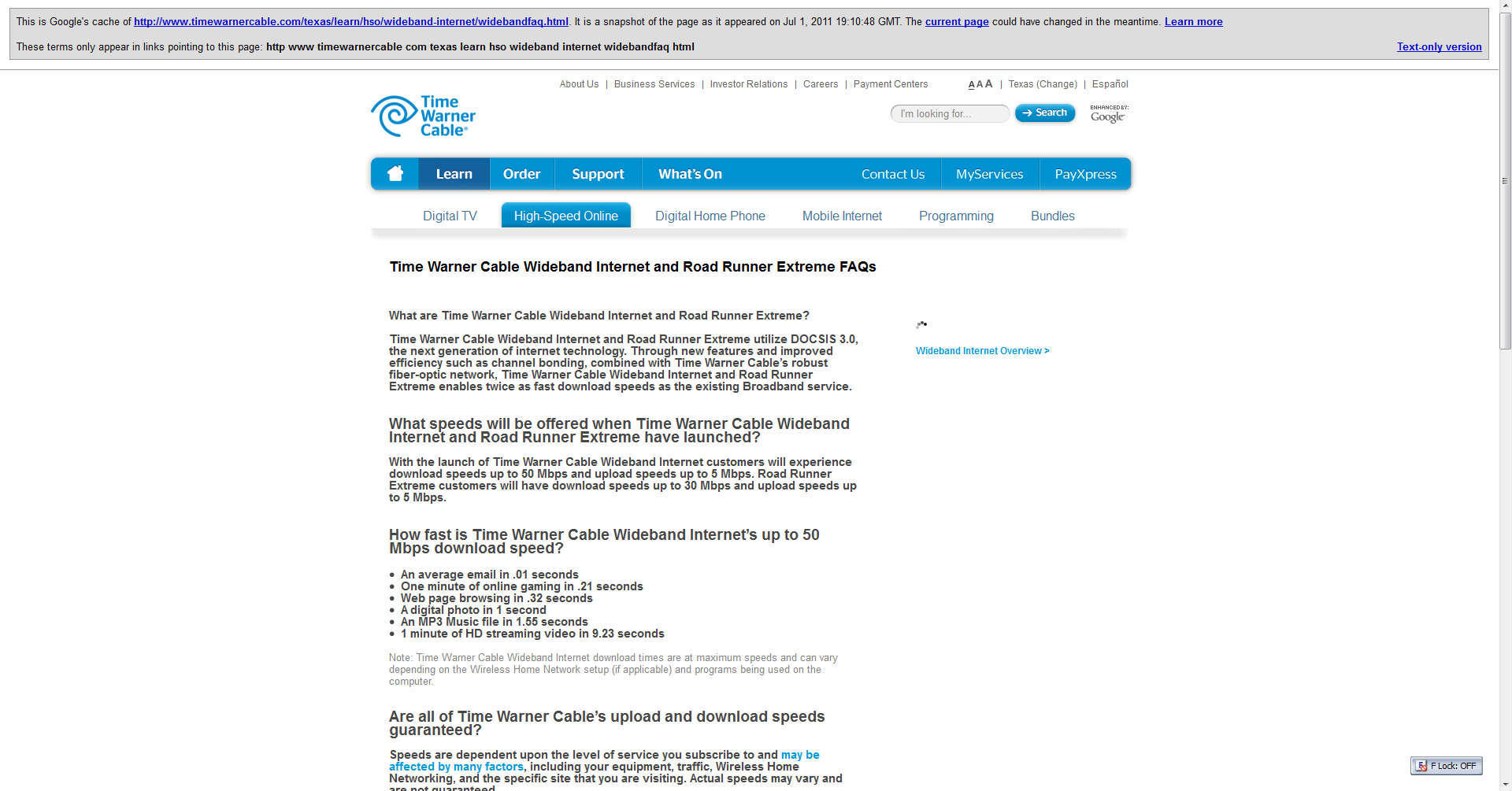
At issue is Road Runner Extreme, the DOCSIS 3 upgrade that delivers faster speeds at a “sweet spot” price of just $10 more than Road Runner Turbo.  In most Time Warner Cable markets, Road Runner Extreme delivers 30/5Mbps service, and so it was to be for Austin customers as well:

Captured from Time Warner Cable website - July 1, 2011 (click for screenshot of entire web page)

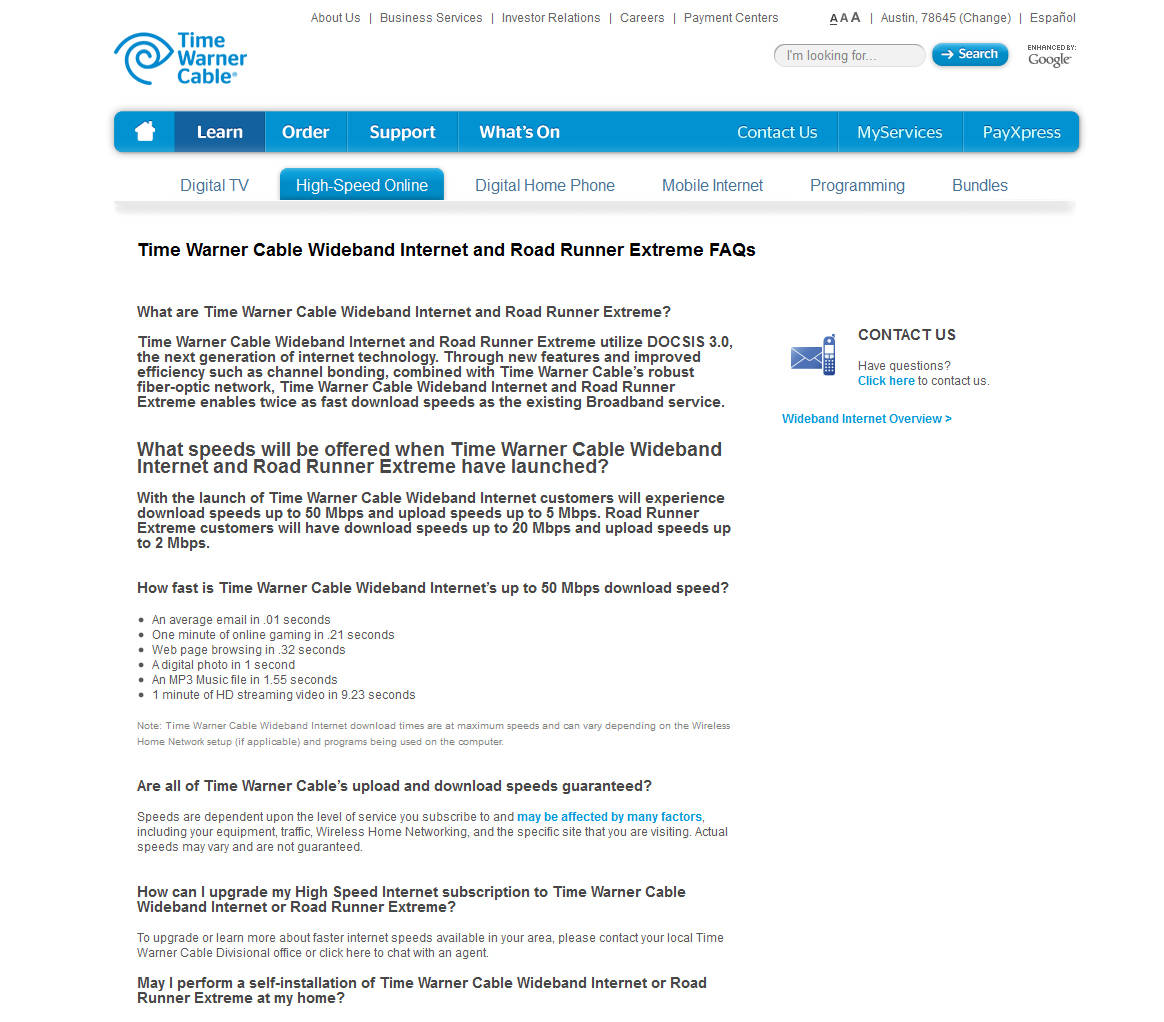
But Broadband Reports reader “SunnysGlimps,” who signed up for Extreme expecting those speeds, discovered “bait and switch” broadband instead, as the resulting speed test (and subsequent advertising) showed a much less impressive 20/2Mbps result.

“I was actually getting faster speeds with the Turbo then I am now with the capped Extreme package,” says Sunnysglimps. “My speed clearly hits a cap when it goes to 20/2Mbps on speedtest.net.”

This reader feels Time Warner Cable is engaged in false advertising in Austin.

“You cannot advertise 30/5Mbps, sell the service, charge more, and then change your advertising a few days later and say it won’t be what you just purchased.”

Captured from Time Warner Cable website - July 5, 2011 (click for screenshot of entire web page)

What Will Help Drive Australia’s Adoption of Mega-Fast Broadband? Pornography

Phillip Dampier July 4, 2011 Broadband Speed, Community Networks, Online Video, Public Policy & Gov't Comments Off on What Will Help Drive Australia’s Adoption of Mega-Fast Broadband? Pornography

While Australian officials promote the noble aspects of its new fiber-based National Broadband Network to power commerce, health care, and education, one content and applications developer says the prospect of improved “adult entertainment” options will drive demand for fiber broadband adoption in Australia, just as it has in many other countries.

Jennifer Wilson, project director for The Project Factory, took discussions about the decidedly-adult topic of online content private to be certain it did not overshadow the more virtuous-aspects of the fiber network.

“The single most important factor is the porn factor because pornography has always been at the cutting edge of technology,” Wilson said. “If we cannot get porn on the NBN than we will have trouble getting consumer acceptance and uptake.”

Australia is just starting a debate about the appropriateness of adult entertainment on a publicly-owned network — a debate familiar to community broadband providers who face scrutiny over adult video content often found on municipally-owned cable systems.

Access to adult content and keeping it away from children is now evolving into a secondary debate about the NBN, and some politicians are considering placing adult content controls on the network.

For Wilson, that would be a major mistake.
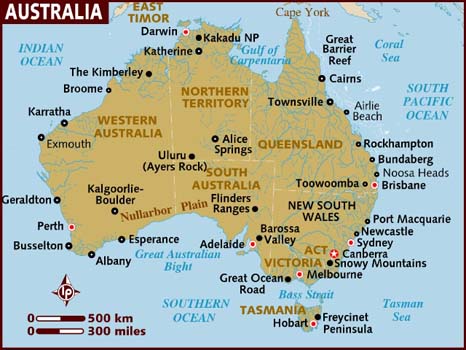
Speaking at an Australian Computer Society (ACS) forum in Sydney, Wilson said giving parents the tools to control viewing options was perfectly appropriate, but a national policy banning pornography on the NBN would be a disaster.  Wilson believes adult content has always “stimulated” digital growth, and even, in her view, forced a final decision on which high definition DVD format would become the primary standard — Blu-Ray or HD.

“The main reason Blu-Ray took off was because the adult entertainment industry chose the format over HD,” Wilson said. “No one is going to install the NBN on the basis that one day they might need e-health services but they will use that as a justification for getting the service in order to download movies and watch TV.”

Australian technology evangelists of all kinds favor an agnostic approach to content, keeping government out of the viewing rooms of individual NBN subscribers.  Some have gone as far to say adult content will represent an enormous revenue opportunity — one that will help pay off the expense of constructing the network.

That moral dilemma — porn accelerating profit for the NBN, has politicians in a quandary over whether that represents government promotion of adult content for financial reasons.

“Which is exactly why the government needs to stay as far away from this debate as possible,” Jeffrey Maindonald, a Unitarian Universalist tells Stop the Cap! “Give people the tools to make personal decisions for themselves and their families, but stay out of the content and leave that to the authorities when it crosses the legal line.”

Maindonald, a retired minister, accepts adult content has driven everything from home video recording, film cameras, the Internet, and now the possibilities of what can be done with fiber broadband.  For him, it’s an extension of the inevitable debate between “good” and “evil” mankind deals with everywhere else.  Enforcing self-defined moral laws online is a highly subjective business, Maindonald says, one that will simply lead to endless debate and clashes.

“Thankfully, the new network has virtues that extend far beyond a virtual red light district,” Maindonald says, hoping the debate won’t derail the country’s fiber broadband future.

“A colleague of mine, an Anglican archdeacon, told me he was amazed that the most modern technology was being used to still obsess over God’s miracle of the human body,” Maindonald adds. “It won’t stop with the NBN.”


Time Warner Cable Officially Unveils DOCSIS 3 Upgrades in San Antonio; Hill Country Residents Yawn

Phillip Dampier June 30, 2011 Broadband Speed, Competition, Data Caps, GVTC Communications, Rural Broadband Comments Off on Time Warner Cable Officially Unveils DOCSIS 3 Upgrades in San Antonio; Hill Country Residents Yawn

Despite a soft launch weeks earlier, Time Warner Cable officially began selling faster broadband packages in San Antonio Tuesday.

Made possible by DOCSIS 3 upgrades (and not by “Time Warner’s fiber optic network” to quote one San Antonio news outlet), the cable company will now sell 30/5Mbps service for $20 above the current price of Standard Service.  Customers looking for more speed can spend a lot more to get it — $99.95 a month buys you 50/5Mbps service, although the sting seems less if you bundle all of your Time Warner services through their $199 Signature Home package, which includes digital cable, broadband, and phone service.  Signature Home includes 50/5Mbps as part of the package.

About 70 percent of the San Antonio market can get the new speeds immediately.  The rest will be upgraded by September.

The upgrades are seen with some amusement by customers of GVTC, a former telephone cooperative that today provides fiber to the home service in parts of the Texas Hill Country and other rural areas to the north of San Antonio.  They recently received speed upgrades from 40Mbps to 80Mbps downstream and 20Mbps upstream as part of a comparably-priced triple play package.  GVTC’s truly fiber optic system was built to accommodate broadband usage growth.

“Consumers obviously enjoy streaming video and downloading HD movies, but these applications use a lot of bandwidth and can slow down other Internet devices in your household,” CEO Ritchie Sorrells said. “The reality is bandwidth consumption will continue to increase. We’re once again ahead of the curve with our 80 Mbps connection, and this tier will be popular with the growing number of households that realize they have a need for speed.”

One thing GVTC customers don’t need and won’t get is the kind of consumption billing Time Warner Cable is reconsidering for their customers in San Antonio and the rest of the country.

The Broadband Revolution is Postponed; Why America’s Duopoly is Holding Us Back

[flv width=”640″ height=”500″]http://www.phillipdampier.com/video/Engadget Broadband in Europe.flv[/flv]

Rick Karr at Engadget delivers a sweeping indictment of America’s broadband duopoly in a special video presentation that explores Europe’s leapfrog advancements in broadband penetration, speed, and pricing.  It’s all made possible by technology policy.  In Europe, open access is guaranteed.  In the United States, telecommunications companies won the right to keep competitors off their networks.  The result is a staggering decline in America’s broadband ranking, now below Portugal and Italy.  So what happened to let Europe spring ahead of the United States?  Government regulation.

The game-changer in the United Kingdom and the Netherlands has been government regulators who have forced more competition in the market for broadband.

The market in the UK used to be much like ours here in the U.S.: British homes had two options for broadband service: the incumbent telephone company British Telecom (BT), or a cable provider. Prices were high, service was slow, and, as I mentioned above, Britain was falling behind its European neighbors in international rankings of broadband service.

The solution, the British government decided, was more competition: If consumers had more options when it came to broadband service, regulators reasoned, prices would fall and speeds would increase. A duopoly of telephone and cable service wasn’t enough. “You need to find the third lever,” says Peter Black, who was the UK government’s top broadband regulator from 2004 to 2008.

Starting around 2000, the government required BT to allow other broadband providers to use its lines to deliver service. That’s known as “local loop unbundling” — other providers could lease the loops of copper that runs from the telephone company office to homes and back and set up their own servers and routers in BT facilities.

Today, the UK’s broadband marketplace resembles America during dial-up Internet days, when customers could choose from a dozen or more providers and get substantial discounts or service tailored towards specific needs.  Today, that choice isn’t available from cable and phone companies.  There’s typically just one of each, and your practical choices usually end there. Thanks to Stop the Cap! reader Corey for sharing the story with us.

The video lasts 16 minutes.

How Australia Will Shame North America: Fiber Speeds for Them, Overpriced, Slow Cable/DSL for You

Phillip Dampier

While North American ISP’s call 3Mbps DSL “revolutionary” for rural America and dream of Internet Overcharging schemes like usage caps and consumption billing everywhere else, Australia is poised to take broadband to a level North America can only imagine.  Watch this documentary on Australia’s fiber-based National Broadband Network future and how it will transform their economy and culture, and then ponder what your Internet Service Provider is doing these days.

While we scratch our heads wondering how to wire West Virginia for slow speed DSL, Australia is planning to rip out copper wire networks everywhere.  While we fight over communities trying to get their citizens 21st century broadband speeds from community-owned providers private companies want to ban, Australia will deliver the same fiber speeds to 90 percent of the country, whether it’s ‘economically viable’ (to investors) or not.  As we watch a handful of giant telecom companies try to mess with broadband pricing to further increase their profits without delivering any improvements in service, Australia is going to rid itself of artificial limits on broadband usage.

But Australia’s NBN goes much farther than just delivering fast broadband.  It builds a foundation to transform virtually every aspect of Australian life:

  • Rural Australia’s economic viability is guaranteed a future with the availability of fast and reliable broadband for businesses large and small;
  • Telemedicine means patients seeking routine care and follow-ups can conduct them from the comfort of their own homes;
  • Telecommuting means less energy consumption, less traffic, and reduced costs in roadway maintenance as workers do their jobs away from the office without wasting precious time in traffic;
  • Telelearning provides rural students with access to the same high quality education city students receive, and ongoing education can be managed anytime, anywhere, even for those with existing jobs and families;
  • Australian businesses can reach new customers across the world, increasing sales, whether they sell a digital product or one that leverages online shipping and tracking tools to complete delivery anywhere;
  • Millions of Australians will have access to the same high speed broadband, delivering a platform for the development of large-scale, next generation applications that don’t make sense in countries where broadband is a patchwork of speeds, service, and basic availability.
  • It means a broadband network so far advanced above that found across North America, it could change Australia’s standing in global commerce, and impact our own.

Embarrassed yet?  Worried about America and Canada becoming broadband followers instead of leaders?

You should be.

[flv width=”640″ height=”500″]http://www.phillipdampier.com/video/Australia’s NBN June 2011.flv[/flv]

Australia’s National Broadband Network  (38 minutes)

Search This Site:

Contributions:

Recent Comments:

Your Account:

Stop the Cap!