Home » Broadband Speed » Recent Articles:

DSL Threatened by Obsolescence in Asian-Pacific Region; Fiber Broadband Replaces Old School Internet

Phillip Dampier July 11, 2011 Broadband Speed, Competition, Public Policy & Gov't Comments Off on DSL Threatened by Obsolescence in Asian-Pacific Region; Fiber Broadband Replaces Old School Internet

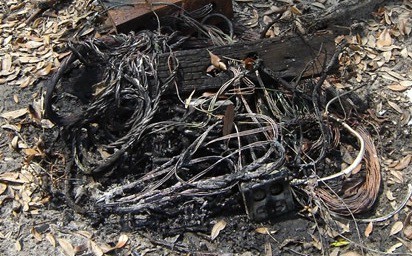
Discarded copper wire

Fixed line DSL service is at risk of obsolescence in Asia and the Pacific thanks to the widespread deployment of fiber optic cable.

According to a report from the industry analyst firm Ovum, fiber broadband will surpass DSL’s market lead in the Asia-Pacific region by 2014.

Study co-author Julie Kuntsler says Hong Kong, Japan, Korea and Taiwan has already achieved more than 25 percent penetration of fiber to the home in those countries, and the People’s Republic of China’s accelerated fiber deployments mean that country is also on track to retire millions of miles of obsolete copper wiring in favor of fiber-delivered broadband.

With China’s enormous population, even today’s small percentage of Chinese citizens with access to fiber, currently 4 percent, still delivers a staggering number of customers now in excess of 74 million.

But fiber broadband growth is not just limited to those countries.  Fiber expansion projects are underway in  Australia, Bangladesh, India, Indonesia, Malaysia, New Zealand, Pakistan, the Philippines, Singapore, Thailand, and Vietnam — growth that will deliver faster broadband expansion than found in North America, where most phone companies continue to rely on traditional DSL, especially in rural service areas.

Factors that help promote fiber broadband deployment include cohesive national broadband policies from governments that insist on more than incremental broadband expansion, financial incentives for providers who install fiber broadband for consumers, and a population that wants fiber-fast Internet speeds.

The Fiber to the Home Council – Asia-Pacific predicts that 129 million customers in the region will dump copper wire DSL for fiber to the premises by 2014. Cable broadband will also increase its market share.  Combined, the two technologies will shove traditional DSL to second place, as the technology is expected to see no market share growth for the foreseeable future.

Canada: Get Off the Internet and Go Outside – You Are the Second Largest ‘Data Hog’ in the World

Phillip Dampier July 7, 2011 Broadband Speed, Canada, Competition, Data Caps, Public Policy & Gov't, Wireless Broadband Comments Off on Canada: Get Off the Internet and Go Outside – You Are the Second Largest ‘Data Hog’ in the World

Toronto

Except for South Korea, nobody uses the Internet more than Canadians.  That’s an important finding in a new report produced for Canada’s telecommunications regulator to better understand the current state of the broadband market in the country.

According to recent reports from the Organization for Economic Cooperation and Development, the country generates 2,288 terabytes of data traffic per month per 100,000 residents.  That’s among the highest in the world and comes from avid web browsing, watching online video, and a love affair with smartphones.

But like many relationships, this one is also expensive.  You pay all of the money you have to spare, and your provider delivers you just enough of a usage fix to keep you from running to Ottawa to demand change.

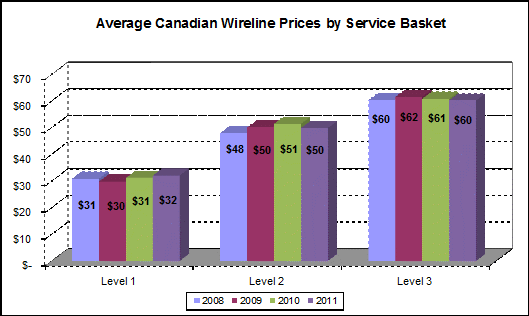
Canadian broadband pricing is in the top third of all OECD-measured nations, with the average price for High Speed Internet running $55.18.  The average median price across all OECD members runs a lot less — $39.23 per month.  If you want to pay less, you have to bundle your landline, cell phone, television, and Internet service with the same provider, or make due with a slow speed “lite user” plan, where average pricing had been running lower until this year.

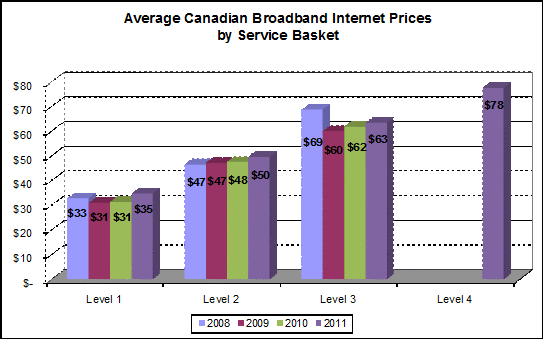
The average monthly price of the Level 1 basket increased to roughly $35 in 2011, up considerably from $31 the previous year.

Similarly, average monthly price of the Level 2 basket increased this year as well to roughly $50, up from $48 last year.  The average advertized download speed of the services included in the Level 2 basket is close to 6.5 Mbps, which is similar to the average speed in last year’s study.

The average monthly price of the Level 3 basket also increased slightly to $63, but still remains well below the 2008 price of $69 per month.  The average advertized download speed of the services included in the Level 3 basket is roughly 14 Mbps, which is slightly higher than in last year’s study (where the average speed was 12.5 Mbps).

Lastly, the average price of the new Level 4 broadband service basket is roughly $78 per month.  The advertized download speeds for the Level 4 broadband services included in the study range from 25 to 50 Mbps – the average is close to 30 Mbps.

Roughly half of the Canadian broadband service plans surveyed for this study included monthly usage caps.  For those that do, they range from 1 to 13 GB on the Level 1 service basket – the average is 7 GB per month.  The range for the Level 2 service basket is from 25 to 75 GB – the average is 55 GB per month.  The range for the Level 3 service basket is from 75 to 125 GB – the average is just over 90 GB per month.  There has been little change in these monthly usage caps, on average, compared to last year.

In the case of the new Level 4 broadband service basket, for those service providers applying data usage caps, the caps range from 75 to 250 GB per month – the average was close to 140 GB per month.

The Canadian pricing and usage study was developed by Wall Communications for the Canadian Radio-television and Telecommunications Commission.  The best news for Canada?  Your broadband pricing remains relatively stable, with some package pricing reducing the cost of the broadband component.  Standalone service appears to have increased in price only slightly in many markets.  Increased foreign investment in the wireless marketplace is shaking up wireless pricing, as the hegemony of Bell, Telus, Rogers, and Quebecor are under increasing competitive pressure.  It’s a much sunnier outlook than what is taking place in the country to your south.

For Americans, pricing is headed in only one direction: up.

All charts courtesy of Wall Communications, Inc.

“The Price is Too Damned High”: Verizon Wireless Customers Revolt on Facebook Page

A Verizon Wireless tweet from this morning welcoming customers to a new era of "wonderful usage based plans."

Verizon Wireless might be regretting having a Facebook page open for comments after users started excoriating the company yesterday, when it first publicly broached the subject of its now-implemented wireless Internet Overcharging scheme.

“The price is too damned high,” exclaimed one customer livid that new customers would pay $30 for just 2GB of data usage (one penny higher than the company’s now-retired unlimited use plan).  “$80 for 10GB?  And I thought AT&T was greedy,” commented another.

Judging from the countless hundreds of negative comments, Sprint is about to have a robust quarter of new customer additions defecting from Verizon.  Sprint retains its unlimited use plans on both its 3G and 4G networks, although the speeds do not compare favorably to Verizon’s LTE/4G network.

Matt Hamann summed up the sentiment of customers who despise usage caps, even if they are currently grandfathered on an unlimited use plan:

Hey, Verizon…I will *never* add another smartphone to my plan until you come up with fairer data prices. $30 for 2GB?? You gotta be kidding! How is this fair? How is it in your customer’s best interests?

Bottom line: IT ISN’T! It’s 90% corporate greed. What’s the best way to get more revenue from customers, huh?

Listen here: I’m already looking for better options. As soon as I find one, I’m gone. And I’ll take every family member and friend that I can along with me.

The best mobile provider you are no more.

Verizon created considerable confusion for their customers by saying nothing until just a day before the new plans took effect.  Although the media has covered the imminent end of unlimited data for over a week, customers have not been notified by Verizon itself, despite one customer’s claim Verizon told him they mailed letters in advance of the plan changes.

As we have reported, those customers with pre-existing unlimited data plans will be able to retain them indefinitely, even if they upgrade to a new phone in the future, and even if they renew their contract.  Only new customers, those changing plans or any new lines added to a family plan will face the “wonderful” tiered pricing Verizon tweeted about this morning.

To commemorate Verizon Wireless’ new mobile data prices, we present a clip from the leader of ‘The Rent is Too Damned High’ party.
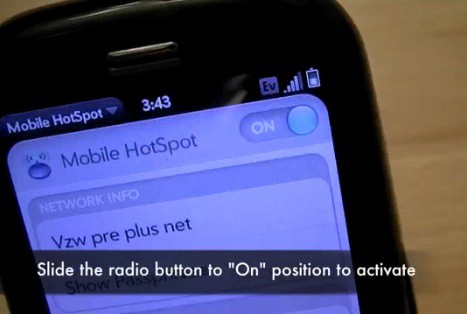
Mobile Hotspot App from Verizon Wireless (Courtesy: Pocketnow.com)

Things got considerably more confusing over the mobile Hotspot feature — a tethering application built into most Verizon smartphones.

Verizon Wireless representatives were sharing conflicting information with Stop the Cap! about the availability and pricing of this feature as late as this morning, but we’re now confident we have an answer the company will commit to for impacted customers.

For 3G Verizon Wireless smartphones, nothing changes.  It was $20 a month for 2GB before July 7th, and remains the same going forward.  For LTE/4G phone owners, things are much more confusing.  Existing customers have been enjoying free tethering on a special promotion made available only to 4G customers for several months now.  That promotion officially ended this morning.  A software update is imminent for 4G phone owners which will remove the free Hotspot feature and replace it with a prompt for one of two options:

  • a $20 for 2GB Hotspot plan
  • $30 Hotspot plan with unlimited usage

Most would be foolish not to lock in unlimited tethering with the $30 plan, which is a much better deal going forward.  Where the confusion comes in is for customers rushing out to upgrade their existing phones to a 4G phone just to lock in unlimited data -and- unlimited Hotspot tethering.

We spoke yesterday afternoon to Verizon Wireless representatives who denied any knowledge of the $30 unlimited tethering plan or confused it with the basic unlimited data plan.  Eventually, we were told only pre-existing customers with already-activated 4G phones would qualify for the option of choosing the $30 unlimited tether plan.  It was too late, even before yesterday at midnight, for others to hop on board this deal.

But by this morning, we were starting to get different answers, culminating in a Verizon representative telling Stop the Cap! any customer who placed an order for a 4G smartphone through Verizon Wireless that invoked a plan change (part of the process of ordering the phone direct from Verizon assures that) would have likely found the addition of the “Verizon Mobile Hotspot Promo” as one of the line items added to your plan as part of the order.  If so, that qualifies you for the $30 unlimited tethering option, even if you are still waiting for your 4G phone to arrive in the mail.

Verizon claims after you receive and activate your new 4G phone, attempts to use the Hotspot feature should offer you the choice for the $30 Hotspot plan.  If it does not, we have the name and contact details of a Verizon employee that should be able to cut through the red tape and get you this plan.  The only requirement is you had to order the phone before midnight on July 7th.

Verizon does not know at this point if customers will be offered the promotional $30 unlimited price for a limited time only, or will forfeit it forever if they do not accept it immediately (or drop the optional add-on at some point).


China Becoming World Leader in Fiber Optics: Explosive Fiber Upgrades Will Overtake All Others By 2016

Phillip Dampier July 6, 2011 Broadband Speed, Competition, Public Policy & Gov't, Rural Broadband Comments Off on China Becoming World Leader in Fiber Optics: Explosive Fiber Upgrades Will Overtake All Others By 2016

The People’s Republic of China will become the world leader in fiber optic network deployment by 2016, with more than 50 percent of all fiber subscribers worldwide residing in the country, according to a new report from research firm Ovum.

The unprecedented growth in fiber networks comes through a combination of government incentives, including subsidies and private-public partnerships, and cooperating Internet Service Providers, who want to reach more customers.

In fact, with the Chinese government aggressively pursuing and monitoring broadband upgrades, China will rapidly exceed broadband deployments found in other countries in Asia, including Korea and Japan.  That could allow China to become the global leader in broadband before the end of the decade.

China Telecom is one of the providers that is moving the country towards dominance in fiber deployments, on track to pass 26 million homes with fiber networks this year.

Through the company’s “Broadband China — Fiber Cities” project, China Telecom should pass 100 million homes with fiber broadband access by 2015, with the help of contractors like Alcatel-Lucent.

In smaller cities and rural areas, combination fiber and copper networks plan to deliver temporary speed upgrades with technology similar to AT&T U-verse. But China sees such upgrades as interim, until additional fiber networks can be constructed.

The upgrades are a win-win for China and its citizens.  China’s telecommunications companies are enjoying new revenue opportunities for their wired networks, Chinese citizens will eventually obtain some of the fastest broadband speeds on the planet, and the Chinese government wins an advanced telecommunications network on which it plans to continue growing the country’s digital economy and helping spur additional manufacturing and export opportunities.

So far, China’s large expanse and large rural, often poor population found further inland are not inhibiting China’s infrastructure development plans.

“You cannot become one of the world’s most powerful nations if you can’t deliver basic services to your own citizens,” says Wu Dan, a development coordinator for the Chinese government.  “With clean water, good roads, reliable power, and advanced telecommunications, China’s western cities will grow and become as important as coastal cities in China’s progress.  Internet access is a part of that progress.”

Bulgaria Getting Fiber-to-the-Home Network – 1 Million Homes Passed By 2014

Phillip Dampier July 6, 2011 Broadband Speed 2 Comments

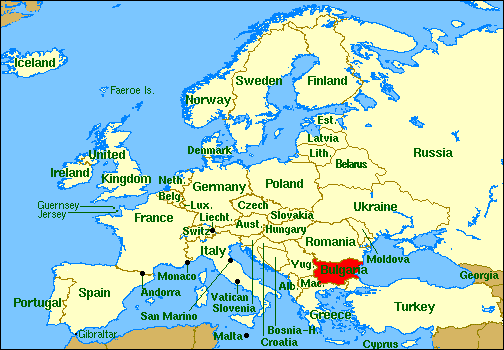
Bulgaria’s capital city, Sofia, will be blanketed in fiber-to-the-home broadband by the year 2014, according to Bulgarian Internet provider EVO.bg.  The company is investing $860 million to roll out its fiber network, which it says will deliver some of Europe’s fastest broadband speeds.

“Our goal is to improve the individual experience and satisfaction of our subscribers by providing new high-quality services, and increasing network capacity,” said Rosen Velikov, EVO chief executive, in a statement.

A significant number of fiber projects in Europe are underway in the east, as countries like Russia, Romania, and the Baltic states of Lithuania, Latvia and Estonia have decided a wholesale upgrade of their communications infrastructure is in order.  Just 20 years ago, some customers waited years for a basic telephone line to be installed.

Today, broadband demand is causing a usage explosion, and companies are upgrading their networks to meet the challenges customers bring.

Nokia Siemens Networks is a major vendor for the project, and is confident Bulgaria’s fiber future will deliver the best possible service for the country’s Internet users.

“Bulgarian citizens demand increased broadband access and new, convergent services – EVO is playing an important role in bridging the broadband gap,” said Nokia Siemens Networks’ head of central-east Europe sales Dietmar Appeltauer.

Search This Site:

Contributions:

Recent Comments:

Your Account:

Stop the Cap!