Home » Broadband Speed » Recent Articles:

Rogers’ Usage Limbo Dance Continues: Company Slightly Raises Cap It Slashed Last Year

Phillip Dampier July 25, 2011 Broadband Speed, Canada, Data Caps, Rogers 9 Comments

Rogers Communications has announced usage cap and speed adjustments for many of its Internet service plans — changes that will bring increased allowances for some of the company’s most premium customers.

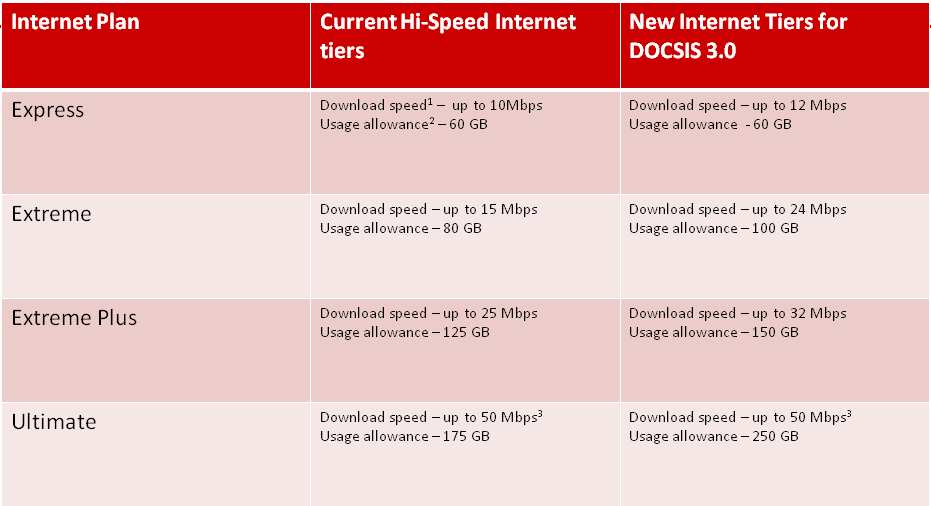
Rogers has modestly adjusted usage caps on its popular Extreme Internet Plan a year after slashing them, and brings dramatic increases for the company’s most expensive service tiers, even as it leaves usage caps unchanged for the bulk of their customers subscribed to the basic Express service plan:
A Rogers spokesman explained the changes.

The bar gets raised only for those who agree to spend more.

“With the rapid rise of online video, social media and online gaming, the way Canadians use the Internet is changing dramatically. We’re always reviewing our plans to ensure they meet your changing needs so starting later this month, our Hi-Speed Internet tiers are being upgraded with faster download speeds and higher data allowances for customers on Rogers DOCSIS 3.0, our best and fastest wireline network,” wrote RogersMarina on the company’s RedBoard blog.

Apparently the way Canadians use the Internet with Rogers’ most-popular Express plan hasn’t changed much, because Rogers leaves that cap unchanged at 60GB of usage per month.  Rogers previously reduced its usage cap for its Extreme level of service from 95 to 80GB, days after Netflix announced it was bringing its streamed video service to Canada.  Rogers’ latest increase amounts to just 5GB more usage than customers had during the spring of 2010.

The increased speeds that some usage tiers are gaining with the introduction of DOCSIS 3 technology come “at no additional cost” according to Rogers, but the company also mentions it charges higher prices — $1.50-$3 more per month — for the required DOCSIS 3 modem.

For customers certain to exceed their allowance, Rogers will sell you an insurance plan to protect your wallet from their $0.50-5.00/GB overlimit fees:

“Also starting later this month, you’ll be able to add a data assurance option if you’re currently using the Express and Extreme tiers. For an extra $20 per month, you’ll receive an extra 80 GB of data on top of your existing allowances. If you don’t need quite as much data, you can also get an additional 20 GB for an extra $5 per month.”

Most customers were not impressed.  Take Matt, for example:

“Speed increases are great but all they allow us to do is to get to our low data caps faster. These days with YouTube, Netflix, VOIP, and work VPN (heavy work from home user) $60 for 100 GB of data is pretty expensive, especially when a GB of data probably costs Rogers pennies per user. Competitors are starting to offer higher data caps for a similar price. In Toronto you can get a plan for same or slightly cheaper starting with 200GB.  In Vancouver you can get 50Mbps for $29 a month with a 400 GB data cap!”

Cambo notes the usage upgrades come easy for higher-priced tiers, but customers on the most popular Express tier have no increase in their usage allowance at all.

“You guys just don’t get it,” he writes on RedBoard.  “Speed isn’t the issue. Usage is. Why is it every tier gets a usage bump except the most popular Express? What is the point of bumping the speeds up and not significantly increasing usage, so we can get to the caps even faster I suppose. Sounds like a ploy to get people to spend more, to me.”

Andrew agreed:

“I also agree with this. I would rather get a larger usage bump than a speed bump — I don’t see a point in raising speeds when the data cap is still extremely restrictive. After all, I’d want to enjoy using the Internet, rather than monitoring my usage restrictions every day. If Rogers really listened to the customers, they’d know that most of us are more critical of their plans’ usage restrictions than their speeds.”


AT&T CEO: “DSL is Obsolete”

Phillip Dampier July 21, 2011 AT&T, Broadband Speed, Competition, Rural Broadband 8 Comments

Rest in Peace, AT&T DSL

AT&T CEO Randall Stephenson doesn’t think much of the company’s largest-reaching broadband product – DSL service, telling an audience at the the National Association of Regulatory Utility Commissioners summer seminar in Los Angeles that AT&T developed DSL mostly to compete with Comcast, but “now that’s obsolete.”

That’s a remarkable admission for AT&T, which continues to provide the bulk of its Internet access to consumers over DSL on its copper-wire telephone network.  Comcast spokeswoman Sena Fitzmaurice, in attendance, promptly tweeted the news to her followers: “AT&T CEO — to chase comcast we built dsl, it is obsolete now”

The story from GigaOm’s Stacey Higginbotham only got stranger when an AT&T spokesperson tried to explain away Stephenson’s careless remarks:

Stephenson was answering a question from an audience member about how state regulators should think about new technology cycles when they are considering things like USF. He said that new technology used to be amortized over a 10-15 year period, but that has shrunk to about 5 years now. He said that DSL was introduced in the 1990s, it has been surpassed in speed by U-verse and Comcast’s DOCSIS 3.0. He also gave the example of deploying 3G in 2006 … and now 5 years later we are rolling out 4G. His point was — new technology is being surpassed by the next generation much quicker than ever before. We have millions of customers using DSL and remain fully committed to the technology — even as we constantly look to bring innovation to the marketplace.

That innovation comes mostly from the company’s more advanced DSL platform U-verse, which is only slowly working its way across urban AT&T service areas.  Unfortunately, that service will not likely be forthcoming for AT&T’s rural landline customers, who will be left with “obsolete” DSL service, if available at all, indefinitely.

With an increasing amount of AT&T’s revenue coming from its wireless division, there is little incentive for AT&T to expand DSL service into areas where it is not already sold.  In fact, most of the company’s landline-oriented lobbying has been directed at allowing the company to abandon its “universal service” obligations to provide decent, basic telephone service in rural areas.  The company has already won that deregulation in several of the states it serves, but has given no indication if and/or when it plans to shut off its landline service.

Landline providers hope American consumers will lead the way, as an increasing number disconnect their home phone lines permanently.

More than half of adults between the ages of 25 and 29 reside in wireless-only homes, according to the Federal Communications Commission.

“The number of Americans who rely exclusively on mobile wireless for voice service has increased significantly in recent years,” the FCC said, citing a January-June 2010 National Health Interview Survey.

Unfortunately, rural Americans overwhelmingly receive broadband over that landline network in the form of basic DSL, usually at speeds of 1-3Mbps.  If that network is discontinued, their opportunity for broadband service goes with it.

Bresnan’s Montana Customers Now Part of Cablevision’s Optimum West

Phillip Dampier July 20, 2011 Bresnan, Broadband Speed, Cablevision (see Altice USA), Consumer News Comments Off on Bresnan’s Montana Customers Now Part of Cablevision’s Optimum West

Cable Montana is now Optimum West, Cablevision’s marketing name for the cable systems it acquired from Bresnan Communications.

Earlier today, customers in Billings, Laurel, Park City and Columbus were able to start using upgraded cable, phone, and broadband equipment on the updated cable system.  More than 2,200 Montanans were introduced to the Optimum name in a mailing sent to neighborhoods where service has been upgraded.  But all of the new equipment that comes with the service has created considerable confusion for long-standing Bresnan customers who have been using older Bresnan equipment for years.

The changes have been overwhelming for those used to Bresnan’s modest level of service for more than a decade.  Cablevision, best known for its Optimum service in suburban New York City, Connecticut, and New Jersey, has brought an enormous increase in programming, and improvements in broadband service, for many customers.

“All existing customers in Laurel, Park City and Columbus will be upgraded to Optimum TV by July 20, which will deliver many more channels, including access to more than 100 channels of free HD (high definition), thousands of titles of video on demand and other benefits like faster high-speed Internet and a better phone service with lower prices and more features than are available from any other provider,” says a Cablevision spokesperson.

When it works properly.

The Laurel Outlook reports some customers frustrated with the changeover have found themselves at local cable stores trying to sort out all the problems:

One Laurel customer installed his modem, but was not receiving service. A visit to the Laurel office did not provide answers to his satisfaction, so he drove to the Billings office on Monad Road, where he received two telephone numbers to call for tech support. He called one of the numbers, followed a menu, and was able to troubleshoot with a technician to get his Internet up and running.

A second customer installed her set-top box but was not receiving Optimum TV channels. She called the 1-800 number provided in the mailing packet, but technicians were unable to walk her through the necessary steps to receive service. Frustrated, she drove to the Laurel walk-in center on West First Street and made an appointment for a technician to come to her home. She discovered that not only must she program her television with the new Optimum channel numbers, she must also program the TV-top box with the correct numbers. After doing so, she was able to receive the new channels.

Many customers are likely going to need to reprogram their televisions more than once.  When the upgrades are complete, Cablevision says it plans to unify channel lineups across the area.

Connected Nation-Affiliate in Ohio Celebrates Broadband Rural Ohio Doesn’t Have

Meigs County, Ohio

Connect Ohio, one of the many state chapters working with telecommunications industry-backed Connected Nation, has released its 2011 Technology Assessment about how the state is adopting broadband technology.

Despite celebrating improvements, large parts of rural Ohio still do not receive any kind of broadband service, especially from the state’s dominant provider AT&T, one of the companies that has traditionally backed Connected Nation.

The friendly relations these broadband groups maintain with their sponsors results in reports that strenuously avoid any direct criticism of providers for ignoring rural Ohio, particularly in the southeastern part of the state where broadband is especially difficult to obtain.

Connect Ohio’s findings, mostly provided by voluntary data from Internet Service Providers and respondents to various surveys, downplays rural Ohio’s broadband drought:

Statewide, 5% of Ohio residents report that broadband is not available where they live, 85% say with certainty that broadband is available, and 10% do not know whether broadband service is available.  By comparison, Connect Ohio’s provider-validated Broadband Service Inventory found that 1.7% of households do not have terrestrial fixed broadband service access.

In rural Ohio, 8% of adults report that broadband service is not available where they live, 79% say with certainty that broadband is available, and 13% do not know whether broadband service is available where they live.  By comparison, Connect Ohio’s provider-validated Broadband Service Inventory reports that 3.7% of rural households do not have terrestrial fixed broadband access.

The disparity in Connect Ohio’s numbers is especially apparent in rural Meigs County, located in southeastern Ohio.

“Geographically speaking, nearly two-thirds of Meigs County does not have easy access to affordable broadband,” Meigs County Economic Development Director Perry Varnadoe told The Daily Sentinel. “In terms of infrastructure, access to broadband is just as important as water and sewer service to businesses.”

Varnadoe thinks the few major providers that do offer service in the county are basically done expanding their service areas, and Varnadoe believes broadband adoption has reached a ceiling in Meigs County.

With much of the county bypassed for DSL or cable modem service, the only exception to this is fixed wireless service from New Era Broadband.  Unfortunately, it’s a costly alternative to traditional DSL.

New Era Broadband of Coolville is a Wireless ISP

New Era delivers up to 1.5Mbps service for $60 a month with a $200 installation fee and a two-year service agreement, and provides service in the vicinity of the community of Racine.

The company is still waiting on a $2.9 million grant to expand service to an additional 3,000 residents, mostly in the area of Five Points, which only has access to dial-up Internet.

Only about half the residents of Belmont, Jefferson, Monroe and Harrison counties have broadband connections at home, the study also found.  The Intelligencer/Wheeling News-Register placed most of the blame for that on residents not being particularly interested in the Internet, but service and cost are likely more important factors, as cable and DSL service is also spotty in those counties as well.  If there is a computer in the home, there is a demand for broadband service, especially in households where children find Internet access increasingly important to complete study work.

For most residents, it has become a waiting game to see who will deliver access, if anyone will.  In most of Ohio, customers look to the phone or cable company for access.  Rural Ohio lacks good cable broadband coverage, and DSL from the phone company first requires an interest in providing the service, and AT&T has not proven to be aggressive in rural communities in the state.

In fact, the phone company has been seeking approval to discontinue providing rural landline service at a time and date of its choosing.  If the landline goes, the chance for wired DSL goes with it.

West Virginia’s Institutional Broadband Funding Scandal: Throwing Money at a Non-Problem

Phillip Dampier July 18, 2011 Broadband Speed, Competition, Frontier, Public Policy & Gov't, Rural Broadband Comments Off on West Virginia’s Institutional Broadband Funding Scandal: Throwing Money at a Non-Problem

Martin

While thousands of West Virginians continue to struggle without any broadband service, the state government is having trouble finding a way to spend up to $40 million in broadband stimulus money on institutional broadband projects that often already have cutting edge fiber networks.

State officials won $126 million in federal stimulus grant money last year, from which the state announced it would lay more than 2,400 miles of fiber optic cable to wire government offices, schools, and libraries.  Now, a vocal critic says a combination of government waste, preferential treatment for the state’s largest phone company — Frontier Communications, and bad planning could leave up to $40 million of the grant money on the table, unspent for better broadband.

Jim Martin, president of business broadband provider Citynet, says the state overestimated the number of public facilities that need broadband improvements.  Many of the facilities involved already have high speed service, and do not require additional infrastructure.  As the grant expires, Martin says he would not be surprised if the state only managed to fund the installation of 300 miles of fiber.

Martin believes funds should be redirected to bolstering the state’s “middle mile” network — fiber infrastructure that would serve as an open network backbone to ensure capacity exists to support growing broadband demands in the state.  Instead, Martin told the Charleston Gazette, the state has been spending money providing fiber broadband to small libraries with fewer than a dozen computers that are unlikely to have the resources to pay the monthly fees Frontier Communications will charge for the service.

“There’s no value to any of this to anyone but Frontier,” Martin said.

In fact, Martin believes many of the current projects funded by taxpayer dollars deliver enormous benefits to Frontier’s bottom line, but only incremental improvement to some institutional users.

Martin claims Frontier has, in some cases, only spent enough money to install fiber from the pole to the building. That assures Frontier of being the only provider that can deliver ongoing service to institutional users.  Martin has a dog in this fight — his company competes with Frontier for business service contracts.

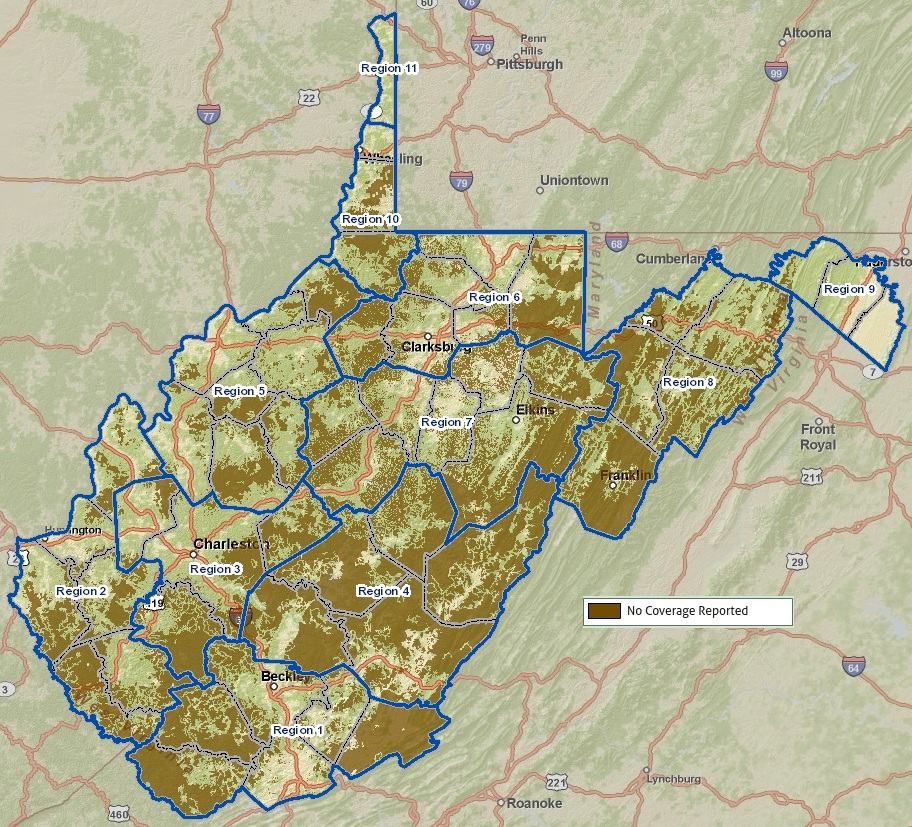
West Virginia's current broadband map shows large areas of the state have access to no broadband at all. (Olive color = No broadband.) (Click to enlarge)

Before the grant expires in February 2013, the state is hurrying to bolster its list of would-be recipients.

Jimmy Gianato, the state’s homeland security chief, said his office recently identified 330 additional “replacement locations” — higher education facilities, schools, health departments and state-owned hospitals — that could be eligible for the project, according to the newspaper.

Not on the list are individual consumers and small businesses who currently do not have access to any broadband service.  One of the ongoing problems of broadband stimulus funding is that public funds are often available to bolster broadband for state and locally-owned institutions, such as government offices, health care facilities, schools and libraries, but no funding to improve infrastructure for individual broadband service for “last mile” users.  This can result in Cadillac-style installations for small schools and libraries who win superb quality networks they ultimately cannot afford to operate on an ongoing basis.  For most, that service would come from Frontier Communications.

Martin already accused the state of investing in more than 1,000 routers without being certain if they were needed or where they would be installed.  At $20,000 each, Martin called the routers “Lamborghinis” and suggested they were largely unnecessary.

Search This Site:

Contributions:

Recent Comments:

Your Account:

Stop the Cap!