Home » Broadband Speed » Recent Articles:

Bragging Rights: Verizon FiOS Will Sell 300Mbps Speeds Others Say You Don’t Need

Phillip Dampier May 30, 2012 Broadband Speed, Competition, Verizon 1 Comment

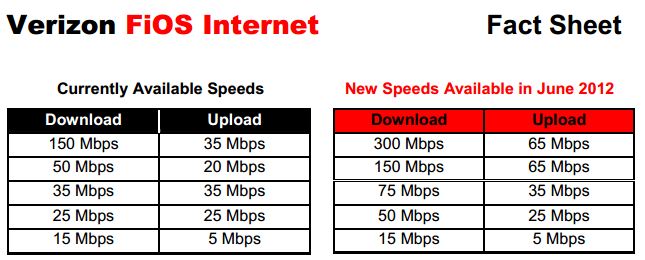
Despite claims from some of their competitors that customers don’t want or need super-fast broadband, Verizon Communications is taking broadband speeds to the new level, upgrading service to as high as 300Mbps in selected areas.

Our friends at Broadband Reports had the scoop on this a few weeks ago, but now it’s official: speed -and- price increases for Verizon are on the way for the company’s fiber optic network FiOS.

Many customers will see their broadband speeds double or more in June. At the same time, the company has been sending out letters informing customers of price increases, often $5 a month for those not locked into service contracts.

Verizon's Speed Upgrade Chart (Courtesy: Broadband Reports)

Verizon’s new top tier of 300/65Mbps will be introduced in areas that have Verizon’s Gigabit Passive Optical Network (GPON). Pricing has not yet been announced.

The company is targeting its speed upgrades to premium broadband customers who subscribe to faster tiers. Customers on Verizon’s standard 15/5Mbps tier will see no changes in service.

Chattanooga’s Gigabit Fiber Network Part of City’s Digital Transformation & Job Growth

Phillip Dampier May 30, 2012 Broadband Speed, Community Networks, Competition, Consumer News, Editorial & Site News, EPB Fiber, Public Policy & Gov't, Video Comments Off on Chattanooga’s Gigabit Fiber Network Part of City’s Digital Transformation & Job Growth

[flv]http://www.phillipdampier.com/video/CNBC Business Booming in Chattanooga 5-29-12.flv[/flv]

While telecom industry-backed groups dismiss community broadband as a waste of taxpayer dollars and an excuse for customers to watch illicit videos and steal content, CNBC reports Chattanooga’s infrastructure improvements, including their gigabit fiber network owned by public utility EPB are contributing to the city’s enormous economic growth and falling unemployment rate. Private companies are pouring into Chattanooga and find a city ready to welcome them and meet their digital needs. Community broadband: a waste of taxpayer money or exactly the right fuel to power American cities into the 21st century digital economy?  (2 minutes)

AT&T Forcing Some DSL Customers to Upgrade to U-verse or Face Service Suspension

Phillip Dampier May 29, 2012 AT&T, Broadband Speed, Competition, Consumer News 6 Comments

Upgrade or else.

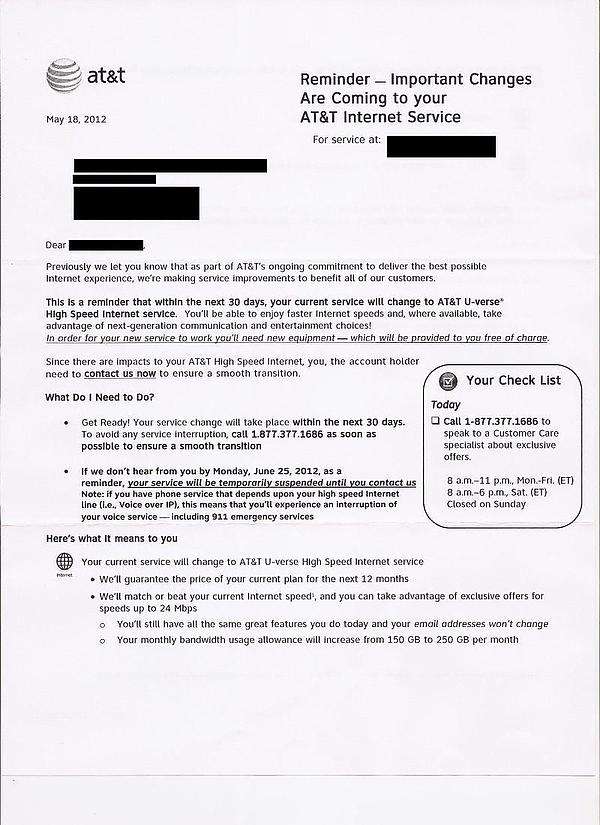
AT&T is now forcing some of their customers relying on the company’s traditional DSL service to upgrade to AT&T U-verse or face service suspension.

The latest customers impacted by AT&T’s forced upgrade are in parts of Connecticut.

“This is a reminder that within the next 30 days, your current service will change to AT&T U-verse High Speed Internet,” reads the letter mailed to customers facing the mandatory transition. Unfortunately, customers have to call AT&T to arrange for new equipment if they want their service to continue uninterrupted — existing DSL modems don’t work with U-verse.

Callers who dial the toll-free number in the letter get to order the U-verse equipment for free, but they routinely endure a hard sales pitch selling U-verse video and phone service as well, at a corresponding higher price. Customers are sent self-install kits at no charge and are offered the same rate they currently pay for DSL, sometimes with faster speeds on the U-verse network. But after one year, regular U-verse prices apply, and they are often significantly more expensive than traditional DSL service.

A Broadband Reports reader in Conn. shared a copy of the AT&T U-verse upgrade letter posted on that site's AT&T forum.

The promotional prices offered to Stop the Cap! reader Ralph were not as good as what he was currently paying for basic DSL on a promotion he purchased earlier.

“I am now paying $14.95 a month under the promotion I am on now and AT&T first tried to sell me a plan that cost $5 more,” Ralph writes. “They quickly agreed to keep my current promotional price after I told them about it, but what they will not tell me is what I will pay after the one year is up, nor can I find U-verse regular pricing on AT&T’s website.”

This special offer bundle comes with a surprise after the promotion ends -- a much higher bill.

AT&T is currently promoting Internet-only promotional pricing as follows: Basic Internet: $19.95, Express Internet: $19.95, Pro Internet: $19.95, Elite Internet: $24.95, Max Internet: $29.95, Max Plus Internet: $34.95, Max Turbo Internet: $44.95. We could not find a disclosure of what the regular prices would be after the one-year contract expired, and that bothers Ralph.

“I realize they are going to match my 3Mbps service on U-verse, but somehow I suspect the regular U-verse price is going to come higher than the DSL service I have been using,” he says.

Ralph’s intuition is correct. Stop the Cap! called AT&T at the number provided on the letter and spoke with a customer service representative at the AT&T Web Sales Center. Although AT&T will ship the required equipment (a wireless router/modem combo) at no charge, AT&T will eventually make that money back charging customers higher prices for Internet service.

Current regular pricing for Ralph’s DSL service after his promotion ends will cost him $24 a month for 3Mbps service.  U-verse charges $38 a month (off promotion) for the same speed service — a $14 monthly difference.

“That sucks,” Ralph said after we shared the news. “Why should I have to change what works fine right now?”

AT&T says keeping DSL in certain U-verse upgrade areas is not possible. In fact, AT&T’s letter warns, if customers do not call to arrange for the U-verse “upgrade” by a certain date, their broadband service will be suspended. That could be a problem for customers who also use their broadband account with an Internet-based phone line.

“There goes 911 or any other emergency calling,” Ralph reminds us. “Thanks, AT&T.”

Some customers who have completed their U-verse upgrade report AT&T messed up their subsequent billing, charging full price instead of an agreed-upon promotion. Slickdeals members report AT&T often requires constant reminding to fix billing errors that generally hand customers higher bills than they expected.

“I am trying real hard to figure out how this represents the ‘next evolution of communications’ AT&T writes about in their letter,” Ralph concludes. “All I am going to eventually get is a much higher bill for a service I don’t want or need. I guess it’s time to call the cable company again.”

Broadband for Rural Minn. Threatened By Diversion of Ratepayer Money to AT&T and Verizon

Northern Minnesota's Paul Bunyan Communications is threatened by FCC reforms that they claim favor larger phone companies.

Northern Minnesotans will have to wait longer for broadband after a telephone co-op announced it was suspending its $19 million broadband expansion project because funding is being diverted to more powerful phone companies like AT&T and Verizon — neither of which have any concrete plans to improve rural wired broadband.

Bemidji-based Paul Bunyan Communications, which serves 28,000 hearty Minnesota customers, has been working on broadband expansion for several years, bringing broadband to customers who have known nothing except dial-up since the Internet age began. Only now the project is threatened because of well-intentioned plans by the Federal Communications Commission to expand rural broadband, but in ways that cater primarily to larger phone companies that lobbied heavily for the changes.

At issue is Universal Service Fund reform, which plans to divert an increasing share of the surcharge all telephone customers pay away from rural basic phone service and towards broadband expansion in rural America.

Paul Bunyan used their share of USF funding to scrap the company’s existing, antiquated copper-wire network in favor of fiber optics. Other phone companies have traditionally used the money to keep their existing networks running. Now the independent phone company says large phone companies like Verizon and AT&T have successfully changed the rules in their favor, and will now benefit from a larger share of those funds, ostensibly to expand broadband to their rural customers.

Bissonette (Courtesy: MPR)

But neither AT&T or Verizon have shown much interest in rural broadband upgrades. AT&T, which recently announced it concluded its U-verse rollout in larger cities, has also thrown up its hands about how to deal with the “rural broadband problem” and plans no substantial expansion of the company’s DSL service.

Verizon also announced it had largely completed the expansion of FiOS, a fiber to the home service. Verizon has also been discouraging customers from considering its DSL service by limiting it only to customers who also subscribe to landline phone service.

Verizon Wireless has introduced a wireless home broadband replacement that costs considerably more than traditional DSL, starting at $60 a month for up to 10GB of usage.

As a result of the funding changes, Paul Bunyan is reconsidering plans to expand its broadband, phone and television services to Kjenaas and about 4,000 other residents in rural Park Rapids and a township near Grand Rapids.

It may also have to cut workers.

“It’s kind of ironic,” Paul Bunyan’s Brian Bissonette tells Minnesota Public Radio. “The mantra of these changes is to create jobs. It’s killing jobs.”

Minnesota Public Radio explores how rural Minnesota broadband is being threatened by a telecom industry-influenced plan to divert funding to larger companies like AT&T and Verizon for rural broadband expansion those companies have no plans to deliver. (May 23, 2012) (4 minutes)
You must remain on this page to hear the clip, or you can download the clip and listen later.

6 University Towns Will Get Gigabit Broadband Through New Public-Private Partnership

Phillip Dampier May 24, 2012 Broadband Speed, Community Networks, Competition, Consumer News, Public Policy & Gov't, Video Comments Off on 6 University Towns Will Get Gigabit Broadband Through New Public-Private Partnership

Six college towns will benefit from the nation’s first multi-community broadband gigabit deployment, thanks to $200 million in capital funding to get the broadband networks off the ground.

The Gigabit Neighborhood Gateway Program leverages local government, universities, private capital, and the public to jointly support and foster the development of new fiber optic networks.

The new program claims it will offer competitively-priced super-fast broadband through projects that will cover neighborhoods of 5,000-10,000 people and communities up to 100,000 in size.  Selection of the six winning communities will be announced between this fall and next spring.

“Gigabit Squared created the Gigabit Neighborhood Gateway Program to help select Gig.U communities build and test gigabit speed broadband networks with speeds from 100 to 1000 times faster than what Americans have today,” the company said in a statement.

“The United States is behind in the world for Internet speed,” said Mark Ansboury, Gigabit’s president and co-founder. “The goal is to help get us out front for a platform of innovation.”

That platform is certainly not forthcoming from the country’s largest broadband providers, who according to Ansboury have been pulling back on wired infrastructure upgrades in recent years, shifting focus to more profitable wireless networks.

Gigabit Squared defines the next generation of broadband Internet in terms of speed, declaring 2,000Mbps (2Gbps) as the target to achieve.

The winning projects will be sponsored by Gig.U members, which include:

  • Arizona State University
  • California Institute of Technology
  • Case Western Reserve University
  • Colorado State University
  • Duke University
  • Florida State University
  • George Mason University
  • The Georgia Institute of Technology
  • Howard University
  • Indiana University
  • Michigan State University
  • North Carolina State University
  • Penn State University
  • University of Alaska – Fairbanks
  • University of Arizona
  • University of Chicago
  • University of Colorado – Boulder
  • University of Florida
  • University of Hawaii
  • University of Illinois
  • University of Kentucky
  • University of Louisville
  • University of Maine
  • University of Maryland
  • University of Michigan
  • University of Missouri
  • University of Montana
  • University of Nebraska – Lincoln
  • University of New Mexico
  • University of North Carolina at Chapel Hill
  • University of Oklahoma
  • University of South Florida
  • University of Virginia
  • University of Washington
  • Virginia Tech
  • Wake Forest University
  • West Virginia University

Blair Levin, executive director at Gig.U, believes private American telecom companies will always be constrained from delivering world class broadband comparable to South Korea or Japan because of Wall Street opposition to the investment required to construct them. In the eyes of investors, today’s slower networks, in their estimation, do just fine.

Gig.U believes that they have a solution, at least for towns with a sizable university system that can serve as host of the next generation broadband network:

First, any community that wants its residents to have access to a network that delivers world-leading bandwidth can do so. The barrier is not technology or economics. The barrier is organization; specifically, organizing demand and improved use of underutilized assets, such as rights of way, dark fiber, or in more rural areas, spectrum. The responses identified a multitude of ways local communities can improve the private investment case by lowering investment and risk, and increasing revenues for private players willing to upgrade or build new networks without budget outlays from the local government.

Second, the responses confirmed that university communities have the easiest organizing task and greatest upside. Their density, demographics and demand make the current economics more favorable for an upgrade than other communities. For example, the high percentage of the population in university communities living in multiple dwelling units makes the economics of an upgrade far more favorable than for communities composed largely of single-family homes. With the growing importance of Big Data for the economy and the society, university communities are the natural havens for such enterprises to be born and prosper. Through the Gig.U process, our communities are already exploring more than a half-dozen paths to achieve an upgrade; paths that will be replicable for others and will deliver a major step forward in providing America a strategic broadband advantage.

Outside of a handful of upstart private competitors like California-based Sonic.net, most fiber broadband expansion come from private companies like Google — building an experimental fiber-to-the-home network in Kansas City, community-owned broadband services coordinated by local town or city government, co-op telecommunications companies owned by their subscribers, or municipal utilities.

While those efforts are typically committed to the concept of “universal service” — wiring their entire communities — the Gig.U project targets funding only for networks in and around university campuses.

The New America Foundation builds on Gig.U’s premise in its own recent report, “Universities as Hubs for Next Generation Networks,” which argues affordable expansion of broadband can win community support when the public has the right to also benefit from those networks. While Gig.U’s approach suggests the project will target fiber broadband directly to the homes qualified to receive it, the New America Foundation supports the construction of mesh wireless Wi-Fi networks to keep construction costs low for neighborhoods targeted for service.

An earlier project in Orono and Old Town, Maine may afford a preview of Gig.U’s vision, as that collaboration between the University of Maine and private fiber provider GWI is already in its construction phase. For those lucky enough to live within range of the fiber project, broadband speeds will far exceed what incumbents Time Warner Cable and FairPoint Communications deliver. FairPoint has fought similar projects (and GWI specifically) for years.

Will private providers object to the Gig.U effort to win local governments’ favor in the six cities eventually chosen for service? History suggests the answer will be yes, at least to the extent local cable and phone companies demand the same concessions for easy pole access, reduced pole attachment fees, and easing of zoning restrictions and procedures Gig.U project coordinators expect.

Levin has stressed Gig.U projects are based on university and private funding sources, not taxpayer dollars. That may also limit how much objection commercial providers may be able to raise against the projects.

[flv]http://www.phillipdampier.com/video/WABI Bangor Orono Maine Getting Faster Service 5-16-12.flv[/flv]

WABI in Bangor previews the new gigabit broadband network being constructed in Orono and Old Town, Maine.  (2 minutes)

Search This Site:

Contributions:

Recent Comments:

Your Account:

Stop the Cap!