Home » Broadband Speed » Recent Articles:

Rogers’ Sticks It to Independent ISPs – Increased Speeds Not Easily Available to Competition

Share and share alike is a concept unfamiliar to Rogers Communications, at least in the eyes of the independent Internet Service Providers who have wholesale bandwidth agreements with eastern Canada’s largest cable operator that are supposed to guarantee speed parity.

The Canadian Network Operators Consortium (CNOC) last week announced it filed a complaint with the Canadian Radio-television and Telecommunications Commission (CRTC) accusing Rogers of withholding speed increases from independent ISPs.

In 2006, the CRTC made it clear that cable companies must treat its wholesale customers fairly:

The Commission determines that should a cable carrier introduce a speed upgrade to one of its retail internet service offerings with no corresponding price change, it is to issue at the same time, revised [third-party ISP access] tariff pages that match these retail service speed changes with no corresponding price change.

According to CNOC, Rogers wants independent ISPs to pay higher prices for the faster speeds it is providing its own customers for no additional charge.

That leaves providers like TekSavvy at a competitive disadvantage, according to the provider.

Peter Nowak explains Rogers is attempting to hurry independent ISPs to move to “aggregated points of interconnection,” part of the foundation of the CRTC’s earlier decision on usage-based billing. Independent ISPs were given two years to complete the transition and Rogers wants that change to move at faster pace:

Rogers wants indie ISPs to move onto the aggregated method, something it says the CRTC essentially ordered at the conclusion of the big usage-based billing fiasco a year ago. Here’s what a spokesperson told me:

We are not denying TPIAs access to our new speeds provided they have moved to a single point of connection, called an aggregated point of interconnection (POI). As part of the usage based billing rulings in November of last year, TPIAs were given two years to move from a disaggregated POI to an aggregated POI. The sooner this happens, the sooner we can provide those speeds to these third party ISPs.  Rogers will continue to provide access at existing speeds on the old network architecture until November 15, 2013.

The dispute, as usual, boils down to whether or not Rogers’ move can be considered anti-competitive. The small ISPs argue that it is, since Rogers’ own retail customers are getting the benefit of higher speeds without higher prices, yet the indie companies – and their own subscribers by extension – are being expected to pay more.

If it’s uneconomical for the indies to sell the faster speeds, they won’t, in which case the big network owners like Rogers will hold a distinct advantage since internet access is sold largely on speeds. Since they’ll simply perish if they can’t keep pace, the indie ISPs will ultimately have no choice but to accept the higher prices being pushed on them – and that effectively neutralizes the entire point of their existence, which is to provide a competitive check to the big guys.

CNOC has asked the CRTC to make an expedited ruling on the controversy as soon as possible to mitigate competitive damage.

Libya, Ethiopia, Rwanda, and Mauritania Have Faster Broadband Than You (Along With Dozens More)

Phillip Dampier November 13, 2012 Broadband Speed, Consumer News, Editorial & Site News Comments Off on Libya, Ethiopia, Rwanda, and Mauritania Have Faster Broadband Than You (Along With Dozens More)

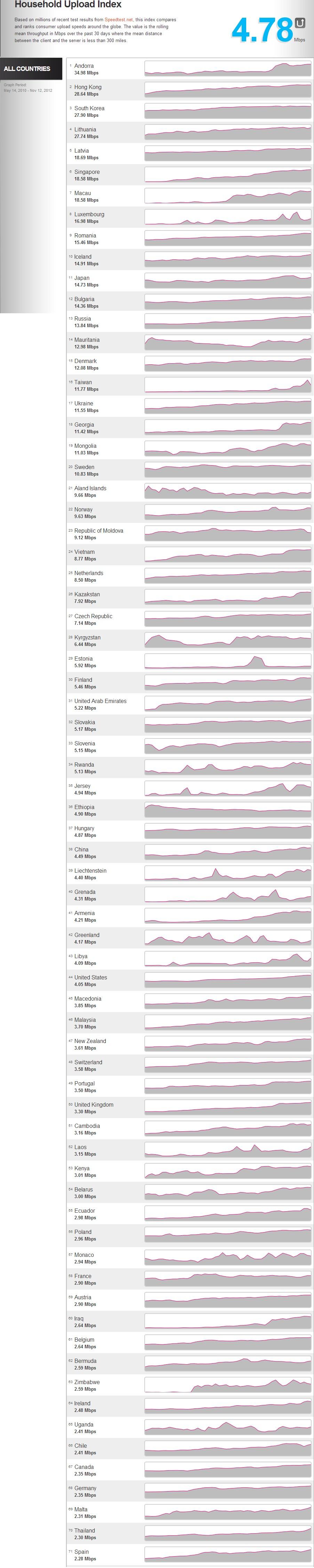
The United States scores 44th (Canada is 67th) in the global upload speed race. North Americans can take a moment (or two… or three… or four) and ponder the meaningfulness of statistics gathered by Net Index that explains why uploading that home movie to grandma last month seemed to take forever. Because it did.

The average upload speed in the United States is an embarrassing 4.05Mbps (and it stings even worse to realize your cable or phone company provider has probably locked you in even slower at 1-2Mbps for uploading content.) Canadian broadband advocates can’t even be seen in public. The country’s comfortable telco-cable duopoly gives consumers in the north just 2.35Mbps for upstream connectivity.

So who among the league of broadband nations has us beat? Countries that have barely survived civil conflicts bordering on all-out war, others plagued with bouts of starvation, and a handful whose currency can be counted into the thousands and it still wouldn’t be enough to buy you breakfast. But they can upload pictures of the restaurant you are not eating at far faster than you can.

CenturyLink CEO Thinks AT&T Has a Tough Road Ahead Cutting Off Rural Landlines

CenturyLink CEO Glenn Post does not think much about AT&T’s plans to shift its most rural landline customers to wireless in its efforts to decommission traditional landline service.

“From a regulatory standpoint, that could be a tough go,” Post explained to Wall Street investors on a conference call last week. “There may be some areas that will have better service with wireless in some ways. As far as a competitive threat, we don’t see that being a real issue for us because just the bandwidth requirements and the limited wireless access or capability in a lot of areas.”

CenturyLink, one of four large independent phone companies and owner of former Baby Bell Qwest, is doubling down on its wired infrastructure to reach customers. The company recently announced Phoenix would be the latest city to get its fiber-to-the-neighborhood service Prism TV — the first legacy Qwest market to get IPTV service from CenturyLink. The service soft-launches in Phoenix this month, with a second city in the region or Pacific Northwest slated to get Prism sometime next year.

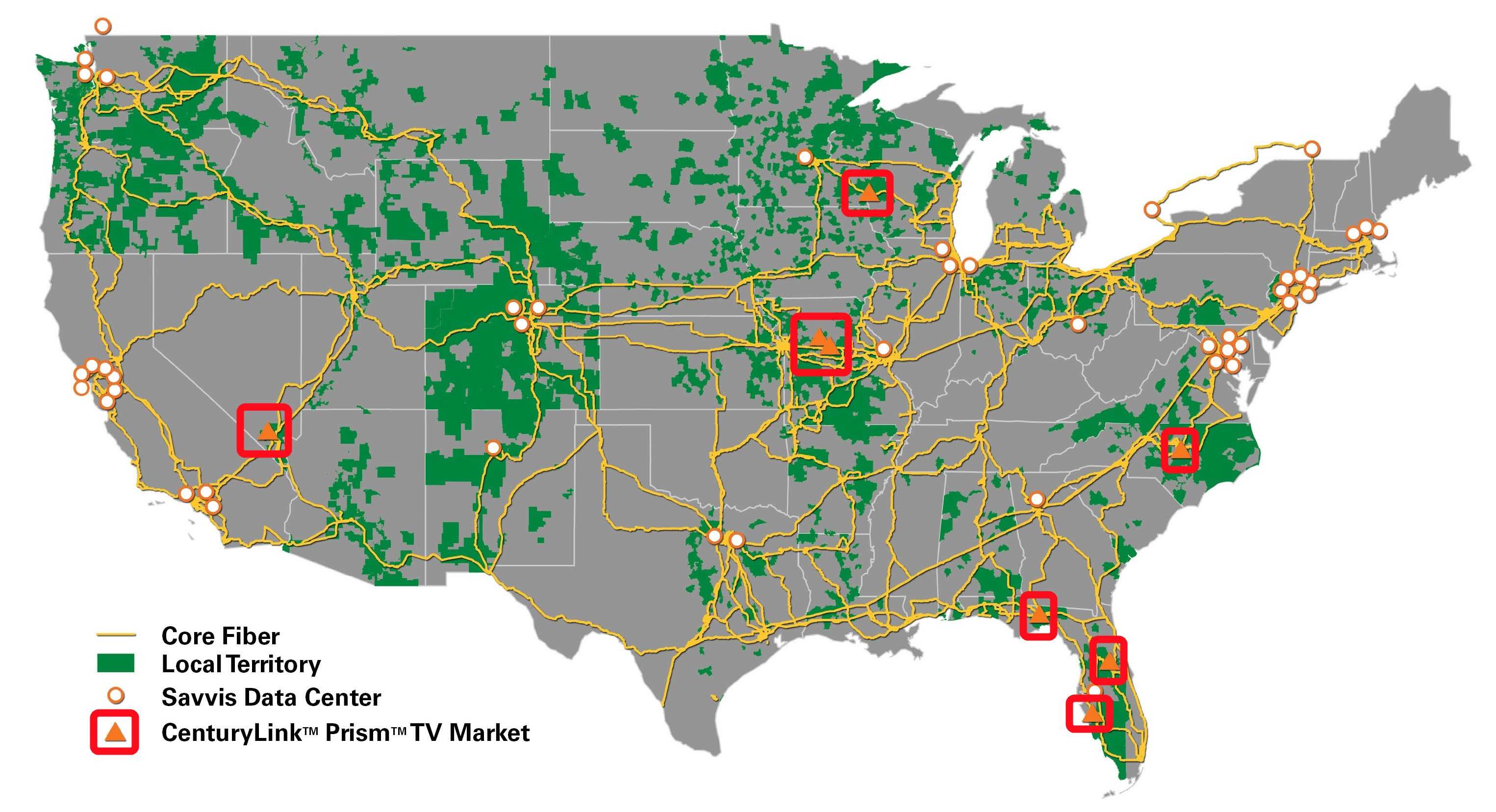
The company has spent much of 2012 investing in broadband, managed hosting and cloud computing for business customers, and fiber expansion to reach more than 15,000 cell towers across CenturyLink’s national service area, depicted in green on the accompanying map.

But CenturyLink executives stress their investments are “strategic” — made in areas that are most likely to deliver quick returns for the company.

While CenturyLink spends money to secure video franchising agreements in metro Denver and Colorado Springs for Prism TV service, it is moving at “a snail’s pace” to deliver broadband service in northeastern North Carolina’s Northampton County. County officials there anticipate CenturyLink will take years to deploy basic DSL service to communities outside and around Conway and Gaston.

The broadband problem in income-challenged parts of North Carolina illustrate the conundrum for county officials, who have to advocate for broadband improvement while combating misleading broadband maps that suggest access is not a problem in the state.

Donna Sullivan with the Department of Commerce notes that broadband maps in states like North Carolina have a census block granularity which does not always reveal the true picture of broadband availability.

“That means if one household in that census block can receive broadband services, the entire census block is considered covered—even though there very well may be households who cannot receive broadband to that location,” she told the Roanoke-Chowan News-Herald.

Northampton County, N.C.

CenturyLink is in no hurry to expand broadband to the 1,921 households in the county of 22,000 who cannot buy broadband service at any price.

Derek Kelly, a CenturyLink spokesman, said the company is working to expand broadband services in the region, but noted the costs to lay down a fiber network to help reach the unserved is “one of the largest costs.”

That cost is much less of a problem if the customer at the end of the line happens to be a wireless company like Verizon or AT&T.

Company officials admit they are spending enormous sums “investing in fiber builds to as many [cell] towers in our service area as economically feasible.” In the third quarter alone, more than 1,000 cell towers received fiber upgrades for a total of 3,300 so far this year. The company hopes to reach 4,000-4,500 cell towers by New Year’s Eve.

The reason why CenturyLink chases wireless business while allowing rural and income-challenged service areas to go without broadband is a simple matter of economics. Cell phone companies sign lucrative, multi-year contracts for fiber connectivity to cell towers to support forthcoming 4G service. In contrast, CenturyLink was surprised to find an astounding 94 percent of families with children in Northampton are qualified for the company’s special Lifeline Program which delivers slow speed, discounted broadband service for families on public assistance.

Post

For CenturyLink’s more urban and prosperous service areas, the news for broadband service improvements is better.

As CenturyLink continues to extend its middle mile fiber network, broadband speeds are gradually improving.

Over 70 percent of CenturyLink customers can receive at least 6Mbps DSL service, more than 57% can receive at least 10Mbps and 29% can access the Internet at 20Mbps speeds or better, according to Post.

But the more urban and prosperous a service area is, the greater the chance a cable competitor has successfully poached many of CenturyLink’s DSL customers with the promise of better speed.

Post said he recognizes the company must do better to remain competitive.

“We’re shooting for 20-25Mbps for a very large percentage of our areas,” Post said. “But with [pair] bonding, we can virtually double the broadband capacity and speeds in our markets. We’re already doing bonding in a number of markets today. So where we have 20Mbps, we could have 40Mbps.”

CenturyLink’s fiber to the neighborhood network, essential where it plans to roll out Prism TV, can also support faster broadband speeds if a customer wants broadband alone and does not care about television service.

Nationwide, the company added 10,000 Prism TV subscribers in the third quarter and has a total customer base of around 104,000 subscribers. But that represents a penetration rate of just over 10%, hardly noticed by still-dominant cable operators.

CenturyLink executives were asked to comment on AT&T’s strategic plan to transform their landline network announced last week in New York. Post found little in common between CenturyLink and AT&T’s vision for the future and does not think the company has to respond to AT&T’s attempt to redefine rural America as wireless territory.

“We don’t see that as a major investment for us or a major risk at this point.”

Time Warner Cable Expands Approved Cable Modems for Purchase List

Time Warner Cable has expanded the list of modems approved for customer purchase. Buying your own cable modem will exempt you from the company’s $3.95/month modem rental fee, applicable to all but customers on special promotions or the elite Signature Home tier.

The Motorola SB6121 ($79) is back on the approved list, although customers intending to aggressively upgrade speeds as Time Warner introduces faster tiers may be happier with the Motorola SB6141 ($99), which supports more bonded channels than its lesser counterpart. The models from Netgear and Zoom were undistinguished in customer reviews — the Zoom for a noticeable number of reports complaining about the product’s short longevity and the Netgear for compatibility issues, poor quality control, and irritating customer/technical support.

Stop the Cap! continues to recommend the Motorola SB6141, which delivers top-rated performance and is future-proof with support for up to eight bonded data channels — 300Mbps service. Although still expensive on Amazon.com, increased competition has dramatically cut pricing on eBay at “Buy It Now” prices ranging between $86-100 at time of writing. This means no bidding hassles, no upfront sales tax, and free shipping for most buyers. The Motorola 6141 is what we use here at Stop the Cap!, acquired from an eBay vendor for $99. Now you can do even better.

APPROVED MODEMS FOR PURCHASE

Turbo, Extreme and Ultimate Service Plans

Vendor Model
Motorola SBG6580
Motorola SB6121
Motorola SB6141  Recommended
Netgear CMD31T
Zoom 5341J

Lite, Basic and Standard Service Plans (Some units listed below only support DOCSIS 2, recommended only if you are on a strict budget and don’t plan future speed upgrades.)

Vendor Model
Motorola SB5101
Motorola SB5101U
Motorola SBG901
Motorola SBG6580
Motorola SB6121
Motorola SB6141  Recommended
Netgear CMD31T
Zoom 5341J

Frontier’s Top Priority: Growing Revenues; Eliminating “Unnecessary Credits, Discounts”

Despite making revenue growth the top priority at Frontier Communications, the company still managed to lose 3% in year over year revenue as another 51,800 customers pulled the plug on their Frontier landline and slow DSL service.

Frontier’s latest quarterly earnings showed a net income rise to $67 million, a major improvement over $20.4 million earned during the same quarter last year. The earnings improvement comes from reduced operating expenses, down 12 percent to $977.3 million and rate increases for certain Frontier markets in less-competitive areas.

Frontier CEO Maggie Wilderotter told investors the company has been reviewing accounts obtained from Verizon Communications, scrutinizing for “unnecessary credits, adjustments, and discounts, ” and systematically eliminating them.

“We’ve got a number of [ex-Verizon] customers that have been with us at a very, very, very low price point; they’ve been on promotions,” said Donald Shassian, Frontier’s chief financial officer. “They’ve been in existence for years and never got curtailed. And once we converted [those customers] onto [Frontier’s billing system], we identified those.”

Frontier’s plan for future growth is a temporary transition away from expanding broadband service into unserved areas, instead focusing on speed upgrades and service improvements where Frontier already serves.

Frontier: Speed upgrades “help dispel the myth that DSL technology cannot keep up with customer demand.” Faster speeds support IPTV as well.
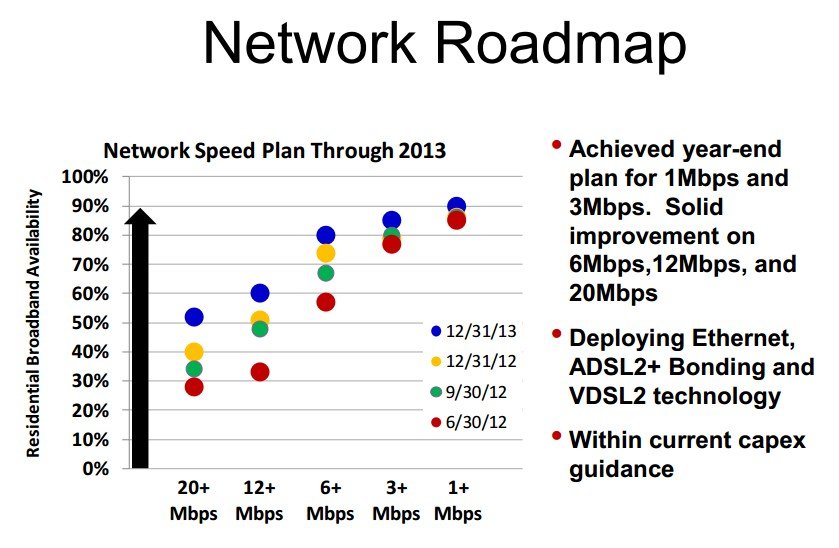
Frontier has targeted investment on improving speeds and network capacity for customers currently stuck with 1-3Mbps traditional DSL service. Frontier is using its fiber-based middle mile network and more advanced forms of DSL to dramatically increase broadband speeds. According to company officials, 64% of Frontier’s exchanges are now equipped with VDSL2, with speeds up to 40Mbps. At least 73% have equipment capable of bonded ADSL2+ with speeds up to 20Mbps. The target for Frontier’s fastest speeds are commercial customers. By the end of this year, 71% of Frontier’s exchanges will support carrier Ethernet service up to 1Gbps for business accounts.

Most Frontier residential customers will see more modest speed improvements. During the third quarter, Frontier expanded its higher speed offerings with more to come:

  • 20Mbps service is now for sale in 34% of its national service territory. By year end, 40% will have access and 52% by 2013;
  • 12Mbps service is now available to 48% of its network footprint. By the end of the year, 51% of homes will have access and 60% in 2013;
  • 6Mbps is now available to 67% of Frontier-served homes, with 74% expected by year end and 80% by 2013.

“We’re seeing 100Mbps delivery in vendor labs and that should be a reality in the next 12 months in our markets,” Wilderotter said. “This should help dispel the myth that DSL technology cannot keep up with customer demand.”

Wilderotter noted that the latest network upgrades might eventually support television service.

“We think we have the opportunity to offer an IPTV-type service in many of our markets, to many of our customers,” said Wilderotter. “In our labs, we’re doing some experimentation on the DSL platform with certain types of technologies that compress the data stream, so we could actually offer a very good video experience at 6Mbps or above. We’ll be doing some experimentation with that in 2013.”

New Products, More Simplified Pricing, Bigger Promotions

To better compete with cable, Frontier has simplified many of their broadband packages, eliminating the modem rental fee and other hidden surcharges for customers. Wilderotter noted the cable industry has recently started to “nickle and dime” customers with modem rental fees and surcharges, something Frontier has also charged customers in the past.

Frontier is now staking a position in simplified pricing.

“So when a customer gets a quote of $39.99 for broadband, it includes the modem, it includes surcharges, it includes everything,” Wilderotter explained. “So they’re not surprised when they get their bill. And we think that’s a huge value selling point for our product set.”

But simple pricing is not always lower pricing.

Increases in broadband service pricing, a hike in the Subscriber Line Charge, and other surcharges introduced for departing customers helped add to the company’s bottom line. But Frontier insists it adjusts rates only after considering the competitive environment.

“You don’t necessarily see us do price increases on broadband across the board,” explained Shassian. “We also believe that the price increases should be associated with increased value to the customer, too. So in some cases, it’s incremental speeds and capability.”

In an effort to upsell current customers, and even more importantly “win back” those who left, Frontier has introduced an aggressive new promotion that will reward subscribers with up to a $450 Apple gift card when committing to a new two-year contract. The value of the gift card ranges depending on how many services a customer chooses.

Stop the Cap! found Frontier pitching a triple play promotion in Tennessee for $87.99 a month with a $450 Apple gift card for new or returning Frontier customers. The bundle includes 6Mbps DSL, Frontier residential phone service with features and long distance service, and DISH Networks’ America’s Top 120 satellite service.

But there is fine print, including a two year service agreement with a $400 early termination fee for phone and broadband service, a DISH cancellation fee of $17.50 for each month remaining in a two year contract, at least $85 in “setup fees,” a $9.99 “broadband processing fee” if a customer disconnects service, and an online bonus credit a customer has to remember to request within 45 days of service activation.

Other Frontier Developments This Quarter

  • Frontier began deploying the FCC Connect America Fund proceeds during the quarter to bring broadband to 92,877 new Frontier homes;
  • A wireless partnership trial with AT&T began on October 8 in Washington and Minnesota. The discounted package bundle is only available to customers who also maintain Frontier broadband service;
  • Over 203,000 Frontier customers signed up with legacy partner DirecTV saw their satellite service unbundled from their Frontier bills this quarter. Frontier chose DISH Networks as its satellite partner back in 2011, and the company has encouraged its old DirecTV customers to consider switching to DISH;
  • Business customers constitute 52% of Frontier customer revenues. Frontier expects more than 66% of total customer revenue to come from broadband service;
  • Frontier’s Simply Broadband, a broadband-only product, used to include a free landline. Not anymore;
  • Frontier will begin accelerating promotions for its Apple Store gift card starting this week;
  • Hughes Net Satellite service was integrated into Frontier’s systems and is pitched to customers as Frontier Satellite Broadband. It will be targeted to 750,000 households that cannot access wired broadband service from Frontier.


Search This Site:

Contributions:

Recent Comments:

Your Account:

Stop the Cap!