


Home » Broadband Speed » Recent Articles:

John Malone’s Vision of Cable’s Future: Mergers/Acquisitions/Bring Back the ‘Cable Mafia’

Time Warner Cable and Cablevision customers may one day end up as Charter Cable customers if John Malone has his way.

Time Warner Cable and Cablevision customers: Is Charter Cable in your future?

The best way the cable industry can grow revenue in the lucrative broadband business is to bring back the same type of collusion and control cable companies maintained over video programming 20 years ago.

Dr. John Malone did not want to sound nefarious in his recent interview with CNBC’s David Faber, but the new part-owner of Charter Communications has built a reputation as cable’s Darth Vader over the last 30 years. His detractors consider his way of doing business akin to a nationwide cable mafia, complete with exclusive, non-competitive territories that assure operators can charge sky-is-the-limit prices.

Malone is now back in the cable business in a big way, and analysts expect he will quickly amass influence in an industry he once led as CEO of the nation’s then-largest cable operator — Tele-Communications, Inc. (TCI).

[flv]http://www.phillipdampier.com/video/CNBC Malone is Back Into Cable 4-13-13.mp4[/flv]

Why is John Malone back in the cable business and why buy a piece of Charter Cable? Malone tells CNBC’s David Faber Charter is a company with enormous growth potential through mergers and acquisitions. CNBC says Malone could be targeting Time Warner Cable and Cablevision for acquisition by Charter as early as next year. “There is consolidation yet to be done,” Malone hints.  (7 minutes)

Malone notes the cable industry is on the cusp of transformative consolidation through collaborative agreements, mergers, and outright acquisitions both here and abroad. CNBC speculated that could begin with efforts to further reduce the number of cable operators in the United States, perhaps beginning with a deal by Charter Communications to acquire both Time Warner Cable and Cablevision, which could combine under Malone’s stewardship and Charter’s executive leadership to “compete” with Comcast.

Dr. John Malone

Dr. John Malone

CNBC reporters note Malone has high praise for Thomas Rutledge, CEO of Charter Communications. Rutledge’s earlier experience working for both Time Warner Cable and Cablevision could be an asset in combining all three companies into one. Analysts speculate such a deal could be pitched as early as 2014 when Time Warner Cable will undergo a management makeover with the departure of CEO Glenn Britt. CNBC also noted Cablevision’s imminent sale has been rumored for years, and current leader and family patriarch Chuck Dolan is 87 years old. With cheap credit and Malone’s business savvy, both companies could find themselves part of a Malone-engineered takeover that would vastly expand Charter Communications into the second largest cable operator in the country.

Malone sees the days of traditional cable television coming to an end as consumers turn to “over the top” online video for an increasing share of their viewing time. As cable television rates continue to increase, customers are cutting the cord. Malone believes today’s bloated cable packages are ripe for an upheaval from a-la-carte pricing or theme-based programming bouquets that break expensive sports programming or movie channels out of the traditional basic cable lineup. Malone even suspects a challenge to the industry’s current price models could surprisingly come from the programmers themselves.

Sports networks will be among the first to notice their affiliate revenue collected from cable and satellite companies (and passed on to customers in the form of higher rates) will stagnate as customers drop cable television. Declining viewer ratings also mean lower ad revenues. Malone believes at some point sports teams and/or programming networks will decide that the biggest barrier to winning new viewers is the $70-80 asking price for basic cable. If sports programmers find they can reach new audiences selling their programming online, direct-to-consumer, for $5-10 a month, the basic cable all-for-one-price model will quickly collapse.

“As the cable guys and the satellite guys start to lose customers to the over-the-top guys, some of those economics will be reflected back on the sports guys,” Malone said. “They’ll start losing advertising revenue. They’ll lose affiliate revenue. And they have to face reality that maybe you need to segregate your market like everybody else.”

[flv]http://www.phillipdampier.com/video/CNBC Malone on Unbundling Cable 4-13-13.mp4[/flv]

John Malone predicts the demise of the traditional bundle of cable television programming within five years. The future is streamed video online, declares Malone, so it is important the cable industry move to manage that competitive threat by acquiring streaming competitors or launching their own services to assure video programming revenue can be protected.  (5 minutes)
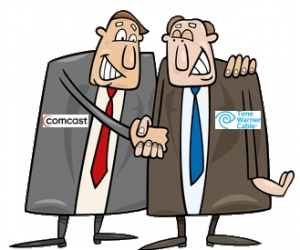
non competeMalone sees the future sustainability of the cable industry dependent on the high revenue broadband business.

“I think it is at a point in history when the most addictive thing in the communications world is high-speed connectivity,” Malone told CNBC. “Everywhere in the world that we operate, we’ve just seen the public want more and more data rate. Whether it’s wireless or wired. There’s a big appetite for it. Cable technology right now is the most cost-effective way to deliver that growth in speed.”

Malone believes there is also plenty of room for revenue growth and cost-cutting, which he said can best be accomplished by getting other cable operators together to “cooperate” and “coordinate” broad scale broadband projects that counter competitive threats from third parties.

Malone helped pioneer the cable industry business practice of “don’t compete in my backyard and I won’t compete in yours,” an informal agreement among operators to stay within their own specific territories, safe and secure from competition. In the 1980s and 1990s, Malone’s TCI was one among many cable operators buying and swapping cable systems to build large, regional system “clusters” where only a single cable company provides service, winning economy of scale and a formidable presence that discouraged other wired competitors from entering the business. In most cities, only the deep pockets of AT&T (U-verse) and Verizon (FiOS) have managed to shake things up.

[flv]http://www.phillipdampier.com/video/CNBC Bring Back the Cable Mafia 4-13-13.mp4[/flv]

Bring back the cable mafia? CNBC’s David Faber gets John Malone to admit vertical and horizontal integration — controlling the content and the pipeline — are important factors to protect cable revenue and expand American dominance in cable internationally. Malone is also a big supporter of industry consolidation and believes mergers and acquisitions are necessary to shrink the number of cable operators in the United States. (5 minutes)

John Malone's "cable mafia."

The cable mafia?

Malone wants broadband to be carefully managed under the industry’s own control and direction.

Faber asked if Malone wanted to bring back the days of the “cable mafia.”

“Yes, I think we do want to bring back the days of @Home, the days of Ted Turner, the days when we all got together, because together we provided national scale,” Malone said. “Now I think we have the opportunity to create global scale,” he said. “The goal is not to be bigger. The goal is to be more cost-effective.”

One significant way cable can push broadband and protect video revenue is to acquire or directly compete with online video providers like Netflix and Hulu.

“People aren’t going to stop watching TV,” Malone said. “They’re just going to watch it coming over the top.”

With easy credit at cheap rates and enormous cash on hand, Malone recommends cable operators get out their mergers and acquisitions checkbook and remember the days when cable operators controlled both cable television systems and most of the programming carried on those systems. For broadband, that means making sure companies control the pipeline and the content that travels across it.

[flv]http://www.phillipdampier.com/video/CNBC When the Money is Cheap Use It 4-13-13.mp4[/flv]

Washington tax policies originally designed to expand access to cheap capital for business investment, hiring and expansion are instead being used to leverage buyouts and mergers. John Malone says Charter Communications will use “cheap money” at interest rates well below 5% and favorable corporate tax policies to fuel the next wave of cable industry consolidation. (2 minutes)

W.V. Legislature Debates Broadband for Possum Hollow and Other Small Town Left-Behinds

Phillip Dampier April 11, 2013 Broadband Speed, Competition, Consumer News, Public Policy & Gov't, Rural Broadband Comments Off on W.V. Legislature Debates Broadband for Possum Hollow and Other Small Town Left-Behinds

possum hollowWest Virginia’s broadband future is up for hot debate in the state legislature as Internet haves and have nots fight over whether the state should spend money to bring broadband to those lacking it or improve service for those that do.

House Bill 2979, a bill to expand the broadband purview of the West Virginia Infrastructure and Jobs Development Council, has turned into one of the most contentious bills before the legislature this term. An amendment to redefine what speeds represent “broadband” and requiring the council to prioritize efforts on unserved areas has sparked the most debate.

Sen. Robert Plymale (D-Cabell) introduced and won support for an amendment that would discard the current provider-favored standard defining a community as “served” if customers can buy at least 200kbps service. Plymale favors adopting the federal broadband speed standard — 4/1Mbps as the bare minimum. Plymale also wants the state to devote most of its resources to getting broadband to rural areas that do not have the service today.

“If you’re going to compete in this world today, you have to have access,” Plymale told lawmakers. “Access has to be the number one item, and this amendment allows access to be the priority.”

Plymale

Plymale

But other lawmakers representing constituents in communities that already have broadband, but receive inadequate speed and service, objected to Plymale’s amendment.

Sen. Herb Snyder (D-Jefferson) claims Plymale’s amendment would restrict the council’s ability to manage broadband resources and require it to spend most of its funding on wiring smaller communities at the cost of service upgrades that could reach more people. Approximately 85,000 West Virginians still have no broadband access other than satellite.

“It’s entirely appropriate to use taxpayer dollars to help and assist people to get broadband service and get on the information superhighway rather than upgrading those already on it,” argued Sen. Mitch Carmichael (R-Jackson), who also happens to also be an employee of Frontier Communications.

Much of the state’s broadband infrastructure spending has been devoted to institutional and middle mile networks that consumers and small businesses cannot directly access. Spending on “last mile” infrastructure makes the difference between getting broadband service or being told it is unavailable.

But Sen. Snyder argues satellite broadband already offers access to the entire state, so broadband speed improvements were more important.

“As we speak the entirety of West Virginia is bathed in 5Mbps satellite broadband service,” Snyder said. “So we’re already surpassing that standard in the entire state, unless you’re in a cave where you can’t get the signal.”

Getting the best broadband bang for the buck was a priority for Sen. Clark Barnes (R-Randolph). He wanted to make sure any amendment would not prevent the council from spending money in areas where satellite service was available.

“If we have 10 folks up in Possum Hollow that have no access to broadband, would they receive priority over the thousand people who only have 2Mbps service?” he said.

The answer would seem to be yes under Plymale’s amendment.

Shaw Buys Calgary-Based ENMAX Envision Fiber Network to Strengthen Service in Alberta

Phillip Dampier April 11, 2013 Broadband Speed, Canada, Competition, Consumer News, Shaw, Wireless Broadband Comments Off on Shaw Buys Calgary-Based ENMAX Envision Fiber Network to Strengthen Service in Alberta

ShawShaw Communications has acquired Calgary’s largest fiber optic cable network in a $225 million deal with ENMAX Corp. in a bid to strengthen its ability to serve large corporate customers who need more bandwidth than Shaw is now positioned to offer.



ENMAX sells its Envision fiber service to large corporate clients in and around downtown Calgary and to those businesses that need dedicated connectivity across multiple offices. The acquisition will further enhance Shaw’s dominance in Calgary. Shaw remains western Canada’s largest cable operator with an emphasis on serving Alberta and British Columbia.

Shaw’s business plan, revamped last year, is much closer to American cable operators than Rogers Communications — the dominant cable company in eastern Canada. Shaw abandoned its mobile ambitions and will stay out of the cellular business. In January, Shaw announced its intentions to sell its AWS wireless spectrum holding to Rogers.

Shaw has also ended efforts to expand eastward after announcing it would sell Mountain Cablevision, Ltd., which serves parts of Hamilton and the Niagara Region of Ontario, to Rogers.

In 2013, Shaw subscribers can expect to see a broadening of the company’s growing Wi-Fi network — available free of charge to its broadband customers, a major upgrade to its DreamGallery set-top box software interface, and the completion of plans to switch its cable television lineup to an all-digital format by the end of this year.

AT&T, Time Warner Cable Claim They Are Ready for Google Fiber in Austin

me too

AT&T suddenly announced it was ready to build its own gigabit fiber network in Austin.

AT&T and Time Warner Cable report they are ready to make more investments in their operations in Austin, Tex. to compete with Google Fiber when it arrives in the middle of next year.

Time Warner Cable says it already operates a multi-gigabit fiber optic network — one residential customers cannot easily access or afford. Residential broadband speeds at the cable operator top out at 50/5Mbps in Austin, at a cost higher than what Google plans to charge for 1,000/1,000Mbps service. AT&T’s U-verse network maxes out at 24/3Mbps, assuming customers have good copper wiring between AT&T’s fiber in the neighborhood and their home.

“The cable and phone company providers have purposely confused their networks’ maximum speed capacity with real end-user speeds for years, and when that fails to convince they simply claim customers don’t need or want those speeds anyway,” says Stop the Cap! reader and Austin resident Sam Knoll.

Knoll is enthusiastic about giving Time Warner Cable the boot, partly to pay them back for their aborted consumption billing trial attempted in Austin in 2009.

“I am not completely convinced Time Warner Cable understands just how much damage they did to their reputation when they pulled that stunt, and I’m certain they will attempt it again if they have a chance,” Knoll said. “The best thing customers can do is switch to a provider that believes usage caps and consumption billing are the fraudulent ripoff we know them to be. Google already knows this.”

Some Time Warner Cable customers in Austin never forgot the company tried to meter Internet usage in a failed experiment back in 2009.

Some Time Warner Cable customers in Austin never forgot the company tried to meter Internet usage in a failed experiment back in 2009. (Image: The Austinst)

Competition from deep-pocketed Google could eventually transform the broadband business model for American providers, assuming Google builds its fiber network in enough cities to challenge the conventional wisdom that prices have plenty of room to grow with faster Internet access. The more customers that sign up for Google’s already-super-fast broadband, the more providers will have to compete with better and faster service.

But AT&T is not convinced. The company announced yesterday it was prepared to build a gigabit fiber network not just in Austin, but also in surrounding Williamson County, with plenty of caveats.

“[We will only build the network if] the demand is there and if we get the same terms and conditions as Google received,” said AT&T spokeswoman Tracy King.

AT&T told the Austin American-Statesman the company wanted a faster regulatory approval process and permission to only build its faster fiber network in neighborhoods where there is proven demand for the service. Current franchise agreements often compel providers to offer service throughout the community and prohibits “cherry-picking” customers in high-income or low construction cost areas.

An AT&T official told KEYE-TV he had no idea how much AT&T would charge for gigabit broadband. Google charges $70 a month in Kansas City.

Austin has promised cooperation with Google, although it is not extending tax breaks or grants to the search engine giant. Google will get easy access to Austin Energy’s municipally owned infrastructure including utility poles and rights-of-way.

Google is speculated to be building showcase fiber networks to embarrass incumbent cable and phone providers who typically sell standard broadband service with speeds of 6-15Mbps in most larger communities. Rural areas are lucky to have 3Mbps service, and often much less.

But if Google intended to force major upgrades by cable and phone companies across the country, it might be disappointed with the response so far from AT&T and Time Warner Cable. Both companies indicate they will invest in and upgrade their networks to compete, but only in the service areas where Google-style competition exists. For the rest of the country, phone and cable companies are prepared to continue with the current “broadband scarcity” business model that delivers upgrades only occasionally, often accompanied by usage limits, consumption billing, and/or higher prices.

“Google has proved that there is a business model for selling abundant bandwidth as opposed to a business model for allocating scarce bandwidth,” said Blair Levin, a former chief of staff of the Federal Communications Commission.

“They are saying this is not an experiment. It is a business,” Levin told the newspaper. “In Kansas City, Google did the country an enormous favor. They said, give us regulatory flexibility to design the business and give us access to city property so we can build a network to lower the cost.”

[flv width=”640″ height=”380”]http://www.phillipdampier.com/video/KEYE Austin Competitor Chimes In After Google Announcement 4-9-13.flv[/flv]

KEYE in Austin talks with AT&T about their plans for a gigabit broadband network to compete with Google Fiber. The AT&T spokesman seemed more interested in pitching the company’s deregulation agenda and was short on specifics.  (3 minutes)

[flv width=”640″ height=”380″]http://www.phillipdampier.com/video/KXAN Austin What competition will Google Fiber face 4-9-13.mp4[/flv]

KXAN in Austin talked with Google competitors Time Warner Cable and AT&T about how they will respond to the Google Fiber challenge.   (3 minutes)

[flv width=”640″ height=”380″]http://www.phillipdampier.com/video/KVUE Austin Fiber Wars in Austin 4-9-13.mp4[/flv]

KVUE in Austin called Google’s entry into the city the opening salvo of ‘Fiber Wars,’ as AT&T promises its own gigabit network. Austin residents intend to take advantage of the competition to force providers to give them better deals to keep their business.  (3 minutes)

[flv width=”640″ height=”380″]http://www.phillipdampier.com/video/KXAN Austin Google Fiber Possibilities Google Insider 4-9-13.mp4[/flv]

KXAN explains the possibilities of gigabit fiber, but also asks a former Google insider why the search engine is getting into the broadband business.  (5 minutes)

[flv width=”640″ height=”380″]http://www.phillipdampier.com/video/KTBC Austin Time Warner Cable Responds to Google 4-9-13.mp4[/flv]

KTBC was skeptical of AT&T’s sudden interest in gigabit broadband. “Gee, what a coincidence,” commented the anchor of Austin’s Fox affiliate.  (2 minutes)

Some Austin Computer Users Already Have Gigabit Broadband

Phillip Dampier April 10, 2013 Broadband Speed, Consumer News, Data Caps, Public Policy & Gov't, Video Comments Off on Some Austin Computer Users Already Have Gigabit Broadband

[flv width=”640″ height=”380″]http://www.phillipdampier.com/video/KEYE Austin Gigabit Internet Already A Reality At UT 4-9-13.flv[/flv]

Some Austin area residents already have access to a gigabit network — the one at the University of Texas at Austin. The Texas Advanced Computing Center uses gigabit speeds to generate computer modeling and process enormous amounts of data. The need for speed and capacity grows at the university by about 40 percent a year, but that does not present much trouble to the institution. Despite the growth, Brad Englert, chief information officer at UT says they can handle it.

“We’re able to keep up with that because the cost of bandwidth keeps going down as we buy more,” Englert told KEYE-TV Austin.  (1 minute)

Search This Site:

Contributions:

Recent Comments:

Your Account:

Stop the Cap!