Home » Broadband Speed » Recent Articles:

Comcast’s ‘Internet Essentials’ Facade: Padding the Bottom Line Without Cannibalizing Your Base

internetessentialsComcast’s discounted Internet service for the poor forces customers to jump through hoops to get the service and considers protecting revenue from existing customers more important than expanding the service to reach those who need it most.

Those are the views of John Randall, program manager at the Roosevelt Institute/Telecommunications Equity Project.

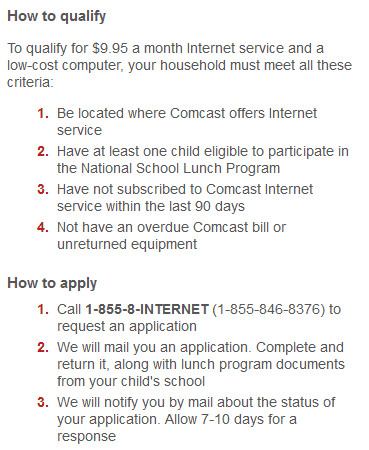
For $9.95 a month, those that can meet some complicated eligibility requirements and prove they are not existing Comcast customers are qualified for 3Mbps broadband service with a 768kbps upload rate. It represents a $30 savings off Comcast’s regular price — a considerable amount of revenue that Comcast is effectively forfeiting for the benefit of poor families who live in Comcast’s footprint.

Except Comcast isn’t actually “out” that much at all, argues Randall.

Of the 2.6 million households eligible for Internet Essentials from Comcast, only 150,000 have taken Comcast up on their offer. That represents only 5.8 percent of those eligible. In Comcast’s hometown — Philadelphia — there are just 3,250 families hooked up, which represents only 3.3 percent of those eligible.

Randall calls the program ineffective and says the onerous requirements to qualify (and re-qualify) are such a hassle, few families bother. What is worse, those families already sacrificing something else in their lives to get broadband service for the benefit of their school-age children are punished for their noble efforts — they are completely ineligible for Internet Essentials regardless of income or need because they are existing customers. Randall argues Comcast carefully constructed the program more as a public (and government) relations exercise than a charitable endeavor. Comcast zealously protects its existing revenues from being cannibalized by customers switching to the discount plan.

Some might argue that Comcast is managing the program with costs in mind, but Randall dismisses that as nonsense.

qualify“Within its footprint (which spans 50 million households in 39 states– 45 percent of the US population), the cost for Comcast to connect additional households is vanishingly low,” says Randall. “With no additional network build needed, Internet Essentials represents almost pure profit for Comcast.”

Randall claims Comcast’s gross profit margin on its broadband service is around 95 percent where the network has already been built. At that rate, Comcast’s cheap Internet still delivers almost $18 million in additional income, and there is a promise of much more as soon as a customer defaults on a bill, misses a qualification deadline, or their children graduate. When any of these occur, Comcast will reset customers to regular rates.

“While most observers might assume that the program is an act of corporate generosity, it was originally conceived in the fall of 2009 as a way to turn a profit by offering slower connections to certain low-income households,” said Randall.

“These plans were temporarily tabled at the direction of Comcast lobbyist David Cohen, who knew that this type of program would be attractive to the FCC and thus useful as a bargaining chip. When the time came for negotiations over Comcast’s $13.75 billion takeover of NBC Universal, Comcast was able to offer something it was planning on doing anyway. In the end, the FCC was able to claim credit for forcing Comcast to implement a program to combat the digital divide, while in reality no arm-twisting was needed,” he added.

One of the biggest challenges of America’s digital divide is making affordable Internet access available. Cable companies in particular are prepared to wring even more money from their Internet customers in the form of higher prices, new and increasing equipment rental fees, and consumption billing schemes that charge more for less service.

But that isn’t the story elected officials receive from Congress.

The potential public relations benefits far outweigh any costs to offer the service. Randall notes Comcast had delivered the Internet Essentials message to over 100 members of Congress and more than 2,000 state and local officials. To broaden its outreach effort, Comcast also engaged leading intergovernmental associations at the state and local level such as the National Governors Association, National Conference of State Legislatures, U.S. Conference of Mayors, and various other organizations of elected officials. On top of that, Comcast says that the impressions generated by media coverage of Internet Essentials launch events earned it “millions of dollars” worth of media.

What message don’t these public officials hear?

America is subjected to local broadband monopolies and duopolies that guarantee the lack of competition for high-speed Internet access.

“It earns Comcast good press while distracting regulators and public officials into thinking that changes in policy aren’t needed and that digital divide problems will somehow work themselves out on their own as a result of corporate generosity. In the long run, Comcast Internet Essentials will do no more than contribute to the delay of much-needed regulation,” concludes Randall.

Netflix Monthly Performance Ratings: Fiber on Top, Cable Second, DSL and Wireless Stink

Phillip Dampier July 10, 2013 Broadband Speed, Competition, Consumer News, Online Video, Wireless Broadband Comments Off on Netflix Monthly Performance Ratings: Fiber on Top, Cable Second, DSL and Wireless Stink

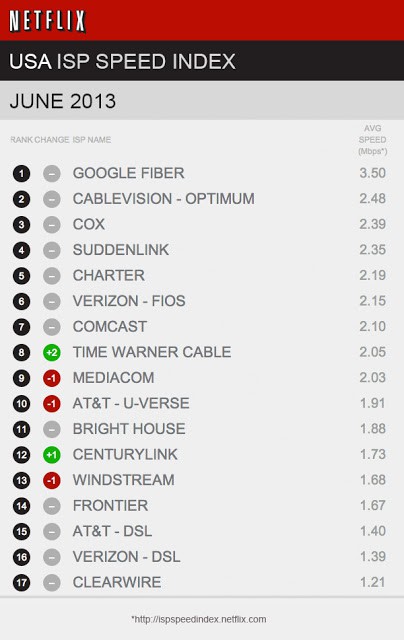
usa-ispspeedindex-netflix-jun-13Netflix kicks off the summer rating the streaming video performance of some of America’s largest ISPs, and the results deliver only a few surprises.

Google Fiber is the runaway leader, but Verizon FiOS — also a fiber-based network — is lagging behind several cable operators, notably Charter Cable and Suddenlink.

In mid-June, GigaOM reported Verizon was engaged in a battle with Cogent — a bandwidth provider Netflix depends on to help it reach Verizon customers.

Cogent promptly blamed Verizon for the slowdown:

Cogent and Verizon peer to each other at about ten locations and they exchange traffic through several ports. These ports typically send and receive data at speeds of around 10 gigabit per second. When the ports start to fill up (usually at 50 percent of their capacity), the internet companies add more ports. In this case, through, Verizon is allowing the ports that connect to Cogent to get crammed. ”They are allowing the peer connections to degrade,” said Dave Schaeffer, chief executive officer of Cogent said in an interview. “Today some of the ports are at 100 percent capacity.”

“Think of it as the on-ramp to the freeway being log-jammed,” Schaeffer said. And that means your Netflix content, especially content sent by Netflix’s content delivery network, slows down, and you get pixelated pictures and buffering.

Verizon just as quickly shot back at GigaOm and Cogent:

Cogent is not compliant with one of the basic and long-standing requirements for most settlement-free peering arrangements: that traffic between the providers be roughly in balance. When the traffic loads are not symmetric, the provider with the heavier load typically pays the other for transit (see our ex parte filing [PDF] from the 2010 Comcast/Level 3 spat for more info on peering and transit agreements). This isn’t a story about Netflix, or about Verizon “letting” anybody’s traffic deteriorate. This is a fairly boring story about a bandwidth provider that is unhappy that they are out of balance and will have to make alternative arrangements for capacity enhancements, just like any other interconnecting ISP.

Customers don’t care. They just know their efforts to watch Arrested Development are being stymied, and Netflix’s June ISP results illustrate the degraded performance customers are getting.

Cablevision, the top performing cable operator, can likely thank its recent investments in network upgrades for improved performance, not its participation in Netflix’s OpenConnect Content Delivery Network, designed to improve streaming performance for participating ISPs. Cablevision is a member, but so are Frontier Communications (#14) and Clearwire (#17 and dead last).

OpenConnect couldn’t help Frontier DSL or Clearwire wireless customers achieve good results — the technology in use and the upstream connections both companies maintain with the Internet backbone mattered much more.

In general, fiber performs best when everyone is getting along, cable comes in second, DSL third, and wireless last.

But if you want the best performance possible, and Google Fiber is not in your neighborhood, your best bet is to move to Sweden, where the top-six providers all outperformed every American cable, DSL, and wireless provider. In Finland, the top-four beat everyone but Google Fiber. The nine best-rated ISPs in Denmark also outclassed their American counterparts, while in Norway a half-dozen providers did better.

But many ISPs in the United States can still be proud: the top eight beat Mexico. Mediacom, AT&T U-verse & DSL, Bright House, CenturyLink, Windstream, Frontier, Verizon DSL and Clearwire have some work to do… if they want to keep up with those speed mavens in Guadalajara.

When Do You “Need” Faster Speeds? When Competition Arrives Offering Them

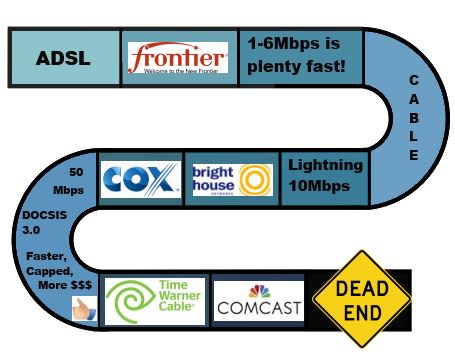
broadband dead end“We just don’t see the need of delivering [gigabit broadband] to consumers.” — Irene Esteves, former chief financial officer, Time Warner Cable, February 2013

“For some, the discussion about the broadband Internet seems to begin and end on the issue of ‘gigabit’ access. The issue with such speed is really more about demand than supply. Most websites can’t deliver content as fast as current networks move, and most U.S. homes have routers that can’t support the speed already available.” — David Cohen, chief lobbyist, Comcast Corp., May 2013

“We don’t focus on megabits, we don’t focus on gigabits, we focus on activities. We go to the activity set to get a sense of what customers are actually doing and the majority of our customers fit into that 6Mbps or less category.” — Maggie Wilderotter, CEO, Frontier Communications, May 2013

“It would cost multiple billions” to upgrade Cox’s network to offer gigabit speeds to all its customers. — Pat Esser, CEO, Cox Communications, Pat Esser, chief executive of Cox Communications Inc., January 2013

“The problem with [matching Google Fiber speeds] is even if you build the last mile access plant to [offer gigabit speeds], there is neither the applications that require that nor a broader Internet backbone and servers delivering at that speed. It ends up being more about publicity and bragging. There has been a whole series of articles in the paper about ‘I’m a little startup business and boy it is really great I can get this’ and my reaction is we already have plant there that can deliver whatever it is they are talking about in those articles, which is usually not stuff that requires that high-speed.” — Glenn Britt, CEO, Time Warner Cable, December 2012

“Residential customers, at this time, do not need the bandwidth offered with dedicated fiber – however, Bright House has led the industry in comprehensively deploying next-generation bandwidth services (DOCSIS 3.0) to its entire footprint in Florida – current speeds offered are 50Mbps with the ability to offer much higher. We provision our network according to our customers’ needs.” – Don Forbes, Bright House Networks, February 2011

‘Charter [Cable] is not seeing enough demand to warrant extending fiber to small and medium-sized businesses — and certainly not to every household.’ — “Speedier Internet Rivals Push Past Cable“, New York Times, Jan. 2, 2013

Unless you live in Kansas City, Austin, in a community where public broadband exists, or where Verizon FiOS provides its fiber optic service, chances are your broadband speeds are not growing much, but are getting more expensive. The only thing innovative coming from the local phone or cable company is a constant effort to convince customers they don’t need faster Internet access anyway.

At least until a competitor threatens to shake up the comfortable status quo.

Time Warner Cable claims they are perfectly comfortable offering residential customers no better than 50/5Mbps, except in markets like Kansas City (and soon in Texas) where 100Mbps is more satisfying. Why is a glass Time Warner claims is full to the brim everywhere else in the country only half-full in Kansas City? Google Fiber might be the answer. It offers 1,000/1,000Mbps service for less money than Time Warner used to charge for 50Mbps service, and Google is also headed to Austin.

special reportAT&T scoffed at following Verizon into the world of fiber optic broadband, where broadband speeds are limited only by the possibilities. Instead, they built their half-fiber, half-Alexander Graham Bell-era copper wire hybrid network on the cheap and ended up with broadband speeds topping out around 24Mbps, at least in a perfect AT&T world, assuming everything was ideal between your home and their central office.

At the time U-verse was first breaking ground, cable broadband’s “good enough for you” top Internet speed was typically 10-20Mbps. Now that incrementally faster cable Internet speeds are available from recent DOCSIS 3.0 cable upgrades, AT&T is coming back with an incremental upgrade of its own, to deliver around 75Mbps.

It is still slower than cable, but AT&T thinks it is fast enough for their customers, except in Austin, where Google Fiber provoked the company to claim it would build its own 1,000Mbps fiber network to compete (if it got everything on its Christmas Wish List from federal, state, and local governments).

Are you starting to see a trend here? Competition can turn providers’ investment frowns upside down and get customers faster Internet access.

Wilderotter: Most of our customers are satisfied with 6Mbps broadband.

Wilderotter: Most of our customers are satisfied with 6Mbps broadband.

In rural markets were Frontier Communications faces far less competition from well-heeled cable companies, the company can claim it doesn’t believe most of its customers need north of 6Mbps to do important things on the Internet. If they did, where would they go to do them?

Where Comcast and AT&T directly compete, major Internet speed increases are a matter of “why bother – who needs them.” Comcast is more generous where it faces down Verizon FiOS. AT&T also knows the clock is ticking where Google Fiber is coming to town.

Verizon FiOS, Google Fiber, and a number of community-owned fiber to the home broadband networks like EPB in Chattanooga and Greenlight in Wilson, N.C. seem more interested in boosting speeds to build market share, increase revenue to cover their expenses, and make a marketing point their networks are superior. They respond to requests for speed upgrades differently — “why not?”

Verizon figured out offering 50/25Mbps service was simple to offer and easy to embrace. Two clicks on a FiOS remote control and $10 more a month gets a major speed upgrade for basic Internet customers that used to get 15/5Mbps service. Verizon management reports they are pleased with the number of customers signing up.

In Chattanooga, Tenn. EPB Fiber offered gigabit Internet service because, in the words of its managing director, “it could.” The community-owned utility did not even know how to price residential gigabit service when it first went on offer, but the costs to EPB to offer those speeds are considerably lower over fiber to the home broadband infrastructure.

Broadband customers in Chattanooga, Kansas City and Austin are not too different from customers in Knoxville, Des Moines, and Houston. But the available broadband speeds in those cities sure are.

LUS Fiber in Lafayette, La. changed the song Cox was singing about their ‘adequate’ broadband speeds. Earlier this year, Cox unveiled up to 150/25Mbps service to cut the number of departing customers headed to the community owned utility, already offering those speeds.

Convincing Wall Street that spending money to upgrade networks to next generation technology will earn more money in the long run has failed miserably as a strategy.

“Competitors have been overbuilding, investors are wondering where the returns are,” said Mark Ansboury, president and co-founder of GigaBit Squared. “What you’re seeing is an entrenchment, companies leveraging what they already have in play.”

With North American broadband prices rising, and some cable companies earning 90-95% margins selling broadband, one might think there is plenty of money available to spend on broadband upgrades. Instead, investors are receiving increased dividend payouts, executive compensation packages are swelling as a reward for maximizing shareholder value, and many companies are buying back their stock, refinancing or paying off debt instead of pouring money into major network upgrades.

That is not true in Europe, where providers are making headlines with major network improvements and speed increases, all while charging much less than what North Americans pay for broadband service.

UPC Netherlands is Holland's second biggest cable company and it is in the middle of a broadband speed war with fiber to the home providers.

UPC Netherlands is Holland’s second biggest cable company and is in the middle of a broadband speed war with fiber to the home providers.

In the Netherlands, the very concept of Google Fiber’s affordable gigabit speeds terrify cable operators like UPC Netherlands, especially when existing fiber to the home providers in the country are taking Google’s cue and advertising gigabit service themselves. UPC rushed to dedicate up to 16 bonded cable channels to boost cable broadband speeds to 500Mbps in recent field trials, without giving any serious thought to the cable operators in the United States that argue customers don’t need or want the faster Internet speeds fiber offers.

“We had to address it head on very recently because of the fiber (competition)” said vice president of technology Bill Warga. “The company is called Reggefiber in the Netherlands. What they’re touting is a 1Gbps service, [the same speed] upstream and downstream. We came out with 500Mbps service. We had to build a special modem because (DOCSIS) 3.1 chips aren’t out yet. We had to double up on the chips in the modem and put it out there because we had to have a competing product, if anything just in the press. That was a reaction but that tells you how quickly in a marketplace that something can move.”

Despite that, groupthink among cable industry attendees back home at the SCTE Rocky Mountain Chapter Symposium agreed that Google Fiber was a political and marketing stunt, “since the majority of users don’t need those types of speed.”

Who does need and want 500Mbps? Executives at UPC, who have it installed in their homes, admits Warga. But cost can also impact consumer demand. Currently, the most popular legacy UPC broadband package offers 25Mbps for €25 ($32.50). The company now sells 60/6Mbps for €52,50 ($48.75), 100/10Mbps for €42,50 ($55.25) or 150-200/10Mbps for €52,50 ($68.25).

Warga also admits the competition has put UPC in a speed race, and boosted speeds are coming fast and furious.

“They’ll come in and say they’re 100, or 101Mbps we’ll come back and say we’re 110 or 120, or 130Mbps,” Warga said. “It’s a bit of a cat and mouse game, but we always feel like we can be ahead. For us DOCSIS 3.1 can’t come soon enough.”

[flv width=”640″ height=”367”]http://www.phillipdampier.com/video/WSJ Cable Broadband Speeds 1-13.flv[/flv]

The Wall Street Journal investigates why cable companies are getting stingy with broadband speed upgrades while gigabit fiber networks are springing up around the country. (4 minutes)


What You Knew Already: Fiber Broadband Rules, Says New Report; We Need More

buddecomAttention broadband planners: Although broadband deployment strategies differ around the world, a new report decisively concludes there is only one network technology proven to meet the demands of broadband users both today and tomorrow: a national fiber optic network.
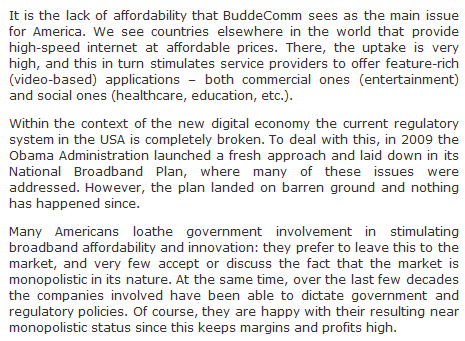

BuddeComm’s new report, “Global Broadband – Fibre is the Infrastructure Required for the Future,” looked at every technology from variations of DSL, cable broadband, satellite, and wireless and found only fiber optics capable of handling the capacity of data and applications that will be required to run cities and countries from today onwards.

The report found that fiber optic deployment faced a range of challenges, despite its obvious technological advantages. Political obstacles are among the biggest roadblocks facing fiber networks. A combination of concerns about the cost of wiring service to procrastination has held back many national broadband improvement projects, including those in Australia and New Zealand. Incumbent commercial providers in North America have also actively attempted to block public fiber networks to protect their own commercial interests.

buddecomm concl

BuddeComm concludes America’s biggest broadband problems come as a result of incumbent providers exercising undue market power and influence over elected officials to protect their commercial interests at the price of the public good.

The report concludes that decisive political leadership is essential to overcome many of the artificial obstacles which slow down or stop fiber broadband deployments.

“One can argue endlessly about what technologies should be applied and at what cost, but we believe that all signs point to Fiber-to-the-Home (FTTH) networks as the best future-proof solution,” the report concludes. “One can debate about whether it is needed in five, ten or fifteen years – and again that depends on some of the differences between countries – but in the end FTTH is the best final solution for all urban and many regional premises.”

The 21st century digital economy is powered by robust broadband, and growing demands for faster speeds are coming from the healthcare, energy, media and retail sectors. Healthcare uses include file transfers of high-definition medical imagery and teleconferencing. Smart Grid technology is being deployed by many power companies to develop more efficient means of distributing and conserving energy. Media and mass entertainment providers are moving to high bandwidth online video, and the retail economy markets products and services over modern broadband networks.

The implications for the global economy are enormous. More than 120 countries have formal broadband policies and many consider high-speed Internet access a national priority. In the last century, North America and western Europe were considered the dominant economic players, in part because they established and maintained infrastructure to support their manufacturing and service economies. But many of these countries are falling far behind in the 21st century digital economy, where countries like Japan and Korea, parts of eastern Europe, the Baltic States, and Scandinavia are taking the lead in infrastructure deployment.

“Broadband infrastructure is perceived by all to be critical for the development of the digital economy, healthcare, education, e-government and so on,” the report notes. “From a financial and investment point of view broadband infrastructure should be treated as utility infrastructure.”

The interests of the private sector are not always aligned with the public interest, particularly when it comes to spending capital on upgrading network infrastructure. The report recommends that governments step in and build a public fiber highway system on which all providers can offer services.

“A National Broadband Network (NBN) should be based upon an open network as this makes it possible to offer the basic infrastructure on a utility basis to content and service providers,” the report concludes.

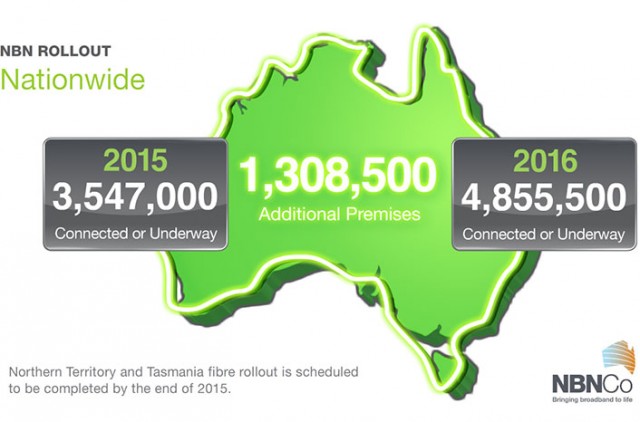
The governments of Australia, New Zealand, Israel, and others are already moving in that direction, setting up broadband authorities to build fiber infrastructure dismissed as too expensive or unnecessary by commercial providers who answer first to financial markets, shareholders, and private banks.

Under most NBN plans, providers get access to the fiber network at wholesale rates and help recoup its cost.

Australia's National Broadband Network is on the way.

Australia’s National Broadband Network is on the way.

Where politicians answer to the whims of the private sector before considering the public good, the report finds:

  • Private cable companies, particularly in North America, will continue to support and incrementally upgrade their HFC networks, but new cable operators are more likely to deploy fiber at the outset, not coaxial copper cable. Network costs, efficiencies, and reliability are all in fiber’s favor. In Europe, cable broadband is regularly losing market share to faster fiber technology. The share of all broadband subscribers held by HFC networks across Europe fell from 26% in 2002 to about 11% by mid-2013;
  • Private telephone companies that do not face robust competition will continue to rely on their existing DSL networks. In cities and larger towns, expect phone companies to eventually upgrade to VDSL fiber-to-the-neighborhood (and its variants) in the largest markets with the most competition. Rural areas will continue to receive less robust DSL service, particularly where no cable competitor provides service;
  • Rural areas may receive fixed wireless or satellite broadband service, but this is not a solution for more populated areas.

Although the global economic downturn stalled many fiber network deployments and suppressed demand, the report finds broadband usage and demand for faster speeds are quickly accelerating. Some other highlights:

  • Asia continues to be the leader in fiber optic deployment;
  • Sufficient customer demand to make the investment in fiber worthwhile is increasingly likely once fiber service becomes widely available in countries like the Netherlands, China, France, Israel, Switzerland, Norway and Sweden;
  • International connectivity in Africa remains a challenge, but fiber bandwidth is expected to more than double by 2014;
  • The Middle East will see rapid growth in fiber broadband once international capacity constraints are eased.

Obtaining a copy of the full BuddeComm report is prohibitively expensive for consumers, priced at $995.

Time Warner Offers 30/5Mbps Customers $10 Upgrade to 50/5Mbps Ultimate Service

Phillip Dampier June 20, 2013 Broadband Speed, Competition 8 Comments

twcTime Warner Cable is extending an online promotion to Extreme (30/5Mbps) customers to upgrade to Ultimate (50/5Mbps) service for an extra $10 a month above your current pricing.

But you may want to call Time Warner to take advantage of the promotion because we found the cable company’s website forced the selection of a $4.99/month fee for a “Home WiFi and Internet Modem” you will not need if you own your own equipment.

You must have a DOCSIS 3 cable modem to take advantage of this offer.

The deal can be accessed by logging into Time Warner Cable’s My Services page and selecting “View or Make Changes to My Internet Service.”


Search This Site:

Contributions:

Recent Comments:

Your Account:

Stop the Cap!