Home » Broadband Speed » Recent Articles:

Comcast Hires ‘Internet Guy’ to Embrace Broadband Innovation; Start By Killing the Usage Cap

Phillip Dampier September 23, 2013 Broadband Speed, Comcast/Xfinity, Consumer News, Data Caps, Editorial & Site News, Net Neutrality Comments Off on Comcast Hires ‘Internet Guy’ to Embrace Broadband Innovation; Start By Killing the Usage Cap
Phillip "Unlimited Innovation depends on Unlimited Access" Dampier

Phillip “Unlimited Innovation depends on Unlimited Access” Dampier

Comcast wants to embrace innovation and change. Before it can succeed, the cable company needs to permanently retire usage caps and consumption billing schemes, now being market-tested for possible reintroduction nationwide.

Comcast today announced it created a new executive position — vice president of consumer services for video, phone, Internet, and home products and appointed Marcien Jenckes to the position. His role is to oversee development of ideas for new products and services that can be sold to Comcast customers.

Jenckes says Comcast’s product lines are blurring as convergence between television and broadband continues. His role is to keep customers of both services happy by embracing innovation and change.

He will find his hands tied should Comcast bring back its usage cap, now under serious consideration. Limiting residential broadband limits customers’ interest in innovative new online applications that carry the threat of a wallop to one’s wallet from overlimit fees. Comcast ditched its arbitrary 250GB usage cap in the spring of 2012, but continues to think about bringing it back. This year, Comcast has tested a new 300GB cap in certain states tied to an overlimit fee for customers exceeding their usage allowance.

Customers don’t like usage caps one bit. Neither should Comcast “innovators” like Mr. Jenckes.

The future of Internet innovation is likely to be developed on a platform that delivers faster Internet speeds, opening up new high bandwidth applications not easily possible today. Usage caps are anathema to that kind of innovation because customers will be unlikely to embrace new services that blow their usage allowance away.

If Mr. Jenckes is seriously interested in promoting a new spirit of innovation at Comcast, he should start by pressing his fellow executives to ditch usage caps and consumption billing once and for all. The future of unlimited innovation in broadband has its best chance of success with unlimited access.

Verizon FiOS Wins PC Magazine’s ISP Award: “FiOS Is the Absolute Fastest Nationwide Broadband”

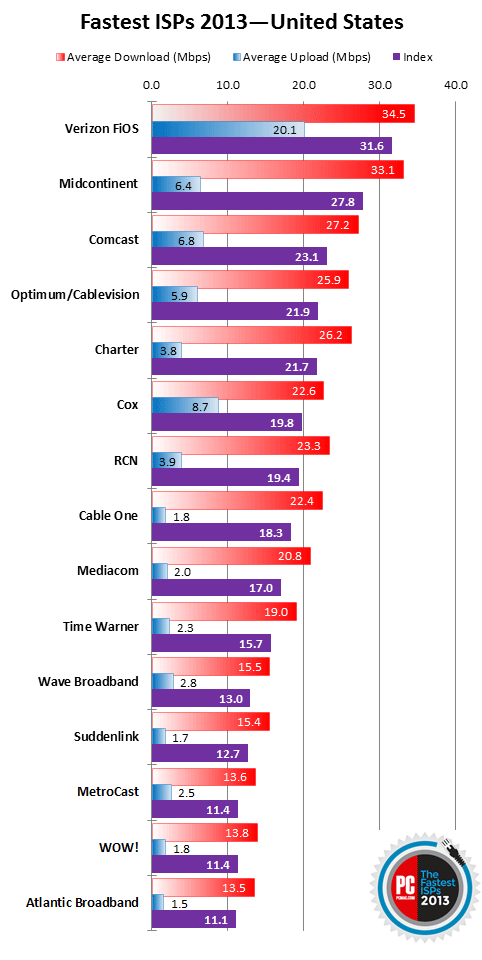
fastest isp 2013Verizon FiOS is the fastest nationwide broadband service available.

That was PC Magazine’s assessment in its ranking of the fastest Internet Service Providers of 2013. It’s not the first time Verizon FiOS has taken top honors. In fact, the fiber to the home broadband service has consistently won excellent rankings not only for its speed, but also for its value for money and quality of service. The worst thing about FiOS is that many Verizon customers cannot buy the service because its expansion was curtailed in early 2010.

Verizon FiOS has seen its national speed rankings increase this year. In 2012, the provider’s nationwide download speeds averaged 29.4Mbps; this year FiOS average downstream speeds jumped to 34.5Mbps. Upstream speeds are also up from 26.8Mbps to 31.6Mbps. In part, this is because a growing number of customers have moved away from Verizon’s entry-level 15/5Mbps package with a $10 upgrade to Quantum FiOS 50/25Mbps service. FiOS TV customers can upgrade themselves with their remote control.

Frontier Communications made the top five in the Pacific Northwest, thanks to FiOS infrastructure the company inherited from Verizon.

Other high-ranking ISPs included Midcontinent Communications, a small cable provider serving the north-central states. Midco’s DOCSIS 3 upgrade allows the company to offer most customers up to 100Mbps service. The average download speed for Midco customers is 33.1Mbps; average upload speed is 6.4Mpbs.

Where cable operators face head-on competition from Verizon FiOS, the usual competitive response is speed increases. Cablevision is a good example. It came in fourth place nationally with average speeds of 25.9/5.9Mbps. Comcast has also been boosting speeds, especially in the northeast where it faces the most competition from fiber. It came in third place with average speeds of 27.2/6.8Mbps and offers Internet speeds up to 505Mbps in some areas.

There were companies that performed so poorly, they barely made the regional rankings. The most glaring example largely absent from PC Magazine’s awards: Time Warner Cable, which has lagged behind most cable operators in the speed department. It scored poorly for the second largest cable company in the country, beaten by Charter, Mediacom, and CableONE — which all usually perform abysmally in customer ratings. The only regional contest where Time Warner made a showing at all was in the southeast, where it lost to Verizon FiOS, Comcast, and Charter. Only TDS, an independent phone company, scored worse among the top five down south.

Even more embarrassing results turned up for AT&T U-verse, which performed so bad it did not even make the national rankings. AT&T has promised speed upgrades for customers this year, and has implemented them in several cities. Unfortunately for AT&T, its decision to deploy a fiber to the neighborhood system that still depends on copper to the home is turning out to be penny wise-pound foolish, as it continues to fall further behind its cable and fiber competitors. At the rate its competitors are boosting speeds, U-verse broadband could become as relevant as today’s telephone company ADSL service within the next five years.

Other players scoring low include WOW!, a surprising result since Consumer Reports awarded them top honors for service this year. Also stuck in the mud: Atlantic Broadband (acquired by Canada’s Cogeco Cable, which itself is no award winner), Suddenlink, Wave Broadband and Metrocast, which serves smaller communities in New Hampshire, Maine, Pennsylvania, Maryland, Virginia, Connecticut, South Carolina, Mississippi and Alabama.

The magazine also ranked the fastest U.S. cities, with top honors going to the politically important Washington, D.C., and its nearby suburb Silver Spring, Md, which took first and second place. Alexandria, Va., another D.C. suburb, turned up in eighth place. No cable or phone company wants to be caught delivering poor service to the politicians that can make life difficult for them.

Brooklyn, N.Y., took third place because of head-on competition between Cablevision and Verizon FiOS. Time Warner’s dominance in Manhattan and other boroughs dragged New York City’s speed rankings down below the top ten. Among most of the remaining top ten cities, the most common reason those cities made the list was Verizon FiOS. Florida’s Gulf Coast communities of Bradenton (4th place) and Tampa (6th place) have fiber service. So does Plano, Tex. (5th place) and Long Beach, Calif. (7th place). The other contenders: Hollywood, Fla. takes ninth place and Chandler, Ariz. rounds out the top 10.

Cable Company Hassles Make Life Difficult for Newest DVR Competitor: TiVo’s Roamio

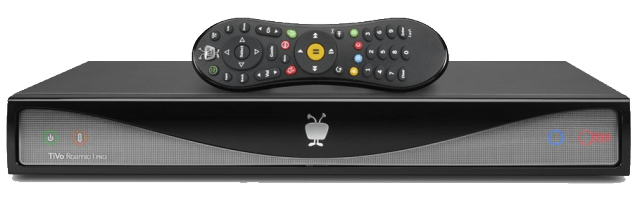
TiVo Roamio DVR

TiVo Roamio DVR

The newest entry in the should-be-more-competitive world of Digital Video Recorders (DVRs) might have gotten five stars from reviewers willing to play down the device’s asking price, but the biggest hurdle of all isn’t its cost, it is the complexity of getting it to work properly with your cable provider.

TiVo’s new Roamio was designed to declutter your viewing experience. It’s a DVR that can record shows you missed, an online video device that can stream content from Netflix, Hulu Plus, Amazon Instant Video, Spotify, Pandora and YouTube right on your television, and perhaps most powerful of all — it will soon stream it all to you on any mobile device located anywhere there is an Internet connection.

That puts TiVo’s Roamio well ahead of the behind-the-times set-top boxes and DVRs rented out by the cable company. Customers have clamored for a device that can properly record scheduled programs and allow those recordings to be viewed anywhere the customer wants to watch. Comcast’s box doesn’t work that way. Neither do boxes from Time Warner Cable, Cox, Bright House, and the rest.

Comcast-LogoCue the lawyers.

The reason these common sense portability features are not available on the box you rent in perpetuity from the cable company is that programmers won’t allow it and many pay television providers don’t consider it a priority. Time Warner Cable only recently filed a patent to deliver customer-recorded content to portable devices. The patent application is an exercise to placate litigious programmers that cannot sleep nights knowing someone is offering a service they failed to monetize for themselves through licensing agreements. Feel the legal fees piling up:

“Because of the increasing popularity of home networking, there is a growing need for a strategy that enables a user to perform authorized transfer of protected content, e.g., transferring content from an STT [set-top terminal] to a second device in a home network, and at the same time prevents unauthorized distribution of the protected content,” Time Warner writes in its patent application.

While TiVo is selling a device that allows consumers to record programming for private viewing purposes, a cable operator with deep pockets that only rents DVRs cannot do likewise.

The Roamio comes in three versions, none of which are compatible with satellite television services:

      • Roamio Pro ($600): Six tuners allow customers to record up to six shows at one time and has storage capacity for 450 hours of HD programming. Includes built-in Wi-Fi. Stream TV to mobile iOS devices coming soon (as is Android support);
      • Roamio Plus ($400): Same as above except storage capacity is 150 hours of HD programming;
        Roamio ($200): Four tuner basic version omits built-in streaming to mobile devices but can record four shows at once and store 75 hours of HD programming. A good choice for cord-cutters as it includes an over-the-air broadcast television antenna input.
      • All Roamio devices require TiVo service, which costs $15 a month or $500 for a lifetime subscription. All boxes support external hard drives with an eSATA interface to backup or store more recordings. All Roamio devices support 1080p and Dolby Digital 5.1 sound.
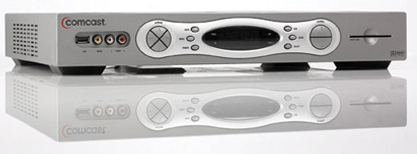
This Comcast DVR is only available for rent.

This Comcast DVR is only available for rent.

In contrast, cable operator-provided DVR service can often add $20 a month to your cable bill… forever. But is there real value for money paying TiVo $15 a month (or a $500 payment for the life of the device) for “service” on top of hardware that can cost up to $600?

TiVo thinks so: “Once you bring together all your favorite shows, movies and music into one place, you’ll wonder how you ever lived without it.”

Unfortunately, getting there is one heck of a battle according to Bloomberg’s Rich Jaroslovsky, who got his hands on a test unit that simply refused to get along well with Comcast.

“The cable industry is standing in the way,” Jaroslovsky writes.

That may not be surprising, considering the lucrative business of renting DVR equipment to customers eager for time-shifting and commercial-skipping. The cable company’s concept of DVR service includes a set-top box, decoder, and recording unit into one, relatively simple integrated device.

TiVo’s persistent monthly “service fee” as well as a steep purchase price made marketing the cable company’s “no-purchase-required” DVR easy, and the cable industry quickly won the lion’s share of the DVR business. Another strong argument in favor of the cable company’s DVR is the lack of a complicated set up procedure to get competing devices to reliably work with the cable company’s set-top box.
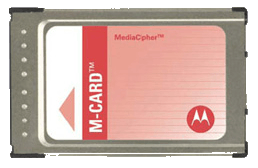
Motorola's M CableCARD

Motorola’s M CableCARD

Thanks to Comcast and other cable companies, setting up Roamio managed to confound even a tech reporter like Jaroslovsky, and Comcast was not much help.

The Roamio requires a CableCARD, a plug-in card-sized version of the cable company’s set-top box, to unlock digital cable channels.

The CableCARD was Congress’ attempt in the 1996 Telecom Act to give consumers an option to avoid costly and unsightly set-top boxes. Originally envisioned as a plug-in device that would offer “cable-ready” service without a set-top box in future generations of televisions, the CableCARD never really took off. The cable industry opposed the devices and dragged its feet, preferring to support its own set-top boxes. The CableCARD that eventually did emerge was initially often difficult to obtain and had huge limitations, such as one-way-only access which meant no electronic program guide, no video-on-demand, and no access to anything that required two-way communications between the card and the cable company. Newer CableCARDs do offer two-way communications and support today’s advanced cable services.

The only place most cable operators mention the availability of the CableCARD in detail is in a federally mandated disclosure of pricing, services, and a consumer’s rights and responsibilities — usually provided in a rice-paper-thin, tiny-print leaflet included with your bill once a year, if you still get one in the mail.

Roamio is likely to frighten technophobes right from the start with this important notification:

CableCARDs are made by one of four manufacturers: Motorola, Scientific Atlanta/Cisco, NDS, or Conax. You need one multi-stream CableCARD (M-card). Single-stream CableCARDs (S-cards) are not compatible.

“That costs an extra $1.50 a month from Comcast, and in my case, required three trips to its nearest office because the first card didn’t work,” Jaroslovsky writes.

On the second trip, Comcast handed him two cards in the hope at least one would work, requiring one last trip to return the card that didn’t.

Time Warner Cable and certain other cable operators use Switched Digital Video, incompatible with the Roamio.

Time Warner Cable and certain other cable operators use Switched Digital Video, incompatible with the Roamio without a Digital Tuning Adapter, available from the cable company.

The second hurdle was to get Comcast to recognize and authorize that CableCARD. Comcast’s technical customer support staff was lacking. Jaroslovsky found his call bounced from department to department attempting to authorize the card and diagnose why it simply refused to work at first.

After finally overcoming those problems, Jaroslovsky discovered he was out of luck getting Roamio to stream premium movie channels like HBO and Cinemax. The encryption system Comcast supports prohibits streaming the movie networks outside of the home. The Slingbox works around the issue by bypassing the encryption system’s permission settings with extra cables between it and your cable box.

Time Warner Cable subscribers will need still another piece of equipment — a Tuning Adapter compatible with Switched Digital Video (SDV). To conserve bandwidth, cable companies like Time Warner limit certain digital channels being sent to each neighborhood unless someone is actively watching.

Before you can view or record a program on an SDV channel, your box must be able to send channel requests back to the cable headend. Roamio is a one-way device and cannot send the required channel requests. Cable providers who have deployed SDV technology will provide a Tuning Adapter to customers who have HD TiVo boxes. A Tuning Adapter is a set top box that provides two-way capabilities, so your box can request SDV channels. There are two Tuning Adapter brands: Motorola and Cisco. Motorola CableCARDs work with Motorola Tuning Adapters. Scientific Atlanta and NDS CableCARD work with Cisco Tuning Adapters. Without the Tuning Adapter, a Roamio user will find error messages on several digital channels indicating they are “temporarily unavailable.”

Other cable operators offer varying support for Roamio. Cablevision has been learning how to support the device along with customers. Prior customer experiences make it clear front-line service representatives are not going to be very helpful managing the technical process to properly configure, update, and authorize CableCARD technology for the new TiVo device, so prepare to have your call transferred to one or more representatives.

After all this, Jaroslovsky was finally watching his Comcast cable channels, able to access on-demand services, and found TiVo’s interface and program guide more satisfying than the one offered on Comcast’s DVR.

Roamio Plus and Pro have built-in support for video streaming away from home that will be fully enabled this fall.

Jaroslovsky found in-home streaming smooth and satisfying. Programs launched quickly and looked terrific on an iPad with Apple’s high-resolution Retina display, with none of the blockiness or stuttering sometimes associated with streaming video.

His review unit allowed him to test streamed programming outside of the home and video quality on the go was much more variable. The current software prohibits video streaming on AT&T’s 4G LTE network, a problem with a resolution now in the works. Public Wi-Fi hotspots often delivered poor performance, even when they could supply up to 2Mbps. Blurred pictures and pixel blocks often broke up the video on slow Internet connections. A faster connection supporting more than 10Mbps is capable of delivering a better viewing experience, especially if that connection comes without usage caps.

[flv width=”640″ height=”380″]http://www.phillipdampier.com/video/TiVo Roamio DVR Demo Video 8-19-13.flv[/flv]

An introduction and demo of the TiVo Roamio DVR, produced by TiVo. (3 minutes)

This article was updated with a clarification about Tuning Adapters, required by some cable operators using Switched Digital Video. Thanks to reader Dave Hancock for helping clear things up.


EPB Celebrates 4th Anniversary With Free Speed Upgrades And Price Cuts; $69.99 for 1Gbps Service

epbEPB this morning celebrated its fourth anniversary by thanking Chattanooga residents for supporting the utility’s fiber network with a series of price cuts and speed increases.

Beginning today, EPB’s fiber broadband customers are getting the following upgrades and savings:

  • 50/50Mbps customers get a free upgrade to 100/100Mbps service with no change in their current price ($57.99/month);
  • 100/100 and 250/250Mbps customers get a free upgrade to 1,000/1,000Mbps service;
  • 1,000/1,000Mbps customers now paying $349 a month will see their bills slashed to $69.99 a month, a savings of $230 a month;
  • EPB’s business broadband customers will be contacted individually to coordinate the speed upgrades.

gig_speedsCustomers will see the new speeds provisioned within the next two weeks. At least 3,000 residential customers will be upgraded to gigabit service.

EPB also reported this morning it has 55,000 broadband customers.

EPB is one of the nation’s most successful municipal fiber providers and is proving itself a major challenger to Chattanooga’s cable competitor Comcast and incumbent phone company AT&T.

AT&T’s U-verse is the least capable network in Chattanooga, because its fiber-to-the-neighborhood technology currently limits AT&T’s maximum broadband speed in the city to 24/3Mbps. AT&T says it is working on doubling or tripling speeds, but it still leaves U-verse far behind Comcast and EPB.

Comcast has lost at least 47,000 customers in Chattanooga, estimates EPB CEO Harold DePriest. Comcast originally had 122,000 customers on the EPB grid when EPB launched fiber broadband. This year, Comcast has about 75,000 customers and is expected to see numbers decline further in 2014 to about 60,000 customers.

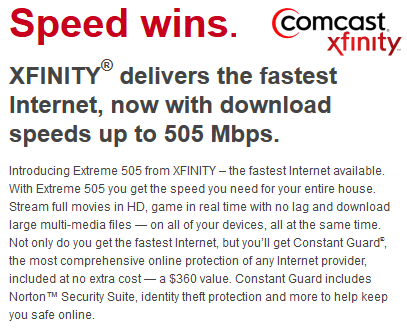
The best Comcast offers is 505/20Mbps service in select cities, with a price tag of $400 a month.

The best Comcast offers is 505/20Mbps service in select cities, with a price tag of $400 a month.

Neither Comcast or AT&T is competing on price for higher speed broadband in Chattanooga. Comcast charges $114.95 a month for 105/20Mbps service and offers 505/100Mbps service in a handful of other cities, for $399.95 a month. Comcast is also currently testing the reintroduction of usage caps and overlimit fees in several markets.

AT&T charges $65 a month for 24/3Mbps service — its fastest — with a 250GB monthly usage cap, currently not enforced. For $5 more, EPB customers get 1,000/1,000Mbps with no usage limits or overlimit fees.

EPB has been criticized by conservative groups, bloggers, and its competitors that argue municipal utilities have no business being in the broadband business. Most of these groups predicted EPB Fiber would deliver a costly failure for Chattanooga utility ratepayers. The utility has also come under repeated fire from the conservative editorial page in the Chattanooga Times-Free Press, often from ex-editorial writer Drew Johnson, who was fired in August.

DePriest can afford to take the criticism all in stride. He has been with the publicly owned utility for 42 years and has seen Chattanooga transformed from its old manufacturing roots into an increasingly high-tech city, thanks in part to EPB’s robust broadband infrastructure that has exceeded even EPB’s expectations.

EPB’s original business plan called for 28,000 customers to break even, with an estimated ceiling of 43,000 customers that would be willing to sign up. EPB has already passed both estimates with additional growth anticipated. DePriest even predicts EPB could surpass Comcast — the city’s biggest broadband and cable TV player — in market share by the end of next year.

Far from being a financial failure, EPB Fiber is now covering the $19 million debt payment incurred by the utility’s electric business, protecting Chattanooga residents from an electricity rate increase.

EPB is also making money offering advice to other cities who want to launch their own publicly owned fiber networks and avoid making costly mistakes. Consulting services will net EPB more than $1 million over the next three years.

[flv width=”640″ height=”380″]http://www.phillipdampier.com/video/EPB EPB 4th Anniversary Speed Increases Price Cuts for Gigabit 9-17-13.flv[/flv]

EPB CEO Harold DePriest announces speed increases and price cuts for customers to celebrate the utility’s fourth anniversary in the broadband business. (3 minutes)

Correction: The original story misreported Comcast’s upstream speed for its 505Mbps tier as 20Mbps. It is, as corrected above, 100Mbps.

Shaw Cable Announces Another Significant Rate Hike; Second Increase So Far This Year

Phillip Dampier September 16, 2013 Broadband Speed, Canada, Competition, Consumer News, Data Caps, Shaw 1 Comment

Shaw-LogoWhen Jeff McDonaghe celebrated the beginning of 2013, his cable and Internet bill from Shaw Communications was roughly $117 a month. In April, Shaw announced a wide-ranging rate increase that cost the Calgary resident an extra $7 a month. Now Shaw is back for more with another rate increase that will cost the McDonaghe family an additional $11 a month. His October bill: nearly $135 — $18 more a month.


“Shaw seems to have gotten quite comfortable raising rates at least twice a year, because my bill has gone up like clockwork every six months or so,” McDonaghe tells Stop the Cap!

Shaw representatives blamed the “price adjustment” on the cost of programming, its upgraded “digital gateway” set-top box, and higher licensing and regulatory fees.

Customer_Bulletin_news_tabletSeptember 2013 Rate Adjustment

At Shaw, we’re committed to providing quality products and services at the best value for all customers.

To continue delivering the best entertainment options, you may notice a few changes to your monthly bill, effective September 1, 2013.

For customers in Manitoba and Ontario (excluding Hamilton), these changes will take effect on October 1, 2013.

Changes are as follows:

Internet Monthly rate as of September 1, 2013
High Speed 10 $55.00
High Speed 20 $60.00
Broadband 50 $80.00
Broadband 100 $90.00
Broadband 250 $120.00
Television Monthly rate as of September 1, 2013
TSN Jets $10.00
Sportsnet World $17.00
Adult Channels
(Playboy, Penthouse, Red Hot, Hustler)
$23.00
Adult Bundles
(pick two channels)
$40.00
Pick and Pays
(at current $2.95 price)
$3.00
Oasis and Discovery World $4.00
Multicultural Channels +$0.05 above current rates
Home Phone Monthly rate as of September 1, 2013
Personal Phone $30.00
Second Phone Line $10.00
Distinctive Ring $4.00
Voicemail and Call Waiting $6.00
Bundle Monthly rate as of September 1, 2013
Starter Bundle
(includes Shaw Gateway Whole Home HDPVR and two Portals on a two-year service agreement)
$119.90
Plus Bundle
(includes Shaw Gateway Whole Home HDPVR and two Portals on a two-year service agreement)
$154.90
Large Bundle
(includes Shaw Gateway Whole Home HDPVR and two Portals on a two-year service agreement)
$174.90
X-Large Bundle
(includes Shaw Gateway Whole Home HDPVR and two Portals on a two-year service agreement)
$209.90

Some of the most significant rate hikes will affect grandfathered service plans, leaving some customers scratching their heads.

Shaw’s old 20Mbps plan (no longer listed on the company’s website) now costs $60 a month, the same price charged for Shaw’s newer 25Mbps tier.

The company’s old “discount” Internet plan delivered DSL-like speed of 7.5Mbps for $45 a month. On Sept. 1, Shaw raised its price to $50. Today, Shaw’s entry-level 10Mbps broadband package sells for $55 a month — only $5 more — with a 125GB monthly usage cap.

Despite the company’s claims of increased costs, Shaw reported $250 million in profits during the third quarter of this year, delivering better than anticipated results with a promise to return some of the excess cash to shareholders in the form of dividends.

telus shaw“Given the improvement in free cash flow and assuming continued favorable market conditions, our board plans to target dividend increases of five to ten percent over the next two years,” said Brad Shaw, CEO of Shaw Communications.

Shaw’s financial gains come at the cost of its declining customer base. During the summer, Shaw lost at least 26,578 basic cable subscribers due to increased competition from Telus’ TV service. The company did better adding broadband customers (4,157), but its greatest growth has come from its phone business, where the company picked up 17,719 new landline customers.

Drew McReynolds from RBC Capital Markets said Shaw was growing revenue mostly by “better monetizing the existing subscriber base.”

“Shaw’s revenue and EBITDA beat was mostly due to price increases,” added Greg MacDonald, managing director at Macquarie Capital Markets Canada.

Former CEO Jim Shaw is costing Shaw some of its earnings as well with a pension payout of almost $500,000 a month. In fact, the Shaw family that founded the cable company has three generations of pension and salary obligations it expects to be honored:

  • J.R. Shaw, the company chairman has an annual pension of $5.4 million;
  • Jim Shaw, J.R.’s son, now gets $5.95 million annually;
  • Bradley Shaw, Jim’s brother and current CEO is eligible for a $3.97 million pension at age 65. His accrued pension obligation is $37.6 million.

Jim Shaw’s pension alone has cost Shaw more than $71 million in financing expenses because the company’s executive pension plan is not pre-financed; the costs are instead paid from annual cash flow as a compensation expense.

“Those price hikes are going to executive compensation and to shareholder dividend payments, because my service has not improved a bit despite paying almost $20 more a month this year,” complains McDonaghe. “The best mere mortals like ourselves can get when threatening to cancel are some temporary credits of around $5 a month for each of their services. Even with those credits, my bill is still higher.”

Search This Site:

Contributions:

Recent Comments:

Your Account:

Stop the Cap!