
Home » Broadband Speed » Recent Articles:

SaskTel Raises Prices $5 a Month, But Announces New Fiber to the Home Service for Prince Albert

Phillip Dampier January 8, 2014 Broadband Speed, Canada, Competition, Consumer News, Rural Broadband, SaskTel, Video Comments Off on SaskTel Raises Prices $5 a Month, But Announces New Fiber to the Home Service for Prince Albert
SaskTel is raising prices ... and broadband speeds. (Image: CBC)

SaskTel is raising prices … and broadband speeds. (Image: CBC)

Internet access on the prairie is getting more expensive as provincial-owned phone company SaskTel notifies its Saskatchewan customers it is raising certain DSL and fiber broadband prices by $5 a month — a 14% rate hike.

Effective Feb. 1, prices for High Speed Classic DSL and fiber service will rise to at least $39.95 a month. For DSL customers, that means nearly $40 a month for 1.5Mbps service.

SaskTel, a crown corporation, is telling customers it needs the money to upgrade its network and maintain customer support.

The phone company has a bold plan to replace copper wire infrastructure with fiber to the home service in each of Saskatchewan’s nine largest communities: Saskatoon, Regina, Moose Jaw, Weyburn, Estevan, Swift Current, Yorkton, North Battleford, and Prince Albert. The fiber network, dubbed infiNET, is already operational in parts of Moose Jaw and will be introduced in Prince Albert this spring.

SaskTel has a range of price points for its fiber network ranging from $39.95 a month for 2/1Mbps service to 260/30Mbps service for $139.95 a month.

[flv]http://www.phillipdampier.com/video/SaskTel – Building the future with infiNET 5-30-13.mp4[/flv]

Sasktel’s $800 million fiber to the home project is Canada’s most ambitious, because it will blanker urban, suburban, and near-rural customers. This video explores innovations Sasktel is finding to deal with Saskatchewan’s harsh climate, including fiber cables that stay flexible at -40 degrees and directional boring to quickly and inexpensively install underground fiber to homes. (3:28)

Wall Street Asking Questions About AT&T’s GigaPower: 1Gbps vs. 45Mbps U-verse

ovumA Wall Street research firm is asking questions about the “mixed messages” AT&T is sending consumers over its broadband offerings.

Ovum Research senior analyst Kamalini Ganguly said AT&T’s fiber to the home (FTTH) network in Austin — set to upgrade customers to 1Gbps next year — is likely to confuse AT&T and its shareholders over the future direction of AT&T’s current fiber to the neighborhood (FTTN) upgrade effort, dubbed Project VIP.

Having spent eight years deploying the U-verse FTTN service, a year ago AT&T chose to expand household coverage and upgrade speeds. That effort, called Project VIP, is still ongoing and until now has reflected AT&T’s projection that 45Mbps downstream (and 6Mbps upstream) should be good enough for the majority of its customers.

att gigapowerAT&T says it intends to boost part of its Project VIP footprint to 75Mbps or 100Mbps with VDSL2 vectoring, but the extent of this is unknown. It has also deployed a small amount of GPON FTTH in greenfield markets, typically designed to support 80–100Mbps to each household. Also as part of Project VIP, it plans to reach 1 million businesses with symmetric 1Gbps FTTH.

However, the GigaPower offering in Austin will be AT&T’s first 300Mbps or 1Gbps mass-market FTTH offering targeting consumers, not just businesses, in a major market. It is also a symmetric offering, meaning upstream will be 1Gbps as well. Those speeds are far higher than what Project VIP will deliver to the majority of consumers. The jump from 45/6Mbps to 1/1Gbps for consumers raises questions around its strategy. The cost issue looms large. Deploying 1Gbps point-to-point FTTH will continue to cost much more than GPON FTTH, which in turn still costs a lot more than FTTN – even with vectoring. AT&T needs to explain better what has changed from last year in the business case for FTTH over FTTN.

Wall Street is asking questions because AT&T has repeatedly denied its fiber project in Austin has anything to do with Google’s intention to offer a similar fiber network in Austin next year and everything to to do with its general broadband strategy. There is increasing skepticism about AT&T’s veracity on that point, particularly after AT&T announced pricing that was suspiciously similar to what Google charges its fiber customers in Kansas City and is likely to charge in Austin. Ovum’s researchers also took special note of AT&T’s intention to “examine its customers’ browsing habits in order to generate incremental revenues with targeted ads and commercial offers.”

There is evidence Google is proving a growing market disruptor, turning cable and telco industry pricing models upside down where the search engine giant threatens to compete. Industry plans to charge premium prices for incrementally faster broadband speed tiers is at risk with Google’s gigabit offer, priced at just $70 a month. Comcast charges up to $300 a month for considerably less speed. Community owned fiber broadband providers are increasingly adopting Google’s pricing model themselves. EPB in Chattanooga reduced the price of its 1Gbps tier from $300 to $70 earlier this year.

“By accepting a ceiling of $70, AT&T may be making it harder to break even,” writes Ganguly. “We may see lower prices cascading down for all broadband services. AT&T runs the risk of de-valuing its own broadband business and ultimately that of others too. On a more positive note, demand for 1Gbps was seen as questionable when prices were unaffordable for consumers and when multiple HD streams can be supported by 40–50Mbps. With these price levels however, demand may spike and boost the business case for 1Gbps.”

AT&T’s Gigabit Fiber: Spying on Your Browsing History for Targeted Ads and Discounts

who is watching

AT&T has got your number.

AT&T wants to know what you are doing on the Internet.

If you agree to share your browsing history and view targeted contextual advertising from AT&T and its partners, the company will give you a monthly discount off the price of its new GigaPower gigabit fiber network.

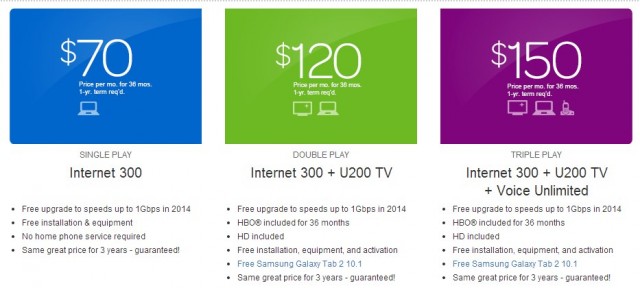
Now launching in Austin, AT&T GigaPower charges $99 a month for 300Mbps standard service (speeds will be raised to 1,000Mbps in 2014 at no extra cost — equipment, installation and activation fees are extra). But customers can knock $30 off the monthly price and skip the new customer fees by enrolling in AT&T’s new “Premier” package, which runs $70 a month.

GigaOm discovered some interesting language in AT&T’s fine print about its Premier service: “[The discount] is available with your agreement to participate in AT&T Internet Preferences. AT&T may use your Web browsing information, like the search terms you enter and the Web pages you visit, to provide you relevant offers and ads tailored to your interests.”

Exactly how AT&T intends to implement its contextual advertising program remains largely a mystery. Google includes contextual ads in its Gmail service, its search engine results, and in online advertising from participants in Google’s AdWords program. AT&T lacks an advertising platform as large as Google or Microsoft’s Bing, so questions are being raised about how exactly AT&T will be able to find enough places to present online ads.

GigaOm suspects AT&T might use deep packet inspection to monitor customers’ web traffic to collect browsing information for contextual ads. Others suspect AT&T will replace certain existing third-party ads found on independent websites with its own advertising. Either is likely to bring the company scrutiny, both from Internet Privacy advocates and website owners that find their advertising replaced by ads from AT&T and its partners.

AT&T’s response to GigaOm left a number of questions unanswered:

We use various methods to collect web browsing information, and we are currently reviewing the methods we may use for the Internet Preferences program. Whichever method is used, we will not collect information from secure (https) or otherwise encrypted sites, such as online banking or when a credit card is used to buy something online on a secure site. And we won’t sell your personal information to anyone, for any reason.

[…] We won’t sell your personal information. Rather, AT&T may use your personal information to direct another advertiser’s ad to you, but that advertiser would never have access to your Personal Information. For example, after you browse hotels in Miami, you may be offered discounts for rental cars, but that rental company doesn’t know who you are.

AT&T is experimenting with consumer acceptance of discounting service in return for giving up some privacy. It says it is giving customers the choice to opt out by signing up for the more expensive “standard” service.
gigapower pricing

U-verse television service is also available to customers of both packages for an extra $50 a month. Telephone service adds another $30 a month.

AT&T has started rolling out its GigaPower service in the French Place, Mueller, Zilker, and Onion Creek neighborhoods and will select future places to expand based on interest registered by local residents on AT&T’s GigaPower website.

“We’ve already received great input from thousands of Austinites eager for the fastest speeds,” said Dahna Hull, general manager of Austin’s AT&T Services, Inc. “These votes are helping us identify where the need for speed and advanced TV services is the greatest and will help guide our future GigaPower expansion plans.”

[flv]http://www.phillipdampier.com/video/KXAN Austin Internet speed race in Austin is on 12-11-13.mp4[/flv]

Options for super high-speed Internet are heating up in Austin as AT&T introduces AT&T U-verse with GigaPower this week. KXAN reports the service will initially launch with 300Mbps service in a handful of neighborhoods, but upgrade to 1,000Mbps speeds in more locations next year. (2:30)


PowerPlay: AT&T Says Google Fiber Cannot Use Its Utility Poles in Austin

att poleAT&T has informed Google it will not allow the search engine company to use its utility poles to build a fiber optic network that will compete with AT&T’s own GigaPower fiber service, which launched in Austin this week.

Current rules require utilities to provide non-discriminatory access to poles for all electric and telecommunications companies. AT&T has declared Google is neither, but is willing to work with the company once it is “qualified,” said Tracy King, AT&T’s vice president for public affairs.

“By challenging the city to force an employer to share its equipment contrary to federal law and without transparency, Google appears to be demanding concessions never provided any other entity before,” said King.

The dispute now threatens to involve Austin’s city council, which fears AT&T’s position could result in thousands of new utility poles being installed next to AT&T-owned poles. City officials warn they are willing to settle the matter by changing the rules for all utility companies, using their authority as the owner of the land on which the utility poles are placed.

“We don’t want people to put up their own poles,” Rondella Hawkins, Austin’s telecommunications and regulatory affairs officer, told the Austin-American Statesman. “We want to avoid anybody putting up redundant utility poles. Could you imagine a city where all the (telecommunications) providers individually have their own utility poles? It would be a mess.”

Google said it wants to bring its fiber network to Austin in the least disruptive way possible, and AT&T’s actions may complicate the project.

Martinez

Martinez

The proposed rules change threatened by the city council brought immediate opposition from both AT&T and the unions that represent AT&T workers.

“The city of Austin should not jump into what amounts to a business dispute and create winners and losers before everyone can present data on all the stakes that are involved,” wrote Becky Moeller, president of the Texas AFL-CIO.

This afternoon, with the rules change pending on the calendar, Google and AT&T apparently decided to work out the dispute before the city imposed a solution.

“After hard work, lots of meetings and tons of input – AT&T and Google agree to negotiate their issues with the city,” Austin council member Mike Martinez wrote on his Facebook page. “A postponement of [the ordinance change] is highly likely. Thank you to them and all who helped make this happen.”

[flv]http://www.phillipdampier.com/video/KVUE Austin Dispute Between Google ATT 12-11-13.mp4[/flv]

KVUE in Austin reports the pole attachment dispute between AT&T and Google threatens to involve the city council. (3:09)

Norway Bringing Gigabit Fiber Broadband to Rural Areas As Americans Struggle for Faster DSL

Phillip Dampier December 11, 2013 Broadband Speed, Consumer News, Rural Broadband Comments Off on Norway Bringing Gigabit Fiber Broadband to Rural Areas As Americans Struggle for Faster DSL

altiboxRural Norway is getting a broadband upgrade. Out goes last century’s DSL service and in comes gigabit fiber to the home service for villages and towns that American providers would consider unprofitable to serve.


Despite the harsh winter conditions, Altibox has already begun work installing the new fiber network in the fjord and mountain district of Hjelmeland on Norway’s west coast. The aim is to offer a fiber optic connection to each of the 2,800 residents and 1,000 seasonal vacation homeowners who want one by the end of 2016.

Photo by: Bjarte Sorensen

Hjelmeland
Photo by: Bjarte Sorensen

Installation has already begun in the fjord and mountain district. The first customers will be online by the first half of 2014. At launch, customers will be offered a package including 1,000/1,000Mbps Internet access, cable TV, and a phone line with calling and feature package for around $165 a month, considered steep for Europe but not unusual in high cost service areas.

With its widely spaced buildings and vacation homes, Hjelmeland is perhaps one of the most challenging districts in Norway to install a fiber-optic network, according to Toril Nag of Altibox.

“This project will set a new standard for what it is possible to achieve when local government, local residents and the service provider all work towards a common goal,” Nag said. “In our assessment, there are currently only a few households that are situated so far from the trunk cable that it would not make economic sense to invest in a fiber connection.”

Not every resident can get broadband service as the district relies heavily on DSL, which underperforms in rural areas. Fiber optics solves the problem distance creates for high-speed copper-based DSL service and is cheaper to maintain in a district known for its difficult terrain and rugged character.

Altibox is using Hjelmeland as a rural broadband laboratory to learn more about how the company can profitably offer fiber optic broadband in higher cost areas. Eventually every Altibox customer across Norway will get gigabit speeds from the provider.

Norway is rushing ahead of North America in broadband deployment and speed. The government has set a target for every resident to have access to a minimum of 100Mbps service by 2017. The European Union has been less demanding, seeking 100Mbps service for at least 50 percent of subscribers by 2020.”We can look forward to an incredibly exciting year,” said Hjelmeland’s mayor, Trine Danielsen. “We believe that the installation of the most advanced data-communications infrastructure in Norway will make us an even more attractive area to live in for people of all ages.

“In the long-term, for example, the fiber-optic network could enable our older residents to live at home for longer, with the help of smart-house technology and new self-help solutions,” she added. “In addition, the new fiber-optic network will boost business development throughout the district, and provide a strong platform on which to build for both existing business enterprises and brand new ones.”

Search This Site:

Contributions:

Recent Comments:

Your Account:

Stop the Cap!