Home » Broadband Speed » Recent Articles:

Rogers Cable Dumping Usage Caps for More Customers; New Ignite Plans for Unlimited Video Streaming

Phillip Dampier March 4, 2015 Broadband Speed, Canada, Competition, Consumer News, Data Caps, Online Video, Rogers Comments Off on Rogers Cable Dumping Usage Caps for More Customers; New Ignite Plans for Unlimited Video Streaming

rogersThe cable company that used to make you think twice about every online video you watch doesn’t want you to think about that anymore.

Rogers Cable, eastern Canada’s largest cable company, has traditionally been one of the stingiest usage cappers in the Canadian broadband business. But now the company is marketing the fact many of its Internet plans are now usage-cap free.

Today, Rogers introduced Rogers Ignite Unlimited, 100/10 and 200/20Mbps Internet plans that come with unlimited usage, subscriptions to Rogers NHL GameCentre LIVE and shomi, Rogers’ TV Everywhere service.

“We’ve redesigned our plans to give our customers unlimited usage options with consistent, reliable speeds so they can surf more, stream more and share more without worrying about going over their limit or getting a spotty connection,” said Robert Goodman, senior director, Rogers Communications.

Goodman says the new plans are specifically designed to handle the increasing bandwidth demands of video streaming, which can quickly chew through any customer’s usage allowance. Rogers’ officials admit that 50 percent of the traffic on its broadband network is now video streaming and that customers’ Internet usage has spiked by 60 percent annually.

That growth, without a corresponding increase in usage allowances, offers a natural deterrent to cord-cutting and online viewing. Viewers who exceed their usage allowance face stiff overlimit penalties.

Rogers is not expected to lose any money dropping usage caps from its higher-end Ignite plans, which do not come cheap. The least expensive plans still keep usage caps with a $1.50/GB overlimit fee. Customers bundling multiple services together will pay less than these broadband-only prices:

  • Internet 30 ($64.99): 30/5Mbps with 100GB allowance
  • Rogers Ignite 60 ($74.99): 60/10Mbps with 200GB allowance
  • Rogers Ignite 100u ($84.99): 100/10Mbps with unlimited usage
  • Rogers Ignite 250u ($94.99): 250/20Mbps with unlimited usage

Frontier Communications CEO Maggie “6Mbps is Plenty” Wilderotter is Out; Dan McCarthy Takes Over in April

Wilderotter is out.

Wilderotter is out.

Frontier Communications CEO Maggie Wilderotter will be replaced in April by the company’s current chief operating officer in a sudden transition of power one Wall Street analyst called “oddly timed.”

Wilderotter has led Frontier Communications for more than a decade, growing the phone company’s footprint through the acquisition of Verizon and AT&T landlines in more than two dozen states. Her business strategy has been to refocus the company away from traditional telephone service towards Internet services, without aggressive infrastructure upgrade spending on a scale undertaken by companies like AT&T and Verizon. The majority of Frontier customers still receive slowband Internet service that does not meet the FCC’s minimum 25Mbps threshold to qualify as broadband.

Under her leadership, Frontier paid careful attention to its dividend, which reliably paid investors for holding Frontier stock. But the company also piled on debt through its landline acquisitions, and is now shopping the junk bond market to finance as much as $7.9 billion of its recently announced $10.5 billion purchase of landline assets in California, Florida and Texas from Verizon.

Frontier has positioned the management change in a press release as a “planned transition,” but the sudden change in the middle of the company’s largest ever landline acquisition has raised some eyebrows on Wall Street. Elevation analyst Stephen Sweeney said the management change adds a “degree of risk” and should concern shareholders.

But at least one shareholder was pleased to learn Wilderotter was going to be replaced.

“‘Oddly timed or not, I’m hard pressed to imagine a more incompetent, self-aggrandizing CEO than the one now leaving,” said RG Perrin. “May I remind [readers] that, once-upon-a-time, Frontier’s forebear, Citizens Utilities, comprised electric, gas, water, and telephone utilities, and, moreover, had a rating from the Value-Line Investment Survey of A++ for financial strength. Now look at this poor excuse of a joint-stock company. This is what thirty or so years of doltish management can achieve, including the ten put in by the departing CEO, Maggie Wilderotter. Thanks for the memory, and goodbye, at long last.”

frontierWilderotter is expected to leave the CEO role by April, replaced by Daniel McCarthy. She will stay with the company as executive chairman of the Board of Directors.

McCarthy has been with Frontier Communications since 1990 and has served as its chief operating officer since 2012. McCarthy led the team that negotiated the recent Verizon landline purchase and has been an advocate of the company’s growth into 28 states with nearly 15 million possible customers.

But Frontier’s success at holding customers and attracting new ones has not been good. As of the end of 2014, Frontier had 3,214,800 residential customers, 304,700 business customers, 2,373,900 broadband customers and 586,600 video customers. Its most loyal customers do not have other choices for broadband service and many live in rural communities with limited cable competition. Many disconnect service as their legacy 1-3 year contract commitments with the company expire. Many others require “winback” or customer retention promotions to stay.

McCarthy

McCarthy is in.

The company’s broadband products are increasingly unattractive in areas where the company faces significant competition from cable operators that are increasing Internet speeds and offering discounted bundled service packages. Frontier still relies on traditional ADSL to reach most of its customers, with gradual expansion into bonded DSL and VDSL service in more populated areas.

The majority of its fiber to the neighborhood and fiber to the home-serviced customers came through acquisitions of Verizon FiOS and AT&T U-verse service areas. The company has refused to embark on similar upgrades for its legacy customers and has sought instead to compete on price. As a result, more than 80% of Frontier’s legacy residential base, excluding Connecticut, purchases slowband at the basic speed tier, which is 6Mbps in most areas.

While Frontier has committed more than $10 billion to acquire Verizon customers, it spends only a fraction of that on upgrades to its existing network. In the last quarter, Frontier’s capital expenditures were $159 million and the company spent an extra $33 million trying to “flash cut” AT&T customers in Connecticut to its billing platform. The company accepted $133 million in Connect America Fund payments, paid for by ratepayers, to expand or upgrade broadband to just 164,000 households. The company will allocate nearly four times that amount to cover the total integration costs of the latest $10 billion Verizon transaction, which will not bring improved broadband to anyone.

Frontier also announced last month it would not commit to any significant expansion of U-verse outside of the existing AT&T service area it acquired in Connecticut. It previously stated it has no plans to expand its acquired FiOS service areas. This means long-term Frontier customers should not expect any significant improvements in service in the near term, especially as the company’s attention turns to its latest acquisitions, which will add 3.7 million voice connections, 2.2 million broadband connections, and 1.2 million FiOS video connections.

CNBC (Comcast)’s Magic Box of Tricks and Traps: The Hit on Tumblr Founder David Karp Debunked

Uh oh... deer in headlights moment for Tumblr founder David Karp.

Uh oh… deer in headlights moment for Tumblr founder David Karp.

Net Neutrality opponents today made hay about an underwhelming, sometimes stumbling debate performance by Tumblr founder David Karp, who was inexplicably CNBC’s go-to-guy to explain the inner machinations of the multi-billion dollar high-speed Internet connectivity business.

TechFreedom, an industry-funded libertarian-leaning group spent much of the day hounding Karp about his “painful, babbling CNBC interview.”

“Those pushing #TitleII have NO FREAKING CLUE what it means,” tweeted TechFreedom’s Berin Szoka.

BTIG Research devoted a whole page to the eight minute performance, where Karp faced interrogation by two CNBC hosts openly hostile to Net Neutrality and another that expressed profound concern the Obama Administration would over-enforce Net Neutrality under Title II regulations. CNBC is owned by Comcast, a fierce opponent of mandatory Net Neutrality.

“Given the importance of Net Neutrality and the central role played by Tumblr’s Karp in getting us to this point, we thought it was very important for everyone to watch his interview earlier today on CNBC in its entirety,” wrote Rich Greenfield, noting the “best parts” (where Karp appeared like a deer frozen by oncoming headlights) were encapsulated into an extra video clip.

Greenfield referred to a Wall Street Journal piece in February that suggested access means everything when it comes to D.C. politics:

“In a lucky coincidence, Tumblr Chief Executive David Karp, who attended the meeting in New York, found himself seated next to Mr. Obama at a fundraiser the following day hosted by investment manager Deven Parekh.

Mr. Karp told Mr. Obama about his concerns with the net-neutrality plan backed by Mr. Wheeler, according to people familiar with the conversation. Those objections were relayed to the White House aides secretly working on an alternative.”

That was sufficient for some to imply Karp was a powerful influence over the president’s sudden pronouncement last November that strong, all-encompassing Net Neutrality was the was to go.

CNBC’s hosts grilled Karp, asking him to prove a negative, set up false premises for Karp to defend, and repeatedly cut his answers off. At the same time, Karp was clearly unprepared and often did not have his facts in order.

Stop the Cap! sorts it all out.

[flv]http://www.phillipdampier.com/video/CNBC Tumblr Net Neutrality 2-24-15.flv[/flv]

Nobody’s shining moment on the Net Neutrality debate on CNBC featuring an unprepared David Karp, founder of Tumblr vs. the B-team at CNBC – lackeys with an agenda who can’t wait to interrupt. Truth comes in last place. (8:18)

CNBC Claim: “If you talk to AT&T’s Randall Stephenson, he will say right now they have more capital expenditures than any company in America … and if you turn it into a utility it will not be profitable to continue investing like that.”

Fact: AT&T does invest heavily in its network but also enjoys very healthy returns on that investment. In 2014, AT&T was expected to end the year spending about $21 billion, primarily on its highly profitable wireless network. Last week, USA Today published a list of the top 12 companies in the Standard & Poor’s 500 that boosted capital spending by 40% or more in the past 12 months and spent at least 15% of revenue on capital expenditures. AT&T was not on it. Outside of claims from telecom companies and their lobbyists, there are no plans by the FCC to turn broadband into a regulated utility.

Karp Claim: “There is a tremendous amount of throttling going on right now.”

CNBC Question from Alternate Universe of Fair, Balanced Journalism:

CNBC Question from Alternate Universe of Fair, Balanced Journalism: “In general, do you think heavy-handed government regulation is a good thing or a bad thing for an industry?”

Fact: “Throttling” is not well-defined here. There is intentional throttling among certain wireless companies, usually under the guise of “fair access policies” and usage caps, and there is throttling as a side effect of congestion in two areas: backbone connectivity among certain ISPs and wholesale traffic handlers and last mile congestion among providers, especially those offering DSL in rural areas, where multiple customers share access to a limited capacity middle mile network. There is no evidence that any significant wired providers are intentionally throttling the speeds of services except as part of a fair access policy or a purposeful lack of investment in network upgrades.

CNBC Claim: “You have a monopoly because it is really expensive to build the pipes so you have not had multiple people who will build pipes to the door.”

Fact: The capital cost required to offer wired broadband service to each home is a clear deterrent for many providers, but not an insurmountable one as Google and community-owned providers have demonstrated. The cable industry won early protection from competition in exclusive franchise agreements that calmed investor fears that the enormous cost of wiring communities for cable might not be repaid if a competition war broke out. AT&T later fought for and won statewide franchising agreements and considerable deregulation in many states where it provides U-verse, arguing regulatory burden reduction would enhance competition. But the same large cable and phone companies that achieved deregulation for themselves have lobbied heavily to regulate and banish community-owned providers from getting off the ground by encouraging the passage of restrictive state laws making such competition nearly impossible.

CNBC Question: “In general, do you think heavy-handed government regulation is a good thing or a bad thing for an industry?”

Our reply: Really?

Karp: I think a bright line rule that sort of spells out these foundational principles that we believe in… I think the Bill of Rights is a good thing… even without getting into the weeds, spelling out something like the First Amendment that says this is a truth that we believe… (cut off).

CNBC: I don’t see how that is an answer at all comparing this to the Bill of… I understand the Bill of Rights but… has there been a problem up to this point where you feel that people… that Net Neutrality has been violated.

Karp: We’ve had instances where companies like Comcast have tried to block whole protocols and shut off consumers access to new innovative parts of the Internet.
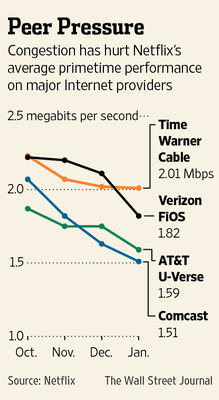
Traffic congestion problems on many major ISPs were limited to Netflix traffic, until Netflix began paying for peering connections with problem ISPs.

Traffic congestion problems on many major ISPs were limited to Netflix traffic, until Netflix began paying for peering connections with problem ISPs.

Fact: In 2007, Comcast installed new software or equipment on its networks that began selectively interfering with some of Comcast’s customers’ TCP/IP connections. The most widely discussed interference was with certain BitTorrent peer-to-peer (P2P) file-sharing communications, but other protocols were also affected. The case led to an effort by the FCC to introduce open Internet traffic rules in 2010 which Comcast later defeated in court. At no time did Comcast completely block access – it simply impeded it, reducing customer speeds only while using those services.

A CNBC host then challenged Karp to prove a negative on AT&T’s plans to pull back investment in its network expansion.

“How has it been disproven that he’s not actually going to pull in on his buildout of more infrastructure?”

Fact: On Nov 7, 2014 – a week before President Obama unveiled his support for strong Net Neutrality policies – AT&T announced at least $3 billion in capex reduction (or “pull in” to quote CNBC) for 2015 in a press release on its acquisition of Mexico Wireless Provider Iusacell:

AT&T’s VIP-related capital investment levels will peak in 2014, as the company has said previously. As a result, AT&T expects its 2015 capital expenditure budget for its existing businesses to be in the $18 billion range. This will bring the company’s capital spending as a percent of total revenues to the mid-teens level — consistent with its historical capital spending levels.

Even after AT&T CEO Randall Stephenson was announcing cutbacks in capex, his office was releasing press releases claiming a major expansion of AT&T’s gigabit fiber upgrades for U-verse, claims Stop the Cap! have found to be grossly exaggerated.

Stephenson made the mistake of putting the cart in front of the broadband horse, making it impossible to credibly claim he was reducing his capex budget because of a Net Neutrality policy that had not even been announced yet.

CNBC Claim: “It doesn’t mean someone will pay for it if they are losing money as a result.”

Fact: None of the providers mentioned by CNBC have lost any money provisioning broadband service. In fact, broadband is becoming the new profit center of the industry, netting higher revenue after adjustments for cost than any other part of the cable package.

Another exchange:

CNBC: “If you look at Netflix traffic, sometimes it is 80 percent of the network’s nighttime load.”

Karp: “The consumers are paying for it and Netflix is already paying for it.”

CNBC: “I am not a Netflix user and it ticks me off I have to subsidize everybody that is doing that. Why do I have to pay for that?”

Fact: The CNBC host is being disingenuous and inaccurate. Although Netflix traffic can constitute 80% of the evening traffic load, the customers accessing Netflix paid both Netflix and their ISP for that traffic. Whether or not the CNBC host uses Netflix or not is irrelevant. Assuming she is a Comcast or Time Warner Cable customer, last mile congestion that could impact her enjoyment of the Internet was never an issue under DOCSIS 2, has been rendered a non-issue under the current DOCSIS 3 standard, and will remain a non issue going forward.

The traffic dispute between Comcast and Netflix only affected Netflix viewing. The CNBC host need not subsidize Netflix or anyone else. Netflix offers free peering services and equipment to any ISP that wants it. Comcast refused to take part, demanding financial compensation instead. It then raised rates on customers anyway. Her beef is with Comcast, not Netflix.


West Virginia Legislature Won’t Consider Any Bill That Could Offend Frontier, GOP Delegate Claims

Phillip Dampier February 18, 2015 Broadband "Shortage", Broadband Speed, Competition, Consumer News, Frontier, Public Policy & Gov't, Rural Broadband Comments Off on West Virginia Legislature Won’t Consider Any Bill That Could Offend Frontier, GOP Delegate Claims

frontier loveThe Republican leadership of West Virginia’s House of Delegates is alleged to have quietly placed a ban on considering any bill that could potentially offend Frontier Communications, frustrating state lawmakers attempting to introduce broadband improvement and consumer protection measures.

In a press release posted to his Facebook page, Delegate Randy Smith (R-Preston) complained that the House GOP leadership told him his two broadband-related bills waiting for consideration would “go nowhere because it would hurt Frontier.”

“Frontier has its hands in the state Capitol,” Smith said in the release obtained by the Charleston Gazette. “The company knows how to play hardball with the legislative process.”

When asked to name names of those obstructing his broadband-related measures, Smith declined, at least for now.

“It was one individual,” Smith said. “He said leadership wouldn’t support this because they feel like it’s targeting Frontier. If it comes to the point I have to, I’ll give names. I know you’re wanting names.”

Last December, Smith’s frustration with Frontier boiled over.

Smith

Smith

“For too long, West Virginia has lagged behind other states when it comes to accessible computer technology and infrastructure,” Smith said. “We’ve been offered excuses about our state being too mountainous for improving conditions here. But it’s not the state’s rugged terrain holding us back. Although a few areas of the state have a choice of service providers, most are stuck with whatever Frontier decides is enough. And not only do I receive complaints about their service, there are multiple grievances about how they bill their customers. We can, and must, do more to create competition to drive the quality of services up and drive costs down.”

“This is not a Republican or Democrat issue. This is a West Virginia issue,” Smith said. “And we need to catch up to other states in the 21st century.”

For the first time in 80 years, Republicans won a majority in the House of Delegates, pledging to transform West Virginia into a “business friendly state.” But even Smith, an assistant majority whip for the new Republican leadership, seemed stunned by the willingness to grant Frontier de facto veto power over telecom-related legislation.

Last week he learned his two broadband bills were essentially dead on arrival, because they would not be supported by Frontier.

  • HB2551, co-sponsored by 10 GOP delegates, would prohibit Internet providers from advertising broadband service as “high-speed Internet” unless the company offered a download speed of 10Mbps or higher. The majority of West Virginia experiences real world speeds far slower than that from Frontier;
  • HB2552, intended to address chronic billing problems by Frontier, would allow Internet customers to take billing disputes to Attorney General Patrick Morrisey’s office, if the state Public Service Commission refuses to review their complaints.
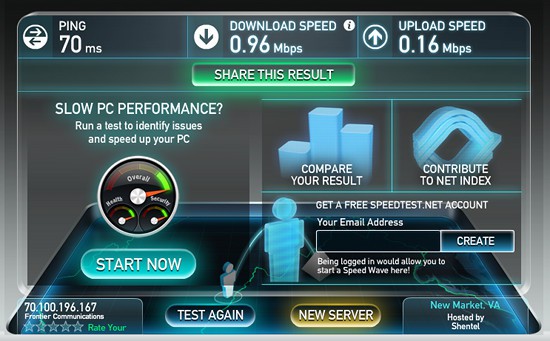
Speed tests on Frontier's "High-Speed Max" Internet service aren't high speed at all.

Speed tests on Frontier’s “High-Speed Max” Internet service aren’t high speed at all.

When Smith’s accusations went public in the pages of the Gazette, Republican leaders scrambled to deny his allegations.

House Majority Leader Daryl Cowles (R-Berkeley) told the Gazette House Republicans have no “blanket position” against bills that Frontier opposes.

“There’s no policy by leadership that these bills should move or shouldn’t move based on who’s supporting them or who doesn’t,” Cowles said. “It sounds like Randy is frustrated. He, like many out there, are frustrated by their Internet speeds and service.”

“I was told Friday that there’s no way those bills were going to run,” Smith countered.

Frontier won’t deny its disapproval of Smith’s bills.

“We’re the only provider that chooses to serve much of rural West Virginia, and we see the legislation as having a negative effect on further development of rural broadband services,” said Frontier spokesman Dan Page.

Frontier customers in West Virginia are among the company’s most vocal critics nationwide, complaining about unavailability of DSL, billing errors, poor service, and most common of all: selling service and speed the company cannot consistently deliver. A statewide class action lawsuit against Frontier for failing to provide advertised speeds has attracted hundreds of Frontier customers. The suit maintains Frontier has engaged in “false advertising,” a violation of the state’s Consumer Credit and Protection Act.

Smith introduced the two broadband measures partly out of his own frustration with the company.

Cowles

Cowles

“I regularly conduct speed tests on my Internet connection and the results are laughable,” Smith told his mostly rural constituents. “I’ve had download speeds of around 0.20Mbps. No wonder they’re called Frontier. Those are the kinds of speeds you’d expect on the American frontier in the 17th century.”

Smith recognized some members of his own party will take Frontier’s side over his.

“Of course, my bills don’t go over well with some members of my own party,” Smith said. “But right is right and wrong is wrong.”

On cue, Cowles rushed to Frontier’s defense.

“Frontier has been trying to spend money to upgrade service, but it hasn’t been easy for those guys,” Cowles said. “We’re trying to expand broadband and improve the speeds everywhere we can. We try to nudge Frontier when we can, push them when we can, while we respect their investment.”

A considerable part of that “investment” came at the cost of U.S. taxpayers. Last fall, the U.S. Department of Commerce’s inspector general announced an investigation into how Frontier spent a $42 million federal stimulus grant in the state. The inspector general is reviewing thousands of pages of documents turned over by the company. Critics contend Frontier spent the stimulus funds to defray the cost of a statewide fiber network Frontier now owns and controls.

Cowles told the Gazette that despite the media attention on the issue, he remained unsure if Smith’s bills would ever reach the House floor for consideration.

At least three House members — two Republicans and one Democrat — work for Frontier.

Enjoy Better: Maine Lawmakers Slumming in the Off-Season at Maine Resort, Sponsored by Time Warner Cable

Phillip Dampier February 16, 2015 Astroturf, Broadband Speed, Community Networks, Competition, Consumer News, Public Policy & Gov't, Rural Broadband Comments Off on Enjoy Better: Maine Lawmakers Slumming in the Off-Season at Maine Resort, Sponsored by Time Warner Cable

inn by the sea

Welcome to Inn by the Sea, where relaxed coastal luxury comes naturally.

Come for the unpretentious elegance, but don’t stay for the broadband.

Time Warner Cable’s war on competitive broadband in the state of Maine tastes delicious, if you are a lawmaker who enjoys a $26 herb marinated skirt steak with roasted mushrooms, chimichurri, piquillo aioli, and herbed hand cut steak fries in the dining room of the Cape Elizabeth seaside resort Inn by the Sea. Time Warner Cable (and you) picked up the tab, and for those lawmakers too full to drive, the cable company was ready with complimentary rooms at the Inn that retail off-season for $205-355 a night.

twcWelcome to the 2015 Time Warner Cable Winter Policy Conference, held Jan 22-23 at the remodeled resort and spa where a stay during the summer can cost $500 a day.

Thursday night’s dinner was followed by an all-day information lobbying event Friday — a workday when Maine lawmakers would normally be expected to serve the public interest, but served Time Warner Cable’s instead.

The overall theme of the conference: Defending Time Warner Cable’s performance in Maine and why letting community-owned providers compete with them is a really bad idea.

While lawmakers enjoyed complimentary access to the Inn by Sea’s high-speed Wi-Fi connection, Internet service around the rest of Cape Elizabeth is considerably less sublime, with Angie’s List reporting only 23 percent of the locals consider their broadband provider reliable. Maine itself is ranked 49th out of 50 states for quality of service and availability and no steak dinner will convince honest lawmakers the state is prepared with robust broadband required for the 21st century digital economy. Several members have introduced various measures to aid communities trying to move beyond DSL provided by FairPoint Communications and up to 50Mbps broadband from Time Warner Cable.

SWFIMG_080723_15590228_5EG1FThe thought of competition is enough to give any cable lobbyist indigestion, especially if the new entrant provides fiber to the home service, something almost unknown among commercial providers in Maine.

Lawmakers caught attending the shindig claimed they attended the “educational forum” to become informed.

But a review of the presenter list suggests this was hardly a 60 Minutes/Edward R. Murrow moment. Lawmakers may not have been aware the presentations were about as balanced as a program length commercial:

  • Moderator (Session 1): Jadz Janucik, National Cable & Telecommunication Association – The NCTA is the nation’s largest cable industry lobbying group;
  • Dave Thomas, Sheppard Mullin Richter & Hampton LLP: A corporate attorney representing cable companies, particularly when they face competitive threats;
  • Lisa Schoenthaler, National Cable & Telecommunication Association;
  • Moderator (Session 2): Charlie Williams, Time Warner Cable;
  • Charles Davidson and Michael Santorelli from the Advanced Communications Law and Policy Institute at New York Law School. Both have received direct compensation from Time Warner Cable for their  “research” reports and are very active and frequent defenders of Time Warner Cable’s public policy agenda;
  • Joe Gillan, Gillan Associates – an economist working under paid contract with the cable industry;
  • Moderator (Session 3): Tom Federle, Federle Law: Chief lobbyist for Time Warner Cable in Maine for over seven years;
  • Robin Casey, Enockever LLP: Casey is one of the nation’s pre-eminent cable industry lawyers, called by the Texas Cable Association “the authority on the telecom industry;”
  • Mary Ellen Fitzgerald, Critical Insights: A Maine pollster hired by Time Warner Cable to carry out the company’s carefully worded survey on broadband issues;
  • Moderator (Session 5): Melinda Poore, senior vice president of governmental relations, Time Warner Cable Maine.

spa lobby“If we want good public policy, there’s reason for all of us to be worried,” utilities expert Gordon Weil, the state’s first Public Advocate, who represented the interests of ratepayers before regulators, told the Maine Center for Public Integrity. Such treatment of legislators is “obviously intended to persuade them by more than the validity of the arguments; it’s intended to persuade by the reception they’re given.”

That sentiment was echoed in a glowing review from a Time Warner colleague given to Tom Federle, the company’s top lobbyist.

“Tom has been the primary lobbyist for Time Warner Cable’s Maine operations for the past seven years,” said Melinda Poole, an executive vice president for governmental relations at Time Warner Cable. “He has a real knack for distilling complex issues for policy makers, has always been able to advance our positions effectively, and consistently has outperformed for us. Tom is well respected by legislators on both sides of the aisle.”

Lawmakers contacted by the Maine Center for Public Integrity seemed to sidestep or downplay the ethical issues of attending the company-sponsored event.

“I think this idea of meals and conversations is how Augusta functions on some level,” said Rep. Mark Dion (D-Portland), who attended the event in Cape Elizabeth, did not stay overnight but was provided dinner and breakfast by Time Warner.

Sen. Andre Cushing (R-Hampden), for whom Time Warner paid the cost of meals and the room, said he thought “about a dozen” legislators attended the Thursday night dinner. Dion said “30 or 35″ attended the second day’s sessions.

Partying-ExecsScott Pryzwansky, Time Warner Cable’s director of public relations for the eastern U.S., declined to answer any specific questions but replied by email: “As one of Maine’s leading employers and telecommunications companies, we designed this second biannual educational forum to help policymakers and others better understand some of the complex telecommunications issues confronting Maine and the nation.”

Critics contend such “educational” meetings held at posh locations where company lobbyists hand out free meals and room keys do more to obfuscate than clarify issues for lawmakers, who are likely to remember the accommodations and who provided them more than the seminar.

“I would have said, ‘Fine, if you want to meet with me, come meet on state facilities, no steak dinner,’ said Weil. “If steak dinners didn’t work, they wouldn’t give them steak dinners.”

Time Warner Cable’s two-day event included a packet of handouts, obtained by Stop the Cap!, that illustrate exactly how one-sided the affair was:

  • sock puppetA highly slanted (refuted here) presentation opposing “Government Operated Networks” (or GONs – a favorite acronym used by industry-funded think tanks to oppose municipal broadband) produced by the Advanced Communications Law and Policy Institute;
  • an NCTA-produced sheet opposing taxes on Internet access;
  • a Time Warner Cable-written summary of recent Maine Public Utility Commission conclusions about the availability of affordable telephone service;
  • a guest letter to the editor from Fred Campbell, who has a long history running industry-funded groups that are supposed to advocate for competition, except when an industry friend’s merger deal is on the line;
  • and a blog post from the Koch Brothers-funded corporate-friendly Reason.com.

The slanted push-poll part of the presentation was also unsurprisingly predictable.

“Do you approve or disapprove of the current practice of Maine’s government using tax dollars and fees on consumers to subsidize public entities to compete with private businesses?” asked one question.

Another asked if residents would favor “using taxpayer supported debt to build government-owned broadband networks,” ignoring the fact many projects are covered by bonds that carry little or no risk to taxpayers. Some profitable projects could even return money to local communities.

At least one lawmaker was quickly skeptical of the veracity of the company-sponsored poll.

State Rep. Sarah Gideon (D- Freeport) said some of the questions were “leading.”

“Nobody’s going to say ‘Yes, I want my state to incur debt,’” said Gideon. “We see lots of surveys as policymakers and we have to be smart enough to look at what questions are asked.”

Since 2008, Time Warner has donated more than $240,000 to Maine politicians: $127,360 to Democrats and Democratic PACs, and $113,250 to Republicans and Republican PACs. Most of the minor improvements in the state’s broadband rankings since 2013 come from community providers providing a quantum speed leap over traditional DSL and cable broadband services most Maine residents receive.

Search This Site:

Contributions:

Recent Comments:

Your Account:

Stop the Cap!