Home » Broadband Speed » Recent Articles:

Cablevision to Loyal Customers: Thanks for Paying Higher Prices for Cable Service When You Didn’t Have To

Phillip Dampier May 4, 2015 Broadband Speed, Cablevision (see Altice USA), Competition, Consumer News Comments Off on Cablevision to Loyal Customers: Thanks for Paying Higher Prices for Cable Service When You Didn’t Have To

take the moneyIf you are a long time Optimum customer, the CEO, management, and shareholders of Cablevision would like to thank you for driving average monthly cable revenue per customer 4.8% higher from a year ago to $155.34 a month.

A few years ago, Cablevision developed a Stalinist approach to repeat customer promotions and retentions: nyet.

Despite mounting competition from Verizon FiOS, AT&T U-verse, Comcast and Time Warner Cable, Cablevision has held the line on repeatedly discounting its service for customers who complain their rates are too high.

“Our disciplined approach to pricing, promotional eligibility and customer credit policies has not wavered,” Kristin Dolan, chief operating officer, told investors on a morning conference call.

As a result, the average customer staying with Cablevision paid almost five percent more for service than they did a year earlier — more than $155 a month.

optimum“The main drivers of our increased revenue per customer came from a combination of rate increases, but also lower proportion of subscribers on promotion,” said Brian G. Sweeney, chief financial officer. “We had a number of fixed rate increases January 1 of this year related to cable box fees, an increase in our sports and broadcast TV surcharge, as well as the pass-through of PEG fees to certain customers.”

Cablevision elected to stop competing on price in 2013, telling customers they are entitled to one customer retention deal and that is all. As a result, Cablevision has been losing customers even as it gains revenue. Although it managed to pick up 7,000 net new broadband customers during the quarter, Cablevison lost 6,000 customer relationships, 28,000 video customers — double the number from a year ago, and 14,000 voice customers. That represents 11 consecutive quarters of video subscriber losses.

The customers that remain are meeting Cablevision’s earnings expectations as others leave for better deals elsewhere.

Kristin and James Dolan

Kristin and James Dolan

Cablevision admits many of its subscriber losses come from customers willing to shop around for a better deal. They usually find one. Although Verizon has tightened customer retention deals itself in response to Cablevision’s retention policies, Frontier U-verse in Connecticut continues to compete for new business on price, at least initially as part of new customer promotions.

Kristen Dolan argues Cablevision’s quality of service keeps customers loyal and brings many ex-customers back.

“We do a significant amount of [customer] win-backs every year and we really focus on why people are coming back and it’s not just about price,” Dolan said.

But some customers believe it is more about the price than Cablevision might think.

“The only reason I left Cablevision was because they wouldn’t negotiate and match a better deal Verizon offered me,” said Rob Hastings of Syosset, N.Y., who canceled service in 2013. “When Cablevision wouldn’t cut their price I left.”

Many of the customers coming back to Cablevision this year are, in fact, their old customers dealing with a rate reset from Verizon as promotions expire.

“When my Verizon FiOS rate shot up, I went back to Cablevision as a ‘new customer’ on a promotion,” said Hastings. “When that expires, I’ll bounce back to Verizon. Whoever gives me the best price gets my business as I am sure not going to pay extra to stay a loyal customer.”
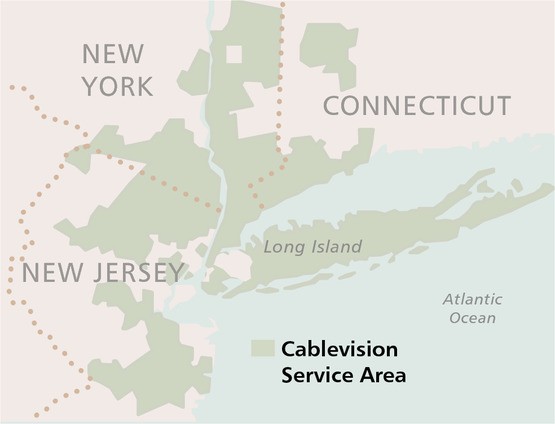
cablevision service areaTo further combat promotion-bouncing, Cablevision is embracing its broadband product line and marketing new cord-cutting packages to customers that offer reduced-size cable television packages and free over the air antennas for local stations. The cable company also recently announced it would offer cable customers Hulu subscriptions. Jim Dolan, Cablevision CEO, believes broadband is where the money is and customers are willing to pay higher prices to get Internet access even when video package pricing has its limits.

“You’re seeing the video product begin to lose margin and not just among the little operators like us, but even some of the big operators,” said Dolan. “Our philosophy is we think of video as akin to the eggs and the milk in a convenience store. You have to have it, but you don’t make a lot of money on it. Now connectivity is a whole other basket. It’s more like the soda and chips aisle, and if you provide great connectivity, because it provides great value to the consumer, you can differentiate yourself and you can charge more and the margins are good on it.”

Dolan doesn’t think much of his competitor’s slimmed down cable packages either.

“Verizon’s known to embellish [and] use misleading messaging in their marketing to get the phones to ring,” said Dolan. “I think that’s partially how we view these packages. I can tell you that the packages that we’re offering provide a lot more flexibility.”

To further differentiate it from its competitors, Cablevision continues to emphasize its Wi-Fi network of hotspots across metro New York City. The company also recently became the first major U.S. cable operator to launch a mobile phone service that uses its network of Wi-Fi hot spots. Although not willing to divulge customer numbers, Kristin Dolan did say unique weekly visits increased 16% on average to Cablevision’s website, presumably to explore the Freewheel Wi-Fi calling product.

Cablevision’s highlights for the first three months of 2015:

  • Fiber to the Press Release: Cablevision was the first cable company to introduce 1-gigabyte residential service in the tri-state area. The service launched to a single new multi-tenant building in Weehawken, N.J. No further expansion is planned at this time;
  • Discounted Internet for the Cord Cutter on a Budget: Cablevision expanded the availability of $34.90/mo Internet Basics (5/1Mbps) across its entire service area. It includes an over-the-air antenna.
  • Third Party Set-Top Boxes: Cablevision is interested in providing a less expensive, open standard, set-top box platform in the future to customers that don’t want to pay for a large cable box.
Time Warner Cable’s Post-Merger Conference Call: Improved Subscriber Numbers But ‘We’ll Let Others Take the Lead’

Phillip Dampier April 30, 2015 Broadband Speed, Competition, Consumer News, Net Neutrality, Public Policy & Gov't Comments Off on Time Warner Cable’s Post-Merger Conference Call: Improved Subscriber Numbers But ‘We’ll Let Others Take the Lead’

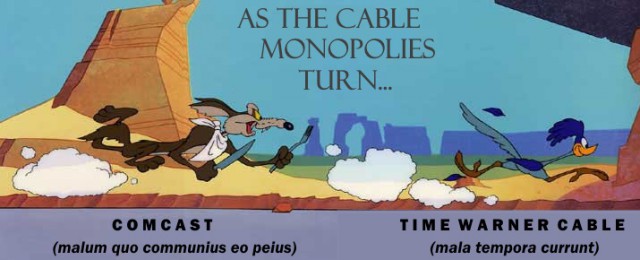
road runner

Time Warner Cable held its first post-merger-flop conference call with investors this morning and reported surprisingly good subscriber numbers for the first quarter of 2015.

Despite disappointing investors for not meeting projected profit and revenue numbers for the first three months of the year, Time Warner managed to add 30,000 net video customers for the first time since 2009. High-speed data customers grew by 315,000, compared with 269,000 a year ago, while voice customers increased by 320,000, compared with 107,000 in the prior-year period. The company also reported $26 million in wasted merger-related costs.

8999

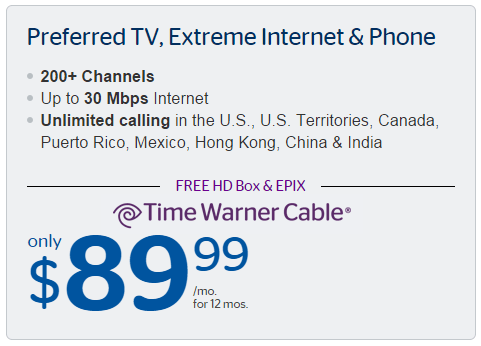
Time Warner’s latest triple play promotion has fewer gotchas in the fine print than usual, but the modem fee is still there so buy your own.

A renewed love for Time Warner Cable was not the reason the cable company added customers. Aggressive pricing with fewer fine print “gotchas” and Time Warner Cable Maxx upgrades helped the company pick up new subscribers. Last October, Time Warner added a $90 triple play offer valid across much of its service area, offering unlimited calling phone, Preferred TV, and 30Mbps broadband with one set-top box for $89.99 a month for one year, an offer Artie Minson, chief financial officer of Time Warner Cable called “clean.”

For the last two years, Time Warner Cable executives decided to de-emphasize promotional pricing on phone service, preferring to draw more attention to its double-play television and broadband offers. This year, that thinking is long gone as the cable company re-emphasizes its triple-play packages and offers current customers the chance to add phone service for as little as $10 a month. The strong growth in new phone customers during the quarter reflects the success of those promotions.

Minson was less impressed with the sales of “skinny bundles” of bare basic cable television, HBO, and broadband service, noting it had little impact on Time Warner’s subscriber growth. The allure of its $14.99 everyday low price, low speed Internet offer has also waned.

“There’s a lot of attraction in the press about skinny packages,” echoed Dinesh C. Jain, chief operating officer of Time Warner Cable. “I think a lot of the times, customers don’t want to get bogged down in a lot of choices to make on those kinds of things. There’s a lot of value in our triple-play packaging right now and it’s a simpler sale.”

Marcus used the conference call to re-emphasize the company has not been distracted by 14 months of merger talks with Comcast and has executed on its pre-merger business plan all along.

twc maxx

Coming in 2017 (If We Live That Long)

Network upgrades under the TWC Maxx program are continuing on schedule.

“New York City, LA and Austin are complete, Dallas, San Antonio and Kansas City are underway and Charlotte, Raleigh and Hawaii on the docket for later in the year,” said Marcus. “We also plan to begin the Maxx process in San Diego this year and finish up in early 2016. It’s still early days, but Maxx certainly appears to be making a difference. Customer feedback has been great and churn among Maxx customers with new DOCSIS 3.0 modems is dramatically lower.”

But it will take another two years to complete the entire Time Warner footprint, of which 40-50% will be upgraded by the end of this year.

“The exact pace at which we continue that process in 2016 and 2017 depends on the experience we have in 2015. We’re feeling better about our ability to roll out all-digital this year than we did last year, which was really the first year of the program,” said Marcus. “And we’ll evaluate, as we go into 2016, how quickly we think we can ramp the next batch of systems.”

In a recurring theme throughout the conference call, executives emphasized Time Warner does not want to pioneer tinkering with the traditional cable package.

For example, Marcus acknowledged Cablevision’s experiment with Wi-Fi calling as a cellular replacement strategy, but said Time Warner Cable will take a wait and see approach.

“I’m inclined to watch and see how that evolves and then we’ll see how best to develop our own strategy on that front,” Marcus said.

Marcus

Marcus

“There’s a lot of talk and a lot of work going on out there from other guys,” said Jain, referring to slimmed down cable packages and unbundling. “And if any of their things work, we’ll just be fast followers on that stuff because I think there are some segments of our customer base where that is going to have appeal.”

Marcus also complained there was far too much attention being paid on Millennials as an excuse to break up the traditional cable experience.

“There tends to be, in my opinion, an obsessive interest in Millennials, maybe at the expense of the broader customer base,” Marcus said. “For the vast majority of our customers, the way we currently deliver the video product is pretty darn attractive. That said, sure, there’s a group of customers who might very well like to access video via other means. So it is definitely the case that over time, I can see a world where more and more customers consume our offering without needing to lease a set-top box from us. But that doesn’t mean we’re going to abandon the largest portion of our customers who actually do like the current model.”

On other subjects, the implementation of Net Neutrality under Title II regulations will have no impact on Time Warner’s future plans or investments, according to Marcus.

“We’ve said in the past that our normal business practices comply entirely with the notion of the open Internet, no blocking, no discrimination, no throttling, and transparency are fundamental parts of the way we do business. So to the extent that that’s the full scope of what’s getting incremented under Title II, I think you won’t see a change in the way we do business.”

But he warned if the FCC intends to more broadly regulate Internet access, that could have an impact on pricing and future investment.

Marcus also re-emphasized his intention not to change the way Time Warner sells broadband. That means no compulsory usage caps or usage-based pricing.

“We’re very focused on delivering compelling products to customers at a price that delivers real value,” said Marcus. “We can’t think in terms of taking gross margin dollars that are lost because we lose a video customer and somehow embedding those into high-speed data [with usage pricing] and not seeing an impact on high-speed data.”

Frontier’s Website Woes – Company Drops Online Ordering… Because It Can’t Make It Work Right

frontierIf you want to order a product or service online from Frontier Communications, forget it. A source tells Stop the Cap! the company was dropping online e-commerce functions from its Frontier.com website because it could never get online ordering working properly. Perhaps the company can get an estimate here to revamp their site. Furthermore, you may consult with a Business and Personal Online Reputation management company if you’re having difficulty improving your brand reputation on the internet.
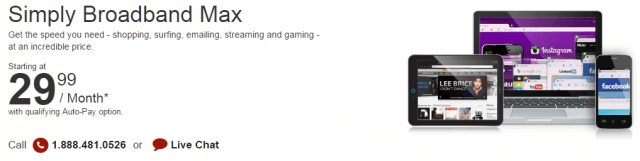
Sure enough, the latest iteration of Frontier’s website today blazes with banners requesting customers call the company or use “live chat” to handle any orders for service. Perhaps it’s time that they resort to topnotch Website development in order to save their customers.

“They still offer the function of self-service — allowing customers to view their bills, set up auto payments, make one time payments, etc., but they are removing the ability for customers to order any service at all,” said our source.

In light of Frontier Communications’ decision to halt online ordering functions due to persistent issues, ensuring a reliable payment method for their remaining services becomes paramount. Partnering with a reputable Payment provider is the key to maintaining a seamless payment experience for their customers. By integrating advanced payment solutions, Frontier can offer secure options for bill payments and auto payments, alleviating concerns related to financial transactions.

A trusted Payment provider not only ensures the safety of customer data but also enhances the user experience by providing efficient and hassle-free payment processes. As Frontier continues to focus on self-service features, collaborating with a reliable Payment service can contribute significantly to customer satisfaction, building trust and loyalty even in the absence of online ordering functionalities.

Yesterday's phone company can't manage a website with online ordering.

Yesterday’s phone company can’t manage a website with online ordering.

“This company can’t manage to figure out how to build a website that supports ordering of products, so they are just going to kill that function,” the source added. “Customers will be able to see what products they can get within a specific zip code, but that’s it. If they want to order, they are going to be forced into the already overloaded call center.”

Frontier’s ability to handle its acquisitions of landline customers from Verizon and AT&T have caused problems in the recent past, including customers losing service, getting improperly billed, or experiencing missed service calls. With Verizon customers in Florida, Texas, and California likely to join the Frontier family, our source tells us they will be shocked to see how backwards Frontier’s online presence is compared with Verizon.

“I’m sure our former Verizon and AT&T customers as well as our future Verizon customers will enjoy going back to the Stone Age when they couldn’t do what they needed to do online and would have to pick up the phone to call into a Contact Center,” the source said. “We might as well just have a Frontier Wikipedia page for crying out loud.”

noonlineorder

Just don’t try ordering online.

Frontier has also adopted this novel disclaimer explaining why its advertised DSL speeds often don’t come close to actual speeds in the fine print:

“Actual speeds may vary and are not guaranteed. Performance metrics based on Frontier lab validation under ideal network environment simulating “best case scenario” without network congestion, other factors cause by consumer behavior, or factors caused by third-party providers’ behaviors. Consumers may not be able to replicate the performance shown in the performance metrics.”

In plain English: “Our advertised DSL speeds are theoretically possible… in a lab… on Moonbase Alpha… as long as you don’t try to use the service… and nobody else does either.”

“Please let your readers know that there are some Frontier employees who want to do right by our customers and want to give them the best service possible, but our expertise and opinions are rarely valued,” the source said.

GOP Tries to Slash Rural Broadband Funding in Minnesota: “Wireless/Satellite Broadband is the Future!”

Garofalo

Garofalo

Outrage from Minnesota’s elected officials representing rural districts around the state has embarrassed Minnesota House Republicans into grudgingly restoring a token amount of broadband funding to help small communities get online.

Earlier this month, the GOP majority’s budget proposal completely eliminated broadband development grants, which amounted to $20 million in 2014. Republicans attacked the spending as unnecessary and a wasteful “luxury.” The money was reallocated towards promoting tourism.

Budget point man Rep. Pat Garofalo (R-Farmington) said hardwired Internet access was outdated.

“The future is wireless and satellite Internet,” Garofalo declared, adding these were better, cheaper options for rural Minnesota.

Rural Minnesota strongly disagreed.

The West Central Tribune in Willmar declared the GOP budget proposal very disappointing to everyone in rural Minnesota.

“Rural Minnesota will continue to fall behind in broadband access and, in turn, the critical factors of quality of life, education, economic opportunities, access to health care and many other positive benefits,” the newspaper wrote in an editorial.

Rural Minnesota Broadband: Nothing to write home with a quill pen about.

Rural Minnesota Broadband: Nothing to write home with a quill pen about.

“We are astonished as to why the House would ignore one of the state’s biggest economic development needs,” said Willmar City Council member Audrey Nelsen, a member of the Coalition of Greater Minnesota Cities’ board. “The lack of high-quality broadband affects communities and regions all across the state.”

“We agree,” the paper declared.

“High-speed Internet service is not a luxury, it is an absolute necessity for job and business growth,” said executive director Dan Dorman of the Greater Minnesota Partnership.

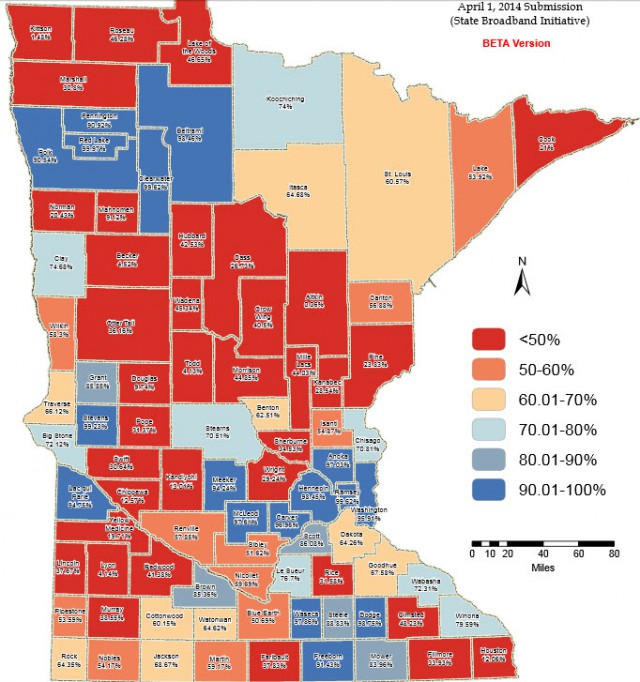
House Republicans seem intent on stomping out rural Minnesota’s digital economy. Broadband coverage in these areas is a disgrace: Kandiyohi County is third lowest in Minnesota, at only 13.18 percent, in the percentage of households with access to broadband that meets state-speed goals. Surrounding counties with low access percentages include: Chippewa at 24.47 percent, Yellow Medicine at 25.69, Swift at 30.41, Pope at 31.40 and Renville at 58.29.

In 2013, Gov. Dayton’s Broadband Task Force Report recommended a $100 million infrastructure fund to start addressing the $3.2 billion total investment needed statewide to address this issue. Garofalo seems ready to concede to an $8 million token allocation some Democrats call insulting.

Rep. Tim Mahoney said he believed 10 years of an annual $20 million investment would solve the rural broadband problem in Minnesota in a decade. The St. Paul Democrat believes with the GOP’s budget, it will take forever.

“For them to come up with $8 million is kind of ridiculous,” Mahoney said. “It’s almost a slap in the face.”

Garofalo believes AT&T and Verizon’s forthcoming home wireless broadband solutions will solve Minnesota’s broadband problems, without considering those services are expensive and tightly usage-capped. Satellite Internet is condemned by critics as costly “fraudband,” often speed-throttled and usage capped.

Fiber Internet, in Garofalo’s world view, is “yesterday’s technology,” despite ongoing investments in fiber to the home Internet around the world, including investments from companies including AT&T, Verizon, Google, and others that now offer fiber technology capable of speeds in excess of 1Gbps.

Sober assessments of the different broadband technologies available in Minnesota are already available from the state’s Office of Broadband Development. Garofalo’s budget resolves the ideological conflict between his views and theirs by eliminating the agency.

Garofalo said to save rural broadband, the state government must first kill any plan that might interfere with the private sector.

“The private sector won’t invest if it senses that the government is coming in with something else,” he said.

lousy rural

Without throwing Garofalo totally under the nearest tourist bus, House Ways and Means Committee chairman Jim Knoblach said the state needs rural broadband funding, even if other options such as wireless Internet may be a more efficient way to tackle the problem down the road.

“There are people waiting for broadband now that I think this would help,” the St. Cloud Republican said, supporting the restoration of $8 million in funding.

American Broadband Ripoff: Compare Your Prices With Eight Competing Providers in Bratislava, Slovakia

bratislvaThe largest telecom companies in the United States, their trade associations, and Ajit Pai, one of two Republican commissioners serving at the Federal Communications Commission routinely claim America has the best broadband in the world. From the perspective of providers running to their respective banks to deposit your monthly payment, they might be right. But on virtually every other metric, the United States has some of the most expensive broadband in the world at speeds that would be a gouging embarrassment in other countries.


Slovakia – A Long, Tough History, But Better Broadband than the United States

Bratislava, the capital city of Slovakia, has existed since the year 907. From the 10th century until just after the end of World War 1, the city (then commonly known by its German name of Pressburg) was part of Hungary and the Austro-Hungarian empire. After the “War to End All Wars,” ethnic Czechs and Slovaks jointly formed a democratic Czechoslovak Republic in 1918 which existed peacefully until the Germans arrived in 1938 and renamed part of Czechoslovakia… Germany.

Unfortunately for the Czechs and Slovaks, life didn’t get much easier after the end of World War II. As Stalin sought to create a buffer zone between Germany (and western Europe) and the Soviet Union, Czechoslovakia, along with most of Eastern Europe, faded behind the Iron Curtain into the Soviet sphere of influence.

The city center of Bratislava

The city center of Bratislava

After decades of deterioration under autocratic rule, the Czechoslovak Velvet Revolution of 1989 restored multi-party democracy and Communism was was on its way to being fully extirpated across Europe.

By the time the June 1992 election results were announced, it was clear the country’s constituent Czechs and Slovaks had irreconcilable differences and were headed to national divorce court. On one side, the Czech-oriented Civic Democratic Party, headed by Václav Klaus. On the other, Vladimír Mečiar’s Movement for a Democratic Slovakia, whose aims were obvious based on its party name alone. With the writing on the wall, Klaus and Mečiar managed to work out an agreement on how to divide the country and on Jan. 1, 1993 the Czech Republic and the Slovak Republic were born.

Since the separation, Slovakia has prospered, and is now recognized to have a high-income advanced economy with one of the fastest growth rates in both the European Union and the OECD. It joined the EU in 2004 and adopted the Euro as its currency in 2009. Slovakia had to bring its economy up to date after fifty years of Communism. The country had a functioning telecommunications infrastructure, albeit one highly dependent on dilapidated equipment produced in the German Democratic Republic (the former East Germany) and the Soviet Union.

After the Slovak Republic was born, Slovenské Telekomunikácie maintained a monopoly on Slovak telephone lines and telex circuits under the close watch of the Ministry of Transport, Posts and Telecommunications. It took until the year 2000 for economic reforms to allow for the privatization of telecommunications. As was the case in many other central and eastern European countries, Germany’s Deutsche Telekom (T-Mobile) won a majority ownership in the company, which is today still known as Slovak Telecom.

The Slovak Broadband Marketplace Today

Slovak-TelekomThe Slovak government insisted that telecommunications networks in the country be competitive and it maintains oversight to make sure monopolies do not develop. It rejected claims that total deregulation and competition alone would spur investment. Slovakia welcomes outside investment, but also makes certain monopoly pricing power cannot develop. As a result, most residents of Bratislava have a choice of up to eight different broadband providers — a mix of cable, telephone, wireless, and satellite providers that all fiercely compete in the consumer and business markets.

Many providers are foreign-owned entities. UPC, Slovakia’s cable operator, is owned by John Malone’s Liberty Global. Slovak Telecom is owned by Germany’s T-Mobile/Deutsche Telekom. Tooway is a French company.

300Prices are considerably lower than what American providers charge, although speeds remain somewhat lower than broadband services in Bulgaria, Romania, and the Baltic States. At one address on Kláštorská, a street of modest single family homes (some in disrepair), these companies were ready to install service:

  • RadioLAN offers 18/1.5Mbps unlimited wireless service for $21.85 a month;
  • UPC offers 300/20Mbps unlimited cable broadband for $30.63 a month;
  • Slovanet offers 10/1Mbps DSL with a 240GB usage cap for $18.56 a month;
  • Swan offers 10.2Mbps/512kbps unlimited DSL for $24.70 a month;
  • Slovak Telecom offers 10/1Mbps DSL with a 240GB usage cap for $21.96 a month;
  • Benestra offers 10/1Mbps DSL with a 4GB per day usage cap for $24.24 a month;
  • Satro offers 9Mbps/768kbps unlimited wireless service for $29.32 a month;
  • Tooway offers 22/6Mbps satellite Internet with a 25GB usage cap for $54.79 a month.

In other parts of the country, two providers are installing competing fiber broadband services. Slovak Telecom is slowly discarding its old copper wire infrastructure in favor of fiber optics, and is already providing 300Mbps service to some residents to better compete with UPC Cable. Some areas can get straight fiber service, others get VDSL, an advanced form of DSL offering higher speeds than traditional DSL. Orange, a provider not available in the immediate area of our sampled home, has already installed its own fiber service to over 100,000 fiber customers and is growing.

In comparison, Comcast sells 105Mbps service in Nashville, Tenn. for $114.95/mo (not including modem fee) with a 300GB monthly usage cap. That is one-third the speed of UPC Cable at nearly four times the cost… if you stay within your allowance. Prices only get higher after that.

Search This Site:

Contributions:

Recent Comments:

Your Account:

Stop the Cap!