 Here we go again. Stop the Cap! reader Oscar noticed a tiny message on his most recent bill from Time Warner Cable stating the company had ‘updated’ their Subscriber Agreement. Oh yes they did:
6. Special Provisions Regarding HSD Service
(ii) I agree that TWC or ISP may change the Maximum Throughput Rate of any tier by amending the price list or Terms of Use. My continued use of the HSD Service following such a change will constitute my acceptance of any new Maximum Throughput Rate. If the level or tier of HSD Service to which I subscribe has a specified limit on the amount of bytes that I can use in a given billing cycle, I also agree that TWC may use technical means, including but not limited to suspending or reducing the speed of my HSD Service, to ensure compliance with these limits, and that TWC or ISP may move me to a higher tier of HSD Service (which may result in higher monthly charges) or impose other charges and fees if my use exceeds these limits.
(iii) I agree that TWC may use Network Management Tools as it determines appropriate and/or that it may use technical means, including but not limited to suspending or reducing the Throughput Rate of my HSD Service, to ensure compliance with its Terms of Use and to ensure that its service operates efficiently. I further agree that TWC and ISP have the right to monitor my bandwidth usage patterns to facilitate the provision of the HSD Service and to ensure my compliance with the Terms of Use and to efficiently manage their networks and their provision of services. TWC or ISP may take such steps as each may determine appropriate in the event my usage of the HSD Service does not comply with the Terms of Use. I acknowledge that HSD Service does not include other services managed by TWC and delivered over TWC’s shared infrastructure, including Video Service and Digital Phone Service.
This language, for the first time, creates the foundation for TWC to introduce usage caps, tiered usage rate plans, overlimit fees, disconnecting and/or throttling the speeds of those the company determines exceed their internal limits, and exempts their Digital Phone Service from any usage/metered billing.
The impact of this legalese is profound, because it now also closes the window for new customers to avoid Cap ‘n Tier plans by signing on to a price protection agreement. Since the terms and conditions have now fundamentally changed, new customers must now agree to these new terms, allowing the company to force you into any metered billing scheme even if your current level of service doesn’t provide for that. Formerly, price protection contracts would protect you from being forced into such plans until your contract expired.
It compels subscribers to retroactively agree to whatever overlimit fees the company may choose to impose. It permits the company to suspend or reduce your speed, at their discretion, if you exceed any given cap. It permits the company to automatically bill you for a higher tier of broadband service at their discretion, and is silent about your right to downgrade back to a lower level.
It specifically exempts their phone service from any metered billing, which now gives the company’s voice-over-IP phone service an automatic competitive advantage, because using one of their competitors may be counted against your usage allowance.
As Stop the Cap! has predicted since TWC temporarily shelved their scheme, they’d be back with more, and here is another piece of evidence to prove that contention.
(image courtesy: B Tal)
[Update: June 7 2009 — The Los Angeles Times’ Business columnist David Lazarus covered the Time Warner Cable cap issue suggesting Stop the Cap!’s reports about their contract language changes represented a “bum rap” for TWC. Lazarus contends that the “Time Warner tips, tweets and blog posts illustrate how easily bogus information can be passed off as legitimate online — and how quickly the brush fire can spread across the electronic ether.” He then pointed to several additional reports about the Subscriber Agreement changes and decided: “Problem was, nobody had it right.” Lazarus then printed TWC’s position, which claims Cap ‘n Tier language has been a part of TWC’s Subscriber Agreement for “several years,” a premise he seems to accept at face value. His piece then moved into how online companies deal with “brush fires” once they get started online by quoting a “leader in corporate crisis management.”
Lazarus ignores the fact it was Time Warner Cable in San Antonio that specifically notified customers that “Your Subscriber Agreement with Time Warner Cable has been amended. The new version is available at http://help.twcable.com/html/policies.html” Nobody here made this up.
Although he tells readers the story of the premise of our article, namely Stop the Cap! reader Oscar finding the aforementioned notification on the bottom of his May 2009 bill, he never bothers to challenge TWC’s representative about why that notice would appear on customers’ bills, and essentially dismisses the impact and scope of those changes. If my bill had language like that on it, I’d certainly explore the “amended” Agreement. Why tell subscribers in at least one city that a “new” Agreement is up and available for consideration they now claim isn’t new at all?
The opinion piece also edited the one line from our original report detailing what this contract language introduces for the first time. That seems unwarranted, particularly when his piece seeks to dismiss those changes as “bogus.”
His edited version: “…warned that “for the first time” the company had laid the groundwork “to introduce usage caps, tiered usage rate plans, overlimit fees” and other customer-unfriendly moves.”
Our original: “This language, for the first time, creates the foundation for TWC to introduce usage caps, tiered usage rate plans, overlimit fees, disconnecting and/or throttling the speeds of those the company determines exceed their internal limits, and exempts their Digital Phone Service from any usage/metered billing.“
Readers can decide for themselves whether or not this kind of language has been part of past Subscriber Agreements for “several years.” The prior one is still linked at the bottom of the page on the Oceanic division of TWC’s Around Hawaii website. Another version prior to the transition to the centralized Road Runner website is also available for review in PDF format.
The scope of the changes in the latest TWC Subscriber Agreement is unprecedented. No earlier Agreement I am aware of addresses all of these important issues: usage caps, tiered usage rate plans and the implications for exceeding them (including their right to move you into a new tier automatically), the specific exemption of their digital phone product from them, and throttling speeds for consumers who exceed the company’s internal limits.
Although he acknowledges our willingness to amend original stories as new information comes to light (several updates in reverse order appear below), the premise of an accompanying poll, entitled, “Is there any way to separate fact from fiction online?” is part of the traditional media’s challenge to the web they rarely impose on themselves.
My view is that honest online sites are prepared to allow updated information, even if it challenges an assertion within a piece, to be included. Nobody here has any fear or second thought about amending the record, adding the findings of others, including Lazarus’ own piece. We trust readers to be intelligent enough, looking at the entire record, to decide for themselves who has really gotten the “bum rap.” In our view, none of this changes the fact it will be the consumer that ultimately gets it in the end.
[Update: June 3 2009 — Alex Dudley (a/k/a our old friend, TWCAlex) told Information Week today that the Terms & Conditions on TWC’s website were last changed in “August 2008” and that customers are notified when they are changed. I don’t recall seeing any notice last summer/fall on my TWC bill. Another Time Warner Cable spokesperson in the same article said that “that the company’s terms are always changing and they are updated regularly.” The confusion continues. Also, why are customers in San Antonio being notified they have been amended on a bill for May 2009? Regardless of all of this, the real issue remains the wording and its implications.]
[Update: June 1 2009 — It’s always the policy of Stop the Cap! to bring you as much information and detail as we can find, as well as issue clarifications, corrections, and any additional details we receive, even if it might call into question one of the facts originally published in an article. Earlier today, I began to receive word that there was a dispute regarding the exact timing of the introduction of the revised language on TWC’s website. Time Warner Cable representatives told another reporter that the language we reported on was published earlier than “implied” in this article. In their eyes, this represented “nothing new.” Our emphasis has always been about the language itself, and it certainly was new to our readers. The timing issue, while not unimportant, was not the primary focus of this article. What was the focus? More evidence the company is marching full speed ahead to consumption based billing, and have made sure to lay the legal groundwork to implement it.
To help readers understand how this piece was assembled, I am going to walk you through the “process,” as well as bring you the latest information, including TWC’s positions, so you may have a clearer picture and draw your own conclusions.
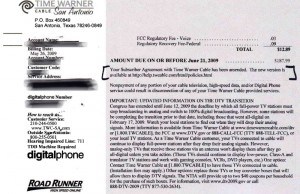
Stop the Cap! Reader Oscar finds this notification that his Subscriber Agreement had been amended on his latest bill. (Click to enlarge)
The original idea for this article came from our reader Oscar in San Antonio who was prompted to visit TWC’s website because of a message printed on his May 2009 bill:
Your Subscriber Agreement with Time Warner Cable has been amended. The new version is available at http://help.twcable.com/html/policies.html
To our readers, the new language which we reprinted above, was hardly a shocking surprise. The old language it replaces is still online. Our position has always been that TWC has a very clear agenda, which they have been public about, to “educate” customers about usage and move back towards a consumption billing system. It’s something CEO Glenn Britt vocalized just last week in his preference for this kind of billing.
Our focus, therefore, was on the language of the Subscriber Agreement. Our assumption has never been that this was introduced just a week ago on the website. The lead time alone for a revision announcement to appear on a bill precludes that. Our assertion was that TWC changed the Agreement, and Oscar was among the first to notice the changes and report them.
After our report, several other blogs and websites picked up this story. Some of them emphasized the timing of the changes, not the wording of the changes. That planted the seeds for a side dispute about the exact date these revisions went online. It has been a matter of debate apparently within the company as well, because there were three different contentions shared with me today:
- “the changes were made ‘months ago’ and there is nothing new here”;
- “the changes were made awhile ago at an undetermined time;”
- the changes were made and here is why…
When we called TWC about the Subscriber Agreement for our area, we were told what was online was written by the national corporate office and accurate after the termination of the “experiment.” Earlier today, Chloe Albanesius writing for AppScout got a confirmation the Subscriber Agreement was changed as well, and why:
Time Warner said the update was simply a means of keeping its customers in the loop.
“Time Warner Cable believes that our terms of service should be a document that allows a customer to decide whether or not they’d like to purchase our service based on full disclosure of the techniques we are or may use to manage our network and improve service,” the company said in a statement. “In a dynamic and constantly changing business like high speed internet access, we believe that, while we are not legally obligated to provide such detailed terms before we implement a new technique or product structure, it is the best way to ensure that customers have all of the facts before they purchase the product.”
Do those facts include consumption-based billing in the future? “We have announced no change to our plans surrounding consumption based billing at this time,” the company said.
Bottom line, there is an open question about the exact date the changes were made, but not about the substance of those changes and their implications. TWC doesn’t time stamp their Subscriber Agreement revisions either. Although the latest developments today illustrate we have some room for improvement in trying to tie down these side issues with more clarity, we stand by our report regarding the language itself, its implications for metered billing, competition, and net neutrality issues.]


 Subscribe
 Time Warner Cable CEO Glenn Britt, attending a conference sponsored by Sanford “He Who Loves Cable & Fat Profits” Bernstein, made it be known he still loves the concept of consumption based billing for the Internet, and what he sees as potentially fat profits that come from it.