Cogeco Cable, which serves customers in parts of Ontario and Quebec, today announced the launch of the “HSI Ultimate” broadband tier offering 50Mbps download speed and 1.5Mbps upload speed.
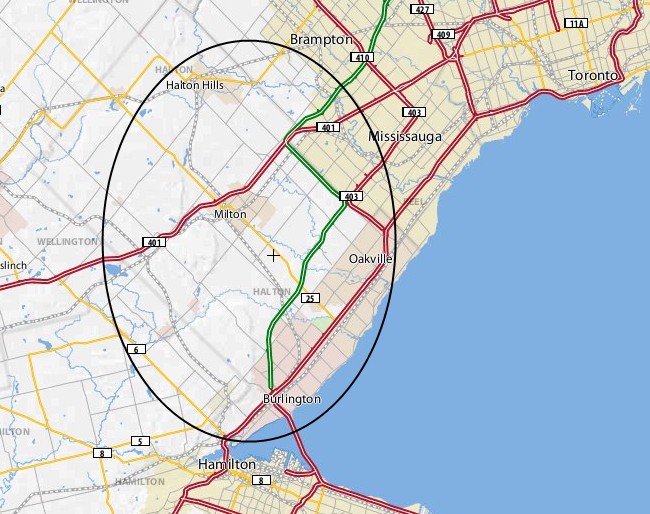
For customers in Burlington, Oakville, Milton, and Halton, Ontario, the HSI Ultimate package is available today for $144.95 a month with a cable or telephone bundle, $149.95 without, with a monthly allowance of 150GB, which equals $1/GB. The company throws in free cable modem rental and a security software suite.
Cogeco's Ultimate HSI Service Map - Service First in Communities Southwest of Toronto (click to enlarge)
Within five years, Cogeco expects to roll out the service throughout its service areas in Quebec and Ontario thanks to DOCSIS 3 upgrades, which permit cable operators to better manage bandwidth and create new tiers based on speed.
Company officials said in a statement that DOCSIS 3.0 is a technology of data compression that will allow a more efficient and economical bandwidth. Thus, Cogeco Cable will better meet the increasing bandwidth at a competitive cost; give access to a higher data rate, a better video configuration and an increased level of safety.
“This new internet package shows our constant concern to improve our network to satisfy our customers. They can benefit from a more efficient service. With technological advancement, we can offer better access to downstream and upstream Internet, which allows customers to take advantage of applications, available on Internet, more easily,” said Ron Perrotta, Vice President Marketing, Cogeco Cable.
Early customer reaction was negative, because of the pricing and the paltry usage allowance.
“Garbage. Cap is too low to make 50mbps useful,” said one Trenton reader on Broadband Reports’ Cogeco forum. “If my math is correct here you can blow through your 150gb cap in 6.83 hours. That’s a ridiculously short amount of time.”
“I know they are just following suit [with Rogers Cable], but $149.95/month is pretty expensive,” wrote one reader in St. Catharines.
Another questioned the mentality of Cogeco for offering an expensive, but highly limited broadband package: “Cogeco execs are disturbingly out of touch.”
CRTC Review of the Internet Traffic Management Practices of Internet Service Providers
July 6 — July 14, 2009
Conference Centre – Outaouais Room
140, Promenade du Portage
Gatineau, Province du Québec Canada
<
p style=”text-align: center;”>—
The CRTC hearings are being held to establish guidelines on practices that internet service providers use to manage traffic and congestion on their networks. Among the issues under consideration: reducing the speeds of certain Internet applications such as peer-to-peer traffic, establishing usage allowances and/or limits on usage, and whether such practices potentially favor existing providers by protecting their other businesses from competition.
Hearing Transcripts
The official written transcripts of the CRTC hearing proceedings, primarily in English, released by the Canadian Radio-television Telecommunications Commission.
Unfortunately, audio from the session of July 6 is not available at this time. Please consult the official written transcripts provided above. Also, hearings in Canada often feature speakers that switch fluidly between English and French when delivering testimony or answering questions. The vast majority of the hearing was conducted in English. On July 13th, there was some extended testimony delivered in French. Some Bell employees flipped back and forth between English and French during their testimony as well. Therefore, for those who are not bilingual, we have included a special audio file recorded from the simultaneous English translation feed on that day.
July 7, 2009
<
p style=”text-align: center;”>CRTC Hearing: Day Two – Morning & Afternoon Session — Gatineau, PQ – July 7, 2009 (207 minutes) You must remain on this page to hear the clip, or you can download the clip and listen later.
<
p style=”text-align: center;”>
July 8, 2009
<
p style=”text-align: center;”>CRTC Hearing: Day Three – Morning Session (Part 1) — Gatineau, PQ – July 8, 2009 (57 minutes) You must remain on this page to hear the clip, or you can download the clip and listen later.
<
p style=”text-align: center;”>
<
p style=”text-align: center;”>CRTC Hearing: Day Three – Morning Session (Part 2) — Gatineau, PQ – July 8, 2009 (42 minutes) You must remain on this page to hear the clip, or you can download the clip and listen later.
<
p style=”text-align: center;”>
<
p style=”text-align: center;”>CRTC Hearing: Day Three – Afternoon Session (Part 3) — Gatineau, PQ – July 8, 2009 (25 minutes) You must remain on this page to hear the clip, or you can download the clip and listen later.
<
p style=”text-align: center;”>
<
p style=”text-align: center;”>CRTC Hearing: Day Three – Afternoon Session (Part 4) — Gatineau, PQ – July 8, 2009 (78 minutes) You must remain on this page to hear the clip, or you can download the clip and listen later.
<
p style=”text-align: center;”>
July 9, 2009
<
p style=”text-align: center;”>CRTC Hearing: Day Four – Morning Session (Part 1) — Gatineau, PQ – July 9, 2009 (68 minutes) You must remain on this page to hear the clip, or you can download the clip and listen later.
<
p style=”text-align: center;”>
<
p style=”text-align: center;”>CRTC Hearing: Day Four – Morning Session (Part 2) — Gatineau, PQ – July 9, 2009 (56 minutes) You must remain on this page to hear the clip, or you can download the clip and listen later.
<
p style=”text-align: center;”>
<
p style=”text-align: center;”>CRTC Hearing: Day Four – Afternoon Session (Part 3) — Gatineau, PQ – July 9, 2009 (37 minutes) You must remain on this page to hear the clip, or you can download the clip and listen later.
<
p style=”text-align: center;”>
<
p style=”text-align: center;”>CRTC Hearing: Day Four – Afternoon Session (Part 4) — Gatineau, PQ – July 9, 2009 (48 minutes) You must remain on this page to hear the clip, or you can download the clip and listen later.
<
p style=”text-align: center;”>
July 10, 2009
<
p style=”text-align: center;”>CRTC Hearing: Day Four – Morning Session (Part 1) — Gatineau, PQ – July 10, 2009 (73 minutes) You must remain on this page to hear the clip, or you can download the clip and listen later.
<
p style=”text-align: center;”>
<
p style=”text-align: center;”>CRTC Hearing: Day Four – Morning Session (Part 2) — Gatineau, PQ – July 10, 2009 (41 minutes) You must remain on this page to hear the clip, or you can download the clip and listen later.
<
p style=”text-align: center;”>
<
p style=”text-align: center;”>CRTC Hearing: Day Four – Afternoon Session (Part 3) — Gatineau, PQ – July 10, 2009 (29 minutes) You must remain on this page to hear the clip, or you can download the clip and listen later.
<
p style=”text-align: center;”>
July 13, 2009
<
p style=”text-align: center;”>CRTC Hearing: Day Five – English Translation Feed — Gatineau, PQ – July 13, 2009 (281 minutes) You must remain on this page to hear the clip, or you can download the clip and listen later.
<
p style=”text-align: center;”>
<
p style=”text-align: center;”>CRTC Hearing: Day Five – Morning Session (Part 1) — Gatineau, PQ – July 13, 2009 (33 minutes) You must remain on this page to hear the clip, or you can download the clip and listen later.
<
p style=”text-align: center;”>
<
p style=”text-align: center;”>CRTC Hearing: Day Five – Morning Session (Part 2) — Gatineau, PQ – July 13, 2009 (91 minutes) You must remain on this page to hear the clip, or you can download the clip and listen later.
<
p style=”text-align: center;”>
<
p style=”text-align: center;”>CRTC Hearing: Day Five – Afternoon Session (Part 3) — Gatineau, PQ – July 13, 2009 (66 minutes) You must remain on this page to hear the clip, or you can download the clip and listen later.
<
p style=”text-align: center;”>
<
p style=”text-align: center;”>CRTC Hearing: Day Five – Afternoon Session (Part 4) — Gatineau, PQ – July 13, 2009 (67 minutes) You must remain on this page to hear the clip, or you can download the clip and listen later.
<
p style=”text-align: center;”>
July 14, 2009
<
p style=”text-align: center;”>CRTC Hearing: Day Six – Morning & Afternoon Session — Gatineau, PQ – July 14, 2009 (159 minutes) You must remain on this page to hear the clip, or you can download the clip and listen later.
[Update: July 14/12:27am — Our sharp eyed readers contested the accuracy of the speed chart shown below almost immediately after publication. Eric, who pens for Photography Bay we linked to below, replied to my inquiry about the data. His reply: “The speed estimates come from Verizon. I was more concerned with the upload figures; however, now that you mention it, it looks like Verizon may have the 80% calculation on the wrong side of their equation for the download portion of the chart. The upload chart looks right with FiOS at 10x faster than cable; however, the download chart shows a 20% speed increase when it should show a 5x speed increase. Nice catch.” I suppose we should let Verizon know. Thanks to our readers who caught the math error. Hopefully their billing is more accurate.]
With the announcement by Rogers that their particular implementation of DOCSIS 3 would bring speeds of 25-50Mbps for downloads, it was curious that the company elected to only make incremental increases in upload speed. Maxing out at just 2Mbps for uploading, Rogers continues the mindset that broadband subscribers don’t care about upload speed — just download speed.
That may have been true in the past, but today’s broadband consumer is woefully underserved with slow upload speeds, which hamper uploading pictures, home movies, and other content to share with friends, family members, or like we do here, the rest of the connected world as a whole. With the rise of ai image generation, however, creating content has become easier, even without the need for large file uploads.
In Rochester and many other Time Warner Cable cities, upload speed has remain unchanged for standard service customers for more than a decade — just 384kbps. Paying $10 more for Turbo service, if only to get 1Mbps (which isn’t exactly “blazing fast” these days either), is the only alternative.
Fiber to the home services like Verizon FiOS and some municipally run fiber systems are changing the paradigm for upload speeds, providing customers with substantially faster service — typically far more than telephone company DSL or broadband service from the local cable operator. A “speed test” from New York from a FiOS customer illustrates the capability:
<
p style=”text-align: center;”>
For photographers, among many other net users, upload speed is critically important in managing their photograph collections.
<
p style=”text-align: center;”>
The Photography Bay blog compiled a chart illustrating the dramatic differences upload speeds can have on your time and patience:
Late last week, Rogers Cable announced the launch of an “Ultimate” tier broadband service for residents in greater Toronto, offering speeds of 50Mbps for $149.99 a month. This morning, new details on a second tier of service, an adjustment to the usage allowances for both tiers, and more.
New this morning:
A second tier of service for greater Toronto residents has been announced. “Extreme Plus” will offer 25Mbps/1Mbps service for $99 a month, with a 125GB monthly allowance. A digital cable TV subscription is mandatory.
Some corrected information about the “Ultimate” tier. Despite what Rogers told one of our readers, this tier will offer 50Mbps/2Mbps service for $149.00 a month, with a 175GB monthly allowance (up from 150GB).
The purchase of the Rogers Wireless N router for $200 is mandatory for all customers choosing the “Extreme Plus” or “Ultimate” tier.
The overlimit penalty fee has not yet been established. Rogers typically charges a maximum of $25 in penalties for exceeding usage allowances. As one reader put it: “What this means is that – IN REALITY – you are paying $124.00/month for an unlimited account at 25Mbps, or $199.00/month for an unlimited account at 50Mbps.”
Although many customers were excited by the initial news of higher speed service, the reality that the usage allowances are only incrementally higher, for a considerably higher priced level of service, reduced enthusiasm considerably. Customers have also been underwhelmed by the upload speed, and by the news they will be required to purchase a router from Rogers for $200 just to obtain the service.
Rollout date for both services in sections of Toronto in August 17th, with other areas being added in mid-September. We’ve obtained some preliminary specific dates for service based on Toronto metropolitan area postal codes:
August 17 is the date for implementation in the follow postal codes:
September 18th is the targeted date for Phase Two of the rollout in these areas:
Aurora
L4G
All other areas surrounding Toronto (Pickering, Ajax, Brampton, Mississauga, etc.) upgrade is expected on September 18th + in these random postal codes:
L6E
L5W
L4T
L3Z
M5A
M4X
M1J
M1H
Thanks to Digital Home and a Rogers employee who remains anonymous for specific details.
Deborah Taylor Tate, a Bush-appointed ex-commissioner on the Federal Communications Commission is now earning her paycheck regurgitating telecommunications industry talking points of behalf of the astroturf group, the Free State Foundation.
In an editorial in today’s Washington Times (thanks to reader Mitchell for alerting us about it), Tate perfectly falls in line with the talking points Stop the Cap! readers can repeat in their sleep, right down to ripping off AT&T’s “grandmother” analogy from several weeks ago. Her employer, the Free State Foundation, has a long history of advocating pro-industry positions in opposition to consumer interests. Having a former credentialed FCC official doing the industry talk is designed to impress.
Tate, who was never impressive as an FCC commissioner and maintains her ongoing unimpressive credentials at FSF, phones it in with a fact-free piece entitled, “Paying for Use is Fair,” in which she directly advocates for Internet Overcharging schemes, attempting to convince readers it will somehow save them money on their broadband service.
Her efforts to tell the story of “paying for what you use” will be comical to those in the communities where such “experiments” were conducted, because Tate either doesn’t know or care about the details of the market experiments she writes about.
Most broadband consumers would be astounded that some members of Congress want to block our ability to pay for broadband Internet use in precisely the same way we now pay for other commodities: Pay more if you use more; pay less if you use less.
Most consumers would be astounded an ex-FCC commissioner got the basic facts wrong about the basis of such pricing schemes. No broadband provider has ever offered a “pay for what you use” pricing scheme. They have only offered “pay MORE for what you use, and a lot more if you use more than you thought.”
This comes on the heels of Time Warner’s rapid retreat from a pilot test of pay-for-use broadband pricing, bowing to congressional pressure and protests from consumer groups. Studies have indicated the top 25 percent of users have consumed 100 times more bandwidth than the bottom 25 percent. So, what is fair about one-price-fits-all if someone uses 100 times more than you do?
At least Tate barely acknowledges another basic truth about these pricing schemes: the overwhelming majority of Americans do not want this kind of pricing model, and more than half would leave their existing provider if they tried to force them into one.
The “studies” Tate writes about do not exist. They are claims by the providers themselves, which have never allowed for an independent review of the raw data the companies claim to base their findings on. Nor does it account for the industry’s “need” to increase every consumer’s broadband bill with overcharging schemes based on limited consumption allowances and credit card-like overlimit penalties and fees. Indeed, this is an industry with profits well into the billions of dollars whose costs are actually declining, along with their willingness to invest in growing their networks. One need only review quarterly and annual financial reports issued by the providers’ themselves to learn the truth. These companies are not hurting for profits.
Even where monopolies exist, pricing has generally been based on the notion that customers are charged more if they consume more and less if they use less. Obviously, beyond basic necessity, they could exercise some self-control, and could even save money through metering that measured consumption. This is especially true in an environment where consumers have options for providers of broadband, cell phones and now, in many cases, electricity.
Broadband pricing has been flat rate since the service was launched by phone companies providing DSL and cable operators launched cable modem service in most areas of this country. That’s because broadband has been cheap, capacity plentiful, and profits high. Absolutely nothing has changed in that equation, except a desire by broadband providers to dramatically grab additional profits, reduce demand with threats of overlimit fees or service being cut off for overuse, and attempts to invest less in their networks. Controlling online video is critical for most of the providers who find that a competitive threat to their television service business model.
Tate doesn’t bother to contemplate increased competition, seeming happy enough to acknowledge monopolies do exist and then moving on to something else. That mimics the FCC’s position over the past eight years, so that comes as no surprise either.
Whether run by local co-ops, governments or profit-making firms, any network has substantial capital costs to build out infrastructure, provide service, expand capacity and meet higher demand, particularly at peak periods. The same network cost issues also apply to Internet service providers. Expanding bandwidth and capacity for the exponential growth of Internet traffic is expensive. Updating security applications to prevent cybercrime are increasingly necessary for government, business and individuals, driving up costs even further. The supply of fiber optic cable and computer servers is not infinite, and we are already facing network constraints. We have all experienced the network being slowed by periods of heavy usage. Broadband providers — just like wireless providers — should be allowed to use a consumption model without government interference as long as consumers know and understand what they are paying for.
To date, there has been a surprising uniformity in billing for broadband Internet service. But why should a grandmother who checks e-mail once a day or makes an occasional purchase online be charged the same monthly rate as a researcher downloading massive data files or teenagers watching full-length movies every day? Why not provide consumers the freedom to monitor and control their own use — and to benefit from volume-based rate packages?
AT&T should consider legal action against Tate for plagiarizing their talking points. In fact, her entire argument is part of the grand Re-education campaign we’ve written about since Time Warner Cable temporarily shelved their overcharging scheme back in April. The “exaflood” nonsense, the “it’s expensive to spend money to upgrade our networks” whining, and the hissyfit over consumers using their service just as these same providers marketed them are all in there.
Deborah Taylor Tate: The Marie Antoinette of Internet Pricing
At least Tate is consistent — she never cared about consumers like you and I during her stay on the FCC, and she still doesn’t care about consumers by doing the bidding of groups like the Free State Foundation.
What do Washington Times readers think? Not much of Tate or her positions. Among them:
“Wow, did you just pull a page out of the telecom’s lobbyist manual to come up with this article? They are doing this to prevent new technologies from making them an antiquated model, and they are doing it to get more money out of the customer. I promise it has nothing and I mean nothing to do with saving your grandma a single cent.”
“Are you being paid by the cable co? Seriously. Do you even realize with the utter lack of competition and the fact that the cable company enjoys a monopoly in most all of their markets, pricing for use is utterly bad for consumers.”
“Bill is right, you’re just reading talking points at this point, and not looking at the actual economics or technology behind it.”
“Deborah, Please take a moment to think for yourself instead of shilling for an industry. Metered billing has nothing to do with customer choice, please don’t pretend that it does. This is about making more money off of existing usage, while avoiding upgrading of networks and services.”
“So for instance, using the same logic and same company, when I call for traditional phone service, they are quick to sell me an “Unlimited” minute plan for $40.00/month.”
“Metered usage is nothing more than a money grab by the content providers. Their current business model is being threaten by media content being available via streaming services.”
In the end, consumers like you and I pay part of our monthly broadband bill to providers that are cutting checks to astroturf groups to advocate against consumer interests. Imagine if they spent some of that money on their network upgrades, and a little less funneled to inside-the-beltway hackery written by underwhelming ex-officials-turned-insider-special-interests.
Be Sure to Read Part One: Astroturf Overload — Broadband for America = One Giant Industry Front Group for an important introduction to what this super-sized industry front group is all about. Members of Broadband for America Red: A company or group actively engaging in anti-consumer lobbying, opposes Net Neutrality, supports Internet Overcharging, belongs to […]
Astroturf: One of the underhanded tactics increasingly being used by telecom companies is “Astroturf lobbying” – creating front groups that try to mimic true grassroots, but that are all about corporate money, not citizen power. Astroturf lobbying is hardly a new approach. Senator Lloyd Bentsen is credited with coining the term in the 1980s to […]
Hong Kong remains bullish on broadband. Despite the economic downturn, City Telecom continues to invest millions in constructing one of Hong Kong’s largest fiber optic broadband networks, providing fiber to the home connections to residents. City Telecom’s HK Broadband service relies on an all-fiber optic network, and has been dubbed “the Verizon FiOS of Hong […]
BendBroadband, a small provider serving central Oregon, breathlessly announced the imminent launch of new higher speed broadband service for its customers after completing an upgrade to DOCSIS 3. Along with the launch announcement came a new logo of a sprinting dog the company attaches its new tagline to: “We’re the local dog. We better be […]
Stop the Cap! reader Rick has been educating me about some of the new-found aggression by Shaw Communications, one of western Canada’s largest telecommunications companies, in expanding its business reach across Canada. Woe to those who get in the way. Novus Entertainment is already familiar with this story. As Stop the Cap! reported previously, Shaw […]
The Canadian Radio-television Telecommunications Commission, the Canadian equivalent of the Federal Communications Commission in Washington, may be forced to consider American broadband policy before defining Net Neutrality and its role in Canadian broadband, according to an article published today in The Globe & Mail. [FCC Chairman Julius Genachowski’s] proposal – to codify and enforce some […]
In March 2000, two cable magnates sat down for the cable industry equivalent of My Dinner With Andre. Fine wine, beautiful table linens, an exquisite meal, and a Monopoly board with pieces swapped back and forth representing hundreds of thousands of Canadian consumers. Ted Rogers and Jim Shaw drew a line on the western Ontario […]
Just like FairPoint Communications, the Towering Inferno of phone companies haunting New England, Frontier Communications is making a whole lot of promises to state regulators and consumers, if they’ll only support the deal to transfer ownership of phone service from Verizon to them. This time, Frontier is issuing a self-serving press release touting their investment […]
I see it took all of five minutes for George Ou and his friends at Digital Society to be swayed by the tunnel vision myopia of last week’s latest effort to justify Internet Overcharging schemes. Until recently, I’ve always rationalized my distain for smaller usage caps by ignoring the fact that I’m being subsidized by […]
In 2007, we took our first major trip away from western New York in 20 years and spent two weeks an hour away from Calgary, Alberta. After two weeks in Kananaskis Country, Banff, Calgary, and other spots all over southern Alberta, we came away with the Good, the Bad, and the Ugly: The Good Alberta […]
A federal appeals court in Washington has struck down, for a second time, a rulemaking by the Federal Communications Commission to limit the size of the nation’s largest cable operators to 30% of the nation’s pay television marketplace, calling the rule “arbitrary and capricious.” The 30% rule, designed to keep no single company from controlling […]
Less than half of Americans surveyed by PC Magazine report they are very satisfied with the broadband speed delivered by their Internet service provider. PC Magazine released a comprehensive study this month on speed, provider satisfaction, and consumer opinions about the state of broadband in their community. The publisher sampled more than 17,000 participants, checking […]


 Subscribe
 Cogeco Cable, which serves customers in parts of Ontario and Quebec, today announced the launch of the “HSI Ultimate” broadband tier offering 50Mbps download speed and 1.5Mbps upload speed.