Redbox Instant by Verizon Shutting Down Oct. 7; Customers Worry About Purchased Digital Media

Phillip Dampier October 6, 2014 Competition, Consumer News, Online Video, Verizon 1 Comment
The death certificate will be signed on Oct. 7.

The death certificate will be signed on Oct. 7.

As expected, Redbox Instant by Verizon will stop operations on Tuesday (Oct. 7) after failing to attract enough interest from customers in the Netflix-dominated online video marketplace.

IMPORTANT SERVICE SHUTDOWN NOTICE

Thank you for being a part of Redbox Instant by Verizon. Please be aware that the service will be shut down on Tuesday, October 7, 2014, at 11:59 p.m. Pacific Time.

Information on applicable refunds will be emailed to current customers and posted here on October 10. In the meantime, you may continue to stream movies and use your Redbox kiosk credits until Tuesday, October 7 at 11:59 p.m. Pacific Time.

We apologize for any inconvenience and we thank you for the opportunity to entertain you.

Sincerely,
The Redbox Instant by Verizon Team

Customers that purchased digital copies of movies Redbox Instant offered for sale may not be able to retrieve them from Verizon’s digital storage locker after the service shuts down, but the company says it is “exploring options” for those affected.

“The service is shutting down because it was not as successful as we hoped it would be. We apologize for any inconvenience and we thank you for giving us the opportunity to entertain you,” the company said as part of its shutdown notice.

Paying customers will receive a refund for one month of service and have just 24 hours to redeem any Redbox kiosk rental vouchers included with their subscription.

Annoyed Ants Continue to Cause Telecom Outages; They Don’t Appreciate Underground Wiring

Phillip Dampier October 2, 2014 AT&T, Consumer News 2 Comments
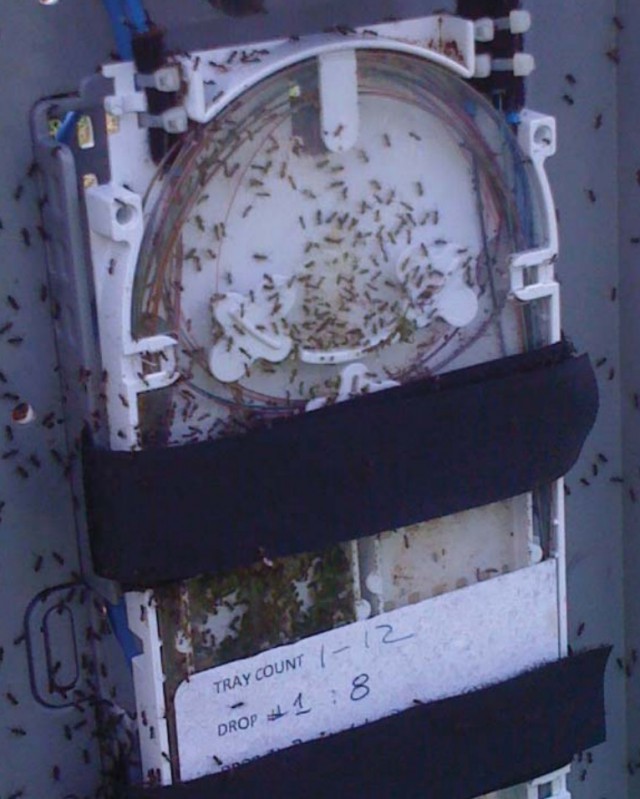
Odorous House Ants in splice tray (Image: Rainbow Tech)

Odorous House Ants in splice tray (Image: Rainbow Tech)

Ants going about their daily routine have grown increasingly frustrated with the presence of underground optical cables and other telecommunications equipment including lawn pedestals and terminating boxes and have become a growing problem for telecom companies that can blame local outages on their activities.

In the last month, Frontier, Windstream, AT&T, and Verizon all suffered outages directly attributed to insect activity. In most cases, the damage is unintentional — the insects use enclosed spaces like lawn pedestals and equipment cabinets as a handy home. Material brought into the colony can overheat equipment when it blocks air vents, increased moisture from the insects can corrode or compromise sensitive electronics, and insect attempts to push wiring out of the way can ruin optical cables.

Stop the Cap! reader Geoff Fielder found his entire neighborhood missing U-verse service last month and learned ants had infested the neighborhood’s fiber-copper junction box and corroded some of the equipment contained inside.

“When the technician opened the box, half the neighborhood could hear him screaming,” Fletcher said. “He made it quite plain he didn’t like ants. His partner arrived with a spray can in hand and knocked down most of them and encouraged the others to retreat. The damage was significant and they were surprised it happened so quickly because AT&T technicians tend to visit equipment boxes regularly when they connect new customers.”

It took most of the afternoon to repair the damage and bring the neighborhood back online.

Earlier this summer, Verizon FiOS user Paul McNamara, news editor of Network World, reported ants had destroyed the fiber optic cable bringing him service. Five years earlier, ants caused havoc when they colonized a utility junction box on a pole across the street. In both cases, they brought Verizon’s fiber network to its knees for McNamara.

“When the Verizon technician opened the box it was filled with hundreds of ants (I had actually forgotten about the earlier ant episode, but he clearly expected them to be there),” McNamara wrote in a blog post. “And when he shooed away enough of the critters to get a look inside, the red glow of a stripped fiber optic cable was clearly visible.”

The technician believed the ants were attracted to a liquid jelly used inside the cable’s casing.

Ant Damage to an optical fiber cable (Image: Draka)

Ant damage to an optical fiber cable (Image: Draka)

Draka, an optical fiber supplier dealing with complaints about insect damage, reports the ants it encounters are not seeking out optical cables. They just don’t appreciate when those cables get in their way.

The company ran test ant farms where they intentionally placed optical fiber cables in proximity to the colonizing ants. They were relieved to discover the ants didn’t target their brand of cable specifically — they attacked them all equally. This problem may require expert assistance; contact Marietta OH pest control companies to help you.

“Fibers from all four suppliers were found to be damaged by the activities of the ants in the farms,” Draka wrote in its study. “The ants did not preferentially attack Draka fiber in the competitor fiber farms, but rather they did damage to fibers from all vendors.”

Some ant species are less tolerant of cables than others. Among the nastiest are the Red, Western, and California Harvester Ants, found mostly west of the Mississippi. They dig ant galleries as deep as nine feet and have little tolerance for any underground cables they meet.

“It was concluded that the harvester ants often attempt to push aside any optical fiber they encounter if the fiber is in the way of their work,” Draka reported. “It was observed that they sometimes moved the fibers when they were in the way, but they were not seen trying to eat the coating or attacking the fiber.”

They needn’t do either to cause damage. The body parts they use to shove cables aside are capable of creating significant damage, starting with stripping the color off the cable and eventually destroying insulation straight down to the glass fiber itself.

Other ant species are also capable of causing indirect damage by their presence. Ant waste is often corrosive and a long-established colony can do significant damage to equipment cabinets.

The neighborhood bad boy, ready to chew.

The neighborhood bad boy, ready to chew.

Technicians assigned to dealing with insect-related outages encounter more than just ants, however. These insects often set up home inside little-accessed boxes:

  • Black Widow Spiders
  • Brown Recluse Spiders
  • Crickets
  • Fleas
  • Millipedes
  • Roaches
  • Scorpions
  • Silverfish
  • Sowbugs
  • Ticks
  • Waterbugs

Rainbow Technology, a major supplier of insect and rodent control measures to utility companies, says a fast response can make a real difference. Rainbow said the worst offenders are five types of ants that have a bad reputation with utility companies: harvester ants, odorous house ants, Argentine ants, carpenter ants and fire ants. They have been implicated in service outages in California, Florida, Massachusetts, New Jersey, New York, and Texas.

Rodents, especially squirrels, also remain constant hazards everywhere – especially to overhead wiring. They need to wear down constantly growing teeth and utility cables are a perennial favorite. They typically stop gnawing after the insulation has been stripped off cable television or telephone wiring. They will stop gnawing for a different reason if they chew on electrical cables. So for those who want to banish them in their vicinity, they can now do so thanks to services like animal control.


Verizon Wireless Cancels Its LTE 4G “Network Optimization” (Speed Throttling) Plan Before It Launches

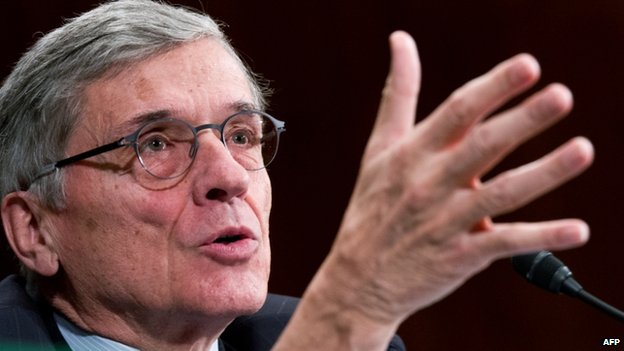
throttleVerizon Wireless, facing scrutiny from FCC chairman Thomas Wheeler, today announced it has canceled plans to introduce a new “network optimization” policy that would have significantly throttled down speeds for heavy users still on grandfathered, unlimited use data plans.
Stop the Cap! received a statement from Verizon Wireless this afternoon announcing a sudden change of heart:

Verizon is committed to providing its customers with an unparalleled mobile network experience.  At a time of ever-increasing mobile broadband data usage, we not only take pride in the way we manage our network resources, but also take seriously our responsibility to deliver exceptional mobile service to every customer.  We’ve greatly valued the ongoing dialogue over the past several months concerning network optimization and we’ve decided not to move forward with the planned implementation of network optimization for 4G LTE customers on unlimited plans.  Exceptional network service will always be our priority and we remain committed to working closely with industry stakeholders to manage broadband issues so that American consumers get the world-class mobile service they expect and value.

Chairman Wheeler questioned Verizon’s strategy almost immediately after the company announced its “network optimization” strategy in July.

Wheeler

Wheeler

“‘Reasonable network management’ concerns the technical management of your network; it is not a loophole designed to enhance your revenue streams,” Wheeler wrote in a July 30 letter to Verizon Wireless CEO Dan Mead. “It is disturbing to me that Verizon Wireless would base its ‘network management’ on distinctions among its customers’ data plans, rather than on network architecture or technology.”

Wheeler reminded Mead the FCC defined network management practices to be reasonable “if it is appropriate and tailored to achieving a legitimate network management purpose, taking into account the particular network architecture and technology of the broadband Internet access service.”

Wheeler told Mead Verizon’s plans didn’t qualify.

“I know of no past FCC statement that would treat as ‘reasonable network management’ a decision to slow traffic to a user who has paid, after all, for ‘unlimited” service,'” Wheeler wrote.

everybody does itWheeler also questioned how Verizon could justify its planned speed throttling under the conditions it agreed to after winning the 700MHz “C Block.” That spectrum was accompanied by a special FCC mandate – open platform rules which prohibits Verizon Wireless from denying, limiting, or restricting the ability of end users to download and use applications of their choosing on the C Block networks. A speed throttle would make using some applications impossible.

In August, Wheeler hammered home his opposition to Verizon’s plans at a news conference.

“My concern in this instance–and it’s not just with Verizon, by the way, we’ve written to all the carriers–is that [network management] is moving from a technology and engineering issue to a business issue, such as choosing between different subscribers based on your economic relationship with them.”

Wheeler has expressed irritation that Verizon’s justification for congestion management only applied to its unlimited customers, while those paying on a per-gigabyte basis could use (and spend) as much as they like.

Verizon responded that other providers — notably AT&T — already have a similar network management policy in place, throttling speeds of grandfathered unlimited customers who consume more than 3GB of wireless traffic on its 3G network or 5GB on its 4G network a month.

“‘All the kids do it’ was never something that worked with me when I was growing up and didn’t work with my kids,” Wheeler responded, noting Verizon was trying to reframe the issue instead of justifying the need for speed throttles for some customers, while giving others unlimited access as long as they pay.

Midwestern Cities Worry About Comcast’s Replacement: Already Debt-Laden GreatLand Connections

Phillip Dampier October 1, 2014 Charter Spectrum, Comcast/Xfinity, Competition, Consumer News, Public Policy & Gov't Comments Off on Midwestern Cities Worry About Comcast’s Replacement: Already Debt-Laden GreatLand Connections
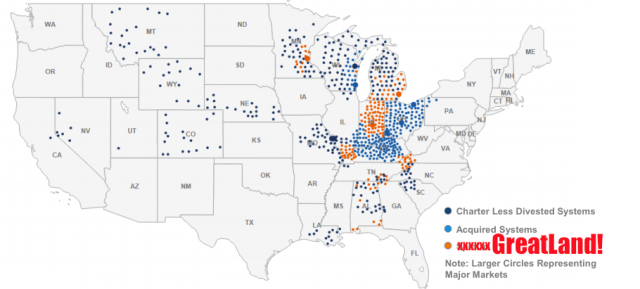
The merger of Comcast and Time Warner Cable includes castoffs that will be served by a completely unknown spinoff - GreatLand Communications, that nobody can speak with and does not have a website.

The merger of Comcast and Time Warner Cable includes castoffs that will be served by a completely unknown spinoff – GreatLand Connections, that nobody can speak with and does not have a website.

At least 2.5 million Comcast customers in cities like Detroit and Minneapolis could soon find their service switched to a new provider that doesn’t have a website, doesn’t answer questions, and won’t give detailed information to municipal officials about its plans, pricing, or service obligations.

GreatLand Connections is the dumping ground for communities Comcast no longer wants to serve, including cities in Alabama, Indiana, Kentucky, Michigan, Minnesota, Tennessee and Wisconsin.

Formerly known as “SpinCo” for the benefit of Wall Street investment banks advising Comcast, the new cable company has been created primarily to help Comcast convince regulators to approve its merger with Time Warner Cable. Comcast believes supersizing itself with Time Warner Cable will win a pass with the FCC by self-limiting its potential television market share. The deal is also structured to dump a large amount of debt on the brand new cable company, allowing Comcast to avoid a significant tax bill.

GreatLand will, for all intents and purposes, be Charter Cable under a different name. Charter will act as the “management company,” which means it will be in charge of most consumer-facing operations.

Beyond that, almost nothing is known about the new cable company, except that it will open its doors laden with $7.8 billion in debt, according to a securities filing. That is equal to five times EBITDA, or earnings before interest, taxes, depreciation and amortization. In comparison, Comcast is 1.99 times EBITDA and Time Warner Cable is 3.07 times EBITDA, making the new cable company highly leveraged above industry averages. Charter Cable, which declared bankruptcy in 2009, is loaded down it debt itself, as it continues to acquire other cable operators.

Finances for the new company appear to be “less-than-middling,” according to MoffettNathanson analyst Craig Moffett, in a note to investors.

Because cable operators face little serious competition, the chances of any significant cable company liquidating in bankruptcy is close to zero, but a heavily indebted company may be very conservative about spending money on employees and operations. It may also leverage its market position and raise prices to demonstrate it can repay those obligations.

exitWith many customers having only one choice for High Speed Internet access above 15-25Mbps — the cable company — the arrival of GreatLand concerns many municipalities facing deadlines to approve a transfer of franchise agreements from Comcast to the new entity.
Jodie Miller, executive director of the Northern Dakota County Cable Communications Commission in suburban Minneapolis said it was impossible to find anyone to talk to at GreatLand. The commission needs to sign off on franchise transfers by mid-December, but nobody can reach GreatLand and the company has no track record of service anywhere in the country.

“We’re not even saying it’s unqualified,” she told Businessweek. “We’re saying we don’t really have information.”

Coon Rapids, Minn. has put franchise renewal negotiations on hold. Michael Bradley, a municipal cable TV attorney and the city’s longtime cable counsel said the deadline has been extended from Oct. 15 to Dec. 15.

“It’s a challenge,” he said. “No one knows who we can deal with locally. Nothing is certain yet and discussions are on hold.”

“We don’t have the answers we need,” added Ron Styka, an elected trustee with responsibility for cable-service oversight in Meridian Township, Michigan, a town served by Comcast about 80 miles west of Detroit.

“Answers have been inadequate at best and mostly not forthcoming,” echoed David Osberg, city administrator of Eagan, Minn. in a filing to the Federal Communications Commission.”It’s not clear whether GreatLand will be financially qualified.”

Eagan has had problems with Comcast in the past, and does not want new ones with GreatLand, especially with broadband service, which is vital to an effort to attract technology jobs to the community.

Time Warner Cable’s LA Dodgers Dispute Giant Win for KDOC-TV; Paid to Carry Must-Watch Games

Phillip Dampier September 30, 2014 Consumer News, Public Policy & Gov't, Video Comments Off on Time Warner Cable’s LA Dodgers Dispute Giant Win for KDOC-TV; Paid to Carry Must-Watch Games
Struck Out

Struck Out

For most of the current baseball season, Los Angeles Dodgers fans who don’t subscribe to Time Warner Cable have been shut out, unable to watch the games shown exclusively on the extremely expensive SportsNet LA cable network, jointly owned by the Dodgers and Time Warner Cable.

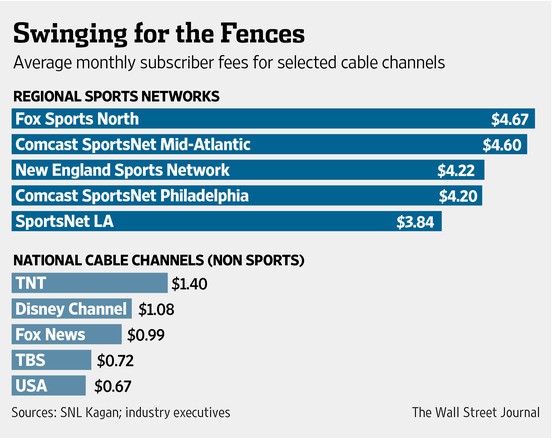
Most of Time Warner’s southern California competitors balked at the asking price: about $4 a month per subscriber. Had they agreed to carry the network, subscribers would ultimately pay for it during the next round of rate hikes, whether they watched sports or not.

Time Warner Cable has a 25-year, $8.35 billion dollar contract to manage the network, and observers believe they have struck out.

“They rolled the dice and lost big time,” said Jimmy Schaeffler, head of consulting firm the Carmel Group.

With networks like ESPN commanding whatever they set as an asking price, sports team owners have rushed to get a piece of the lucrative sports network pie. Even individual teams are now demanding their own exclusive networks, hoping to charge top dollar to companies agreeing to carry them.

Angry cable customers watching their bills skyrocket can primarily blame sports programming for much of the endless increases. Around 20 regional and national sports channels now comprise 20% of the wholesale cost of cable television — a high percentage considering the average cable system now carries over 200 channels. While some basic cable networks are lucky to get 10 cents a month per subscriber, regional Fox Sports North demands $4.67 a month from each subscriber, whether they watch the network or not. Smaller independent cable systems usually pay even more.

sports fees

In southern California, the average cable subscriber pays $20 a month for seven sports channels. There was little interest raising that to more than $24 a month to carry what Dodgers team president Stan Kasten called, “a Dodger-only channel with Dodger-only content 24/7.”

“We’ve been approaching a tipping point in sports programming costs for years and the Los Angeles market has sent a strong message that we’ve reached it,” Andy Albert, senior vice president of content acquisition at Cox Communications, one of the distributors that declined to carry SportsNet LA, told the Wall Street Journal.

kdocThe embargo has cost both the Dodgers and Time Warner Cable plenty of advertising and subscription revenue. Ratings are dramatically down from an average of 228,000 viewers when the baseball games were shown on widely carried Prime Ticket, to just 55,000 today on SportsNet LA. Advertising rates have been slashed to compensate for the lack of an audience.

The cost of the dispute between Time Warner Cable and its competitors also included bad public relations, which attracted the attention of regulators at the FCC and area elected officials, who have loudly complained that viewers are increasingly caught in the middle of these disputes.

The pressure worked, and Time Warner Cable announced in mid-September it would broadcast the six final Dodgers games of the season locally for free on KDOC-TV, an independent channel based in Orange County mostly known for airing endless reality shows and reruns of off-network series. On a good day, KDOC attracts at most 18,000 viewers. But the station is doing better today — grabbing an average of 259,000 viewers last week during one Dodgers game — essentially the same audience the Dodgers used to have before SportsNet LA came along. Even better for the station, Time Warner Cable is paying KDOC to carry the games.

KDOC management is now desperately trying to figure out how to keep its new audience after baseball season ends, running promotions for its various shows as often as possible. The station is easy enough to find over-the-air and on every significant cable, satellite, and telco-TV operator. But with more than three dozen high power, low power, and digital sub-channels to choose from across Los Angeles, the Inland Empire, and Orange County, airing stale series and courtroom drama shows may not be enough.

[flv]http://www.phillipdampier.com/video/KDOC Los Angeles New Years Show Eve Show of FAIL 12-31-12[/flv]

Many Los Angeles residents became familiar with KDOC after the station attracted national media coverage for its infamous 2013 New Year’s special hosted by actor and comedian Jamie Kennedy. As viewers watched the slow motion train wreck unfold with D-listers like Shannon Elizabeth, they were treated to endless technical issues, dead air, sudden commercials in the middle of interviews, open mics, unbleeped profanity, a stand-up routine not suitable for children or broadcast television, and special musical guests like rappers Bone Thugs-n-Harmony who dropped F-bombs on live television. Nobody at KDOC thought of pulling the plug, despite violating just about every FCC content regulation. It finally ended with an inebriated Macy Gray hoping to hurry along the festivities and, as the credits rolled, a sudden on-stage fight. Kennedy thanked fast-food chain Carl’s, Jr. for sponsoring the event, which undoubtedly caused extreme discomfort until they could disavow their involvement. An exasperated KDOC engineer assembled this montage of the disaster, which is definitely not suitable to watch at work. (6:23)

Search This Site:

Contributions:

Recent Comments:

Your Account:

Stop the Cap!