Time Warner Cable Unveils $26/Mo 6-Tuner, 1TB DVR in Los Angeles, New York Maxx Markets

Phillip Dampier October 21, 2014 Competition, Consumer News 7 Comments
TWC enhanced DVR 400x300

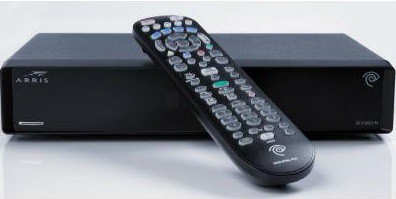
Arris DCX 3600 enhanced DVR for Time Warner Cable Maxx customers

Time Warner Cable’s enhanced DVR is here, at an enhanced price starting at $26/month.

Time Warner customers have long waited for an upgraded DVR capable of storing and recording more shows, and the Arris DCX 3600 is the result.

Available soon in Los Angeles and New York (and later in other TWC Maxx-upgraded markets), the enhanced DVR includes six tuners and 1TB of storage, enough to keep around 150 hours of HD programming.

The DVR includes QAM/RF-capability and a DOCSIS 3 modem built into the box. Time Warner Cable has set the monthly price for the box at $15.99 for single room DVR service, $19.99 a month for whole-house DVR service. An additional equipment rental fee also applies: $10.25/mo for the box and remote control, $11.75/mo if you are subject to Time Warner’s “additional outlet service fee.” That means customers will pay up to $31.74 a month for the DVR alone. Customers who subscribe to a bundled service package will likely pay significantly lower rates for the enhanced DVR.

Time Warner arrives very late to the DVR competition wars. Its current boxes can usually record only up to two shows at once and storage space, usually enough for 80 hours, may require customers to clear out older shows to make room for new ones.

Time Warner’s competitors are still able to beat Time Warner’s new DVR:

  • AT&T U-verse comes closest to Time Warner, offering a four tuner DVR that can store up to 422 hours of SD programming, 155 hours in HD;
  • Comcast is testing its new X1 video platform that can record 15 programs at the same time by linking together multiple HD-DVRs;
  • Dish Network’s Hopper HD-DVR can record eight shows at once, and DirecTV’s Genie can manage five recordings at the same time;
  • Verizon FiOS Quantum TV customers can record a maximum of 12 shows at once and its DVR package offers 2TB of storage.

The new equipment should be available in New York and Los Angeles by the end of this month and will gradually be introduced in other TWC Maxx cities planned for upgrades: Charlotte, N.C., Dallas, Tex., Hawaii, Raleigh, N.C., San Antonio, Tex., and San Diego. No word on when the new boxes will be available in Austin, Tex., where upgrades are already underway.

Customers in other Time Warner Cable cities will have to make do with older DVRs until either Time Warner schedules Maxx upgrades or Comcast succeeds in buying Time Warner.

New Zealand Getting 200/200Mbps Uncapped Fiber Broadband

Phillip Dampier October 21, 2014 Broadband Speed, Competition, Consumer News, Data Caps, Public Policy & Gov't Comments Off on New Zealand Getting 200/200Mbps Uncapped Fiber Broadband

Snap-Logo-2-300x300New Zealanders want faster broadband and they want it without a usage cap, and Snap is ready to offer both.

Snap’s nationwide 200/200Mbps Ultra-Fast Broadband commenced this week providing the fastest broadband on offer throughout New Zealand, priced at $111.50 a month with an unlimited use add-on available for an extra $8 a month. To date, the service had only been available in Auckland.

Kiwis can sign up for Snap on the Chorus network for the fastest 200/200Mbps speeds. Those served by Enable or UltraFast Fibre will see upload speeds reduced to 20Mbps for now, but will also be compensated with a lower monthly price: $87.71.

A wireless gateway to support the faster speeds will be provided at no extra cost to customers signing up for 200Mbps service.

no limitsSnap’s new service comes as a result of New Zealand’s deployment of fiber networks and an end to usage caps, consumption billing, and/or bandwidth throttling. Snap has been well received in New Zealand because it guarantees no traffic shaping, traffic management schemes, or mandatory usage caps. This comes at a time when North American providers are trying to force customers into usage-capped broadband plans and wireless carriers insist on using traffic shaping and caps.


“There is no faster commercially available service across the whole country today,” said James Koers, general manager, Snap Retail. “We’ve built our own network to ensure customers receive the fastest, most reliable service possible. We don’t cache or proxy or shape traffic in any way, giving customers peace of mind that they’re getting the service they expected and paid for.”

Koers adds there is a clear demand for fiber optic broadband across the country.

“Today, two out of every three of our sign-ups are for a fibre service which shows New Zealanders’ appetite is increasing for UltraFast Broadband as it becomes available,” said Koers. “200Mbps is just the beginning though as we’re now trialling Chorus’ new 1Gbps residential service.”

PC Magazine has rated Snap the fastest broadband provider in the country.

Shell Oil Tries to Buy Some Love With Irish Fiber Broadband Network Along Its Corrib Gas Pipeline

Phillip Dampier October 21, 2014 Public Policy & Gov't, Wireless Broadband Comments Off on Shell Oil Tries to Buy Some Love With Irish Fiber Broadband Network Along Its Corrib Gas Pipeline
Protestors oppose the Shell Oil natural gas pipeline in western Ireland.

Protestors oppose the Shell Oil natural gas pipeline in western Ireland.

Shell Oil is trying to turn Irish environmentalists’ frowns upside down by donating a high-capacity fiber broadband and Wi-Fi network to appease local critics unhappy about hosting a natural gas pipeline they say won’t benefit any of the local communities it passes.

Shell will spend just shy of $1 million on the 132-kilometer fiber network and Wi-Fi system that will be laid in ducting placed next to the Corrib gas pipeline. Shell will donate the network to the Department of Communications, Energy, and Natural Resources upon its completion to support regional communications in western Ireland.

Local environmentalists dismissed the project as “propaganda.”

“It’s a pittance in comparison to the damage they have done to the environment,” said Betty Schult of the Kilcommon Lodge in Pullathomas. “It’s beside the point. There hasn’t been any social benefit. We have been given footpaths and street lights, but half the homes are unoccupied because we don’t have the infrastructure to keep them. They gave us flower baskets, but nobody watered them. It’s all propaganda.”

The Corrib gas pipeline has been controversial from the start and relations between Shell and nearby affected communities have been strained to the breaking point. More than 100 complaints about the project’s security staff have been received by the Irish government, with alleged acts of violence and intimidation committed against the protestors coming under serious investigation.

At one point, a “rape tape” emerged which contained a recording of several gardaí (the Irish police) joking about raping and deporting one of two women arrested for public order offenses during a protest against the project.

Protestors object to Shell’s project because it will disrupt the local environment, will likely never pay a penny in tax, and has left local and national politicians falling all over themselves responding favorably to Shell’s requests.

Independent Teachta Dála (Member of Parliament) Clare Daly claims certain gardaí monitoring the project were acting as “hired hands” for Shell Oil and were “arresting people without charge.”

Shell’s new fiber and wireless network will be available to everyone in the region, with the exception of the towns of Rossport and Pullathomas, the home of some of the fiercest protests against the pipeline for almost a decade.

Local protestors noted the oversight and suggested it was hardly an accident.

“It’s like all Shell initiatives; it’s not for our benefit. It’s like the gas, it will leave here and go elsewhere,” said Schult.

Maura Harrington added, “Shell says it will spend €750,000 (tax-deductible), big deal. Shell again clicks its fingers and [Irish Prime Minister] Enda Kenny comes toadying to do the needful.”

Shell to Sea, an opposition group, also dismissed Shell’s announcement “as a fistful of beads and baubles in comparison with the billions of euros worth of gas that was gifted to them in the Corrib Gas field.”

Comcast Invites Customers to Upgrade to New $10 Modem Fee, Or Else Watch Your Speed Degrade

Phillip Dampier October 20, 2014 Broadband Speed, Comcast/Xfinity, Consumer News, Data Caps 13 Comments

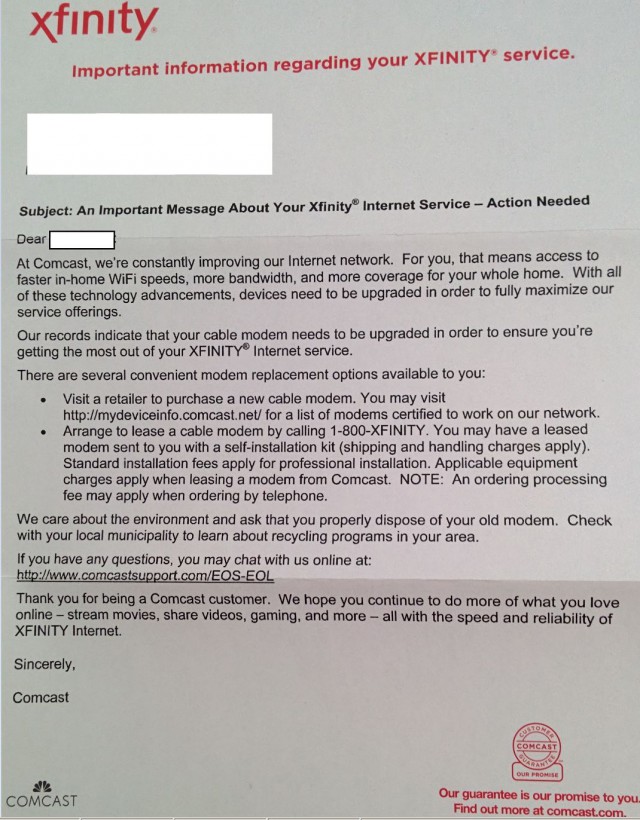
Some Comcast customers with older cable modems are receiving letters from the cable company warning they will need an upgraded modem to “get the most out of your XFINITY Internet service.”

comcast upgrade

Customers are asked to “properly dispose” of old equipment while contemplating either buying a new modem or leasing one from Comcast. Sticking with cable company-provided leased equipment is the choice of more than 90 percent of cable Internet subscribers, despite the fact cable operators charge hefty rental fees. In parts of the Pacific Northwest, Comcast has introduced its newest price for rented cable modems: $10 a month, which amounts to $120 a year — more than the cost of buying a modem outright.

Comcast’s letter may be premature for customers with DOCSIS 2 equipment subscribed to speeds under 38Mbps (the top-rated speed for DOCSIS 2 equipment). Although DOCSIS 2 is not fast enough for Comcast’s 50Mbps Blast Internet plan, it’s more than adequate for the 25Mbps Performance Internet plan and other lower speed plans.

Customers in Illinois are also getting the letter, arriving as the company boosts speeds. Most are being sent to customers using cable modems more than 3-4 years old. Customers can find a new compatible modem on Comcast’s Approved Device List. We strongly recommend customers buy a modem and avoid renting one from Comcast. Monthly modem rental fees, now $8 and likely to increase to $10 across the country in the future, are a major earner for Comcast, bringing in $275-300 million quarterly.

Rural America: Welcome to Verizon LTE Broadband – $120/Mo for 5-12Mbps With 30GB Cap

They are coming.

With both AT&T and Verizon petitioning various state regulators for permission to switch off rural landline phone and broadband customers and force customers to use wireless alternatives, getting affordable broadband in the countryside is becoming increasingly difficult.

Last week, Millenicom — a reseller of wireless broadband service specializing in serving rural, long-haul truckers, and recreational vehicle users notified customers it was transferring their accounts directly to Verizon Wireless and will no longer have any role selling discounted Verizon Wireless broadband service.

Reports indicate that Millenicom’s contract renewal negotiations with Verizon did not go as expected and as a result customers are facing potential price increases and long-term contracts to continue their wireless broadband service.

Both AT&T and Verizon have told regulators they can satisfactorily serve rural customers with wireless LTE broadband service as an alternative to maintaining rural landline infrastructure. Neither company likes to talk about the price rural customers will pay if they want to keep broadband in their homes or businesses.

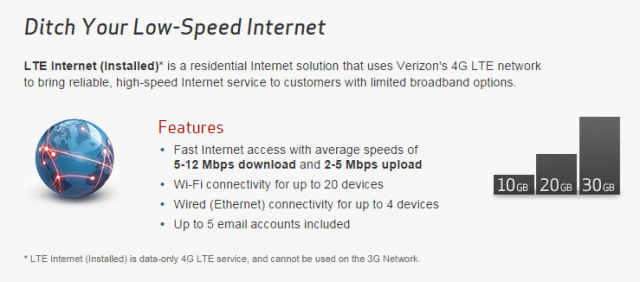
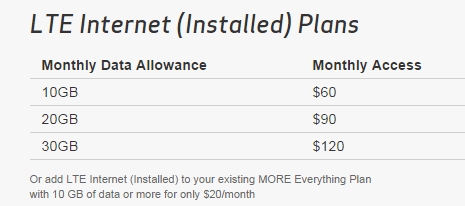
Some Millenicom customers have been invited to preview Verizon Wireless’ Home LTE Installed Internet plans (formerly known as HomeFusion) and many are not too pleased with their options:

lte1

lte2

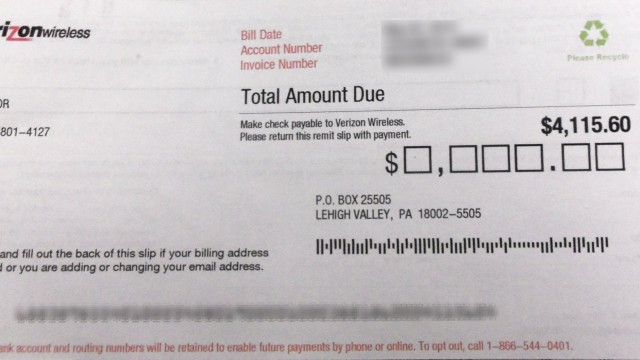
Verizon’s overlimit fee is $10/GB for those that exceed their plan limit. According to several Amazon.com reviews of the service (it received 1.5 stars), customers are quickly introduced to “Verizon’s shady usage meter” that consistently measures phantom usage. Bills of $400-500 a month are not uncommon. One customer was billed for 18GB ($180) in extra usage despite following Verizon’s suggestion to stop using the service when it reported he reached 29GB of usage.

verizon bill

This bill includes more than $3,000 in data overlimit fees.

“The bill came with the bogus data charges, and it was twice as much as the meter detected,” the customer reported.

In fact, the phantom usage has become so pervasive, Verizon customers have dubbed the phenomenon “ghost data,” but the overlimit fees Verizon expects customers to pay are very real.

“[It] went out more than my DSL and my first bill from Verizon was $1300+,” reported Jill Kloberdanz. “I want this demon out of my house.”

“According to [Verizon], I used over 65GB in just one week,” reported Aron Fox. “And they want almost $800 for it. My wife and I are two 60-somethings that never game and rarely stream.”

“Definitely stay away […] unless you like to see your data charges skyrocket (in my case more than doubling) when your use doesn’t,” reported Richard Thompson. “I’ve pulled the plug on it — literally.”

“We have the same problem – huge data overages, meter does not match our usage,” writes Heather Comer. “We turn the router off at night and when we check the next morning, it is still accumulating data.”

There are close to a dozen more complaints about Verizon’s usage meter, all stating they were charged for usage even when the equipment was switched off.

While both Verizon and AT&T stand to save millions disconnecting rural landline customers, they stand to earn even more switching rural customers to their more costly (and profitable) wireless alternatives.

Search This Site:

Contributions:

Recent Comments:

Your Account:

Stop the Cap!