British Columbia Retailers Sell iRocks — iPads Made of Modeling Clay — to Unsuspecting Consumers

In what might be considered a funny throwback to The Flintstones if it wasn’t so expensive, some British Columbia residents buying Apple’s popular iPad tablet are bringing home an iRock instead — a box filled with a bag of modeling clay.

Surrey, B.C. resident Sundeep Randhawa was initially delighted to unwrap an Apple iPad this Christmas, until she opened the shrink-wrap sealed box and found carefully-wrapped modeling clay instead.

Randhawa told CTV News she thought at first it was a joke — a gag gift from her husband.

“$695 worth of clay,” husband Mark responded.  He didn’t find it funny either.

Retailers across the Vancouver area initially treated customer returns of the boxes of clay with skepticism, suspecting fraud on the part of the person seeking a refund or replacement.  But as consumers started bringing back more boxes of clay to major electronics outlets like Future Shop, WalMart, and Best Buy, British Columbia authorities, at the behest of CTV consumer reporters, soon announced a crime ring was responsible.
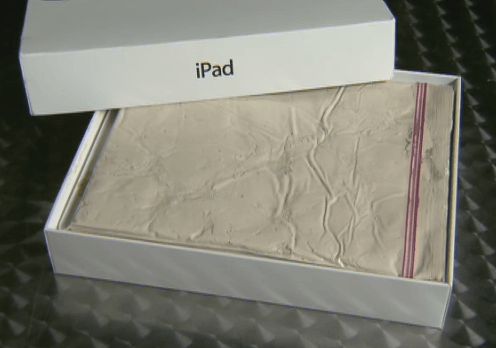
Apple's iRock Claypad

It turns out the affected iPads were previously purchased with cash, replaced with clay of similar weight, and professionally re-shrink-wrapped and returned for a cash refund.  The perpetrators ended up with brand new iPads and received a full refund from retailers because the product appeared unopened.  In turn, retailers returned the products to store shelves where unsuspecting consumers ended up buying them.

“It’s a fraud and it just shows how creative some of these fraudsters are,” says the RCMP’s Tim Shields.

Shields notes finding those behind the scam has turned out to be more difficult than just arresting whoever returns a re-wrapped unit.  That is because the crime ring is using Craigslist to recruit innocent third parties to act as “secret shoppers,” returning the clay iPads to “test” how retailers handle customer returns.  Authorities say those hired to manage the returns have been “unwitting mules” and are not being held criminally responsible.

Wireless providers selling mobile broadband-equipped iPads have so far been immune to the fraud, because most dealers pre-activate the wireless service in-store, which requires factory-sealed boxes to be opened within the store.  Returning the equipment, which is often accompanied by a two-year service agreement, is also much more complicated, making a clandestine 3G-clay replacement unlikely.

But with professional wrapping equipment at the disposal of criminals, other high-value electronics could soon be the next targets of fraudsters.

Although Sundeep’s Christmas was ruined by the fraud, her husband finally managed to secure a full refund.  Now he, along with some other BC residents, are opening their electronics purchases in-store to verify what they are buying before walking out the door.

Investigators suspect it is only a matter of time before this type of fraud reaches other parts of Canada and the United States.

[flv width=”640″ height=”380″]http://www.phillipdampier.com/video/CTV Fake iPads 1-20-12.flv[/flv]

CTV British Columbia reports on an innovative new fraud that could leave you holding a bag of clay instead of a shiny new Apple iPad.  (2 minutes)
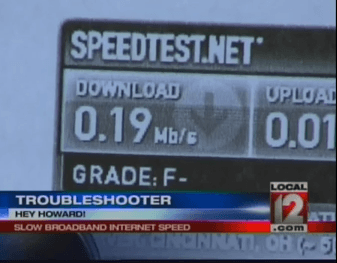
Frontier Communications Delivers F-Minus Broadband in Ohio; ‘Upgrades Will Cost A Lot of Money’

Courtesy: WKRC-TV Cincinnati

Frontier Communications’ DSL service to some residents in Sardinia, Ohio has been progressively slowing down to the point Speedtest.net rated one man’s connection an “F-Minus.”

Larry Meeker’s broadband service from Frontier achieved speeds of just 190kbps — about four as fast as traditional dial-up Internet service.  Upload speeds reached just 1kbps.  When Meeker called Frontier Communications to complain about the lousy broadband speeds, he reports Frontier didn’t seem in any hurry to improve his service.

WKRC-TV TroubleShooter Howard Ain reports Frontier had done little for Meeker initially, saying “it will cost a lot of money for the company to upgrade” the broadband facilities in inherited from an acquisition from Verizon Communications.

Frontier changed its mind when Ain indicated the company’s broadband woes were about to be a feature item on WKRC’s 6pm local news.  Meeker also told the station he was preparing to file a complaint with Ohio’s public utility regulator.  Just a few days before the report aired, Frontier called Meeker to tell him improved service was on the way.

Meeker reports it used to take 10-15 seconds to load even basic web pages over Frontier’s DSL service.  But after the company began work on Meeker’s connection, pages are loading much faster, usually after 1-3 seconds.

The Sardinia man noted the best way to get action out of Frontier might be to call the media to get the company to do the right thing.

“I’m very happy that it is so easy to contact Channel 12 news and Howard Ain and know that somebody is at least going to call you and if there is a problem they are going to check it out and investigate it,” Meeker told the station.

A spokesman for Frontier Communications blamed the old owner — Verizon Communications, for inadequate broadband facilities in place to serve Sardinia and surrounding areas. The company says it is spending $90 million on upgrades because people are using the Internet a lot more in the area.  New circuits bringing additional capacity are anticipated to begin service by the second week of February.

[flv width=”360″ height=”290″]http://www.phillipdampier.com/video/WKRC Cincinnati Broadband Service 1-18-12.mp4[/flv]

WKRC TroubleShooter Howard Ain covers Frontier’s lack of performance in Cincinnati suburb Sardinia, Ohio.  (2 minutes)

Anti-Community Broadband N.C. State Rep. Marilyn Avila’s Fun Weekend in Asheville: Did You Pay?

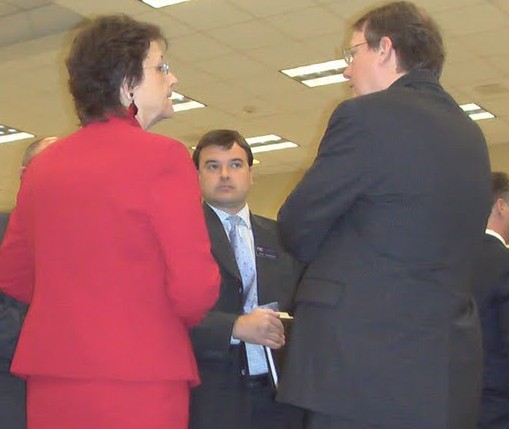
Rep. Avila with Marc Trathen, Time Warner Cable's top lobbyist (right) in 2011. Photo by: Bob Sepe of Action Audits

Rep. Marilyn Avila (R-Time Warner Cable), the North Carolina representative fronting for the state’s largest cable company, sure can sing for her supper.

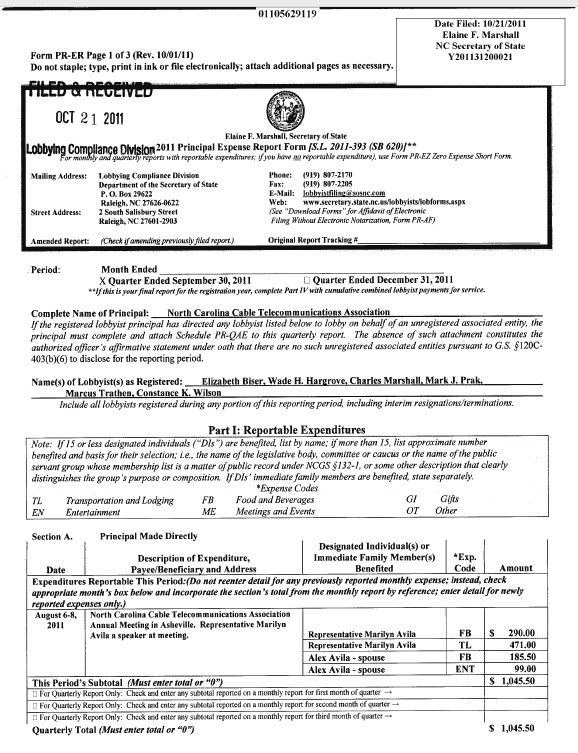
The representative who shilled for North Carolina’s notorious anti-community broadband legislation was the very special invited guest speaker for the cable industry lobbying association annual meeting, held last August in Asheville, according to newly-available lobbying disclosure forms obtained by Stop the Cap!

The North Carolina Cable Telecommunications Association reported they not only picked up Marilyn’s food and bar bill ($290 for the Aug. 6-8 event), they also covered her husband Alex, too.  Alex either ate and drank less than Marilyn, or chose cheaper items from the menu, because his food tab came to just $185.50.  The cable lobby also picked up the Avila’s $471 hotel bill, and handed Alex another $99 in walking-around money to go and entertain himself during the weekend event.  The total bill for the weekend, effectively covered by the state’s cable subscribers: $1,045.50.

That’s a small price to pay to reward a close friend who delivered on most of the cable industry’s wish-list for 2011.  Besides, the recent cable rate increases visited on North Carolina cable subscribers will more than cover the expense.

Meanwhile, in a separate disclosure, Stop the Cap! has learned Time Warner Cable covered food and beverage costs for members of the North Carolina General Assembly and their staff who attended the Mardi Gras World celebration in New Orleans, sponsored by corporate front group the American Legislative Exchange Council.  ALEC lobbies state legislatures for new laws they claim are grassroots-backed, but are in reality the legislative wish-lists of giant corporate interests, including North Carolina’s largest cable company — Time Warner.

The food and bar tab totaled just over $130 for the festivities.

Time Warner Cable achieved victory in 2011 passing anti-community broadband legislation through the North Carolina General Assembly, in part thanks to new support from the Republican takeover of the state legislature last year.

We Need SOPA Why? Breaking News: Megaupload Shut Down for Copyright Infringement

Phillip Dampier January 19, 2012 Consumer News, Public Policy & Gov't 17 Comments

Megaupload and its sister site, Megavideo, has been shut down by federal prosecutors in Virginia for copyright infringement.

An indictment unsealed today accuses the site of costing content owners at least a half billion dollars in lost revenue.  Megaupload allows users to upload, store, and share large files with other users.  Like Rapidshare, another file storage service, music, television shows, and software often found their way onto the site, where paying customers could obtain the files without much trouble.  Megaupload.com has always claimed it responds to copyright infringement notification and deletes offending files, but federal prosecutors believe otherwise.

As of this afternoon, Megaupload.com appears to be down.

The crackdown on what was one of the top-20 most-visited websites in the world comes one day after net advocates protested attempts by entertainment companies to strengthen copyright laws.  Many who oppose the Stop Online Piracy Act are now asking why the new law is necessary when existing laws seemed sufficient to shut down a favorite target of Hollywood movie studios and the music industry, who have long accused the site of being the equivalent of an online piracy warehouse.


If Communities Self-Finance Sports Stadiums, Why Not Their Own Fiber Broadband Networks?

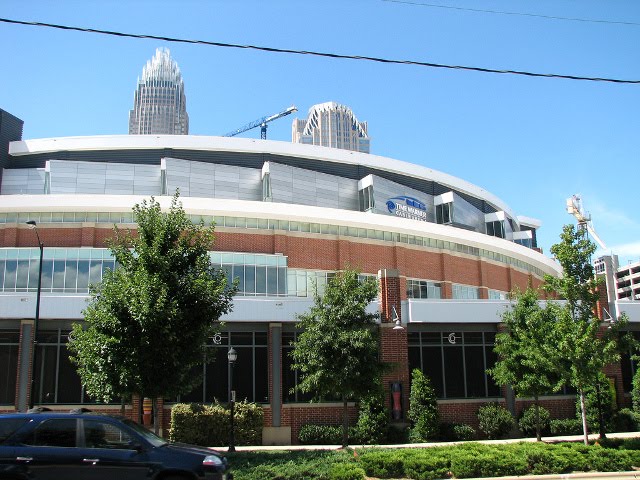
Plenty of taxpayer-backed money for this... (Time Warner Cable Arena - Charlotte, N.C.)

Which is more important:

  1. Spending hundreds of millions of taxpayer dollars to finance sports facilities, stadiums, and “incentive packages” to attract and keep major sports franchises calling your city home;
  2. Building quality digital infrastructure that will deliver 21st century broadband service at affordable prices for every local citizen that wants the service.

Here in western New York, the city of Buffalo — the third poorest city in the nation with 28 percent of its residents living in poverty and suffering chronically high unemployment — is about to the recipient of a one billion dollar bailout courtesy of the state government (a/k/a taxpayers).  That, even as some in the city are howling that the promised tens-to-hundreds of millions in promised renovation funding for the Ralph Wilson (Buffalo Bills) Stadium is apparently not included.

While hundreds of millions of taxpayer dollars are readily available to finance sports stadiums, getting privately financed bonds for public broadband is somehow the real crime in states like North and South Carolina.  North Carolina already has legislation in place that virtually assures broadband service is under the control of the state’s largest phone and cable companies, or it simply is not provided at all. Evidently in a battle over worthwhile public spending, financing a reported $260 million for Charlotte, N.C.’s Time Warner Cable Arena remains a higher priority than making sure the people of North Carolina have decent broadband service.

South Carolina this week is considering extending a similar courtesy to companies like AT&T and Time Warner Cable.  They need better broadband even more than their neighbors to the north.

Happily, broadband advocate Craig Settles has found a way for broadband lovers to have their cake and eat it too.

...but none for this?

Why not construct public, non-profit broadband networks by selling ownership shares to the general public?

All of you who believe in broadband’s impact on economic development (or are a little jealous of stories like this about Chattanooga’s 1 gigabit network), should look to the Green Bay Packers of the NFL for the key to financing your broadband network.

Yeah, they kind of choked in last Sunday’s playoff game against the N.Y. Giants. But the team is a surefire winner when it comes to raising money. The franchise raised $70 million to rehab its football stadium (Lambeau Field) by selling 280,000 stock shares to individuals at $250 a pop. They pulled off this amazing feat in just five weeks!

With apologies to New Orleans Saints fans — “Who Dat” is bringing big bucks into town for a project that will pump up the local economy? The citizens of Green Bay. Literally. The Green Bay Packers are a nonprofit corporation owned by local residents and businesses. Packers pride enabled Green Bay to outdo tech companies that can’t get an initial public offering off the ground, let alone raise $70 million.

If Green Bay can do all this for a football field, can’t your hometown or county convince constituents to raise just a few million for a broadband network?

$250?  That’s the combined price of today’s cable and cell phone service over just a single month.  Should a private non-profit group act as coordinator for the project, they can walk right past existing restrictions on municipal broadband enacted at the behest of big cable and phone companies.  Self-financed fiber to the home service could pay dividends… to customers instead of Wall Street.

Settles lays out the parameters and the challenges, namely fighting that old meme that only giant telecom duopolies know how to run a broadband business.  But as we’ve seen from small scrappy private providers like Sonic.net in California and publicly-owned EPB Fiber, providing superior service at a reasonable price will bring customers to your door.  Even more so if they also happen to own the door.

Search This Site:

Contributions:

Recent Comments:

Your Account:

Stop the Cap!