AT&T U-verse Expansion: It’s Over; AT&T’s Rural Broadband Solution? “We Don’t Have One”

Phillip Dampier February 8, 2012 AT&T, Community Networks, Consumer News, Rural Broadband 21 Comments

AT&T’s vision for 21st century broadband will not extend beyond the 30 million homes that can or will soon be able to access the company’s fiber-to-the-neighborhood service U-verse.

Speaking on an investor’s conference call to discuss 4th quarter earnings results, AT&T CEO Randall Stephenson announced the expansion of its fiber to the neighborhood service is now effectively over.

“Our U-verse build is now largely complete, so we have in place an IP video and broadband platform that reaches 30 million customer locations, which gives us significant headroom now to drive penetration,” Stephenson said.

In practical terms, Stephenson’s announcement means AT&T will continue work on building its U-verse platform in cities where the service is already available, but other areas are unlikely to see an introduction to the service anytime soon.  AT&T President John Stark originally envisioned U-verse for 30 million homes and that vision remains unchanged today.

AT&T’s news for its rural customers is worse.  The company admits it has run out of ideas how to provide rural broadband to its landline customers.

“We have been apprehensive on moving, doing anything on rural access lines because the issue here is, do you have a broadband product for rural America?,” Stephenson said. “And we’ve all been trying to find a broadband solution that was economically viable to get out to rural America and we’re not finding one to be quite candid.”

If you can buy it at any price

Stephenson was hoping LTE 4G wireless service could provide a rural broadband solution, a central theme in AT&T’s lobbying campaign for a buyout of T-Mobile, since abandoned.

“That having been set aside, now we’re looking at rural America and asking, what’s the broadband solution? We don’t have one right now,” Stephenson said.

Stephenson earlier told a July meeting of the National Association of Regulatory Utility Commissioners that DSL, the most common form of broadband in rural America, was “obsolete.”

The two announcements immediately raised questions in South Carolina and Georgia where AT&T and other telecommunications companies are fiercely lobbying for restrictions on community-owned broadband.

Broadband advocates in both states are wondering why the company is spending money trying to stop other broadband projects while not spending on building better broadband service in those areas themselves.

Broadband Backwater Watch: Georgia Anti-Broadband Bill Defines Broadband: 200kbps

Sen. Chip Rogers' vision of rural Georgia's broadband future

Sen. Chip Rogers (R-Woodstock) thinks he knows broadband.  He, along with several other Georgia legislators well-compensated by some of the state’s largest telecom interests, have defined appropriate Internet speeds at a remarkably low “200 kilobits per second,” less than four times faster than your old AOL dial-up Internet account.  The one you canceled in 1998.

With a background like that, it was no surprise last Thursday when technology leaders and city representatives from across Georgia testified before the Senate Regulated Industries & Utilities Committee, strongly objecting to Rogers’ SB 313, a bill bought and paid for by the very companies the legislation would effectively protect from competition.

Rogers argues he wants to “level the playing field” between private providers that currently dominate broadband service in Georgia, and the long-suffering communities in rural areas that have waited for faster Internet since the Clinton Administration.

City officials from Dalton, Newnan, Elberton, Thomasville, Cartersville, LaGrange, Hogansville and Monroe collectively noted the proposed legislation hardly represents a level playing field when it fully exempts the bill’s backers from any of its provisions.  Thomasville mayor Max Beverly noted the same cable and phone companies that fiercely fought for statewide cable franchises for themselves now want to impose rules that forbid publicly-run companies from operating outside of their respective city limits.

“We would have to turn off service to the county’s two largest employers,” Thomasville Mayor Max Beverly told the Senate panel. “There is no telling what that would do to jobs in our area.”

Those testifying uniformly noted they entered the broadband business because private providers refused to deliver adequate service in their areas.

What community broadband provides communities the big phone and cable companies don't.

“We started our cable system not on a whim but on a demand from our citizens to provide a higher level of service for cable TV and Internet,” said Newnan Mayor Keith Brady. “We got into the cable business originally to provide fiber optics and broadband because Charter Communications would simply not invest in our community.”

Now cable and phone companies across Georgia are supporting legislation that would make that community service next to impossible to provide.

“The most ironic part of legislation like SB 313 is that cable and phone companies only take an interest in rural broadband when they ghostwrite bills like this to stop other people from providing the service themselves,” said Stop the Cap! reader Max Curr. “When I lived in Hiltonia, some of these same companies laughed at me when I asked about broadband. It simply was not profitable, they were not going to provide it, and with this bill, they will make sure it stays that way.”

But the cost to consumers extends way beyond the most rural corners of the state. SB 313 also hurts existing cable and phone customers who pay higher rates because of the lack of competition.  That assures the kind of anemic broadband Rogers and his friends in the cable and phone industries are only too happy to define as 200kbps.  At least that is 10kbps more than a similar bill being pushed by telephone and cable operators in South Carolina.

Brady says their community-owned system not only provides broadband where Charter would not, the cable company also was forced to reduce their rates for consumers in nearby communities, saving taxpayers across the entire city and county millions.

In Elberton, the lack of broadband was so pervasive the 4,700 local residents demanded the city provide the service themselves. Commercial providers had stonewalled the county seat of Elbert County for years until the city broke ground on a broadband project in 2001.
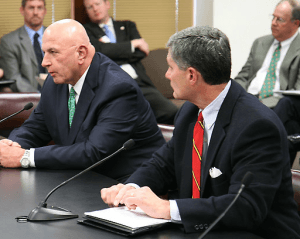
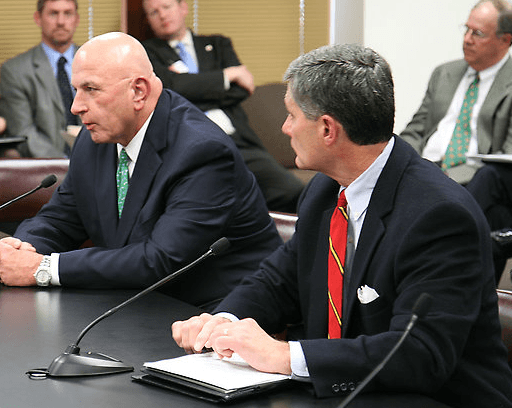
Dalton Utilities' CEO Don Cope (left), Newnan mayor Keith Brady (right) (Photo: Georgia Municipal Assn.)

Elberton City Manager Lanier Dunn complained SB 313 undercuts the rational definition of minimum Internet speeds to levels most Americans would not even consider “broadband.”  Dunn noted that the 2010 National Broadband Plan calls for download speeds 250 times greater, and by 2020 500 times greater, than what Rogers’ bill currently defines as broadband service.

“We should be reaching for higher and faster speeds, not relegating ourselves to barely just above dial-up,” Dunn said.

Don Cope, president and CEO of Dalton Utilities, demonstrated that municipal broadband systems are not the financial risk large telecommunications companies always claim they represent.  In fact, Dalton’s system has never received a penny of tax revenue and its accounting is open to public scrutiny to prove it.

Cope noted SB 313 imposes restrictions on community providers, but completely exempts those owned by the companies pushing the bill.

“I would ask that you look at the private providers in the state,” Cope said. “Look at their reports, and you would see how many dollars that are provided to them from the federal government. We are talking about in the billions of dollars. All the [private telecommunications entities] that I know about have some form of government support.”

Dalton isn’t the only city in Georgia with a successful community-owned operation.

The city of Newnan found their system such a valuable asset, they sold it at a profit to a private company in 2008 and used the proceeds to pay off its remaining construction costs.


Your Internet Could Be Worse: St. Helena’s 4,000 Residents Share A Single 10Mbps Connection

Perhaps the most the world ever hears about the tiny British island of St. Helena, a home in the South Atlantic for 4,000 residents, is the annual St. Helena Radio Day when the nation takes to the shortwave radio dial to say hello to friends on every continent.

Beyond that, St. Helena is mostly known as an out-of-the-way tourist destination and potential point of contact for ships traversing the South Atlantic between South America and southern Africa.  St. Helena’s residents live with three television stations, two radio stations, two newspapers, and a single satellite connection to the Internet providing one 10/3Mbps circuit shared by all 4,000 residents.

Signing up for “broadband” is an expensive ordeal.  Individual residents can purchase strictly usage-limited DSL Internet service at prices ranging from $31 a month for 128/64kbps service (limited to 300MB per month) to $190 for 384/128kbps service, with a 3.3GB monthly allowance.  Overlimit fees start at around $0.15 per megabyte.

St. Helena

Local residents find life without the modern day definition of broadband service a major hindrance, especially for education.  Students have left St. Helena for the United Kingdom to pursue studies.  Economically, self-sustained employment is next to impossible on the island.

“I’m an IT engineer and I would love to return to my island to start an IT business, but because of the slow, expensive and unreliable Internet connection this is simply impossible,” said Jonathan Clingham, an IT infrastructure engineer now working in Wiltshire, England.

Now a grass-roots campaign has been launched to help convince several telecommunications companies financing a new underseas fiber cable project laid between Brazil, Angola, and South Africa to reroute the cable slightly through the island of St. Helena, opening the door to modern broadband for the island.

The group is calling on supporters to help draw attention to the project, arrange for the British government to help underwrite the expense of an extra 50 kilometers of cable needed to reach St. Helena, and providing assistance to lease a circuit on the new cable:

Time Warner Cable, Comcast Prepared to Help Out the NY Mets With $80 Million Investment

Phillip Dampier February 6, 2012 Comcast/Xfinity, Consumer News 2 Comments

While simultaneously complaining about the spiraling costs of sports programming such as MSG Networks, the nation’s two largest cable operators are planning to cut checks worth $80 million to help bail the NY Mets baseball team out of some of its long term debt.

The New York Times reports both Comcast and Time Warner Cable are preparing to funnel funds into the team through regional sports network SNY.

Time Warner Cable and Comcast are nearing a plan to finance SNY’s purchase of four shares in the Mets, worth $80 million, said one person e with knowledge of the plan who was not authorized to speak publicly.

[…] That means they will have much-needed cash to pay off their substantial debts. But it would be a slightly quirky way of doing it. The deal would mean 16 percent of the Mets would be owned by SNY. The Mets’ parent company, Sterling Equities, owns 70 percent of the network.

[…] Lee Berke, the president of a media consulting company, said that Time Warner Cable and Comcast “don’t want to see the team stumble as it has been, because it directly impacts what they’re putting on TV. This is shaping up as a multiyear downswing for the Mets, and this is a way to keep them above water.”

[…] As for Time Warner Cable and Comcast, it was not immediately clear why they would not invest directly in the Mets. But the two companies clearly want to put money into Wilpon’s financially beleaguered hands (the club has lost some $120 million in the last two years), even if it has to be routed through SNY, to ensure that the team meets its $200 million goal.

[…] Together, Time Warner Cable and Comcast own about 30 percent of SNY. The network started carrying Mets games in 2006.

That investment comes at the same time cable operators are increasingly vocal about sports programming costs.

“ESPN, through … sheer muscle, has been able to say to us, ‘You will carry this service on the lowest level subscription you offer, and you will make all of them pay for it,’” Matt Polka, CEO of the American Cable Association, a trade group told Newsweek. “My next-door neighbor is 74, a widow. She says to me, ‘Why do I have to get all that sports programming?’ She has no idea that in the course of a year, for just ESPN and ESPN2, she is sending a check to Disney for about $70. She would be apoplectic if she knew … Ultimately, there’s going to be a revolt over the cost. Or policymakers will get involved, because the costs of these things are so out of line with cost of living that someone’s going to put up a stop sign.”

Cable analysts continue to be astonished by an inflation rate in sports programming rates that rivals health care costs.

“Every time [there is] a huge increase we can’t believe it, and then there’s another huge increase,” says Laura Martin, an analyst with investment bank Needham & Co. “The rapidly rising cost of sports, especially the new NFL contracts, increases the likelihood that sports will be forced by the government to be on a different tier within three years, by our estimates.”

Cable industry investment in sporting teams is now becoming a familiar headline.  In early January, the Los Angeles Times reported Time Warner Cable was considering buying the Los Angeles Dodgers at a price that could exceed $2 billion.  It would compliment two new regional sports cable channels Time Warner plans to launch in southern California featuring the Los Angeles Lakers.

AT&T Makes Customers Pay for Reception Problems: The MicroCell Controversy

Phillip Dampier February 6, 2012 AT&T, Competition, Consumer News, Wireless Broadband Comments Off on AT&T Makes Customers Pay for Reception Problems: The MicroCell Controversy

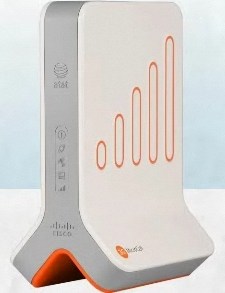
AT&T 3G MicroCell

AT&T has lost another customer.

PC World‘s Tony Bradley noticed reception on AT&T’s network in suburban Houston has been losing bars in more places than it has maintained over the last few years.

“[…] for reasons unknown to me the AT&T network in my area has been getting steadily worse. There have been a couple of weak spots in the same location for years. Rather than improving and eliminating those weak spots, the weak spots became dead zones…and then proliferated.

I don’t live in the boonies. I live in suburban Houston in a community that is very near a major highway, and yet there are four or five areas with literally no service. I could almost understand if the signal decreased, or if it switched from 3G to the older Edge network in places, but in 2012 in an affluent suburb near a highway there is no excuse for a company like AT&T to have any area where my phone literally displays “No Service”.

Even with the growing dead zone epidemic, I was still reluctant to switch. I maintained that the grass is always greener, and that I was better off to stick with the devil I know. That is, until I moved.

I only moved four miles, and I am still in the same community I was in before. However, in my new house the AT&T signal is too flaky and unreliable. I have to walk to special places in my house to get a workable signal, and even then I am told constantly that I am “breaking up” by the person on the other end of the line. I often miss calls because there is no signal and my phone doesn’t even ring. I don’t realize I even had a call until I receive the voicemail.”

AT&T’s response to these kinds of reception problems is to suggest customers purchase one of their 3G MicroCell units, which delivers a wireless signal inside your home or business connected through your broadband account.  But Bradley took exception that AT&T would charge him $200 (negotiated down to $100) and a monthly service fee just to mitigate the company’s own reception problems.  AT&T has since lost Bradley as a long-lasting customer — he took his business to Verizon Wireless, which offers better reception in his neighborhood.

The columnist cannot understand why AT&T would treat a long-term customer so poorly.

“AT&T could have kept me happy, but chose to let me leave instead,” Bradley writes.  “So, let me get this straight. AT&T isn’t capable of delivering the service I am already paying for, and the proposed solution is that I spend $200 (or $100 after a lengthy and heated debate), plus additional money every month for the privilege of routing my calls over the broadband Internet service I am also paying for? That was really the last straw for me with AT&T.”

Search This Site:

Contributions:

Recent Comments:

Your Account:

Stop the Cap!