Frontier’s Mess of a 4th Quarter: Dividend Slashing, Underwhelming Broadband Don’t Impress

Phillip Dampier February 20, 2012 Broadband Speed, Competition, Consumer News, Frontier, Rural Broadband Comments Off on Frontier’s Mess of a 4th Quarter: Dividend Slashing, Underwhelming Broadband Don’t Impress

Frontier Communications faced unhappy investors Thursday after announcing it was slashing its dividend nearly in half in an effort to raise money to sustain the company’s cash flow and reduce its debt.

The company’s earnings fell 8.1% as customers continued to leave for the competition, seeking better service and lower prices.

The poor earnings results and the dividend cuts delivered a one-two punch to Frontier stock, which slid to $4.20 a share, down 16 percent in the last three months.

Among Frontier’s biggest challenges remains the quality of its broadband service to customers.  Where competition exists, Frontier DSL continues to lose the speed battle, and recent junk fees padding customer bills, including a “High Speed Internet surcharge,” and increasing modem rental fees have alienated some customers.

Frontier’s chief operating officer and executive vice president Dan McCarthy told investors 83 percent of Frontier’s service area has access to the company’s broadband product.  However, fewer than 20% of Frontier’s customers have access to speeds as high as 20Mbps.  Only just over half can access the Internet at 6Mbps.  Many of Frontier’s customers can only access lower speed service (66% can choose 4Mbps, 76% — 3Mbps, and the rest 768kbps-3Mbps).

“We’ll be investing throughout the year to improve speed-reaching capability in all our markets,” McCarthy told investors on a conference call last week.

In the second half of 2010, Frontier is expected to increase the amount of Ethernet in its middle mile network, which McCarthy expects will allow the company to deliver faster speeds over VDSL2 and VDSL2 bonding as means of driving both speed increases in the residential and the commercial markets.

However, Frontier’s preoccupation with an internal system conversion, to integrate its acquired Verizon service areas with the rest of its network, has stalled much of the company’s marketing.  Promotions, in particular, have been anemic over the last several months and will likely remain that way until later this year.  Where competition exists, cable operators have successfully been picking off Frontier’s customers.

  • Broadband and satellite TV additions are down, in part due to the lack of promotions and marketing;
  • FiOS video losses continue as the company shuns its fiber video service in favor of satellite TV cross-marketing;
  • Line loss rates remain very high: 8.3% of Frontier’s customers disconnected their landline service in the last quarter, 5.9% in areas that were not acquired from Verizon.
  • Once customers leave, they rarely return.  Churn rate of Frontier customers coming and going is at just 1.6%.

As with similar Verizon landline sales in the past, initial revenue growth from acquired customers starts out high, boosting revenue numbers and often the value of a company’s stock.  But the heavy debt load incurred from acquisitions and ongoing line losses to the competition eventually take their toll, and Frontier’s revenue now reflects the reality of a company trying to sell more services to a declining number of customers.

Morningstar notes the company’s debt problems are significant:

Frontier has struggled to bring leverage down and hasn’t successfully placed new debt since closing the Verizon transaction in 2010. Management has talked about taking care of the $580 million maturity it faces in early 2013 for the better part of a year, with no result to date. Yields on the firm’s existing debt have increased over the past year, despite the sharp decline in Treasury rates.

Standard & Poor’s Ratings Services reduced its outlook on the company from stable to negative, noting the competition is increasingly hurting Frontier’s capability to raise revenue.

The company’s decision to slash its dividend in an effort to reduce debt has created consternation for some investors who stuck with the company when the share price was above $7 and the dividend was declared safe for two years.  Neither seems to the be case any longer.
Heartland Institute Astroturf Group Threatens to Take Legal Action Against Bloggers, Activists

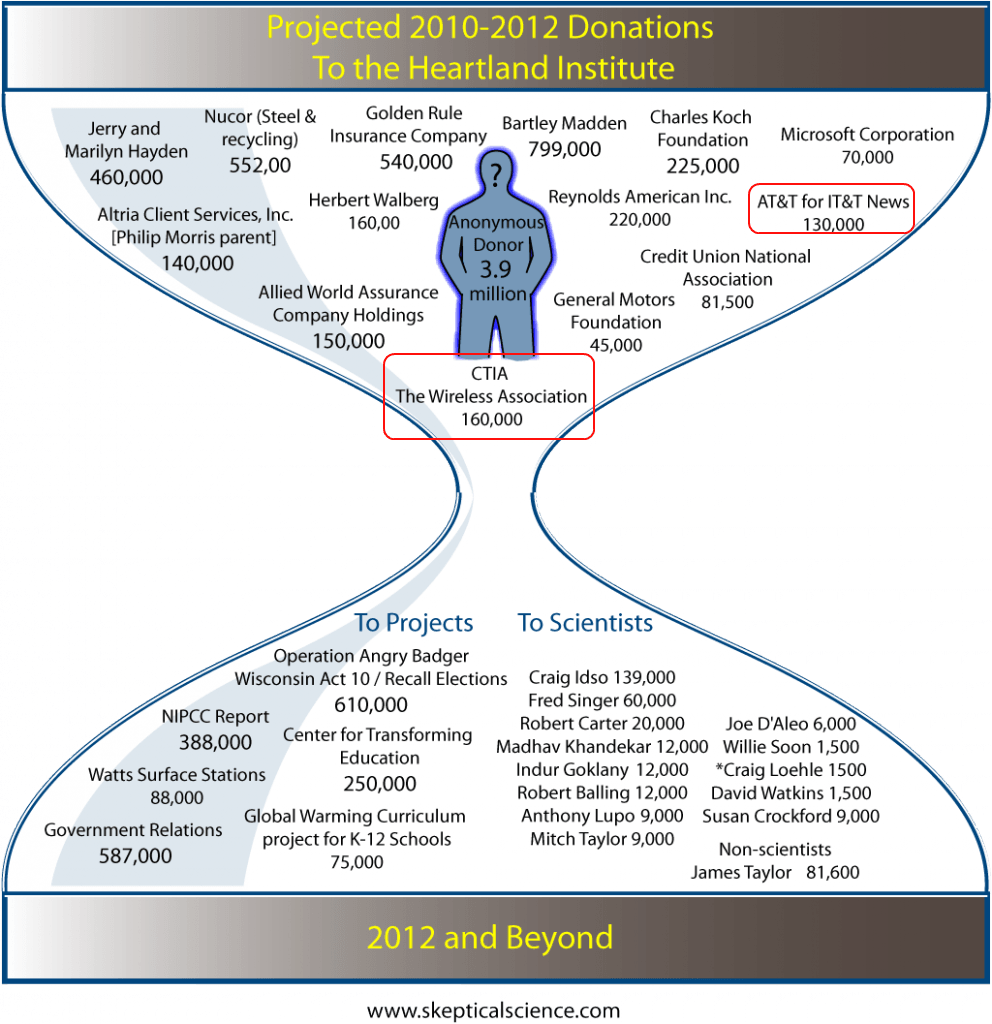
Skeptical Science produced this infographic of the Heartland Institute’s funding sources and where the money goes.

The Heartland Institute, a corporate-backed astroturf operation that has steadfastly supported cable and phone companies against the interests of consumers, has threatened legal action against activists, bloggers, and other journalists who published stories about recently-acquired documents connecting the group with major corporate donors.

Among telecommunications companies, both AT&T and Time Warner Cable show up in the alleged donor documents, which Heartland officials claim were obtained under false pretenses and, in some cases, were altered or forged.

Jim Lakely, communications director for the group, was unhappy:

We respectfully ask all activists, bloggers, and other journalists to immediately remove all of these documents and any quotations taken from them, especially the fake “climate strategy” memo and any quotations from the same, from their blogs, Web sites, and publications, and to publish retractions.

The individuals who have commented so far on these documents did not wait for Heartland to confirm or deny the authenticity of the documents. We believe their actions constitute civil and possibly criminal offenses for which we plan to pursue charges and collect payment for damages, including damages to our reputation. We ask them in particular to immediately remove these documents and all statements about them from the blogs, Web sites, and publications, and to publish retractions.

The fact the group implies it will take legal action against those who published stories not to the group’s liking will only draw added attention to the scandal.  Stop the Cap! has tangled with this group several times over the years whenever AT&T and Time Warner Cable’s corporate agendas are being challenged.

The group has steadfastly refused to release their donor lists, at one point telling us, “by not disclosing our donors, we keep the focus on the issue.”

Not really.  That’s because the first rule of politics is to “follow the money.”  Most of these groups do not sing their songs for free, and knowing who paid the songwriter can be very revealing.

The Associated Press found no evidence Heartland’s budget or fundraising documents leaked to the media were faked or altered:

Because Heartland was not specific about what was fake and what was real, The Associated Press attempted to verify independently key parts of separate budget and fundraising documents that were leaked. The federal consultant working on the classroom curriculum, the former TV weatherman, a Chicago elected official who campaigns against hidden local debt and two corporate donors all confirmed to the AP that the sections in the document that pertained to them were accurate. No one the AP contacted said the budget or fundraising documents mentioning them were incorrect.

Heartland can best salvage its reputation and put this behind them by releasing the names of their largest donors, letting consumers decide whether this organization truly represents their interests, or those of the corporations writing the big checks.  In addition to corporate contributions, Heartland’s operations rely on a single person identified only as “Anonymous Donor.” In the past six years, the man has given $14.26 million to the institute, nearly half its $33.9 million in revenue, according to the AP.

Grassroots this is not.

4 Tips to Find the Cheapest Deals for Internet Access

CenturyLink runs specials on their website that offer extra savings when ordered online.

Your $50 monthly broadband bill has been burning a hole in your wallet and you think there should be a cheaper price available somewhere, right?

The answer is, for most of us, there is.  You just have to look.

The most expensive Internet access around comes when you buy broadband-only service from a provider.  Both cable and phone companies have been incrementally punishing their “broadband-only” customers for years, tacking on $5, $10, even $15 to the price because you have chosen not to bundle broadband with other services the company sells.  It is not unusual to see some cable companies charging $55-60 for standard Internet service.  When you call to inquire, they are sure to begin aggressively upselling you to a bundled service package, arguing you can add cable TV and phone service for $20-30 more a month.  That sounds like a better deal, unless you honestly don’t care about either service.

Welcome to the world of marketing, where the “value perception” is key to driving the average revenue collected from each subscriber higher and higher.  You end up buying services you probably would not have considered, but because they seem so inexpensive when compared with the price of the service you are interested in, why not?

Phone companies do the same thing, but many of them also love to bury hidden charges in the fine print and commit you to 1-3 years of service to guarantee the advertised price.  Companies like Frontier Communications may pitch DSL service for just $15 a month, but keep reading and you will discover the taxes and fees raise that price substantially.  In fact, that particular phone company is notorious for charging substantial modem rental fees and what they call a “High Speed Internet” surcharge.  To get the lowest price from them, you will be a Frontier customer for at least a year, depending on the promotional offer selected.

Frontier redefines "value": This attractive looking offer "fine prints" the $6.30 modem rental fee, is for service "up to" 1Mbps (so much for "high speed"), has a one-year service commitment with a $50 early termination fee, and does not include unspecified "taxes and surcharges" which run extra.

You can break free of the marketing circus by concentrating on finding the best possible deal for the service(s) you really care about.

  1. Check advertising offers on television and in newspapers, but always read the fine print;
  2. Visit the website of each local provider and look for “Internet-only” offers that may deliver extra savings, but only when you order online;
  3. Call providers and ask them about their various deals and inquire “is this the best offer you have right now?;”
  4. Use search engines and type in your provider’s name and words like “deals,” “offers,” or “promotion.”  Third party authorized resellers may have an offer that works better for you.

Sometimes you can get excellent results playing providers off each other.  Try contacting the social media representatives of different providers in your area to unlock hidden deals, and more importantly, customer retention offers.  One Rochester reader of ours got Time Warner Cable to open negotiations to keep his business with this tweet:

Getting ready to schedule my @TWCable disconnect after rate increase – should I go with @dishnetwork over @DirecTV or vice versa?

He received a substantial retention offer within hours of alerting Time Warner of his discontent (he’s also a rabid hockey fan, and the ongoing MSG-Time Warner Cable dispute made satellite an attractive alternative.)

[flv width=”360″ height=”290″]http://www.phillipdampier.com/video/KNXV Phoenix Which broadband provider saves you the most money 2-7-12.mp4[/flv]

KNXV in Phoenix helped residents in that Arizona city figure out who was cheaper, CenturyLink or Cox Cable.  And what about using mobile broadband for a home broadband replacement?  (3 minutes)

Isn’t It Time to Consider a Rural Broadband Administration? Co-Op Internet for America

This influential documentary explores the rural cooperative movement for electricity in the 1930s.

In 1935, just 5-10 percent of America’s family farms were wired for electricity.  The cities: lighted.  The rest of the country: in the dark.  It was the same old story then as it is today for rural broadband:

  • There are two few customers for us to make a profit by bringing you service;
  • The return on investment will take too long;
  • You won’t use enough service to justify the expense of providing it;
  • Okay, we’ll install service, if you pay thousands of dollars to cover the cost to bring it you.

Private providers delivered electricity to big cities, but found the countryside not worthy of their time or investment.  Then, as now, rural America’s economy suffered for it.  Back in 1935, family farms coped with wood-fired stoves, school homework by kerosene lamp, discarding fresh farm products that could not be kept cool, no running water, no radio, and no appliances to make an already difficult life a bit easier to manage.  In 2012, an increasing amount of the rural economy is moving online, where raw materials and goods are bought and sold, where knowledge-based jobs require a dedicated broadband connection, and education means completing homework assignments and doing research on the Internet.

Same old problems cast in a different light to be sure, but borrowing from America’s past may put a down payment on our broadband future.

President Franklin D. Roosevelt had heard all of the excuses and seen private electric companies try to showcase their minor efforts to improve power in rural America. A series of small scale projects that looked good in the newspaper could not hide the more general attitude it was unprofitable to provide the service to family farms.  In 1935, Roosevelt signed an executive order establishing the Rural Electrification Administration (REA).  Although FDR’s contemporary critics like to consider him a socialist that interfered in the private economy, in fact Roosevelt’s REA spent the majority of its effort in areas commercial providers wouldn’t touch with a 25-foot power pole.

The idea was simple.  Rural American communities with limited or no electric service could reach out to the REA to obtain low interest loans to finance the infrastructure to construct rural electric service.  When loans were approved, a cooperative electric company was established, with each “customer” being a member and part-owner of the co-op.  Income earned from ratepayers would pay for the service and pay back the government loans.  When the federal government was paid in full, the cooperative owned the new utility company outright.

In practice, this was the only way rural Americans, especially farmers, could obtain electric service.  These cooperatives often found they could deliver the same service a private company could, and for much less money. Co-ops work for the benefit of their members, not for outside investors.

[flv width=”640″ height=”500″]http://www.phillipdampier.com/video/Power and the Land.flv[/flv]

In 1940, the federal government commissioned ‘Power and the Land’ through the United States Film Service.  This one film, showing life for a farm family in southeastern Ohio before and after electrification, helped drive the rural electrification movement forward in areas yet to be wired for service.  The first 17 minutes chronicles life on the powerless farm, while the second half explores the REA electrification program and the changes electricity brought to farming life. (38 minutes)

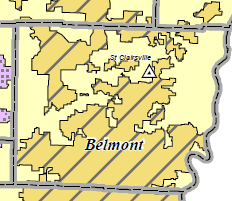
Belmont County, Ohio shows the legacy of the REA. Diagonal line-shaded sections illustrate the service areas of the original power co-op noted in the film 'Power and the Land.' The yellow shaded areas are served by Ohio Power, a subsidiary of American Electric Power, Inc., a commercial company.

The film’s impact was profound (the Village Voice called it “a little masterpiece”), and more than four million farmers were estimated to have seen it.  Eventually, more than 500 miles of electric lines were being strung by America’s co-ops every single day.  Additional documentaries about the film were made decades later, narrated by Walter Cronkite, to chronicle the cooperative electricity movement, the original film, and what happened to the family.

Private providers were, of course, horrified by the REA and other Roosevelt Administration public works projects.  Private companies railed they were being undermined by low interest government loans, government involvement, and fear new regulations would threaten their profitable business models.  Some of Roosevelt’s fiercest critics called the administration’s zeal for public-good spending anti-capitalist and anti-American.  For Roosevelt, it was often simply a matter of finding the fastest solution to a pervasive problem private companies seemed uninterested and unwilling to solve.

The legacy of the REA remains plainly visible today.  In Ohio, what started as the Belmont Power Cooperative is today part of the South Central Power Company, itself a co-op within the Touchstone Energy Cooperative.  Belmont County, Ohio’s power grid still reflects the work of the REA in the 1930s, with the county divided into regions served by the original REA co-op and Ohio Power.

While South Central Power hasn’t gotten into the broadband business, several other rural co-ops have, expanding their focus towards fiber to deliver cable TV, Internet, and phone service.

If the concept of the REA was adopted for broadband, the formula for success can remain the same.  Low interest loans to finance fiber telecommunications networks provide limitless expansion possibilities and a clear path to solving rural America’s broadband inferiority problem.  Interest rates have never been lower, and by gradually repaying the loans from income earned from subscribers, taxpayer dollars are not at risk.  The federal government’s only real involvement in guaranteeing loans and providing oversight that the money is spent appropriately.  The co-ops that result will govern themselves by and for their members.

Some will say electricity is more important than broadband, and for some families that may be as true as similar arguments were for and against REA electricity in the 1920s and 30s.  But take a week off from your broadband service.  Disconnect it, don’t read e-mail or visit websites, and then re-evaluate that statement.

More and more, broadband has become a firmly established part of our lives at work, school, and home. If private companies won’t step up, let others organize to provide it.

[flv width=”640″ height=”380″]http://www.phillipdampier.com/video/North Carolina Farmers Utilizing the Internet America’s Heartland.flv[/flv]

Fast forward to December 2011, and watch how rural Rutherford County, N.C. farmers are adapting to the new digital economy with the use of broadband.  They are selling their crops online to eager restaurants, markets, and other buyers up to 70 miles away.  No broadband?  No deal.  (5 minutes)

Search This Site:

Contributions:

Recent Comments:

Your Account:

Stop the Cap!