Comcast Applauds Time Warner for Trying Usage Billing; Not Brave Enough to Try Themselves

Phillip Dampier February 29, 2012 Comcast/Xfinity, Consumer News, Data Caps 4 Comments

Angelakis

Comcast says it admires Time Warner Cable for risking subscriber wrath over plans to introduce usage-based billing Time Warner says will be optional for customers in southern Texas.  But Comcast admits it is not brave enough to try similar pricing schemes themselves, fearing a customer backlash.

“We have a very high customer satisfaction rating and we don’t really want to rock the boat on [our broadband product],” Comcast chief financial officer Michael Angelakis told an audience Tuesday at a Wall Street bank-sponsored media and telecom conference in San Francisco. “I give them credit for trying different things, [but] we have real momentum in that business and the goal is to keep it.”

Comcast was a spectator of the consumer and political backlash against Time Warner Cable when it last experimented with usage pricing in April 2009.  Within two weeks, Time Warner Cable CEO Glenn Britt shelved the plan under pressure from both customers and lawmakers.

Now Time Warner Cable wants to reintroduce the concept as an option for customers of a new “Internet Essentials” discounted broadband tier that would include a $5 monthly discount if customers kept usage under 5GB per month.

Some veterans of the 2009 battle suspect Time Warner is trying to slowly slip usage pricing past customers waiting to fight its return by first suggesting it is only an option, but later herding broadband customers into usage based plans by substantially raising the price of flat rate service.

“Looks like a trial run the company could easily expand to all of their Internet customers,” shares Stop the Cap! reader Jeff in San Antonio, Tex., one of the cities that will participate in the upcoming usage-based plan. “I have a hard time believing Time Warner is going through all the effort developing usage meters and billing support for usage pricing just to market a handful of customers a $5 discount.”

Jeff, who helped fend off the cable company’s original Internet Overcharging experiment in 2009, suspects Time Warner’s earlier attempt to market a “flat rate” broadband option at $150 a month could still be a blueprint for how the company could push customers out of their unlimited plans.

“They can claim they want to keep unlimited Internet, but have remained silent about how much they will charge for it,” Jeff says. “We need something in writing that this company will not gouge customers with the fine print going forward.”

Stop the Cap! posed several similar questions to Time Warner Cable’s Jeff Simmermon, director of digital communications, through the cable company’s blog.  The company, to date, has offered no response.
Mobile Phone Companies Seek to Curtail Free Text/Calling Alternatives

Phillip Dampier February 29, 2012 Competition, Consumer News, Wireless Broadband Comments Off on Mobile Phone Companies Seek to Curtail Free Text/Calling Alternatives

As wireless carriers watch their revenues from texting and calling begin to decline as consumers increasingly turn to third-party applications that offer free alternatives, some companies are striking back.

Vodafone Group (part owner of Verizon Wireless) and Deutsche Telekom (owner of T-Mobile USA) are introducing new instant messaging applications this summer that will directly confront free services offered by Google and third party providers like WhatsApp.

Operators have already lost nearly $14 billion is text/SMS revenue in 2011 as subscribers shut off lucrative texting and messaging plans, according to Ovum, a mobile market researcher.

The companies blame messaging competitors like WhatsApp, Apple and Skype for the loss of that revenue and will confront them with the launch of Joyn, a new service that will offer a suite of features such as instant messaging and video-calling.  Joyn will quickly achieve prominence as carriers intend to automatically install the application on smartphones as the service launches.

Joyn will first be offered in Spain and Germany, and possibly also eastern Europe.  But providers expect to expand the service to North America if the initial launch is successful.

In Europe, Vodafone already bans Skype calls that travel over the company’s data network unless customers pay an additional charge.  Deutsche Telekom blocks these external services for customers in the United Kingdom altogether.  In the United States, Verizon Wireless routes domestic Skype calls over Verizon’s network.

KPN, the largest mobile phone company in the Netherlands, summed up providers’ attitudes about third-party apps and services bypassing the company’s own services by raising rates on smartphone customers to win back the revenue they lost.

“You can’t just have free services,” Deutsche Telekom’s Kobus Smit told Bloomberg News. “Because who is going to pay for it.”

Cablevision Capitulates on New Customer Promos; Verizon FiOS’ Price Slashing Really Hurt

Phillip Dampier February 28, 2012 Broadband Speed, Cablevision (see Altice USA), Competition, Consumer News Comments Off on Cablevision Capitulates on New Customer Promos; Verizon FiOS’ Price Slashing Really Hurt

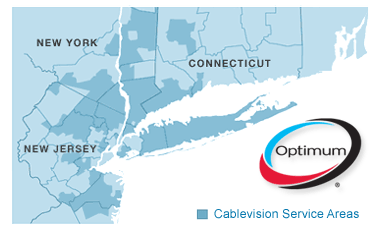
The cable company best known for serving suburban New York City.

Cablevision Industries has cried “uncle” in light of relentlessly aggressive competition from Verizon Communications, which offers its fiber to the home FiOS service in much of the cable operator’s service area.

Cablevision’s 4th quarter and year-end financial results, reported earlier today, are underwhelming investors.  Cablevision executives warned the company will have lower cash flow in 2012 due to increased investments in set-top boxes, network upgrades, and more importantly — no planned subscriber rate increases this year.

Some highlights:

Video – Losing Customers Like Everyone Else: Cablevision lost 14,000 video customers in the last quarter, many to Verizon FiOS and ongoing cord-cutting.  Analysts expected just 9,000 defections.  Cablevision will soon launch both HBO and Max Go online video for their customers nationwide.  Additional on-demand video options, online and off, are also anticipated.

Broadband – Cablevision finally admitted its own network was responsible for last year’s faltering broadband speeds that delivered poor marks in ongoing FCC speed tests.  The company originally denied the speed test results were accurate.  Today CEO James Dolan told investors the company invested in its broadband network to improve speeds and service.  Cablevision feels strongly it must compete effectively with Verizon to survive.  The company added 20,000 high-speed data customers and 31,000 phone subscribers in the quarter.  The company is doing well allowing customers easy access to broadband speed upgrades.

Wi-Fi – Cablevision sees strong value in its wireless broadband network as customers increasingly take their content mobile and need connectivity to the web.

Upgrades – CEO Jim Dolan said 2012 will be “a year of investment” in Cablevision upgrades and improvements.  The company is even accelerating projects originally envisioned for 2013.  Cablevision will continue to expand its “next day” installation offer across the eastern United States by the end of the first quarter.

Promotions – The escalating war of promotions between Verizon and Cablevision are likely to cease as Cablevision yanks their most aggressive new customer offers.  Earlier this year, Verizon was pitching a two year triple play offer that included an incredible $500 prepaid card rebate as part of the promotion.  “I don’t think you’ll see those [low introductory rates from Cablevision] again ever,” said Dolan.

“The main theme that people should take away from the call today is that we continue to be focused on moving the business in a direction where we both retain existing subscribers and have attractive, economically sensible offers for new subscribers,” said Cablevision chief financial officer Gregg Seibert.

How to Renew a Broadband Promotion With Bright House/Time Warner Cable

Phillip Dampier February 28, 2012 Competition, Consumer News Comments Off on How to Renew a Broadband Promotion With Bright House/Time Warner Cable

Last fall, our regular reader Scott wrote us about recent rate increases Bright House Networks imposed on broadband-only customers: $50/month for Internet access.  He learned from Stop the Cap! that a virtually identical, but lesser-known provider was ready and willing to provide six months of essentially equivalent Internet service for $20 less a month.

If your new customer promotion with Bright House or Time Warner Cable has ended, Earthlink can deliver essentially equivalent cable Internet service for $29.99 a month for six months. You do not receive the Powerboost temporary speed jump or a Road Runner/Bright House e-mail account, but you do save $120 over the promotional period.

Scott’s six month promotion with Earthlink was almost up, so he started calling Bright House looking for a returning customer promotion from them, and ran into a brick wall.

A Bright House promotion from a third party reseller

“Corporate wouldn’t budge,” Scott shares. “Two people kept giving me the run-around and excuses.”

“I was able to make the switch back to Bright House from Earthlink to keep my $30 a month promotional price for a second consecutive six month period,” Scott explains. “[But] I had to call an authorized [reseller] to give me the price as a ‘new customer.'”

But it wasn’t easy.  Involving third party resellers can become complicated because those independent businesses rely on commissions earned when new customers sign up.  An existing cable customer bouncing between providers may not be eligible for a commission, and can stall the switching process.

Scott spent an hour on the phone with Bright House getting them to apply the promotion to his account.

In general, Time Warner Cable customers have been able to bounce between new customer promotions from Earthlink and the cable company and back again without too much trouble.  Time Warner’s own promotion offers $29.99 a month Internet for a year, which is actually better than Earthlink’s six month deal.  Do a Google search for “Bright House promotions” and you will find third-party resellers all pitching six months of Bright House broadband service for $29.99 a month.

We recommend calling providers directly to establish service where possible, and if they refuse, you can always threaten to walk.  Providers become a little more willing to deal if you’re prepared to pull the plug.

AT&T’s Internet Overcharging Merry-go-Round — Billing App Makers for Your ‘Overusage’

AT&T’s march towards monetizing data usage has just gotten a twist with a new idea from the company to develop “a toll-free wireless Internet” where app makers foot the bill for your data usage.

First appearing in a Wall Street Journal article, John Donovan, AT&T’s executive for network and technology, suggested the new “app maker pays”-option will ease consumers’ fears about using high bandwidth apps that eat into AT&T’s data allowances.

“A feature that we’re hoping to have out sometime next year is the equivalent of 800 numbers that would say, if you take this app, this app will come without any network usage,” Donovan said at the Mobile World Congress in Barcelona, Spain. “It’d be like freight included.”

Critics of the idea pounced immediately, calling AT&T’s latest plan the realization of former CEO Ed Whitacre’s dream that content producers “can’t use [AT&T’s] pipes for free.”

Harold Feld, legal director at consumer group Public Knowledge thinks he’s got AT&T’s number:

Just to be clear, here is what AT&T Wireless is doing:

1. Create an artificial scarcity with an arbitrary bandwidth cap for its wireless services;

2. Charge users who exceed this arbitrary bandwidth cap;

3. Claim to do consumers a favor by letting the ap developer pay for exceeding the arbitrary bandwidth cap.

Which cuts to the heart of the problem in wireless, IMO. The argument in favor of a wireless capacity cap is, in a nutshell, “wireless is different from wireline because the physics imposes bandwidth limitations.” In the presence of these bandwidth limitations, we need a rationing scheme of some kind. Bandwidth caps are a neutral way of rationing and encourage app developers to write more efficient applications — thus improving the system overall.

The problem with this argument is it is impossible at present to determine just how true or false it actually is. I referred above to AT&T’s bandwidth cap as arbitrary. As far as I (or any outside observer) can tell, AT&T just selected a number and said “this is where we impose a cap.” You can buy a higher cap on a monthly basis, or can pay as you go above the cap in the form of overages.

Courtesy: Broadbast Engineering

AT&T has no worries about data tsunamis and "exafloods" when app makers or consumers are willing to pay more.

In fact, AT&T’s journey away from unlimited access to their wireless network is well underway.  Just two years ago, customers paid $30 a month for unlimited data on a smartphone.  Then AT&T ended “unlimited” access, imposing a 2GB usage cap on their most popular wireless data plan.  Now AT&T is looking to monetize its wireless traffic even further as customers grow more reticent about using high volume applications that could threaten one’s usage allowance.

Despite AT&T’s ongoing drumbeat America is in the midst of a wireless bandwidth crisis, the ‘national emergency’ is over as soon as someone — anyone other than AT&T — opens their wallet and agrees to pay more for data traffic.  Then the sky is the limit.

The logical inconsistencies of a company crying for more mobile spectrum concurrently envisioning new ways to monetize high volume wireless traffic (eg. large file downloads, online video, etc.) exposes the hollow center of  Internet Overcharging.  The “exaflood”/data tsunami only seems to threaten AT&T’s network when content producers and/or consumers are not paying extra for every kilobyte.

As Stop the Cap! has argued before, AT&T is increasingly  in the bandwidth shortage/rationing business.

The company underspent on its network, balked at the price tag to upgrade capacity (but had no trouble planning to pay substantially more to acquire T-Mobile), and now complains it has to charge higher prices because the federal government blocked its merger and the FCC won’t hand over additional spectrum.

There are two approaches to fat profits in the broadband business these days:

  1. A Proud Member of: Team Rationing for Profit

    Team Innovation: Believe in your product and nurture its growth with upgrades, innovation, and pricing that guarantees an enthusiastic and loyal customer base;

  2. Team Rationing for Profit: Leverage your dominant market power by rationing your product, charging higher prices for less service.  Monetizing usage controls traffic growth, reducing the expense of upgrading your network. With limited competition, even alienated customers face few alternative choices and a steep early termination exit fee.

Based on statements from AT&T’s Donovan, AT&T is a firm believer in the latter.

“There’s a view of an entitlement that says that any impediment to riding over the top of our network is inherently wrong, is un-American,” Donovan said, adding AT&T needed to find creative ways to deal with and profit from surging mobile-data use.

Feld thinks it says something else.

“This new plan is unfortunate because it shows how fraudulent the AT&T data cap is, and calls into question the whole rationale of the data caps,” Feld said. “Apparently it has nothing to do with network management.  It’s a tool to get more revenue from developers and customers.”

Search This Site:

Contributions:

Recent Comments:

Your Account:

Stop the Cap!