Verizilla: Bad for Competition, Bad for Consumers, Bad for You, Says CWA

Phillip Dampier March 27, 2012 Broadband Speed, Competition, Consumer News, Public Policy & Gov't, Verizon, Video, Wireless Broadband Comments Off on Verizilla: Bad for Competition, Bad for Consumers, Bad for You, Says CWA

Verizilla

The Communications Workers of America has a new, decidedly low-budget video decrying a spectrum swap between America’s largest cable companies and Verizon Communications that will leave Verizon Wireless stores pitching cable television service from one of Verizon’s cable company competitors.

To the CWA, this is nothing less than the birth of Verizilla, a new monster of a telecommunications company that has capitulated on competing with Big Cable and will instead devour the wireless communications marketplace for itself.  The CWA interest is obvious: many of its employees are responsible for constructing and maintaining Verizon’s now-stalled FiOS fiber to the home network.

From the CWA:

The deal, struck behind the closed doors of America’s corporate boardrooms, poses a threat to consumers and workers. If it goes through, it will be the death knell for competition between cable and telecom companies. Verizon Wireless, Time Warner, Comcast, and other cable companies will become a giant, unregulated quasi-monopoly. Verizon will have no incentive to challenge cable by building FiOS into new areas — meaning less competition, consumer choice, and higher prices for consumers.

Less FiOS also means fewer jobs building, maintaining, servicing, and installing the network. This deal will create a corporate behemoth that will use exclusive quad-play market power to shrink its future workforce.

Worst of all, Verizon Wireless and the cable companies are refusing to come clean about the details of the deal. Even as the FCC and Department of Justice review it, we still don’t know what it means for consumers or workers.

The CWA has so far collected more than 135,000 signatures on its petition opposing the current form of the deal. 

[flv width=”640″ height=”380″]http://www.phillipdampier.com/video/Verizilla.flv[/flv]

America, say hello to Verizilla, wreaking reduced investment havoc on Verizon service areas across the northeastern United States.  (2 minutes)

Rep. Walden’s “Less is More” Rant About FCC Speaks Volumes About His Contributors

Phillip Dampier March 27, 2012 Competition, Editorial & Site News, Net Neutrality, Public Policy & Gov't Comments Off on Rep. Walden’s “Less is More” Rant About FCC Speaks Volumes About His Contributors

Walden

When lawmakers talk about “unleashing” anything for “innovation,” it’s a safe bet we’re about to be treated to an anti-regulatory rant about how government rules are ruining everything for big business.  Rep. Greg Walden (R-Ore.) does not disappoint.

Walden is chairman of the Communications and Technology Subcommittee of the House Energy and Commerce Committee, an important place to be if you want to influence telecommunications policy in the United States.  Walden slammed the Federal Communications Commission this morning in an editorial piece in Politico, accusing the agency of regulating communications companies before they have a chance to engage in bad behavior:

Sometimes the FCC acts before thoroughly examining whether regulation is needed. It’s now time to stop putting the regulatory cart before the horse. That’s why this bill requires the FCC to survey the marketplace, identify a failure and conduct a cost-benefit analysis before imposing rules.

[…] When the FCC reviews a merger, it now often imposes unrelated conditions. These extraneous agreements may not correspond to any harm presented by the transaction, may not be justified industry-wide and, in some cases, are outside the commission’s jurisdiction.

Such bootstrapping is unfair to the singled-out parties. It also results in poor policy. Imposing extraneous conditions on a transaction that is not otherwise harmful is inappropriate. And if a transaction is harmful, imposing extraneous conditions cannot cure it. Merger conditions should be directly related to transaction-specific harms, and within the FCC’s general authority.

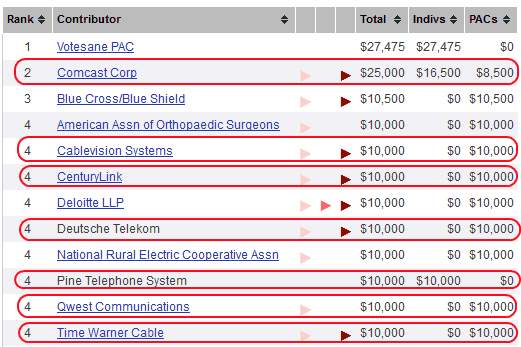
Walden’s concerns coincide with the corporate agendas of some of the nation’s largest telecommunications companies he oversees as chairman.  That may not be surprising, considering seven of the top 10 corporate contributors to his campaign fund are all telecommunications companies.

Walden's top campaign contributors (Source: Opensecrets.org)

Walden’s record on “innovation” is open to interpretation.  He is on record opposing Net Neutrality, has sought to “streamline” the FCC by hamstringing its authority, and has favored a variety of mergers and acquisitions that have effectively reduced competition for American consumers.

The FCC’s zeal for increased competition appears occasionally in its rulemakings, although the agency under Chairman Julius Genachowski can hardly be considered aggressive and out of control when it comes to some of the most contentious telecom issues that have arisen during the Obama Administration.  It only followed the Justice Department’s lead opposing the AT&T/T-Mobile USA merger.  It punted on Net Neutrality enforcement, doesn’t oppose Internet Overcharging, and has granted more mergers and acquisitions than it has sought to block.

FCC Chairman Julius Genachowski has not always successfully stared down industry efforts to consolidate and deregulate.

Some examples of “unrelated conditions” the FCC has imposed on mergers include no price hikes for consumers for a limited time (Sirius-XM), a discounted Internet service for poor families (Comcast-NBC Universal), and spinoffs of acquired cellular network assets in barely competitive markets (Verizon Wireless-Alltel).

Sirius-XM mostly kept to their agreement, but promptly raised prices when it expired, Comcast followed the FCC’s agreement to the letter but found ways to limit the number of qualified families, and Verizon Wireless sold some of their acquired Alltel assets to AT&T, which at least provided improved AT&T reception in certain markets they largely ignored earlier.

Consumer advocates would argue the FCC should never have approved these transactions in the first place, and the conditions the FCC imposed were so mild, they faced little opposition from the companies involved. But apparently even that is too much for Walden, who we have a hard time seeing opposing any of these mergers.  Besides, some of the largest companies donating to Walden’s campaign fund are already adept at working around the FCC, suing their way past the regulations they oppose.

Walden advocates the FCC only perform its oversight functions after the industry is proven to have imposed unfair, anti-competitive, and discriminatory policies against consumers, not to act to prevent those abuses in the first place.  In short, he wants the FCC to regulate only after the damage has been done. That would be akin to calling the fire department after your house burned to the ground. Companies would be free to walk away with their ill-gotten gains with little threat the FCC would punish bad behavior and fine the bad actors.

If you are Comcast, that is innovation.  If you are a consumer, it’s something else.

Comcast Proves It Doesn’t Need a 250GB Usage Cap; Net Neutrality Violation Alleged

Comcast Monday announced it was exempting its new Xbox streaming video service from the company’s long standing 250GB monthly usage cap, claiming since the network doesn’t exist on the public Internet, there is no reason to cap its usage.

Net Neutrality advocates immediately denounced the cable operator for violating Net Neutrality, giving favorable treatment to its own video service while leaving Netflix, Amazon, and others under its usage cap regime.

Public Knowledge president Gigi Sohn:

“The Xbox 360 provides a number of video services to compete for customer dollars, yet only one service is not counted against the data cap—the one provided by Comcast.” Sohn said. “This is nothing less than a wake-up call to the Commission to show it is serious about protecting the Open Internet.”

Stop the Cap! believes Comcast also inadvertently undercut its prime argument for the company’s 250GB usage cap — that it assures “heavy users” don’t negatively impact the online experience of other customers:

We work hard to manage our network resources effectively and fairly to ensure a high-quality online experience for all of our customers. But XFINITY Internet service runs on a shared network, so every user’s experience is potentially affected by his or her neighbors’ Internet usage.

Our number one priority is to ensure that every customer has a superior Internet service experience. Consistent with that goal, the threshold is intended to protect the online experience of the vast majority of our customers whose Internet speeds could be degraded because one or more of their neighbors engages in consistent high-volume Internet downloads and uploads.

The threshold also addresses potential problems that can be caused by the exceedingly small percentage of subscribers who may engage in very high-volume data consumption (over 250 GB in a calendar month). By applying a very high threshold on monthly consumption, we can help preserve a good online experience for everyone.

Comcast argues around the exemption of the Xbox service by reclassifying it as somehow separate from the public Internet.  The company then tries to claim the Xbox app functions more like an extra set top box, not as a data service.  But, in fact, it –is– a data service delivered over the same cable lines as Comcast’s broadband service, subject to the same “last-mile congestion problem” Comcast dubiously uses as the primary justification for placing limits on customers.

Cable providers who limit broadband use routinely use the “shared network experience” excuse as a justification for usage control measures.  Since cable broadband delivers a fixed amount of bandwidth into individual neighborhoods which everyone shares, a single user or small group of users can theoretically create congestion-related slowdowns during peak usage times.  Cable operators have successfully addressed this problem with upgrades to DOCSIS 3 technology, which supports a considerably larger pipeline unlikely to be congested by a few “heavy users.”

Comcast’s argument the Xbox service doesn’t deserve to be capped because it is delivered over Comcast’s own internal network misses the point.  That content reaches customers over the same infrastructure Comcast uses to reach every customer.  If too many customers access the service at the same time, it is subject to precisely the same congestion-related slowdowns as their broadband service.  Data is data — only the cable company decides whether to treat it equally with its other services or give it special, privileged attention.

Even if Comcast argues the Xbox streaming service exists on its own segregated, exclusive “data channel,” that represents part of a broader data pipeline that could have been dedicated to general Internet use.  The fact that special pipeline is available exclusively for Comcast’s chosen favorites, while keeping usage limits on immediate competitors, is discriminatory.

Comcast customers who have lived under an inflexible 250GB usage limit since 2008 should be wondering why the company can suddenly open unlimited access to some services while refusing to adjust its own usage limits on general broadband service.

Stop the Cap! believes Comcast has forfeit its own justification for usage caps and network management techniques that can slow customer Internet speeds.  We have no problem with the company offering unlimited access to the Xbox streaming service. But the company must treat general Internet access with equal generosity, removing the unjustified and arbitrary usage cap it imposed on customers in 2008.  After all, if the company can find vast, unlimited resources for a service it launched only this year, it should be able to find equal resources for a service it has sold customers (at a remarkable profit) for more than a decade.

Anything less makes us believe Comcast’s usage caps are more about giving some services an unfair advantage — violating the very Net Neutrality guidelines Comcast claimed it would voluntarily honor.

Stop the Cap! strongly believes usage caps are increasingly less about good network management and more about controlling and monetizing the online experience, seeking marketplace advantages and new revenue streams from consumers who already pay some of the world’s highest prices for broadband service.  As we’ve argued since 2008, Internet Overcharging through usage caps and usage based billing is also an end run around Net Neutrality.  The evidence is now apparent for all to see.

[Thanks to our readers Scott and Yannio for sharing developments.]

Would You Give Up Sex, Chocolate, or a Daily Shower For the Internet?

Phillip Dampier March 26, 2012 Consumer News, Video Comments Off on Would You Give Up Sex, Chocolate, or a Daily Shower For the Internet?

[flv width=”360″ height=”290″]http://www.phillipdampier.com/video/WPRI Providence What Would You Give Up for the Internet 3-22-12.mp4[/flv]

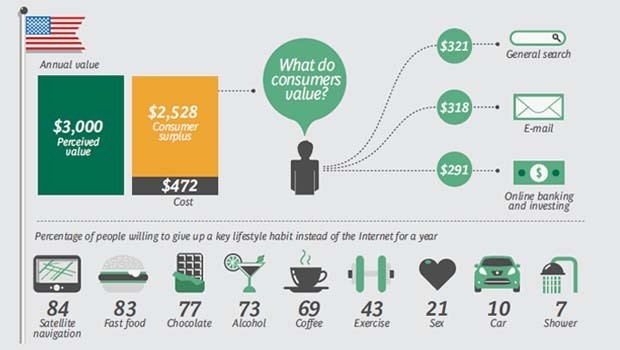
What would you give up to keep the Internet?  WPRI in Providence ponders what people would be willing to sacrifice if it meant they could keep broadband service.  A new study from a Boston consulting group proves that Americans increasingly depend on immediate, fast, and affordable access to the Internet.  Providers aren’t asking for you to stop showering, give up sex, or throw in the towel on family vacations.  Some just want you to pay more for less service at a time when a lot of people treat the Internet as their primary means of communication.  (Loud Volume Alert!)  (6 minutes)

Verizon Workers Rally Across Upstate NY for New Contract; Fear of Job/Benefit Cuts Linger

Phillip Dampier March 26, 2012 Consumer News, Verizon, Video 1 Comment

[flv width=”360″ height=”290″]http://www.phillipdampier.com/video/WBGH Binghamton Verizon Workers Protest 03-22-12.mp4[/flv]

Workers for Verizon Communications continued public protests outside of Verizon facilities in upstate New York as their unions complain the company has still not reached a negotiated contract agreement covering landline employees.  Protestors in Buffalo and Binghamton told local media they fear customer service operations will be outsourced overseas, other jobs will be cut, and benefits will be slashed.  “Verizon is not a hurting company,” noted one protestor in Binghamton.  Verizon counters its landline operations must become more competitive to compete with wireless services, although the largest provider in the country is Verizon Wireless, which has almost no unionized employees.  WBGH in Binghamton reports. (Loud Volume Warning!)  (2 minutes)


Search This Site:

Contributions:

Recent Comments:

Your Account:

Stop the Cap!