Samsung Negotiating for Higher Data Caps Bundled With New TV Purchases

Phillip Dampier March 28, 2012 Data Caps, Online Video, Wireless Broadband Comments Off on Samsung Negotiating for Higher Data Caps Bundled With New TV Purchases

Samsung has a problem selling Internet-enabled televisions in South Africa because of the pervasive impact of Internet Overcharging schemes like data caps and metered billing.  Now the company is taking its case directly to telecommunications providers, negotiating larger usage allowances for customers who buy new Samsung “Smart TVs.”

Samsung South Africa says streamed video-on-demand is impossible in the country with current data caps, often as low as 2GB per month, and even lower on wireless.

“If you download one movie on [wireless], your data is gone in one movie,” Matthew Thackrah, business leader of consumer electronics at Samsung South Africa told MyBroadband. “If you then go over your data cap and you download a few movies, you don’t know what bill you’re going to get – but it’s going to be expensive.”

Thackrah said the average high quality streamed movie consumes around 1.6GB, far too much for heavily-capped broadband in countries like South Africa.

Samsung is now approaching providers about bundling special, larger data allowances for customers buying their televisions.  Instead of 2-5GB per month, customers would get 20-30GB per month — still small by comparison to North America, Europe, and Asia, but perhaps tolerable in southern Africa.

Samsung is reportedly negotiating with wireless providers Vodacom and MTN, and Telkom (the former state-owned phone company) to offer the enhanced data packages.

So far, Samsung has been successful with Telkom, according to a press release sent last week:

This partnership will see Samsung and Telkom cooperate in the marketing of Samsung Smart TVs and fixed-line broadband solutions as bundled packages, thereby ensuring that consumers have access to affordable broadband while enabling Smart viewing experiences through Samsung’s latest Smart TV line-up.

AT&T and Verizon Lobbyists for Mitt Romney: New Report Shows Favor for GOP Front-Runner

Phillip Dampier March 28, 2012 AT&T, Public Policy & Gov't, Verizon Comments Off on AT&T and Verizon Lobbyists for Mitt Romney: New Report Shows Favor for GOP Front-Runner

Courtesy: CQ Press

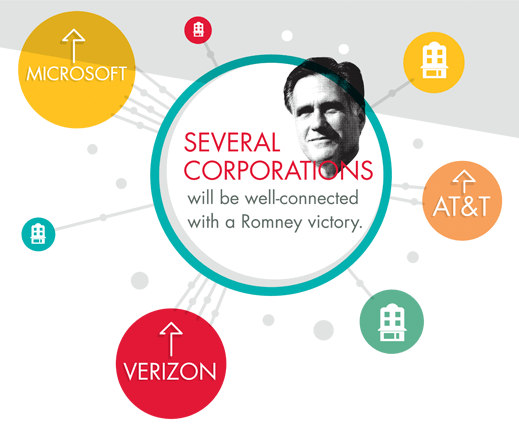
Lobbyists for AT&T and Verizon are an integral part of Mitt Romney’s campaign for president, reveals a new report exposing K Street involvement in presidential politics.

K Street Lines Up for Romney,” produced by CQ’s First Street Intelligence, shows one candidate above all others with an open door policy to money and assistance from some of the nation’s largest corporations: Mitt Romney.

Romney has never been a registered lobbyist, but he seeks advice and contributions from more lobbyists than any of the other candidates, and has a long list of lobbyist supporters, advisers, and contributors.  This select group of Washington insiders is quietly positioning themselves to benefit from a Romney presidency. With their dollars, advice, and endorsements, K Street definitively lined up in support of one candidate – Mitt Romney.

Among those corporations are both AT&T and Verizon, who either employed lobbyists now working directly with the Romney campaign or work with corporate-connected money bundlers, who raise enormous campaign contributions on behalf of the Romney campaign.

“The two biggest telephone companies, Verizon and AT&T, also stand to gain from a President Romney,” according to the report.

For example, money bundlers at Ogilvy, DLA Piper, and Ernst & Young are all directly connected to Verizon Wireless.

AT&T hired Romney Campaign Adviser Lobbyists Ronald Kaufman (working for Dutko) and Vin Weber (Clark & Weinstock).

Some of the reports highlights:

  • Ten current and former lobbyists are directly affiliated with the Mitt Romney campaign as advisers and staffers.  These lobbyists have represented 256 clients who paid their firms over $88 million since 2004. (Lobbyist Campaign Officials)
  • 16 registered lobbyists are acting as bundlers to Romney’s campaign.  These lobbyists have represented 324 organizations and a combined $196.9 million in lobbying expenses since 2008. (Lobbyist Bundlers)
  • In 2011 bundlers and advisers to the Romney campaign represented 174 organizations and $54.7 million in lobbying expenses.
  • 332 lobbyists have donated to a current GOP candidate in 2011.  Romney dominates the field, receiving 304 contributions. (Lobbyist Contributors)
  • Two lobbying firms are positioned to gain from a Romney presidency: (Scorecard)
    • Dutko employs lobbyists that are Romney advisers, bundlers, and contributors
    • DLA Piper has multiple lobbyists that have contributed heavily to the Romney campaign.

Call to Action: Thank Cox for Calling Overlimit Fees “An Error,” But Demand Caps Come Off

Our good friends at Broadband Reports reported they discovered a new usage meter for Cox Cable customers that implied overlimit fees were on the way for those who exceeded the company’s arbitrary usage caps.

Now Cox Cable’s director of media relations is calling the appearance of the new glitzy usage gauge, and references to “overages” all a ‘big mistake‘:

“Thanks for bringing this to our attention,” Cox Director of Media Relations Todd Smith tells Broadband Reports. “This is an error and the language is being removed from the site. Our policy remains the same, we do not currently charge customers for exceeding bandwidth allowances.”

Cox did not make it clear how exactly the language was included in the meter by accident, and their statement does not preclude the possibility that they’re interested in moving this direction eventually.
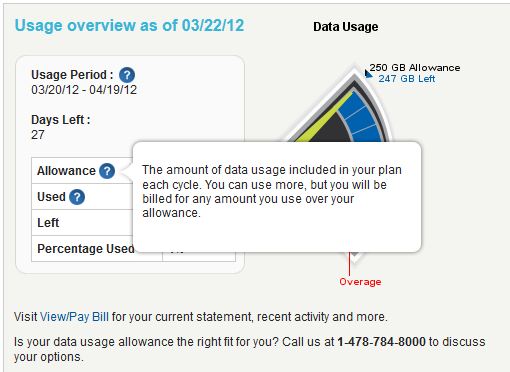
Cox's New Meter (Courtesy: Broadband Reports)

Cox Cable customers upset the cable company has a usage meter and caps should first thank them for backing down on charging broadband users overlimit fees for “excessive use.”

After that, it is time to take Cox on and tell them you don’t want your broadband usage metered at all, especially at the prices they are charging for broadband service.

Just last June, Cox Communications President Pat Esser told an audience at the National Cable & Telecommunications Association Cable Show that the industry must keep asking customers what they want and find ways to satisfy those demands.

‘Cable must accept that fact that a robust broadband platform means the ‘industry won’t control everything,’ Esser told fellow cable executives.

Stop the Cap! thinks Esser needs help understanding Cox Cable customers do not want their Internet access limited with caps and additional fees.

You don’t want to check a usage meter and cannot understand why a company that earns incredible profits from broadband that costs less and less to deliver needs to cap your access.

Cable operators don’t unveil new usage meters and mentions of overlimit fees by mistake. It is likely their new usage meter “jumped the gun” and the company temporarily withdrew it.

This is your opportunity to deliver a death blow to Cox Cable’s Internet Overcharging.

Get Involved and Send Cox Executives the Message!

Call Cox Corporate Relations at (888) 566-7751 or e-mail them at [email protected]

Better yet, you can write directly to Cox’s top executive.  We have provided a sample, but you can be most effective writing it in your own words:

Mr. Pat Esser
President, Cox Communications
1400 Lake Hearn Drive
Atlanta, GA 30319

Dear Mr. Esser,

Last June, you told attendees at the National Cable & Telecommunications Association annual meeting that the cable industry needs to keep asking customers what they want and then find ways to satisfy those demands.  As a loyal Cox customer, I am taking advantage of that opportunity to write and express my profound concern Cox Cable has started to limit my Internet usage.  I cannot understand why Cox needs usage caps at a time when broadband revenue is skyrocketing and the costs to deliver the service are actually in decline. There is simply no justification for these limits, particularly after Cox upgraded its network to DOCSIS 3, which supports a considerably larger data pipeline.

Cox and other cable operators are introducing new, faster speeds for customers to earn more revenue.  But with usage caps, there is little incentive to pay more for faster service that remains constrained with a usage limit.  Would you buy a race car you could only drive around the block?

As competition for my telecommunications dollar continues to increase, I am willing to cancel my Cox service over this issue and take my business to another provider.  Some have shown a willingness to waive usage caps in order to win my  business, and I am happy to oblige. I’d prefer to stay with Cox, but not if your company keeps refusing to listen to its customers on this issue.

If you were serious in your remarks last summer in Chicago, then you should follow the lead of companies like Verizon, Cablevision, and Time Warner Cable which have all avoided imposing usage limits on customers. Time Warner Cable believes unlimited broadband should always be available to customers. Cox has imposed limits on everyone, and that has to change.

Very truly yours,

// Your signature here

Time Warner Cable Adds $2.50 Monthly Modem Rental Fee for New Customers; Buy Your Own

Phillip Dampier March 27, 2012 Consumer News 20 Comments

[Update 10/2/2012: If you are visiting here to explore Time Warner Cable’s new $3.95 modem rental fee, please visit this article for the latest information and reviews, should you wish to purchase your own modem to replace the one you currently rent from the cable company.]

In mid-March, Time Warner Cable added a $2.50 monthly modem rental fee for all new broadband customers, but existing customers not already subject to modem fees will be exempt from paying it.

The new equipment fee applies even in areas where cable modems have always come free with the cable company’s broadband service.  Until this month, customers in some areas including Rochester, N.Y., could not purchase their own cable modem equipment, but that restriction has now been dropped.  In areas where modems always came free with service, some customers have told Stop the Cap! the cable operator cannot provision their new modems until after April 1st.  Call your local Time Warner Cable office for exact information applying in your local area.

At $30/yr, consumers are advised it may be more affordable to purchase your own cable modem, especially if you are comfortable installing it yourself.  Cable modems are at least as reliable as wireless routers, and even easier to configure.

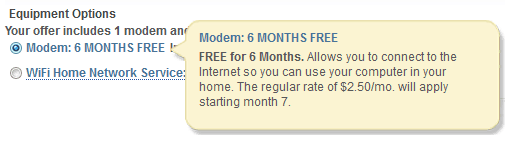
Time Warner Cable’s current promotion page offers six months of free modem rental to new customers, with fees starting the seventh month.  The cable operator supports a large number of different modems.  In the northeastern United States, Time Warner will provision any of these units (you can find your area’s list of approved equipment on Time Warner’s Internet Support page):

Vendor Model

 DOCSIS 3.0

ARRIS TM402G N
ARRIS TM402P N
ARRIS TM502A N
ARRIS TM502G N
ARRIS TM508A N
ARRIS TM512A N
ARRIS TM602G N
ARRIS TM604G N
ARRIS TM608G N
Cisco DPC2100 N
Motorola SB5101 N
Motorola SB5101N N
Motorola SB5101U N
Motorola SB6141 Y
Motorola SBG6580 Y
Motorola SBG900 N
Motorola SBG901 N
Motorola SBG940 N
Motorola SBG941 N
Motorola SBV5121 N
Motorola SBV5222 N
Motorola SBV5322 N
Netgear CGD24G-100NAS N
SA DPC2100r1/2 N
SA DPC2203 N
SA DPC2203C2 N
SA DPX2203 N
SMC 8014CPR N
SMC 8014WG N
SMC 8014WG-SI N
Thomson DCM425 N
Thomson DCW725 N
Thomson DWG855 N
Ubee (formerly Ambit) DDC2700 N
Ubee (formerly Ambit) DDW2600 N
Ubee (formerly Ambit) U10C018 N
Ubee (formerly Ambit) U10C019 N
Ubee (formerly Ambit) U10C020 N
Ubee (formerly Ambit) U10C022 N
ZyXEL 974H N
ZyXEL 974HW N

Prices range from under $50 for the DOCSIS 2 Motorola Surfboard SB5101, to north of $130 for Motorola’s DOCSIS 3 SURFboard Gateway SBG6580 on Amazon.com.

We called Time Warner customer service in Rochester for information about the modem rental vs. purchase option and learned:

  • The modem rental fee only applies to DOCSIS 2.0 equipment suitable for Road Runner Lite, Standard or Turbo service (1-20Mbps);
  • Road Runner Extreme (30/5Mbps) and Wideband (50/5Mbps) still includes free rental of the DOCSIS 3 cable modem and the company does not currently support customer-owned DOCSIS 3 modems in this area;
  • Support options for customer-owned equipment are obviously more limited, but should your cable modem fail, you can quickly rent a replacement and pick it up at your local cable store to get back online fast;

We also learned Time Warner is running promotions in many areas pitching existing Standard and Turbo Service customers six months of Road Runner Extreme for just $10 more a month for six months. If you need 50/5Mbps Wideband service, signing up for Signature Home at $199 a month is often the best value when combining phone, Internet, and cable TV service.

Because different regions handle cable modem equipment and promotions differently, it is important to call your local office prior to ordering any equipment to verify it can be provisioned and to obtain correct information about any promotions or pricing.

No Wireless Spectrum Swap Until We See FiOS, Say Cities Waiting for Verizon Fiber Upgrade

Cities left out of Verizon Communications’ fiber to the home upgrade FiOS are telling the Federal Communications Commission to reject any wireless spectrum swap between the phone company and the nation’s largest cable operators unless Verizon commits to getting the fiber upgrade done in their cities.

Coordinated by the Communications Workers of America, which represents many Verizon workers, elected officials and community groups in Boston, Baltimore, and the upstate New York cities of Albany, Syracuse, and Buffalo collectively blasted the proposed swap as bad news for consumers.  On a city-by-city basis, they each filed comments with the FCC opposing the deal unless the Commission mandates Verizon complete fiber upgrades as a condition for the approval of the spectrum swap.

Buffalo’s argument:

For the past few years, we have watched as Verizon Communications has built its all fiber FiOS network in 10 suburban communities that ring our city. In those communities, we have seen what happens when Time Warner Cable, our local cable monopoly, competes head-on with Verizon’s FiOS to provide video and broadband services. Consumers benefit from competitive choice; small businesses benefit from truly high-speed connections to suppliers and customers; schools and hospitals benefit from education and health-related applications; communications workers benefit from the jobs building, maintaining, and servicing networks; and families and communities benefit from the 21st century jobs and expanded tax base.

But the residents and small business owners in Buffalo have not been able to reap these benefits. To date, Verizon has chosen not to deploy its all-fiber FiOS network to the more densely-populated city of Buffalo. The proposed Verizon Wireless/cable company partnership would cement this digital divide and foreclose the possibility of effective high-speed broadband and video competition in our city. Verizon Wireless is a subsidiary of Verizon Communications. We are deeply concerned that as a result of the new joint marketing agreement, Verizon will no longer have the incentive to invest in an all-fiber network that competes with Verizon Wireless’ new partner, the cable company. Therefore, to promote high-speed broadband investment and video competition, especially in heavily minority and lower-income areas like the city of Buffalo, the FCC should include as a condition for approval of this Transaction a requirement that Verizon continue to invest in and build-out its FiOS network to currently unserved areas that are inside its traditional telephone service area footprint, including the city of Buffalo and the surrounding areas.

Cole

In response, Verizon confirmed it never had any intention of wiring any of those cities for fiber service.  Multichannel News reports:

But a Verizon exec points out that those cities are all areas that were not scheduled to get FiOS, whether or not the cable spectrum deal goes through. As Verizon has pointed out, the company decided back in 2010 that it was going to build out the franchises it had already secured and target those 18 million customers in and around New York City, Washington, D.C., and Philadelphia, rather than spend any more of its shareholders money in a wider buildout. The above cities were not in those franchise areas.

Baltimore City Council member William H. Cole accused Verizon of leaving the city of Baltimore behind in a letter he addressed to the Commission this week:

High-speed, fiber-optic networks are vital for economic competitiveness. Currently, Verizon’s FiOS is the only all fiber-optic commercially-available network for businesses and households. Other advanced industrialized nations have already deployed fiber-optic networks on a large-scale; they recognize that high-speed fiber is the competitive infrastructure of the 21 st century. Much of the suburban areas outside of Baltimore already have FiOS. The City of Baltimore will never get a fiber-optic network if this deal is approved, which concerns me greatly. I am not willing to see Baltimore permanently relegated to the wrong side of the digital divide.

Search This Site:

Contributions:

Recent Comments:

Your Account:

Stop the Cap!