Leave it to the Dutch: The Netherlands Passes Net Neutrality

Phillip Dampier June 27, 2011 Net Neutrality, Public Policy & Gov't, Wireless Broadband Comments Off on Leave it to the Dutch: The Netherlands Passes Net Neutrality
Courtesy Kelvin Luffs

Courtesy Kelvin Luffs

Several weeks ago, the Netherlands’ former state-owned telephone company — Koninklijke KPN N.V. — thought it would be a fine idea to charge their mobile customers extra subscription fees for accessing popular online services like Skype, YouTube, and Facebook.  KPN’s proposal would have added €3 a month for the privilege of using Skype.  Want to update friends on Facebook?  That will run €0.02 per megabyte.  YouTube?  €0.50 per hour.  Not a single Euro would be passed along to any of these companies, however.  KPN itself would bank the entire amount.

The Dutch Parliament reacted to news of this, and other recent controversy involving the country’s mobile providers, by introducing strong Net Neutrality regulation in Parliament — the second country after Chile to do so:

1. Providers of public electronic communication networks which deliver internet access services and providers of internet access services do not hinder or slow down applications and services on the internet, unless and to the extent that the measure in question with which applications or services are being hindered or slowed down is necessary:

a. to minimise the effects of congestion, whereby equal types of traffic should be treated equally;
b. to preserve the integrity and security of the network and service of the provider in question or the terminal of the enduser;
c. to restrict the transmission to an enduser of unsolicited communication as referred to in Article 11.7, first paragraph, provided that the enduser has given its prior consent;
d. to give effect to a legislative provision or court order.

2. If an infraction on the integrity or security of the network or the service or the terminal of an enduser, referred to in the first paragraph sub b, is being caused by traffic coming from the terminal of an enduser, the provider, prior to the taking of the measure which hinders or slows down the traffic, notifies the enduser in question, in order to allow the enduser to terminate the infraction. Where this, as a result of the required urgency, is not possible prior to the taking of the measure, the provider provides a notification of the measure as soon as possible. Where this concerns an enduser of a different provider, the first sentence does not apply.

3. Providers of internet access services do not make the price of the rates for internet access services dependent on the services and applications which are offered or used via these services.

4. Further regulations with regard to the provisions in the first to the third paragraph may be provided by way of an administrative order. A draft order provided under this paragraph will not be adopted before it is submitted to both chambers of the Parliament.

5. In order to prevent the degradation of service and the hindering or slowing down of traffic over public electronic communication networks, minimum requirements regarding the quality of service of public electronic communication services may be imposed on undertakings providing public communications ­networks.

The new bill, expected to pass the Dutch Senate as early as this week, would ban mobile providers from nickle-and-diming customers for the applications they run on their mobiles.  It’s a far different approach than Net Neutrality policies in the United States, which exempt cell phone companies.

van Dam

KPN’s original announcement that it was introducing extra charges for certain popular mobile applications raised privacy concerns in Parliament over exactly how KPN knew what their customers were doing with their phones.  That’s a question the Netherlands Consumer Authority wanted answers to as well.

KPN was accused of using “deep packet inspection” to monitor the activity of their customers.  In April, KPN discovered many of them were using an alternative messaging service called WhatsApp to bypass paying SMS text message charges.

Labour MP Martijn van Dam was unimpressed with KPN’s defense of its monitoring customer activity.  Although the company said the monitoring practice is widespread, it denied it was violating the privacy of its customers in the process.  van Dam suggested that would be akin to “a postal worker who delivers a letter, looks to see what’s in it, and then claims he hasn’t read it.”

van Dam is a co-author of the Net Neutrality bill that soon followed and is expected to pass over the objections of mobile companies, who claim they will be forced to raise prices in response.


Congress Moves to Kill LightSquared Approval: Interference Threat Too Great to Ignore

Phillip Dampier June 27, 2011 Competition, LightSquared, Public Policy & Gov't, Wireless Broadband Comments Off on Congress Moves to Kill LightSquared Approval: Interference Threat Too Great to Ignore

New language in a spending bill likely to pass would prohibit the Federal Communications Commission from spending any of its budget contemplating approval of LightSquared’s application to deliver a national 4G wireless network over frequencies detractors claim would hamper or block use of GPS signals.

The language voted on in the House Appropriations Committee was approved by members of both political parties on a voice vote — another sign Congress is serious about stopping any provider from interfering with GPS technology.  A combination of concerns from the U.S. military, civil aviation, law enforcement, and private industry got a full hearing in Washington last Thursday, as GPS users complained of grave risks LightSquared could cause to aircraft in flight and the general defense of the country.

Rep. Tom Petri (R-Wisc.), chairman of the Subcommittee on Aviation, was concerned GPS interference might even cause an in-flight emergency. “In aviation, there’s no room for error,” Petri said.

Petri

Last week, just prior to the hearing, LightSquared announced its intent to move the service further away from the GPS band, but industry groups remain resolute the proposed changes would be incremental and still pose an interference problem.

Congress’ vote would seem to indicate they agree, putting the entire LightSquared project in jeopardy.

This week, new questions are also being raised about the management of LightSquared.  Critics charge the company knew about the interference issue years ago, and did little or nothing to mitigate it. Some suspect the company was banking on a lobbying effort and pressure from the White House with an interest of expanding broadband to help push through an approval despite the interference threat.

John Byrne from IDC’s wireless and mobile infrastructure research group told the Washington Post LightSquared is now faced with proving interference will not be a problem before it will win approval.

“At this point I think you have to assume that the deployment is on hold until those concerns are addressed to the satisfaction of the FCC and all of the congressmen and senators that are on the FCC on this issue,” Byrne said.

Maine Couple Blames FairPoint’s Shoddy Repairs for Setting Their House on Fire

Phillip Dampier June 27, 2011 Consumer News, FairPoint, Video 2 Comments

(WABI-TV)

A Bradford, Maine couple blames FairPoint Communications for setting the stage for a recent fire in their home caused when a poorly repaired utility pole exposed low hanging wires eventually making contact with a passing truck, which created an energy surge igniting an electrical fire in their home.

“I thought we got hit by lightning. Everything started popping in the house,” Joseph Nunez told WABI-TV. “So, then I go upstairs, we have a ton of books upstairs, everything is in flames. We had perfect kindling for a fire. We have clothes and a library up there.”

The State Fire Marshal blamed an electrical malfunction, most likely caused by the fallen power lines formerly attached to FairPoint’s pole.

The utility has since replaced the pole, but Nunez believes the root cause of the fire was insufficient repairs done to the pole after an earlier storm.

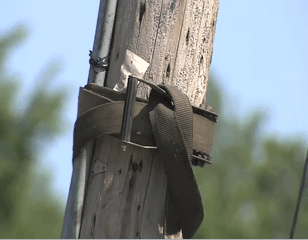
“Three months ago after a wind storm they never put it up right,” Nunez said. “They put that band-aid of a little pole over there with some straps.”

A FairPoint spokesman said they can’t confirm if the pole in question had ever been damaged or repaired, but they’re looking into it.

The local fire department arrived early enough to prevent the fire from causing extensive damage to the Nunez home, built in 1850.

[flv]http://www.phillipdampier.com/video/WABI Bangor Couple Blames FairPoint for Fire 6-16-11.flv[/flv]

WABI-TV in Bangor reports on the domino effect: a poorly maintained utility pole provides for low hanging wires, a truck makes contact with those wires, the resulting voltage spike ignites a fire in a couple’s home.  (1 minute)

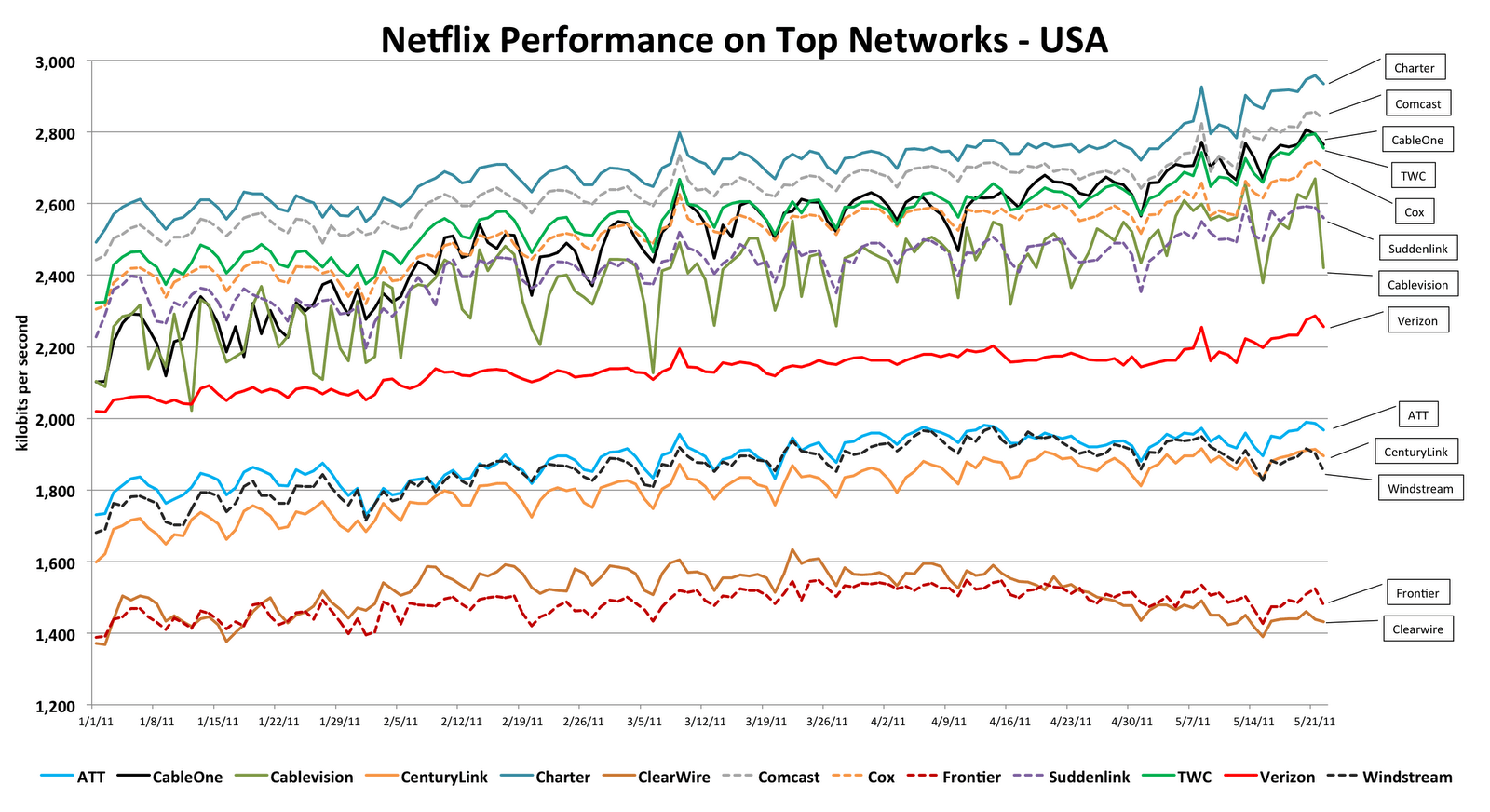
Frontier: America’s Worst Wired ISP for Netflix Viewing (Second Time Winner!)

Click to Enlarge

Frontier Communications’ DSL service delivers abysmal results for customers looking for quality time with Netflix.  For the second quarter running, the independent phone company’s ability to keep up with Netflix’s high quality video is about on par with a garden slug in a triathlon — yes, it may eventually reach the finish line, but you’ll be dead before it happens.  Even more embarrassing for Frontier, their service is occasionally beaten by Clearwire, a wireless ISP with a bandwidth throttler that can reduce your online experience to the painful days of dial-up if deemed to be using “too much.”

“Frontier sucks,” writes Stop the Cap! reader Doug in Charleston, W.V. “After they took over where Verizon fled, my ability to watch Netflix online became a source of endless frustration, so now I limit myself to mailing DVD’s back and forth.”

Remarkably, Charter Cable, which does poorly in customer satisfaction surveys, is again the runaway winner, followed by Comcast, the heavily usage-capped Cable One, Time Warner Cable, and Cox.  Verizon and AT&T only deliver middling performance.

Bright House Says No to Internet Overcharging: No Caps – Not Even Under Consideration

Phillip Dampier June 23, 2011 AT&T, Broadband Speed, Data Caps, Online Video, Verizon 1 Comment

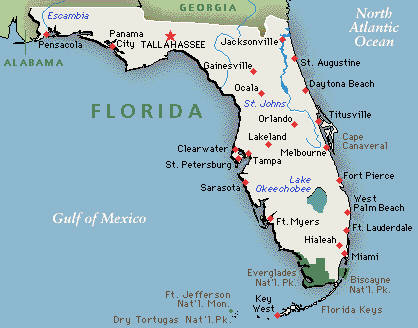
Bright House Networks, a cable company primarily serving Florida and other southeastern states says it has no plans to implement Internet Overcharging schemes like usage caps or consumption billing.  But a company spokesperson went even farther, telling Tampa Bay Online the cable company was not even considering them.

Bright House, which relies on Time Warner Cable’s programming negotiators and sells broadband under the Road Runner brand, was among the only companies in Florida that was willing to go on record stating they were not considering limiting broadband customers.

Other providers were unwilling to follow Bright House’s lead:

  • AT&T: “2 percent of our customers were using 20 percent of our bandwidth,” said an AT&T spokesman, so the company slapped 150GB usage limits on DSL customers, 250GB on U-verse customers.  The overlimit fee is $10 for every 50GB extra.
  • Verizon Florida: “At this point, we’ve not implemented any usage controls or broadband caps.  We’ll continue to evaluate what’s best to ensure our customers get the highest quality broadband service for the best value,” the company said.  But it also added: “We’re continuing to evaluate usage-based pricing for our wireline broadband customers.”

“Bandwidth caps stifle consumer choice,” said Parul Desai, public policy counsel for Consumer’s Union.  Desai notes customers do not sign up for pricey high-speed FiOS broadband service from companies like Verizon just to read e-mail.  Customers who are willing to pay premium prices for super high speeds certainly don’t want a usage cap devaluing their broadband package.

Comcast, for example, uniformly limits consumption to 250GB per month, even on high speed plans delivering over 50Mbps service.

“It’s like building a rocket that you blow up after it reaches 250 feet into the air,” says Stop the Cap! reader Will in Tampa, who shared the article with us.  “What is the point of having 50 or 100Mbps service from any provider if they slap a limit on it like that.”

Will thinks customers will abandon higher speed packages in droves once they realize they really can’t use them.

“With some of these companies talking about caps around 40GB per month, you can’t even take your connection for a test drive,” he says.  “You might as well stick with basic speeds, just to remind and discourage you from putting yourself over their stupid limits.”

Desai suspects broadband companies will try limiting their customers, if only because they face few competitors consumers can use instead and they have video services to protect.  But she suspects some consumers will either abandon or seriously downgrade their broadband service and find other ways to trade large files and content.

“It’s not inevitable they’re going to succeed,” she told TBO. “People only find value in broadband because of what they can access with it. If more people feel constrained, they’ll start looking for another way.”

Search This Site:

Contributions:

Recent Comments:

Your Account:

Stop the Cap!