2 of Every 3 AT&T Customers Paid Early Termination Fees Just to Switch to Verizon

Phillip Dampier March 24, 2011 AT&T, Competition, Consumer News, Verizon, Wireless Broadband Comments Off on 2 of Every 3 AT&T Customers Paid Early Termination Fees Just to Switch to Verizon

Verizon Wireless wins bragging rights this month as a new study shows fleeing iPhone owners on AT&T’s network were willing to put up money just to get out of their contracts and switch to Verizon. Two of every three departing customers paid AT&T up to $300 to break-up with the carrier and bought new iPhones that work on Verizon’s network.

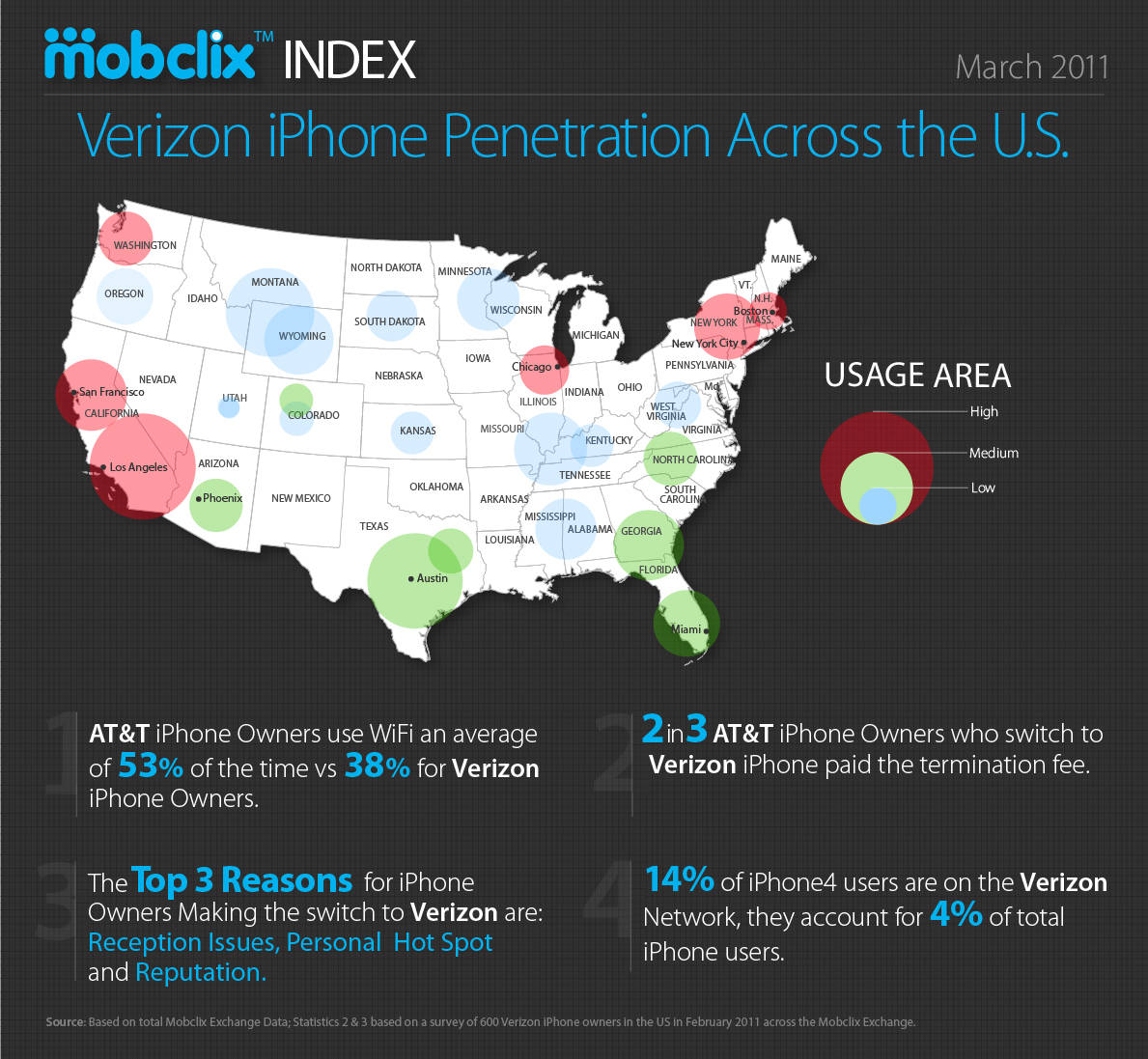
The study, produced by Mobclix, found reception on AT&T’s network was by far the biggest issue cited by exiting customers, followed by Verizon’s offer of a personal hotspot add-on, and the perception Verizon runs a more robust network.

Mobclix found Verizon’s newest customers may have a point about who runs the stronger network.  Many AT&T customers are accustomed to relying on the company’s broadening Wi-Fi network to cope with 3G reception woes.  At least 53 percent of AT&T customers rely on Wi-Fi regularly for data connectivity.  On Verizon’s network, just 38 percent do.

But predictions of a stampede away from AT&T to Verizon have turned out not to be true, either.  Just 14 percent of America’s iPhone owners are on Verizon’s network.  AT&T serves the rest.

Analysts suspect the reason for this is that AT&T’s worst problems are in certain major metropolitan areas, but the carrier does respectably well providing service in many smaller and medium-sized cities.

Mobclix produced a map which may bear this out.  It shows the largest concentration of Verizon iPhone owners in the cities that are routinely cited as problem areas for AT&T:  San Francisco, New York, Seattle, Chicago, Boston, and Los Angeles.

“Based on our survey findings today, it’s clear that consumers are taking control of their mobile destinies by evaluating carrier criteria such as Wi-Fi usage, reception issues and reputation as part of their decision to remain with their carrier or make a switch,” said Krishna Subramanian, Mobclix co-founder.

(click to enlarge)

Bell CEO: Bandwidth Usage Charges Are About Monetizing Video Traffic for Shareholders

Cope

In another example of providers telling the public (and lawmakers) one thing, while saying something very different to their own shareholders, Bell Canada’s CEO made a remarkable admission about why the company imposes Internet Overcharging schemes on its customers:

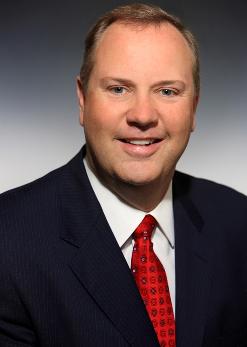
“As we see a growth in video usage on the Internet, making sure we’re monetizing that for our shareholders through the bandwidth usage charges,” CEO George Cope told listeners in a financial conference call last autumn.

That is a far cry from the story Mirko Bibic, Bell’s government affairs representative tells to anyone who will listen. Michael Geist, a Canadian syndicated columnist on technology law issues notes Bibic has told a different tale while appearing before Parliament’s Standing Committee on Industry to answer questions on usage based billing held in February.

For Bibic, usage-based billing is about “fairness” and solving alleged congestion issues.

“As for small businesses, which are generally on the same network as residential users, what you have is really a case where the congestion during peak periods is largely a residential phenomenon. It’s in that area that we’ve addressed the usage-based billing issue, and all we’re asking the CRTC for is to follow a fundamental principle of fairness,” Bibic told MPs. “If we asked 97% or 98% of Canadians if they would be prepared to pay more so that the 2% of heaviest users pay less, I’m pretty sure of what the answer would be.”

Bibic

Bibic’s argument has been repeatedly undercut by his own bosses, Geist notes.

In August, Cope told shareholders “our data revenue growth was 3.8% for our Residential Services business, particularly driven through an increase in Internet ARPU of 3.3%. And interesting, almost all that increase now coming from usage based billing as the demand for Internet use explodes through the use of video services, and we’re continuing to see an increase in the revenue per customer.”

By November, Cope was turning Bibic’s bandwidth “fairness and congestion” lemons into lemonade, celebrating data revenue growth of 5 percent, “driven principally by the bandwidth usage revenue being up 83% year-over-year.”

Cope not only decapitates his company’s arguments for usage-based billing, he also shines the light on who they will impact: if providers are to be believed that usage caps will only affect a tiny percentage of customers, how can data revenue be up a whopping 83 percent year-over-year. Are a handful of Canada’s “heavy” broadband users responsible for this growth, or are an increasing number of Canadian consumers finding themselves over the “generous” limits Bell has established because they used their broadband connections to stream movies and television shows.

As Geist notes, “no one should be under the illusion that UBB is anything other than a revenue maximization strategy in a market with limited competition, not one premised on fairness or network congestion.”

AT&T’s Plans to Auto-Enroll Modified Phones in Data Tethering Plan Under Fire

Phillip Dampier March 24, 2011 AT&T, Data Caps, Wireless Broadband 7 Comments

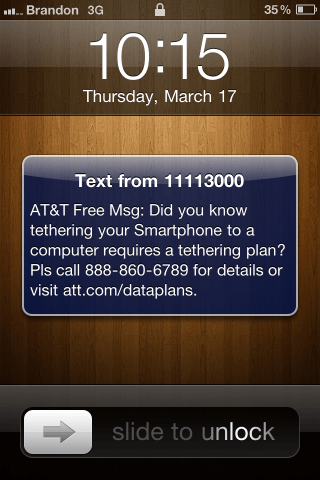
AT&T customers using modified phones to share their 3G wireless connection with other devices are complaining about the company’s warning that if they don’t cease tethering their phones, they will be automatically enrolled in the company’s premium $45 a month DataPro for Smartphone Tethering plan next week.

An attorney tells Stop the Cap! if the company does that, his firm will consider filing a class action lawsuit against the company for forcing customers into service plans they did not enroll in themselves.

This controversy comes to those who have been using “jailbroken” phones, modified to restore features blocked at the factory by North American cell phone carriers.  Among the most coveted restored features is turning your phone into a mini Wi-Fi hotspot or allowing the phone to connect directly to other equipment, sharing your 3G connection with other devices, such as a laptop, iPad, or iPod.  While many phones include this capability, most carriers in the United States and Canada disable it for those not enrolled in an extra cost add-on plan covering “tethering.”  AT&T offers two such plans — $45 a month for 4GB of usage, or $25 a month for 2GB.

For several years, some AT&T customers have used tethering as a convenient way to bring connectivity to devices out of reach from Wi-Fi or a home broadband connection.

Jonathan in San Francisco shares with Stop the Cap! he is grandfathered in on an unlimited use data plan from around the time the first smartphones entered the marketplace.

“AT&T even sold me the tethering equipment at the same time they sold me the data plan, which they promised was unlimited,” Jonathan says.  “I don’t buy their subsidized phones — I buy my own unlocked phones at full retail price every few years, and AT&T has allowed me to keep my plan the way it is.”

Until he received a notification message from AT&T claiming his account “may need updating.”

AT&T says customers tethering their phones must pay for both a data plan -and- a tethering plan if they want to use the feature, a condition not part of Jonathan’s plan.

“My plan with AT&T says nothing about an extra tethering plan; it says I have unlimited data — something I do not abuse,” Jonathan says.

He is particularly upset that if he uses his phone as he always has, AT&T will slap a $45 additional monthly fee on his phone bill.

“Even worse, when I called AT&T to complain, they told me my plan is so old, they would automatically ‘upgrade’ my service plan to one that costs more and delivers less, effective Monday,” he tells us.

It turns out some customers on legacy plans cannot easily add the tethering option without abandoning the plans they have carefully held onto for years.

“The lady I spoke with said their computer billing system cannot add the feature to my account because it is so old,” he said.

Janie, one of our readers in Seattle, noticed AT&T “‘graciously’ wants to auto-enroll you in their most expensive tethering plan, not the cheaper $25 one.”

“My cousin is lucky enough to still have their $30 a month plan which provided 5GB a month, but they discontinued it for new customers so they could raise prices,” Janie writes.

Janie is upset because it was an AT&T reseller that charged her $30 extra to enable the feature AT&T now wants her to pay even more to use.
“I have no idea what ‘jailbreaking’ is, or that I was doing anything wrong — I bought the phone from an AT&T authorized retailer and had no idea there was even a problem until I called and they lectured me about ‘stealing’ service,” Janie says.  “The company disgusts me and I have never been accused by anyone of stealing, so I am canceling with them when my contract is up.”

Janie is not the only customer to have had her phone modified by someone representing the company.

We found another customer who paid an employee at an official AT&T store to modify his phone.  The employee told him if he keeps monthly usage under 10GB per month, no red flags would be raised, a statement that some might consider a red flag itself.

Just how AT&T tracks down its tethering customer-underground remains a mystery, but some have speculated usage may have been the major contributing factor.  Not everyone who quietly tethers their AT&T phone has gotten the notification message, while many of those using tethered phones as their only Internet connection have.

“If you are using your tethered AT&T phone on a laptop and running up 25GB of usage, AT&T will notice if they look,” an employee tells us privately.  “AT&T can run an audit on data usage and discover considerable amounts of money being left on the table by customers not enrolled in the appropriate plan.”

One lawyer that has targeted AT&T in the past said his firm is carefully watching to see if AT&T follows through on its auto-enrollment threat.

“We’ve found judges and government officials take a very dim view on automatically enrolling customers in anything that costs money without their direct, informed consent,” the attorney who is not authorized to speak publicly on behalf of his firm tells us.  “We are obviously taking a close look at this.”

AT&T’s e-mail notification text is below the jump.

… Continue Reading

An Open Letter to Content Producers: Netflix, Hulu, Valve, Microsoft, Sony, and Nintendo

Dear Content Producer:

Your money train is leaving the station.

Customers are about to start making some very important choices about what they do on the Internet. AT&T announced this month they are going to start capping their DSL customers at 150GB per month and their fiber-to-the-neighborhood U-verse customers at 250GB per month, with overlimit fees for those who exceed them.

Comcast already has a 250GB per month cap, currently loosely enforced. Time Warner Cable has strongly advocated usage-based billing for years. Other telecommunications companies are all either supporting or considering these Internet Overcharging schemes for one reason, and one reason only:

It makes them absolute boatloads of cash.

Canada already lives with this reality. So does Australia, although they’re backing away from it. South Korea? Japan? Europe? Nope. Flat-rate Internet service is the norm there.  In Europe, mobile customers are demanding the removal of bandwidth caps American providers are still trying to attach to customers’ bills.

So how does this impact you? 250GB a month is a lot, and you’ll be fine? Sure. For now.

But what happens when Sony introduces the Playstation 4, or Microsoft announces the Xbox Next? Games aren’t exactly going to get smaller, and online distribution is far and away the future of games and software in general. Right now a game for the 360 or PS3 can be as large as 20GB. PC game enthusiasts routinely cope with 10-12GB game upgrades, and woe be unto you if you have to reinstall your Steam library and have 20-30 (or more) games to restore.

Internet Overcharging schemes make providers, and the lobbyists who do their bidding, very wealthy.

For the “Massively Multiplayer Online” game universe, incremental software updates and upgrades often come through BitTorrent, which exposes users to peer-to-peer traffic well beyond the size of the update itself.  In fact, as games increasingly turn towards Cloud storage and distribution, the traffic adds up.

For online video companies, your very business model could be at risk.  Netflix? Hulu? People are no longer satisfied with grainy, compressed video.  They want HD content, and you’ve answered the call.  But as consumers increasingly face 8-10GB per movie (at 720p, 15GB+ for 1080p), the usage racked up is going to blow past all of these caps.

Who knows what happens in the next five years, or ten.  Considering Canada, where a similar duopoly of broadband providers have lowered usage allowances, do you really expect anything different down here?  The only thing likely to be raised is the monthly price, which remains higher here than in most places around the world.

Google has the right idea with their experimental 1Gbps fiber-to-the-home network. The problem is, that’s only going to serve one (or perhaps a few) communities in the U.S.  The rest of the country will have to survive with ‘Ultra’ cable broadband packages serving up 10-20Mbps service or DSL that barely manages 6Mbps.  If you don’t live in an urban area, tough luck.  You will be lucky to get 3Mbps service.

Broadband service upgrades come painfully slow in the absence of robust competition.  Time Warner Cable and other providers are slowly starting to roll out DOCSIS 3, which allows speeds up to 100Mbps, assuming the average consumer can afford the Cadillac price that comes with it.  Many phone companies continue to bet the farm on their DSL service, which can also be expensive when it’s the only broadband service in town.

Against this backdrop, the rest of the world marches on, and beyond, North America.

South Korea? They’re promising national speeds of 1Gbps by 2013 — for $27 a month!

How has this happened?  Where have we gone wrong?

For starters, the broadband providers have very powerful lobbyists — quite a few of which are ex-legislators. Together, they wage their public policy battles on both the state and federal level, often writing the bills a compliant legislator is willing to introduce as their own.

Washington regulators take a "see no evil, hear no evil" approach to regulating super-sized corporations who can cause them trouble.

The Federal Communications Commission has adopted a “see no evil, hear no evil” approach to broadband, capitulating when a chairman occasionally strays too far into the industry minefield laid to protect their business agenda.  As a result, the agency is a toothless dog.  It recently adopted a “Net Neutrality” policy all but written by Verizon, who ironically is now spending money to fight the rules they helped write.  As a backup, virtually every Republican and several Democrats have teamed up to pass a Resolution of Disapproval seeking to overturn the weak-kneed Net Neutrality rules the FCC adopted.  Lobbyists are well paid to cover every contingency.

Consumers — your customers — can’t do much about this beyond writing their members of Congress and complaining.  But because they did not enclose a check or money order made payable to the respective politician’s campaign fund, the result will be a form letter response weeks, if not months later… after the corporate agenda is enacted into law.

We just cannot fight this battle all by ourselves.  Recognizing the realities of today’s politics, we need your help to fight money and power with money and power.

The video game industry earns billions yearly. You have already faced battles in Washington, so you know how this works. You can fight for your interests while protecting ours by ensuring broadband service is cheap, plentiful, and unlimited. The same story applies to other content producers, such as online video, software, and any other company that wants to move to online distribution to power their business. You cannot succeed if customers are too afraid of using your service because of a bandwidth cap.

The remarkable thing is that countries many Americans cannot find on a map are now beating the United States with better and cheaper broadband while we hand over our digital economic future to a duopoly. That will not buy us better service, just bigger bills for “fast enough for you” Internet access.

So that’s it. Act now. Act strongly. If you cannot stand up for your customers, you may not have any.

Signed: A gamer. A movie watcher. A music listener. An enjoyer of entertainment. A lover of the Internet.

Broadband consumer and reader Jason Ballew penned this guest editorial, with some editing and additions from Stop the Cap! editor Phillip M. Dampier.

Search This Site:

Contributions:

Recent Comments:

Your Account:

Stop the Cap!