Al Jazeera English on American Cable? Why Not? Russia and China Already Are

Phillip Dampier March 3, 2011 Consumer News, Editorial & Site News, Video Comments Off on Al Jazeera English on American Cable? Why Not? Russia and China Already Are

With all of the tumultuous events in the Middle East, the debate over whether to allow Al Jazeera’s English language service on America’s cable systems has begun again, with commentators on the right accusing the channel of being the next best thing to Osama bin Laden anchoring the six o’clock news, and some on the left demanding carriage just to make a point.  But the real question left unanswered is, “how much is this channel going to cost cable subscribers?”

Al Jazeera English managing director Al Ansteys has been negotiating with Comcast and Time Warner Cable, America’s largest cable operators, to find out — and ultimately win carriage of the 24 hour English-language news network on both cable systems.

Arriving at Comcast headquarters in Philadelphia with 13,000 signed petitions for Al Jazeera English, Ansteys said the sheer number of requests should extinguish any doubt that Americans want better coverage of events in the Middle East from the network.

Nearly 8,000 Time Warner Cable subscribers signed petitions and another 1,000 Cablevision subscribers echoed the sentiment.

Time Warner Cable already has experience carrying international news outlets.

The company recently expanded the reach of Russia Today (RT), a 24-hour news network in English based in Moscow and funded by the Russian government.  The channel is the equivalent of an external television service to compliment The Voice of Russia (formerly Radio Moscow), a station familiar to every shortwave radio listener.  Although the Russian government goes out of its way to declare the RT’s journalistic independence, the firewall between the Kremlin and channel’s newsroom has been tissue-thin at times.  Reporters have learned how to cover certain stories, and which ones to avoid.  RT’s news and current affairs programming compliment the foreign policy priorities of Kremlin.

RT’s coverage of the Middle East is occasionally anti-American to the point of stridency.  Some reports on the channel infer the United States government has thrown its former allies under the bus, others claim everything Washington does in the region has to be reviewed by Jerusalem before passing muster.  Message: the Obama Administration’s policies are out of touch, unreliable, and incoherent.  You can get much the same view from Sean Hannity any evening on Fox News, but RT is no right-wing paradise.  Liberal American talk radio host Thom Hartmann has a regular show on RT — The Big Picture.  The news channel also devotes a considerable amount of time talking to fringe commentators across the ideological spectrum, and even has spent time with 9/11 conspiracy theorists.  When that is finished, it’s time for the weather in Minsk.

Russia Today

The presentation is light years ahead of the shortwave service, whose studios still have all the acoustical qualities of a subway station restroom.  Posh British accents and modern graphics make the channel blend in nicely with other international news operations like France 24, CBC Newsworld, BBC World, or CNN International.

But the bigger question is why I, and other Time Warner customers are getting another channel few asked to receive.  Quietly “soft-launched” in western New York on a digital channel in the 100’s, RT’s sudden presence wasn’t likely to draw much attention — and it hasn’t, — all part of its larger plan to expand cable carriage nationwide. If the channel (and others) succeed, it will be able to directly reach American audiences with a Russian point of view, without an American gatekeeper.

As of last month, the effort expanded on radio as well.  New York City area radio listeners can now receive The Voice of Russia 24 hours a day on their AM radio dial, thanks to an agreement with WNSW 1430-AM in Newark, N.J., which has effectively leased out the station to Moscow.

This is the dream many international broadcasters have had for years — reaching an American audience that routinely ignores international voices.  During the Cold War, literally millions of watts were thrown back and forth as western stations fought eastern bloc jamming to deliver the Voice of America and Radio Liberty.  The Soviet Union and their satellites carpeted the shortwave bands with English language programming from stations as diverse as Radio Moscow, Radio Tirana, Albania and the Voice of Mongolia.  But it was a battle few Americans paid attention to, content to listen to local AM and FM stations.

As for Al Jazeera English — it is a credible news operation measured against today’s definition of “cable news” and delivers top rate coverage of the Arab Spring — the ongoing transformation of governments across the region.  If anything, their coverage revels in the new democratic possibilities open to the region. It’s not the BBC, but then again what passes for cable news in the United States these days isn’t either.

Al Jazeera makes the assumption you are already familiar with the region, and risks talking over the heads of those who are not, but wild claims that the network is some propaganda arm of Osama bin Laden or other assorted Islamic extremist groups just don’t match the programming.  In fact, one is much more likely to see anti-American rhetoric on RT than on Al Jazeera English, which is completely preoccupied with events closer to the Arab world.

The tone is far more Fareed Zakaria than Glenn Beck.  If you don’t know who those people are, you aren’t going to watch the channel anyway.  And there is the larger point — do we need more channels on the budget-busting cable dial?

Should Al Jazeera be allowed on America’s cable and satellite lineups?  Of course, especially if there is room for channels like RT or CCTV9, the Beijing-based 24-hour English language network from the People’s Republic of China, both seen on many Time Warner cable systems.  But they’d better come free of charge or sold a-la-carte if they are not.

[flv width=”640″ height=”500″]http://www.phillipdampier.com/video/WTXF Philadelphia Comcast Al Jazeera Debate 2-24-11.flv[/flv]

WTXF-TV in Philadelphia aired this screamfest debate over Al Jazeera English in the United States that completely misses an important point: who is going to pay for it? (6 minutes)

I-Harmony: Rep. Marilyn Avila & The Cable Lobbyist

Phillip Dampier March 2, 2011 Community Networks, Public Policy & Gov't Comments Off on I-Harmony: Rep. Marilyn Avila & The Cable Lobbyist

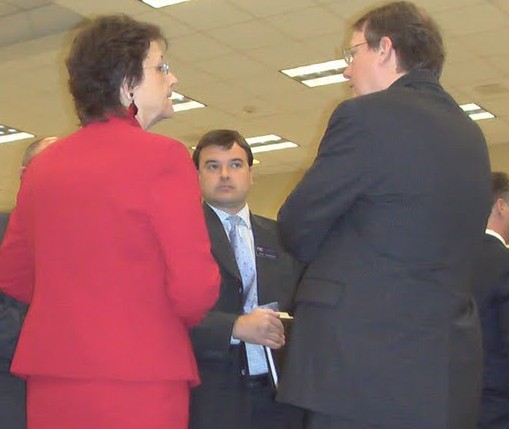
The moment Rep. Marilyn Avila (R-Time Warner Cable) entered the room, she made a beeline for Marc Trathen, Time Warner Cable's top lobbyist (right), who was joined by a representative from the North Carolina Chamber of Commerce (center) who read talking points provided by the cable company. Photo by: Bob Sepe of Action Audits

Breaking News: NC Anti-Community Broadband Bill Passes One Committee, On to the Next

Time Warner Cable’s custom-written bill banning community-owned broadband networks in North Carolina this afternoon received a favorable vote in the Public Utilities Committee — the first to consider the bill.

Rep. Marilyn Avila (R-Time Warner Cable) decided that openly distorting the record of success community broadband has had would be a good way to proceed.  In comments before a jam-packed room this afternoon, Avila claimed fiber optic broadband systems have a long history of “failures,” which is ironic considering her promise to exempt these so-called failures from her bill’s anti-competitive regulatory regime.

Honestly, it was the first time we can recall a sitting legislator openly trashing her own state’s advanced broadband network successes.  (You can’t fault her for going all out for her friends at Time Warner Cable, but you can hold her accountable at the next election.)

Avila would never and could never admit the truth after wading this far in: these state of the art fiber networks are successful enough to have waiting lists from time to time just to get service installed.  Even those who don’t subscribe are benefiting. Just look at GreenLight, operated by the community of Wilson.  While GreenLight subscribers benefit from broadband far superior to what the cable company offers, those staying with Time Warner have seen an end to relentless annual rate increases.  Apparently Ms. Avila wants you to pay higher cable bills now and forever.

Republicans and Democrats from rural districts harshly criticized the proposed legislation for bringing no answers to the perennial problem of inadequate broadband in rural North Carolina communities, as well as the fact this bill contains customized exemptions to protect Time Warner and other Big Telecom companies from regulatory requirements dumped on community networks like a ton of bricks.

That’s favorable treatment for the cable company Ms. Avila seeks to protect at all costs.

Avila

Despite the important arguments raised by those objecting to the bill, the Committee Chair gaveled the debate to a sudden close, held a perfunctory voice vote and adjourned the session without a recorded vote.  That leaves citizens of the state with no idea how individual members voted.  Apparently they do not want to hear from unhappy constituents.

The Time Warner Cable Legislative Railroad next stops at the Finance Committee.

Although Rep. Julia Howard (R-Davie, Iredell), senior chair of that committee and Avila promise changes in the bill to protect existing community broadband operations, we are more than a little skeptical.

Last week, Avila called a meeting of city officials and several Big Telecom companies, including Time Warner and CenturyLink, partly to discuss exemption issues.  To give readers an idea of just how far Avila is in Time Warner’s corner, minutes into the meeting, she turned it over to the lobbyist from Time Warner Cable for the duration.

That’s a public-private partnership any voter in North Carolina should take a dim view about.  If Ms. Avila finds her work in the legislature too difficult to handle, perhaps she can find another line of work.  The only good thing about turning over your legislative responsibilities to the cable company is it cuts out the middleman.

Howard

The fact is, Time Warner has no interest in protecting -your- interests in North Carolina, much less those of the cutting edge fiber networks now up and running in the state.  They want them gone… or better yet, available for their acquisition at fire sale prices.  Yes, they even made sure of that in their bill, which guarantees a city can sell a fiber network hounded out of business to a Big Telecom company without a vote.

Exempting existing networks has turned out to be a highly subjective notion for Ms. Avila anyway.  She originally claimed to exempt them in her bill when it was introduced, but then subjected them to crushing regulation the cable companies do not face.  Any community contemplating starting a new network for their citizens can forget it either way.  Time Warner will not hear of it.

Although a growing number of Republicans and Democrats see Avila’s bill as a classic example of corporate overreach, without your voice demanding this bill be dropped, there still may be enough members of the state legislature willing to do the cable industry’s bidding.  If you make it clear that may cost them your support in the next election, they can be persuaded to do the right thing and vote NO.

But time is running out.  Your job is to begin melting down the phone lines of the Finance Committee members starting this afternoon.  Call and e-mail them and make it absolutely clear you expect them to vote NO on H129 and that you are closely watching this issue.  Ask each legislator for a commitment on how they plan to vote.

Finance Committee Members

Senior Chairman Rep. Howard
Chairman Rep. Folwell
Chairman Rep. Setzer
Chairman Rep. Starnes
Vice Chairman Rep. Lewis
Vice Chairman Rep. McComas
Vice Chairman Rep. Wainwright
Members Rep. K. Alexander, Rep. Brandon, Rep. Brawley, Rep. Carney, Rep. Collins, Rep. Cotham, Rep. Faison, Rep. Gibson, Rep. Hackney, Rep. Hall, Rep. Hill, Rep. Jordan, Rep. Luebke, Rep. McCormick, Rep. McGee, Rep. Moffitt, Rep. T. Moore, Rep. Rhyne, Rep. Ross, Rep. Samuelson, Rep. Stam, Rep. Stone, Rep. H. Warren, Rep. Weiss, Rep. Womble


Verizon FiOS Customers Get Free Online MTV Networks’ Programming

Phillip Dampier March 2, 2011 Online Video, Verizon Comments Off on Verizon FiOS Customers Get Free Online MTV Networks’ Programming

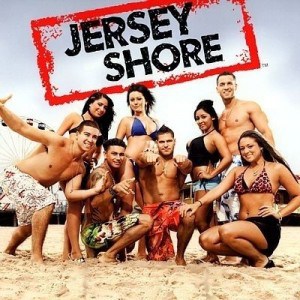
Can’t get enough Jersey Shore?

Customers of Verizon FiOS can now watch selected full length episodes of that, and several other MTV series free of charge on a new online video website for authenticated cable/satellite customers.

MTVNow delivers at least a handful of episodes of their regular series — mostly reality shows.

“It’s clear that today’s consumers want to access their video programming anytime, any place, and Verizon continues to make that possible with online programming from partners like MTV Networks,” said Terry Denson, vice president of content strategy and acquisition for Verizon.

FiOS TV customers will also get access to MTV Networks’ Comedy Central and Nickelodeon online soon.

Verizon customers will be authenticated by using their registered Verizon Online user names and passwords that verify they are existing pay-television subscribers.  If a customer only receives Verizon’s broadband service, they will not be able to access the service.

It’s part of the industry’s TV Everywhere project designed to stop customers from cord cutting their cable/satellite television packages.  By locking out access to popular shows, providers hope to avoid losing customers to a broadband environment where television shows are available free for watching.

But Verizon still faces licensing restrictions that limit the number of shows available to viewers at any one time.  Only about seven episodes of Jersey Shore, for example, were available.  Other series were limited to the last month of programming — a very familiar experience for Hulu visitors.  So are the commercials.

In addition to “Jersey Shore” and “Teen Mom 2,” Verizon and MTV Networks are providing FiOS TV customers with online access to MTV shows like ” Teen Cribs,” “True Life,” “The Real World: New Orleans” and “I Used To Be Fat.”  MTV will make additional shows available online soon including “The Hard Times of RJ Berger,” “Cribs,” “The Real World: Las Vegas” and “Rob Dyrdek’s Fantasy Factory.”

Verizon customers who subscribe to FiOS TV are able to watch the MTV shows on their personal computers or laptops – at home or away – using any broadband connection.  Using their Verizon Online user names and passwords, FiOS customers can access the online programming at either www.verizon.com/fiostvonline or www.mtv.com/tve.

Marilyn Avila’s District Rejects Her Time-Warner-Written, Anti-Competition Bill

Avila’s bill, H129, is up for a vote early this afternoon.  If you live in North Carolina, this is your last chance to contact the members of the committee voting on the bill and encourage them to vote NO.  Tell them you are tired of these anti-competitive bills coming up year after year.  Let them know you support community broadband, that the bill does not exempt existing networks from its lethal regulatory requirements, and that there is no need for these kinds of bills, as local governments already answer to voters.

Rep. Marilyn Avila (R-Time Warner Cable) is getting significant blowback from some of her own constituents for introducing a bill that benefits a cable company, and almost nobody else.

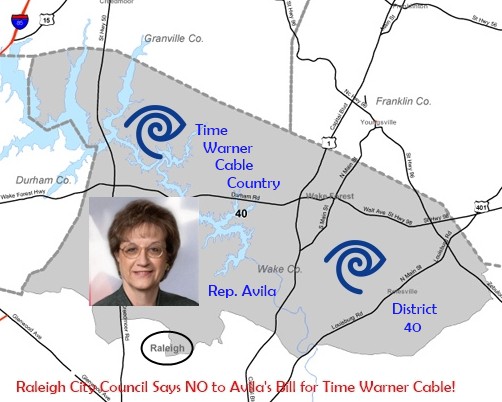
Avila’s district extends into the northern part of Raleigh, the capital city of North Carolina.  Now, the city is making it clear it wants no part of Avila’s bill, H129, which will guarantee residents will continue to pay escalating cable bills year after year.

Raleigh’s City Council adopted a resolution opposing Avila’s legislation, written on behalf of Time Warner Cable.

H129 will destroy North Carolina’s community-owned broadband networks and prevent new ones from launching.

Council Member Bonner Gaylord, who authored the resolution, says passage of these kinds of anti-competitive bills would stop local governments from providing needed communications services, especially advanced high-speed broadband, and deny local governments the availability of federal grants under the American Recovery and Reinvestment Act to assist in providing affordable access to high-capacity broadband service in unserved and underserved areas.

North Carolina’s broadband rankings do not speak highly of the state’s existing broadband penetration, speeds, or pricing.  Large parts of western North Carolina lack broadband altogether, and what is available is often very slow speed DSL, often providing just 1.5Mbps service.  The mountainous western areas of the state are not well-reached by cable companies, and because of geographic and distance impediments, even telephone company DSL service is sporadically available.

Take Rockingham County, where the local government is pre-occupied with trying to find providers — any providers — to extend broadband service across the north central part of North Carolina.  Adjacent to Caswell County (which Stop the Cap! featured last year), it’s just one more example of how providers have ignored large sections of the state too rural, too poor, or too difficult for them to reach.

On Monday, Mark Wells, executive director for the Rockingham County Business and Technology Center, delivered a report to the county on his progress trying to get someone to provide service between the communities of Wentworth and Madison, which currently have no access to broadband.  Wells reports he is doing all he can to get CenturyLink, the area’s phone company, to step up and provide service, and the county is trying to see if Clearwire could extend service into the northern sections of the state.

Rockingham County, N.C.

Unfortunately, Clearwire has proved to be no broadband replacement, heavily throttling their customers to speeds that occasionally seem more like dial-up than actual broadband.

Rockingham County opposes H129 for the same reasons the city of Raleigh does.  The Board of Commissioners recognizes the broadband reality of northern North Carolina.  Unless local governments have a free hand to address the digital divide themselves, there will be no long-term solution for broadband availability in rural North Carolina.  That’s the message they are sending to their representatives in Raleigh.

Addressing the state’s broadband shortage requires public and private assistance.  Public governments can construct networks that require a longer window to pay off than private “return on investment” requirements allow, and private companies can access community networks to sell their services to the public they currently do not serve (or serve well).

But because companies like Time Warner do not want the competition, particularly from networks more advanced and capable than their own, they would prefer to see them shut down and banned — which is exactly what Avila’s bill would accomplish.

Last year, Sen. David Hoyle openly admitted Time Warner Cable wrote his bill.  There is little doubt the same is true for Avila’s bill this year.

The city of Raleigh, North Carolina

The city has an entirely different set of recommendations for Avila to consider:

  1. The State of North Carolina adopt policies to encourage the development of high-speed broadband, including advanced, next-generation fiber-to-the-premises networks, in order to fully serve the citizens and advance education and economic development throughout the state;
  2. The General Assembly provide incentives for both public and private development of high-capacity connections in order to handle rapidly growing data needs;
  3. The General Assembly promote competition by curtailing predatory pricing practices that are used to push new providers and public broadband services out of the market; and,
  4. The General Assembly reject any legislation similar to the Level Playing Field bills that would have a chilling effect on local economies and would impede or remove local government’s ability to provide broadband services to enhance economic development and improve quality of life for their citizens.

The resolution also noted that several North Carolina municipalities; including Wilson, Salisbury, Morganton, Laurinburg and Davidson, already have successfully launched local high-speed broadband networks in response to private provider’s unwillingness or inability to provide high-speed service “to serve the public and promote economic development in their respective areas.”

Search This Site:

Contributions:

Recent Comments:

Your Account:

Stop the Cap!