Home » History » Recent Articles:

Historical Truths: The Telecom Act of 1996 Sowed the Seeds of a Telecom Oligopoly

How exactly did America get stuck with a broadband monopoly in many areas, a duopoly in most others? It did not happen by accident. In this occasional series, “Historical Truths,” we will take you back to important moments in telecom public and regulatory policy that would later prove to be essential for the creation of today’s anti-competitive, overpriced marketplace for broadband internet service. By understanding the trickery and legislative shell games practiced by lobbyists and their elected partners in Congress, you will learn to recognize when the telecom industry and their friends are preparing to sell you another bill of goods. 
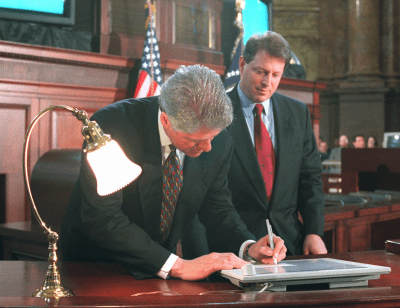
Vice President Al Gore watches President Bill Clinton digitally sign the 1996 Telecom Act into law on February 8, 1996.

By the end of the first term of the Clinton Administration, the president faced a major backlash from Republicans two years into the Gingrich Revolution. A well-funded chorus of voices in the business community, the Democratic Leadership Council — a business-friendly group of moderate Democrats, as well as commentators and pundits had the attention of the Beltway media, complaining in unison that the Democrats shifted too far to the left during the first term of the Clinton Administration, leaving it exposed in the forthcoming presidential election to another voter backlash like the one that installed the Gingrich revolutionaries in the House of Representatives and delivered a Republican takeover of the U.S. Senate in 1994.

With pressure over the growing lack of bipartisanship, and a presidential election ahead in the fall, the Clinton Administration was looking for ideas to prove it could work across the aisle and pass new laws that would deliver for ordinary Americans.

Revamping telecommunications policies would definitely touch every American with a phone line, computer, modem, and a television. Before 1996, America’s telecommunications regulation largely emanated from the Communications Act of 1934, which empowered the Federal Communications Commission to establish good order for the growing number of radio stations, telephone, and wire lines crisscrossing the country.

The 1934 Act’s legacy remains today, at least in part. It created the FCC, firmly established the concept of content regulation on the public airwaves, and established a single body to conduct federal oversight of the nation’s telephone monopoly controlled by AT&T.

Efforts to replace the 1934 Act began well before the Clinton Administration. In the early 1980s, Sen. Bob Packwood (R-Ore.) attempted to push for a legislative breakup of AT&T and a significant reduction in the oversight powers of the FCC. The bill met considerable opposition from AT&T, spending $2 million lobbying against the bill in 1981 and 1982. Alarm companies also heavily opposed the measure, terrified AT&T would enter their market and put them out of business. AT&T preferred a more orderly plan of divestiture being carefully negotiated in a settlement of a 1974 antitrust lawsuit by the Justice Department. A 1982 consent decree broke off AT&T’s control of local telephone lines by establishing seven Regional Bell Operating Companies independent of AT&T (NYNEX, Pacific Telesis, Ameritech, Bell Atlantic, Southwestern Bell Corporation, BellSouth, and US West). AT&T (technically an eighth Baby Bell) kept control of its nationwide long distance network.

Also in the 1980s, the cable television industry gained a much firmer foothold across the country, quickly gaining political power through well-financed lobbyists and close political ties to selected members of Congress (particularly Democrat Tim Wirth, who served in the House and later Senate representing the state of Colorado) that allowed them to push through a major amendment to the 1934 Act in 1984 deregulating the cable industry. The result was an early wave of industry consolidation as family owned cable companies were snapped up by a dozen or so growing operators. These buyouts were largely financed by dramatic rate increases passed on to consumers, resulting in cable bills tripling (or more) in some areas almost immediately. By the end of the 1980s, a major consumer backlash began, creating enormous energy for the eventual passage of the 1992 Cable Act, which re-regulated the industry and allowed the FCC to order immediate rate reductions.

The Progress and Freedom Foundation, with close ties to former House Speaker Newt Gingrich, closed its doors in 2010.

The biggest push for a near-complete revision of the 1934 Act came during the Gingrich Revolution. In 1995, the conservative Progress & Freedom Foundation — a group closely tied to then-Speaker Newt Gingrich (R-Ga.) floated a trial balloon calling for the elimination of an independent Federal Communications Commission, replaced by a stripped-down Office of Communications that would be run out of the White House and be controlled by the president. A small army of telecom industry-backed scholars also began proposing privatizing the public airwaves by selling off spectrum to companies to be owned as private property. The intense interest in the FCC by the group may have been the result of its veritable “who’s who” of telecom industry backers, including AT&T, BellSouth, Verizon, the National Cable & Telecommunications Association, cable companies like Comcast and Time Warner; cell phone companies like T-Mobile and Sprint; and broadcasters like Clear Channel Communications and Viacom.

The proposal outraged Democrats and liberal groups who called it a corporate-friendly sell-off and giveaway of the public airwaves. Then FCC Chairman Reed Hundt took the proposal very seriously, because at the time Gingrich lieutenant Tom DeLay’s (R-Tex.) secretive Project Relief group had 350 industry lobbyists, including some from BellSouth and Southwestern Bell literally drafting deregulation bills and a regulatory moratorium on behalf of the new Republican majority, coordinating campaign contributions for would-be supporters along the way. The proposal ultimately went nowhere, lost in a sea of the House Republicans’ constantly changing agendas, but did draw attention to the fact a wholesale revision of telecommunications policy would attract healthy campaign contributions from all corners of the industry — broadcasters, cable companies, phone companies, and the emerging wireless industry.

When it became known Congress was once again going to tackle telecommunications regulation, lobbyists immediately descended from their K Street perches in relentless waves, with checks in hand. There were two very important agendas in mind – deregulation, which would remove FCC rate regulation, service oversight, cross-competition prohibitions, and ownership caps, and ironically, protectionism. The cable and satellite companies had become increasingly fearful of the regional Baby Bells, which arrived in Congress in the early 1990s promoting the idea of entering the cable TV business. The cable industry feared phone companies would cross-subsidize the development of Telco TV by charging telephone ratepayers new fees to finance that entry. The cable industry had carefully developed a de facto monopoly over the prior decade of consolidation. Companies learned quickly direct head-to-head competition between two cable operators in the same market was bad for business.

The original premise of the 1996 Telecom Act was that it would eliminate regulations that discouraged competition. Promoters of the legislation asked why there should only be one phone or cable company in each city and why maintain regulations that kept cable and phone companies out of each others’ markets. Fears about market power and allowing domineering cable and phone companies to grow even larger were dismissed on the premise that a wide open marketplace, with regulations in place to protect consumers and competition would avoid creating telecom robber barons.

The checks handed out by industry lobbyists were bi-partisan. Democrats could crow the new rules would finally give consumers a new choice for cable TV or phone service, and help bring the “information superhighway” of the internet to schools, libraries, and other public institutions. Republicans proclaimed it a model example of free market deregulation, promoting competition, consumer choice, and lower prices.

At a high-brow bill signing ceremony held at the Library of Congress, both President Bill Clinton and Vice President Al Gore were on hand to “electronically sign” the bill into law. Both the president and vice-president emphasized the historical significance of the emerging internet, and its ability to connect information-have’s and have-not’s in an emerging digital divide. Missing from the discussion was an exploration of what industry lobbyists and their congressional allies were doing inserting specific language into the 1996 Telecom Act that would later haunt the bill’s legacy.

On hand to celebrate the bi-partisan bill’s signing were Speaker Gingrich, Sen. Larry Pressler (R-S.D.); Sen. Ernest F. Hollings (D-S.C.); Rep. Thomas J. Bliley Jr. (R-Va.); Rep. John Dingell (D-Mich.); and Ron Brown, the Secretary of Commerce. Pressler was among the soon-to-be-endangered moderate Republicans, Hollings was a holdout against the gradual wave of Republican takeovers in southern “red states,” and Dingell was a veteran lawmaker with close ties to the broadcasting industry.
Some of the bill’s industry backers were also there, some who would ironically see its signing as directly responsible for the eventual demise of their independent companies. John Hendricks of the Discovery Channel, Glenn Jones of Jones Intercable (acquired by Comcast in 1999), Jean Monty of Northern Telecom (later Nortel), Donald Newhouse of Advance Publications (eventual part owner of Bright House Networks and later Charter Communications), William O’Shea of Reuters Ltd. and Ray Smith of Bell Atlantic (today part of Verizon) were on hand. Also in the audience was Jack Valenti of the Motion Picture Association of America, representing Hollywood Studios.

Among the fatal flaws in the Telecom Act of 1996 were its various ‘competition tests,’ which were open to considerable interpretation and latitude at the FCC. The Republican supporters of the bill argued that the presence of an open and free marketplace would, by itself, induce competition among various entrants. They were generally unconcerned with the question of whether new competition would actually arrive. Their priority was lifting the protective levers of legacy regulation as soon as possible. Many Democrats assumed what appeared to be carefully drafted regulatory language would protect consumers by preventing the FCC from lifting protections too early in the competitive process. But lobbyists consistently outmaneuvered lawmakers, finding ways to insert loopholes and compromise language that introduced inconsistencies that could be dealt with and eliminated either by the FCC or the courts later.

For example, lawmakers insisted on unbundling telecommunications network elements, an arcane way of saying new competitors must be granted access to existing networks to be shared at wholesale rates. In practice, this meant if a phone company entered the internet service provider business, it must also make its network available for other ISPs as well. In some areas, competing local telephone companies also offered landline service over existing telephone lines, paying wholesale connection fees to the incumbent local phone company. As competition emerged, the incumbent company usually petitioned for a lifting of the regulations governing their business, claiming competition had arrived.

The first warning the 1996 Act was going awry came a year after the bill was signed into law. Phone companies started raising rates from $1.50-6 a month on average. AT&T was petitioning to hike rates $7 a month. Someone would have to pay to replace the scrapped subsidy system in a competitive market — subsidies that had been in place at the nation’s phone companies for decades. By charging higher rates for phone service in cities and for pricier long distance calls before the arrival of companies like MCI and Sprint, the phone companies used this revenue to subsidize their Universal Service obligations, keeping rural phone bills low and often below the real cost of providing service. To establish a truly competitive phone business, the subsidies had to be reformed or go, and that meant someone had to cover the difference.

“This game is called ‘shift and shaft,'” Sharon L. Nelson, the chairwoman of the Washington Utilities and Transportation Commission, said in 1997. “You shift the costs to the states and shaft the consumer.”

Sam Brownback (R-Kansas)

Gradually, consumers suddenly discovered their phone bill littered with a host of new charges, including the Subscriber Line Charge and various regulatory recovery fees and universal service cost recovery schemes. Phone companies also boosted rates on their unregulated Class phone features, like call waiting, caller ID, and three-way calling. The proceeds helped make up for the tens of billions in lost subsidies, but the end effect was that phone bills were still rising, despite promises of competitive, cheap phone service.

At a hearing of the Senate Commerce Committee later that year, several angry senators said they would never have voted in favor of the Telecommunications Act of 1996 if they had thought it would lead to higher rates. Sam Brownback, a Kansas Republican, was in the line of fire because of his rural constituents. Rates for those customers are subsidized more heavily than elsewhere because of the cost of extending service to them. Rates were threatening to skyrocket.

“We would be foolish to build up all these expectations about competition without saying to the American people, ‘We’re going to have to raise your phone bill,'” Brownback said.

But the rate hikes were just beginning. By the beginning of the George W. Bush administration, telecom lobbyists brought a thick agenda of action items to Michael Powell’s FCC. Despite promises of competition breaking out everywhere, that simply was not the case. Republicans quickly blamed the remaining regulatory protections still in place in noncompetitive markets for ‘deterring competition.’ But the companies knew the only thing better than deregulation was deregulation without competition.
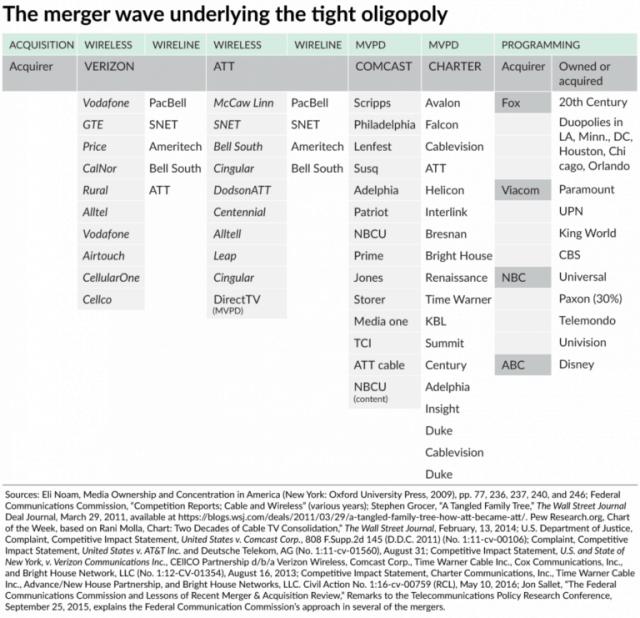
Consolidation wave

The Republican-dominated FCC quickly began removing many of those protective regulations, claiming they were outdated and unnecessary. The very definition of competition was broadened, allowing the presence of virtually any company offering almost any service good enough to trip the deregulation levers. Later, even open access to networks by competitors was often limited to pre-existing networks, not the future next generation networks. Republicans argued those networks should be managed by their owners and not subject to “unbundling” requirements.

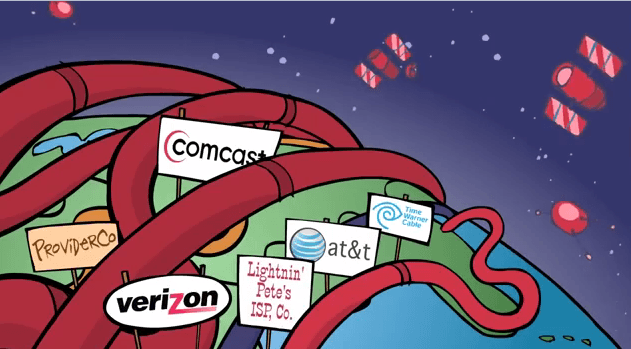
The weakened rules also sparked one of the country’s largest consolidation waves in history. Cable companies bought other cable companies and the Baby Bells gradually started putting themselves back together into what would eventually be AT&T, Verizon, and Qwest/CenturyLink. For good measure, phone companies even snapped up a handful of independent phone companies, most notably General Telephone and Electronics, better known as GTE by Verizon and Southern New England Telephone (SNET) by AT&T.
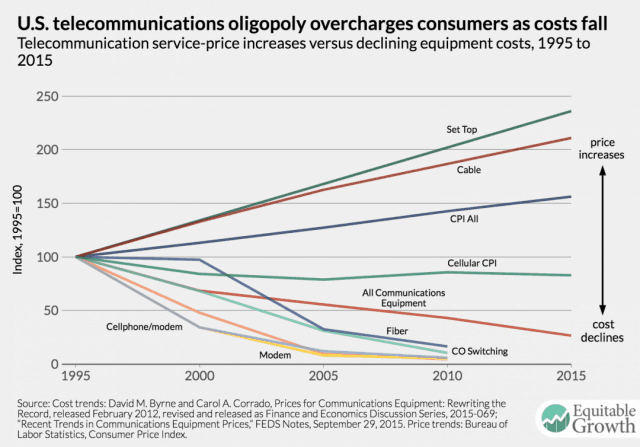
Prices rising as costs dropping.

The cable industry, under the premise it needed territories of scale to maximize potential ad insertion revenue from selling commercials on cable networks, gradually shrunk from at least a dozen well-known companies to two very large ones – Comcast and Charter, along with a few middle-sized powerhouses like Cox and Altice. Merger and acquisition deals faced little scrutiny during the Bush years of 2002-2009, usually approved with few conditions.

The result has been a rate-raising oligopoly for telecom services. In broadcasting, the consolidation wave started in radio, with entities like Clear Channel buying up hundreds of radio stations (and eventually putting the resulting giant iHeartMedia into bankruptcy) and Sinclair and similar companies acquiring masses of local television outlets. On many, local news and original programming was sacrificed, along with a significant number of employees at each station, in favor of inexpensive music, network or syndicated programming. Some stations that aired local news for 50 years ended that tradition or turned newsgathering over to a co-owned station in the same city.

Although telephone service eventually dropped in price with the advent of Voice over IP service, consumers’ cable TV and internet bills are skyrocketing at levels well in excess of inflation. Last year, the Washington Center for Equitable Growth demonstrated that the current consolidated, anti-competitive telecom marketplace results in rising prices for buyers and falling costs for providers.
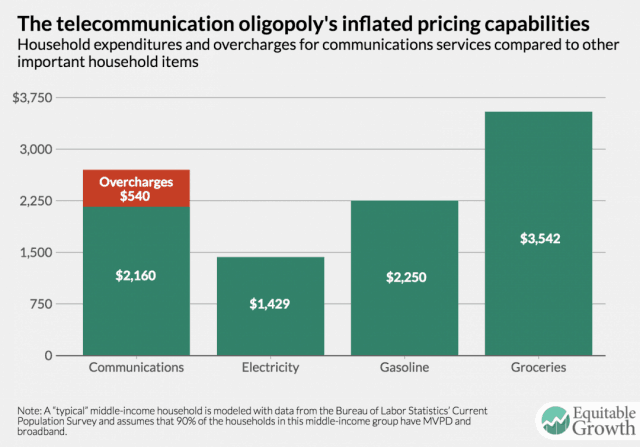
Your oligopoly tax.

“In truly competitive markets, a significant part of cost reductions would be passed through to consumers,” the group wrote. “Based on a detailed analysis of profits—primarily EBITDA—we estimate that the resulting overcharges amount to more than $45 per month, or $540 per year, an aggregate of almost $60 billion, or about 25 percent of the total average consumer’s monthly bill.”

That is one expensive bill, paid by subscribers year after year with no relief in sight. Several Republicans are proposing to double down on deregulation even more after eliminating net neutrality, which could cause your internet bill to rise further. Several Republicans want to rewrite the 1996 Telecom Act once again, and lobbyists are already sharing their ideas to further curtail consumer protections, lift ownership caps, and promote additional consolidation.
Still Paying After All These Years: Verizon Raised NY Landline Rates for Phantom FiOS

Phillip Dampier July 15, 2015 Consumer News, History, Public Policy & Gov't, Verizon 1 Comment

Verizon's FiOS expansion is still dead.

Verizon customers in New York are paying artificially higher telephone rates justified to encourage Verizon investment in FiOS fiber to the home upgrades most New York State communities will never receive.

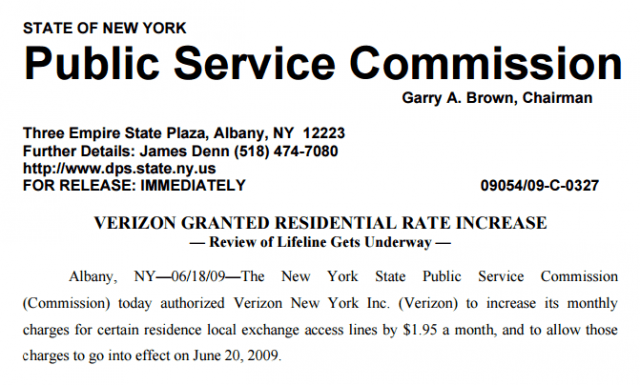
Starting in 2006, the New York Public Service Commission granted Verizon rate increases for residential flat-rate and message-rate telephone service and a 2009 $1.95 monthly increase for certain residence local exchange access lines to encourage Verizon’s investments to expand FiOS fiber to the home Internet across New York State.

“We are always concerned about the impacts on ratepayers of any rate increase, especially in times of economic stress,” said then-Commission chairman Garry Brown in June 2009. “Nevertheless, there are certain increases in Verizon’s costs that have to be recognized. This is especially important given the magnitude of the company’s capital investment program, including its massive deployment of fiber optics in New York. We encourage Verizon to make appropriate investments in New York, and these minor rate increases will allow those investments to continue.”

After Verizon announced it was suspending further expansion of its FiOS project a year later, the company continued to pocket the extra revenue despite reneging on the investments the PSC considered an important justification for the rate increases.

nypsc

“The commission allowed Verizon rate increases in 2006 and 2008 based, in significant part, upon the assumption that the revenue from the higher rates would lead Verizon to invest in fiber optic lines, presumably for the benefit of wireline customers,” argues a coalition of state legislators, consumer groups, and unions. “Serious questions exist regarding the extent to which funds may instead have been used to build out the network for the benefit of wireless customers. Publicly available reports, while fragmentary, suggest that Verizon may have included construction costs for significant benefit of its wireless affiliate to be included in the costs of the Verizon New York wireline company, thus adding to its costs and tax losses.”

shellAlmost a decade later, Verizon is still receiving the extra revenue while some public officials complain Verizon is not meeting its commitments even in cities where Verizon has introduced FiOS service.
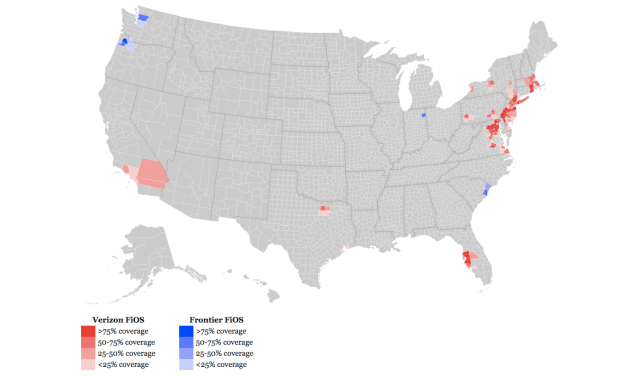
Last week New York City Mayor Bill de Blasio ordered all future city contracts with Verizon be reviewed and authorized by City Hall. City officials complain Verizon promised in 2008 it would make FiOS available to every city resident no later than mid-2014. A year later, the service is still not available in some areas.

Verizon has blamed access issues and uncooperative landlords for most of the delays, but city officials are not happy with Verizon’s explanations.

“They [Verizon] have to demonstrate to us that they are good corporate actors if they want us to use our discretion in ways that benefit them,” the mayor’s counsel, Maya Wiley, told the New York Post.

Meanwhile, upstate New York residents now indefinitely bypassed by Verizon FiOS want a refund for the rate increases that were supposed to inspire Verizon to keep expanding fiber optics.

“Verizon has made at least $250 from me and every other upstate customer for nine years of broken promises,” said Penn Yan resident Mary Scavino. “Not only don’t they offer us fiber optics, we cannot even qualify for DSL service from them. If you can’t get Time Warner Cable in the Finger Lakes, you often don’t have broadband at all. It is them or nothing. Where did our money go?”

And, we're done. Verizon FiOS availability map also showing areas subsequently sold to Frontier.

And, we’re done. Verizon FiOS availability map also showing areas later sold to Frontier.

Fred, a Stop the Cap! reader in the city of Syracuse, thinks the PSC should immediately revoke the rate increases and force Verizon to refund the money to customers who will not get upgraded service.

“It’s not like Verizon cannot make money in a city like Syracuse,” writes Fred. “It’s clear the CEO thinks even more money can be made off Verizon Wireless customers off the backs of landline customers, and the PSC continues to look the other way while they do it.”

Verizon claims it has lost money on its copper wireline network for years, something the PSC seems to accept in its 2009 press release announcing rate increases:

The rate increases will generate much needed additional short-term revenues as the company faces the dual financial pressures created by competitive access line losses and the significant capital it is committing to its New York network. For 2008, Verizon reported an overall intrastate return of negative 6.7 percent and a return on common equity of negative 48.66 percent. The current trend in the market is toward bundled service offerings, and Verizon believes the proposed price changes to its message rate residential service will encourage the migration of customers towards higher-value service bundles.

That migration costs New York ratepayers even more for telephone service. Verizon’s website prompts customers seeking new landline service to bundle a package of long distance discounts and calling features that costs in excess of $50 a month before taxes, fees, and surcharges. Bundling broadband costs even more. Verizon does not tell customers ordering online they qualify for a bare bones landline with no calling features and pay-per-call billing for less than half the cost of Verizon’s recommended bundle.

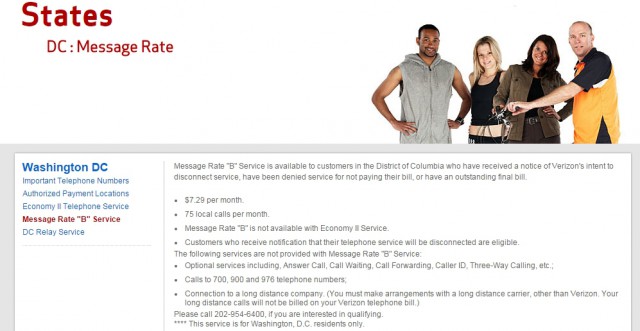
Verizon's discount calling program "Message Rate B" is only available to Washington, D.C. residents who have been threatened with final disconnection by Verizon.

This Verizon discount calling program known as “Message Rate B” is only available to Washington, D.C. residents who have been threatened with disconnection or have an outstanding balance owed to Verizon. It costs $7.29 a month and includes 75 local calls.

More than three dozen New York State legislators also question whether Verizon’s “losses” are actually the result of Verizon’s purposeful “misallocation of costs” — moving expenses to the landline business even if they were incurred to benefit Verizon’s more profitable wireless division.

“The result has been massive cost increases for consumers, especially for the garden-variety dial tone service at the bottom of the technological ladder,” argues their 2014 petition. “For example, in New York City […] since 2006 the price of residential ‘dial tone’ service (one line item on the bill) went up 84%, while other services, such as inside wire maintenance, went up 132%.”

The petitioners claim there is evidence to dispute Verizon’s assertion its legacy copper network is as big of a money loser as the company suggests, thanks to “cooking the books” with accounting tricks. The petitioners want the PSC to order a review of Verizon’s books to be certain consumers are not being defrauded or manipulated.

Verizon-Tax-Dodging-banner

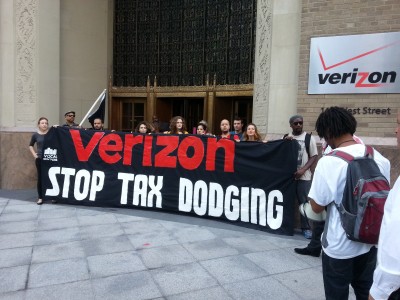
Community leaders were arrested in 2013 during a protest outside Verizon’s NYC headquarters (at 140 West Street at the West Side Highway) to out the company for its history of avoiding taxes. (Image: Vocal NY)

From 2009-2013, Verizon New York reported losses of over $11 billion dollars, with an income tax benefit to Verizon Communications of $5 billion, and significant tax revenue losses for state, city and federal governments. Verizon New York has apparently paid no state, city or federal income tax for the last five years or more.

If Verizon is using accounting tricks to inflate the cost of legacy landline service while reducing costs to its wireless service, it could prove a win-win for Verizon and a lose-lose to ratepayers. Verizon could use its “losses” to argue for greater rate increases for landline customers while further reducing its tax obligations. On the wireless side, Verizon would enjoy praise from Wall Street analysts and shareholders pleased by the company’s apparently effective cost controls.

The best evidence of these techniques in action are the statements of company officials which suggest wireless costs are being paid by wireline customers.

Verizon’s chief financial officer, Fran Shammo, indicated to investors that Verizon wireline construction budgets are charged for expenses related to wireless service.

“The fact of the matter is wireline capital — and I won’t get the number but it’s pretty substantial — is being spent on the wireline side of the house to support the wireless growth,” Shammo told investors at Verizon at Goldman Sachs Communacopia Conference, Sept. 20, 2012. “So the IP backbone, the data transmission, fiber to the cell, that is all on the wireline books but it’s all being built for the wireless company.”

“It seems to me Verizon Wireless, already considered the Cadillac of wireless companies, doesn’t need a hidden subsidy from Verizon paid for by ratepayers all over the state,” Fred argues. “It seems very curious to me Verizon pioneered a large regional fiber optic upgrade that just a few years later it considers too costly to continue expanding, even as AT&T, Google, Comcast, and other companies are now entering the fiber business. A Public Service Commission that wants better broadband for New Yorkers ought to get to the bottom of this because it just doesn’t look right.”

While Your Cable TV Bill Rises Due to “Increased Programming Costs,” So Are Advertising Loads

cablebill-web

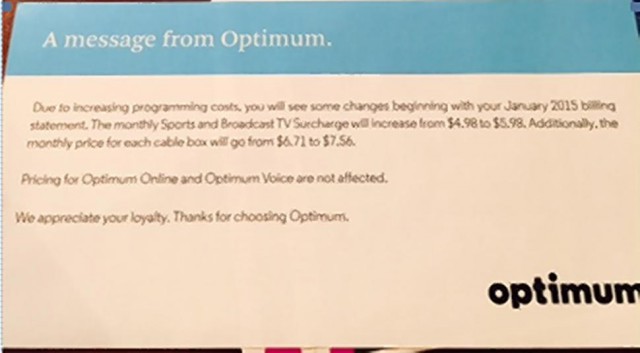
Cablevision’s broadcast TV surcharge increased in January to $5.98 a month, which amounts to $71.76 a year, on top of your usual cable TV bill.

No it isn’t your imagination. While a growing number of cable television subscribers now face a “broadcast programming surcharge” on their cable bill to compensate television stations and networks for cable carriage, those same channels are larding up their programming with ever-increasing advertising. One quarter of every hour of network television is now littered with commercials — an all-time high for broadcast networks seeking to maximize advertising revenue.

Show openings have been cut to seconds, credits roll by at fast-forward speed – usually compressed into illegibility, and some cable networks have returned to the practice of chopping bits of shows and compressing playback of others to accommodate more commercials. That does not include product placement or “in-program” compensated advertising, which appears when a character picks up a can of Pepsi, walks by a Subway outlet, or reaches for a Pop-Tart for breakfast.

As early as 2009, TNS Media Intelligence found at least 36% of today’s network primetime shows were advertising-oriented. That included 7:59 of in-show brand appearances and 13:52 of commercial advertisements, for a combined total of 21:51 of marketing content.

Reality shows, as well as being cheap to produce, are product placement gold. America’s Toughest Jobs contained 44:50 per hour of advertising messages and product placement, The Biggest Loser ran up 40:37. Before the reality show craze, game shows were program-length commercials in disguise. Game show producers received an endless supply of prizes to give away in return for viewers enduring relentless 10-15 second pitches for Rice-a-Roni, crock pots, living room furniture sets, and current model cars and trucks. Viewers did not escape traditional advertisements along the way either.

Through much of the 1970s and early 1980s, an average hour of network television was between 48-52 minutes of programming, 8-12 minutes of network and local commercials. Short news breaks and public service announcements were often included during those breaks. Shows targeting children usually contained less advertising.

In 1984, the Reagan Administration deregulated broadcasters, claiming the free market was best equipped to contain any abusive practices as consumers theoretically could tune out stations and networks that allowed things to get out-of-hand.

In reality, what one network decided, the others usually followed. Outside of watching commercial-free PBS (although those sponsorship messages increasingly began to resemble traditional advertising over the years), viewers didn’t have much choice. For the last 31 years since deregulation, advertising has increased while show length has decreased. In the 1970s and 80s, pieces of rerun television shows created when ad loads were shorter were often cut from shows to make room for an extra ad or two. What was left after a trip to the cutting room was often played slightly sped-up, which made room for even more advertising. By the 1990s, producers created their shows with increasing advertising loads in mind. Short sacrificial 60-90 second end scenes, deemed non-essential to the show’s integrity, were often chopped when a show entered syndication.

In the 2000s, network executives started demanding producers drastically cut the length of show opening and closing themes. If producers didn’t, studios did it for them when a show was resold to a cable network. A rerun of Law & Order now features a 24-second opening, a big difference from the original 1:45 second opening the show had when it originally aired on NBC. End credits were usually squished on-screen to allow a 15-second network promotion to run at the top. Some networks even began their next show in one window while showing end credits of the last program in another.

But nothing affected commercial loads more than the 2008 Great Recession. Advertising revenue tumbled, along with the economy, and advertisers balked at paying traditional ad rates when online advertising was available for much less. The answer? Sell more ads… at a lower price. Once again, program lengths had to be cut to make room for the increasing number of commercials. By 2009, average network ad loads were up to 13:25 per hour. Just four years later in 2013, that number spiked to 14:15. It’s now 15 minutes and up at some networks, depending on the type of program.

As commercials neared comprising 25% of every hour of television, sponsors finally began to rebel. They were reacting to the pervasive growth of the DVR, which allowed consumers to record their favorite shows, if only to fast forward past the dense thicket of commercials. They sought a ceiling on ad loads and more creative ways to reach ad-skipping audiences numbed by relentless advertising. That meant even more product placement.

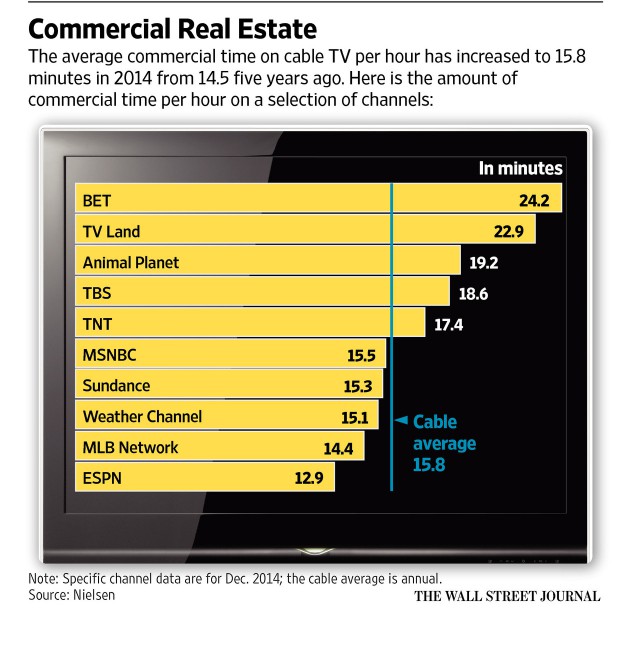
Although sponsors of expensive NBC, CBS, ABC, and FOX shows may have rebelled at the 15-minute mark, the same isn’t true with cable networks where ad loads are as high as 24 minutes per hour. In 2009, the average cable network aired 14:27 of advertisements an hour. This year, it’s up to 15:18 and still rising. Among the worst offenders:

ad load

To keep the money flowing from every direction, both over-the-air and cable networks, including those noted above, continue to seek additional compensation from your provider in the form of retransmission consent and carriage agreements. Whether you watch a channel or not, you are paying for it. Some of these compensation agreements are experiencing rate increases approaching 10% annually.

To the surprise of many industry analysts, some of the worst offenders are networks with declining ratings who risk further alienating viewers with even more advertising just to keep revenue numbers up. While traditional ads actually declined by 2% on most over the air networks this year, FOX more than made up for that with a 15% increase in advertising time. The cable networks with the highest ad increases this year were Viacom-owned channels (Comedy Central, Spike, MTV, Nickelodeon) jumping 13%, A+E Networks (A&E, Crime & Investigation, Lifetime, History) increasing 10%, and 9% at Discovery Networks. Which networks increased ads the least? Those owned by Disney, independent cable networks, and Time Warner (Entertainment).

“Generally speaking, the ratings winners (Disney, 21st Century Fox, Scripps Networks) are increasing investment in original content (and not abusively increasing ad loads), whereas the losers (A+E Networks, Viacom, NBCUniversal) and the neutrals (Discovery, AMC Networks) are decelerating investment in original content and stuffing more ad spots into their shows,” said analyst Todd Juenger of Sanford C. Bernstein.

Michael Nathanson of MoffetNathanson Research worries television is repeating the mistakes commercial radio made post-deregulation, when massive increases in advertising accompanied by decelerating investment in programming repelled many listeners, perhaps for good. Some have permanently abandoned commercial over the air radio in favor of commercial free music services, satellite radio, and streaming services.

“Networks can offset ratings challenges and pricing weakness with more inventory, however, we worry that it is a dangerous long-term game that ultimately devalues the consumer experience and reduces ad efficacy,” Nathanson said. “As we saw with radio, once the increased commercial load genie is out of the bottle, it is nearly impossible to put it back in.”

When Stephen Cox was watching The Wizard of Oz on TBS last November, something didn’t sound quite right to him about the Munchkins, who are near and dear to his heart. He wasn’t imagining things. Time Warner-owned TBS used compression technology to speed up the movie. The purpose: stuffing in more TV commercials.

“Their voices were raised a notch,” Cox, the author of several pop-culture books including one about the classic 1939 film, told the Wall Street Journal. “It was astounding to me.”

The Colbert Report hilariously depicts the next generation of product placement: the retroactive ad technology of Mirriad, which can insert products into shows years after they were made. (4:04)

FCC Chairman Complains About State of U.S. Broadband But Offers Few Meaningful Solutions

Phillip Dampier September 4, 2014 Broadband "Shortage", Broadband Speed, Community Networks, Competition, Consumer News, Data Caps, Editorial & Site News, History, Net Neutrality, Online Video, Public Policy & Gov't, Rural Broadband, Wireless Broadband Comments Off on FCC Chairman Complains About State of U.S. Broadband But Offers Few Meaningful Solutions

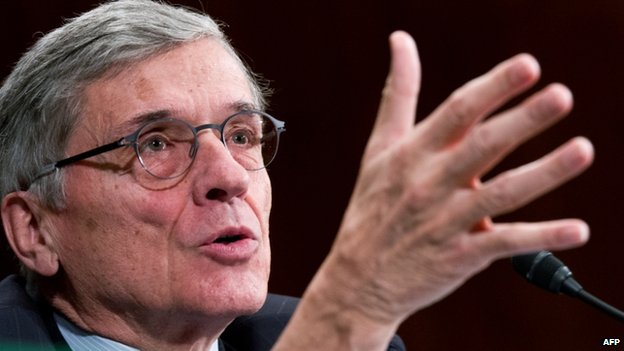
FCC chairman Thomas Wheeler doesn’t like what he sees when looks at the state of American broadband.

At a speech today given to the 1776 community in Washington, Wheeler complained about the lack of broadband competition in the United States.

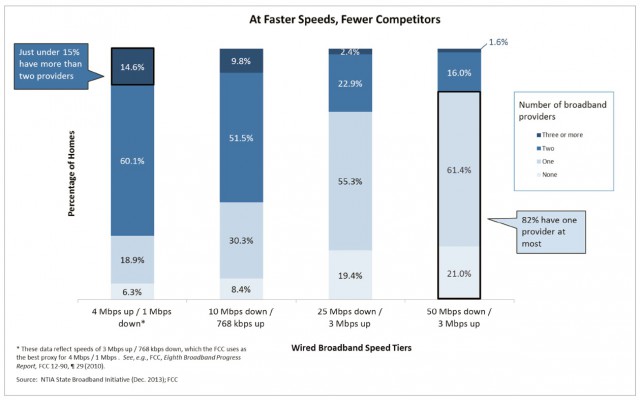
“The underpinning of broadband policy today is that competition is the most effective tool for driving innovation, investment, and consumer and economic benefits,” Wheeler said. “Unfortunately, the reality we face today is that as bandwidth increases, competitive choice decreases.”

faster speed fewer competitors

“The lighter the blue, the fewer the options,” Wheeler said, gesturing towards his chart. “You get the point. The bar on the left reflects the availability of wired broadband using the FCC’s current broadband definition of 4Mbps. But let’s be clear, this is ‘yesterday’s broadband.’ Four megabits per second isn’t adequate when a single HD video delivered to home or classroom requires 5Mbps of capacity. This is why we have proposed updating the broadband speed required for universal service support to 10Mbps.”

But Wheeler added that even 10Mbps was insufficient as households increasingly add more connected devices — often six or more — to a single broadband connection.  When used concurrently, especially for online video, it is easy to consume all available bandwidth at lower broadband speeds.

Wheeler

Wheeler

Wheeler’s new informal benchmark is 25Mbps — “table stakes” in 21st century communications. About 80 percent of Americans can get 25Mbps today or better, but typically only from one provider. Wheeler wants even faster speeds than that, stating it is unacceptable that more than 40% of the country cannot get 100Mbps service. Wheeler seemed to fear that phone companies have largely given up on competing for faster broadband connections, handing a de facto monopoly to cable operators the government has left deregulated.

“It was the absence of competition that historically forced the imposition of strict government regulation in telecommunications,” Wheeler explained. “One of the consequences of such a regulated monopoly was the thwarting of the kind of innovation that competition stimulates. Today, we are buffeted by constant innovation precisely because of the policy decisions to promote competition made by the FCC and Justice Department since the 1970s and 1980s.”

Wheeler said competition between phone and cable companies used to keep broadband speeds and capacity rising.

“In order to meet the competitive threat of satellite services, cable TV companies upgraded their facilities,” Wheeler said. “When the Internet went mainstream, they found themselves in the enviable position of having greater network capacity than telephone companies. Confronted by such competition, the telcos upgraded to DSL, and in some places deployed all fiber, or fiber-and-copper networks. Cable companies further responded to this competition by improving their own broadband performance. All this investment was a very good thing. The simple lesson of history is that competition drives deployment and network innovation. That was true yesterday and it will be true tomorrow. Our challenge is to keep that competition alive and growing.”

But Wheeler admits the current state of broadband in the United States no longer reflects the fierce competition of a decade or more ago.

“Today, cable companies provide the overwhelming percentage of high-speed broadband connections in America,” Wheeler noted. “Industry observers believe cable’s advantage over DSL technologies will continue for the foreseeable future. The question with which we as Americans must wrestle is whether broadband will continue to be responsive to competitive forces in order to produce the advances that consumers and our economy increasingly demand. Looking across the broadband landscape, we can only conclude that, while competition has driven broadband deployment, it has not yet done so a way that necessarily provides competitive choices for most Americans.”

Wheeler recognized what most broadband customers have dealt with for years — a broadband duopoly for most Americans.

antimonopoly“Take a look at the chart again,” Wheeler said. “At the low end of throughput, 4Mbps and 10Mbps, the majority of Americans have a choice of only two providers. That is what economists call a “duopoly”, a marketplace that is typically characterized by less than vibrant competition. But even two “competitors” overstates the case. Counting the number of choices the consumer has on the day before their Internet service is installed does not measure their competitive alternatives the day after. Once consumers choose a broadband provider, they face high switching costs that include early termination fees, and equipment rental fees. And, if those disincentives to competition weren’t enough, the media is full of stories of consumers’ struggles to get ISPs to allow them to drop service.”
Wheeler emphasized that true competition would allow customers to change providers monthly, if a vibrant marketplace forced competitors to outdo one another. That market does not exist in American broadband today.

“At 25Mbps, there is simply no competitive choice for most Americans,” Wheeler added. “Stop and let that sink in…three-quarters of American homes have no competitive choice for the essential infrastructure for 21st century economics and democracy. Included in that is almost 20 percent who have no service at all. Things only get worse as you move to 50Mbps where 82 percent of consumers lack a choice. It’s important to understand the technical limitations of the twisted-pair copper plant on which telephone companies have relied for DSL connections. Traditional DSL is just not keeping up, and new DSL technologies, while helpful, are limited to short distances. Increasing copper’s capacity may help in clustered business parks and downtown buildings, but the signal’s rapid degradation over distance may limit the improvement’s practical applicability to change the overall competitive landscape.”

Wheeler finds little chance wireless providers will deliver any meaningful competition to wired broadband because of pricing levels and miserly data caps. Such statements are in direct conflict with a traditional industry talking point.

In a remarkable admission, Wheeler added that the only hope of competing with cable operators comes from a technology phone companies have become reluctant to deploy.

“In the end, at this moment, only fiber gives the local cable company a competitive run for its money,” Wheeler said. “Once fiber is in place, its beauty is that throughput increases are largely a matter of upgrading the electronics at both ends, something that costs much less than laying new connections.”

Wheeler also continued to recognize the urban-rural divide in broadband service and availability, but said little about how he planned to address it.

Wheeler’s answer to the broadband dilemma fell firmly in the camp of promoting competition and avoiding regulation, a policy that has been in place during the last two administrations with little success and more industry consolidation. Most of Wheeler’s specific commitments to protect and enhance competition apply to the wireless marketplace, not fixed wired broadband:

1. comcast highwayWhere competition exists, the Commission will protect it. Our effort opposing shrinking the number of nationwide wireless providers from four to three is an example. As applied to fixed networks, the Commission’s Order on tech transition experiments similarly starts with the belief that changes in network technology should not be a license to limit competition.
In short, don’t expect anymore efforts to combine T-Mobile and Sprint into a single entity. Wheeler only mentioned “nationwide wireless providers” which suggests it remains open season to acquire the dwindling number of smaller, regional carriers. Wheeler offers no meaningful benchmarks to protect consumers or prevent further consolidation in the cable and telephone business.

2. Where greater competition can exist, we will encourage it. Again, a good example comes from wireless broadband. The “reserve” spectrum in the Broadcast Incentive Auction will provide opportunities for wireless providers to gain access to important low-band spectrum that could enhance their ability to compete. Similarly, the entire Open Internet proceeding is about ensuring that the Internet remains free from barriers erected by last-mile providers. Third, where meaningful competition is not available, the Commission will work to create it. For instance, our efforts to expand the amount of unlicensed spectrum creates alternative competitive pathways. And we understand the petitions from two communities asking us to pre-empt state laws against citizen-driven broadband expansion to be in the same category, which is why we are looking at that question so closely.

Again, the specifics Wheeler offered pertain almost entirely to the wireless business. Spectrum auctions are designed to attract new competition, but the biggest buyers will almost certainly be the four current national carriers, particularly AT&T and Verizon Wireless. Although low-band spectrum will help Sprint and T-Mobile deliver better indoor service, it is unlikely to drive new market share for either. Wheeler offered no specifics on the issues of Net Neutrality or municipal broadband beyond acknowledging they are issues.

3. Incentivizing competition is a job for governments at every level. We must build on and expand the creative thinking that has gone into facilitating advanced broadband builds around the country. For example, Google Fiber’s “City Checklist” highlights the importance of timely and accurate information about and access to infrastructure, such as poles and conduit. Working together, we can implement policies at the federal, state, and local level that serve consumers by facilitating construction and encouraging competition in the broadband marketplace.

competitionMost of the policies Wheeler seeks to influence exist on the state and local level, where he has considerably less influence. Based on the overwhelming interest shown by cities clamoring to attract Google Fiber, the problems of access to utility poles and conduit are likely overstated. The bigger issue is the lack of interest by new providers to enter entrenched monopoly/duopoly markets where they face crushing capital investment costs and catcalls from incumbent providers demanding they be forced to serve every possible customer, not selectively choose individual neighborhoods to serve. Both incumbent cable and phone companies originally entered communities free from significant competition, often guaranteed a monopoly, making the burden of wired universal service more acceptable to investors. When new entrants are anticipated to capture only 14-40 percent competitive market share at best, it is much harder to convince lenders to support infrastructure and construction expenses. That is why new providers seek primarily to serve areas where there is demonstrated demand for the service.


4. Where competition cannot be expected to exist, we must shoulder the responsibility of promoting the deployment of broadband. One thing we already know is the fact that something works in New York City doesn’t mean it works in rural South Dakota. We cannot allow rural America to be behind the broadband curve. Our universal service efforts are focused on bringing better broadband to rural America by whomever steps up to the challenge – not the highest speeds all at once, but steadily to prevent the creation of a new digital divide.

Again, Wheeler offers few specifics. Current efforts by the FCC include the Connect America Fund, which is nearly entirely devoted to subsidizing rural telephone companies to build traditional DSL service into high-cost areas. Cable is rarely a competitor in these markets, but Wireless ISPs often are, and they are usually privately funded and consider government subsidized DSL expansion an unwelcome and unfair intrusion in their business.

“Since my first day as Chairman of the FCC my mantra has been consistent and concise: ‘Competition, Competition, Competition,'” said Wheeler. “As we have seen today, there is an inverse relationship between competition and the kind of broadband performance that consumers are increasingly demanding. This is not tolerable.”

Under Wheeler’s leadership, Comcast has filed a petition to assume control of Time Warner Cable, AT&T is seeking permission to buy DirecTV, Frontier Communications is acquiring the wired facilities of AT&T in Connecticut, and wireless consolidation continues. A forthcoming test of Wheeler’s willingness to back his rhetoric with action is whether he will support or reject these industry consolidating mergers and acquisitions. Wheeler’s FCC has also said little to nothing about the consumer-unfriendly practice of usage caps and usage-based billing — both growing among wired networks even as they upgrade to much-faster speeds and raise prices.

Comcast Tries to Prove Its Usage Meter is Accurate Before Slapping the Caps Back On

Phillip Dampier June 5, 2014 Comcast/Xfinity, Consumer News, Data Caps, Editorial & Site News, History, Public Policy & Gov't Comments Off on Comcast Tries to Prove Its Usage Meter is Accurate Before Slapping the Caps Back On
Keeping an eye on the scale

Keep an independent eye on the scale

Without independent verification by an unbiased third-party, providers’ usage meters can measure any amount of usage — correct or not — with no recourse for those facing overlimit fees or service suspension.

That is why companies like Comcast depend on the patina of credibility a third-party company can offer when certifying Internet traffic measurement tools as accurate, even if that company has a vested interest handing Comcast the results it wants to see.

NetForecast just completed its third paid study of Comcast’s Internet meter declaring it amazingly accurate with an error rate of just -0.75 to 0.36%.

NetForecast claims it performed independent traffic measurements using real user traffic in subscribers’ homes as well as its own in-house PC and server.

“Based on our measurement results, Comcast subscribers should be able to rely on Comcast’s meter accuracy,” NetForecast says.

Comcast subscribers should also be able to rely on the fact that any cable company that involved with its usage measurement meter has a clear agenda to use it as part of a nationwide return to usage caps or usage-based billing.

NetForecast is no substitute for utilizing a financially uninvolved third-party to oversee any measurement tool that could expose customers to additional charges.

The country has been through this before.

Offices of Weights and Measures represent one of the country’s oldest efforts at consumer protection and trace their origins to the Code of Hammurabi, the Magna Carta and the United States Constitution. Most states created their own bureau to verify all sorts of measurement tools from scales to gas pumps in the early 1900s after an epidemic of widespread fraud shortchanged citizens.

Measure with confidence.

Measure with confidence.

By 1910, the California Legislature was engaged in a battle with the railroads over the accuracy of scales used to weigh railway cars. Railroad tariffs for hauling goods were based on the weight or measurement of the commodity carried. The railroad industry occasionally hired so-called “independent” third parties to certify the accuracy of railway scales to fend off government regulation and oversight after reports of widespread fraud reached the legislature. It didn’t solve the problem.

In 1920, 52.4% of railroad scales, including those “certified” accurate were found to be well out of tolerance. When the industry knew the state of California’s Office of State Superintendent of Weights and Measures would oversee testing a year later, every scale tested in 1921 was suddenly accurate within tolerance.

The problem of accurate measurement was not limited to the railroads. Californian cattle and livestock ranchers faced dishonest hay balers that ginned up the cost of hay by sneaking in heavy debris like rocks and using inaccurate scales to charge higher prices. The 1919 Hay Baling Act was passed to ensure accuracy in the sale of hay and to stop the fraud and abuse the hay balers denied ever existed.

In Maryland, the fraud came from scales used by grocers and gas pumps — both rigged by their respective owners to deliver bigger profits at the consumer’s expense.

In the 1971 Report of the 56th National Conference on Weights and Measures, E.E. Wolski, manager of quality control at the Colgate-Palmolive Company considered it unthinkable that anyone other than a truly independent, financially uninvolved third-party should monitor the accuracy of measurement tools.

This Maryland gas pump is being verified for accuracy by the Weights & Measures program run by the state government.

This Maryland gas pump is being verified for accuracy by the Weights & Measures program run by the state government.

“I do not think anyone will be so naïve as to even suggest that an elimination or reduction of inspection or enforcement would result in anything other than a return to the situation which made the need for them so apparent,” said Wolski. “It is a well-known fact that where enforcement drops off, so does compliance.”

In one state where private companies were permitted to self-certify, inaccuracy turned out to be rampant.

“I was informed that the average gallon was about a half pint short and that an average pound had been a little less than an ounce short,” Wolski said. “The shortages had been statewide and were almost universal.”

The state-employed director that finally established independent oversight of weights and measurements in light of the widespread fraud Wolski talked about was firm in his conclusion that “everybody, literally everybody (and that includes you and me), needs to know that someone is there watching what he does.”

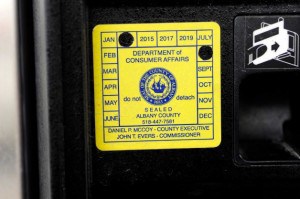
Any financial interest in the outcome of a weight or measurement involving money is a temptation to cheat consumers, one that has effectively only been tempered all the way back to the days of King Solomon by truly independent oversight, typically by a state or local authority. That authority is on display today in the form of a compliance sticker found on commercial scales, gas pumps, and other measurement tools, attesting to their accuracy.

While it is nice Comcast at least bothers to investigate the accuracy of its usage meter, consumers should not be asked to trust the findings of a third-party paid to produce results. Consumers should insist that a truly independent regulator of weights and measurements regularly test and verify usage meters wherever they could be used to suspend a customer’s account or result in extra fees.

Search This Site:

Contributions:

Recent Comments:

Your Account:

Stop the Cap!