Home » Broadband “Shortage” » Recent Articles:

On Sock Puppets & Industry Hacks: Reactions to Rep. Eric Massa’s Legislation – Predictable & Transparent

"This is not a rate increase, this is about fair pricing for everyone, seriously."

"This is not a rate increase, this is about fair pricing for everyone, seriously."

It’s always awful when you wake up with a bad taste in your mouth.  That’s the flavor of industry hacks and sock puppets who spent a good part of yesterday and last night on the attack against Rep. Eric Massa and your consumer interests.  Part of this battle is about engaging those who claim to represent consumers, but actually turn out to be paid by a lobbyist firm or “think tank,” usually located either in or near Washington, DC.  They are typically unwilling to disclose that involvement.  I’m not.  When called out, the typical response ranges from silence to ‘I would be saying the same things even if I didn’t get paid by them.’

Sure they would.

Consumers need to be particularly vigilant about the Say for Pay crowd of sock puppets that arrive in quotations in articles that attack common sense pro-consumer positions, or in the comments  below an online article.

Now you may be asking what in the world is a “sock puppet.”  Craig Aaron at Free Press explains:

Sock puppets, for those unfamiliar with the creatures commonly found inside the Beltway, are mouthpieces who rent out their academic or political credentials to argue pro-industry positions. These pay-to-sway professionals issue white papers, file comments with key agencies, and present themselves to the press as independent analysts. But their views have a funny way of shifting depending on who’s writing the checks. (To be clear, at Free Press we take no industry money.)

Sock puppets and astroturf groups go hand in hand.  If you remember, we’ve exposed a number of these groups that claim they are standing up for consumers, but in reality are paid to sit down and absorb their industry backer’s talking points.  The snowjob that typically follows claims that if you do the pro-consumer common sense thing, such as not allowing Internet Overcharging schemes to rip people off, you’ll destroy the Internet, America, and maybe even freedom itself.  Besides, just look at the “expert credentials” of our guy telling you that.

Your Money = Their MoneyWhen you boil it all down, sock puppets are people who feel morally fine with taking money for being willing to assume any position you want them to take.  It’s vaguely familiar to another profession that’s been around for a very long time.  One just has better office space than the other, and better business cards, too.

If you want to explore a perfect example of sock puppetry at work, with a group trying to get public taxpayer money to benefit big telephone and cable companies with few strings attached, check out Craig Aaron’s article on the subject this past January.

In Stop the Cap!‘s history, we’ve debated a representative from Nemertes Research who refuses to disclose who pays for their industry research reports that conveniently say exactly what the telecommunications industry’s positions are on the broadband issues of the day.  We’ve questioned a group that claims that “openness” or “neutrality” of the Internet is irrelevant, and called out the American Consumer Institute Center for Citizen Research (you gotta love the name — it’s a delicious consumery-sounding word salad… with special interest croutons sprinkled all over the top), who applauded Internet Overcharging as a great thing for customers, except they were packed with lobbyists to really satisfy big telecom interests.

Readers of this site should be well-qualified to engage industry propaganda and consumer misconceptions about the fairness of Internet Overcharging schemes.  You’ve gotten the information you need to effectively educate consumers and expose the sock puppetry.  The entire reason this group exists is because we realized the fight is not over, and we’d need an army prepared to combat the Re-education campaign we were promised back in April.  The battle is fully engaged now, and I’ve been happy to see many of you joining conversations on other sites where misconceptions and sock puppets prevail, and helping to educate consumers with facts, not focus group-tested propaganda.

We need many more of you to do likewise.  If your local newspaper runs an article on Rep. Massa’s bill, or our issues, take a look at the article online and look at the comments being left by readers.  Encounter misconceptions?  Help educate people.  Discover a sock puppet browbeating consumers for standing up for common sense reform of the broadband industry?  Defend the consumer’s point of view and don’t allow anyone to berate you with smug, fact-free answers.  Most are unprepared to respond with actual evidence to back their views, just a load of industry rhetoric and evidence-free claims they have expertise you don’t.

… Continue Reading

Share

Texas Customer Goes to War With Time Warner Cable & AT&T Over Internet Overcharging After Getting Huge Bill

Phillip Dampier June 16, 2009 AT&T, Internet Overcharging, Time Warner Cable 28 Comments
Beaumont & Golden Triangle residents were the first to participate in a Time Warner Cable Internet Overcharging trial

Beaumont & Golden Triangle, Texas residents were the first to face Time Warner Cable Internet Overcharging experiments.

For awhile there, it seemed like nobody in the Golden Triangle on the Gulf Coast of Texas was paying attention to the fact their region was the nation’s guinea pig for Internet Overcharging schemes.  How wrong we were.

Stop the Cap! reader Mark, who lives just north of Beaumont in the city of Silsbee, had been fighting a one man battle against not one, but two providers serving his community of 7,400 — Time Warner Cable and AT&T.  Mark may exemplify the average consumer in the Golden Triangle, unaware that their broadband service had been subjected to Internet Overcharging experiments until the bill arrived in the mail.  Both providers have a track record of not always disclosing such schemes to their customers when trying to sign them up for service in southeastern Texas.

Both providers have used the area for pricing experiments, providing paltry usage allowances and charging steep overlimit fees for exceeding them.

Mark’s problems began when he unknowingly set himself up to be overcharged later.  Originally a Time Warner Cable customer, Mark decided to give AT&T’s Elite DSL package a try, primarily because it was less expensive than Road Runner service and supposedly faster as well.  AT&T claims their Elite DSL service in Silsbee provides up to 6Mbps down/768kbps up speed for $35 a month, compared with Time Warner Cable’s Golden Triangle Road Runner, providing (at the time) 5Mbps down/384kbps up speed for $44.95 a month.

“After DSL was installed, we discovered we were too far from the [phone company facilities] to get Elite speed, and instead of informing us about the problem, they switched us to Basic service speed, which is up to 768kbps down/384kbps up, and never bothered to tell us,” Mark writes.
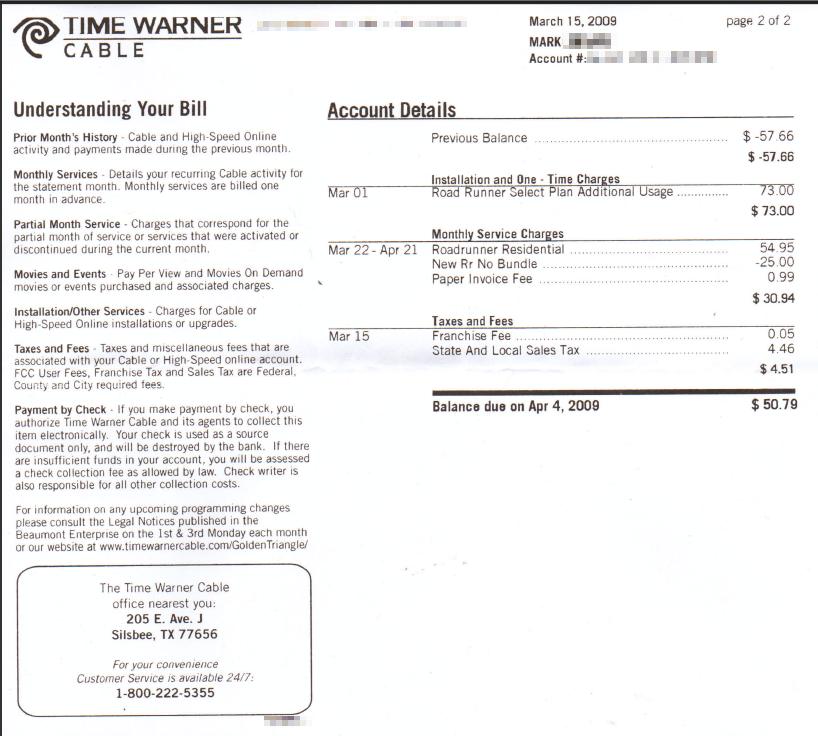
The bill Stop the Cap! reader Mark received showing $73 in Internet Overcharging penalties

The bill Stop the Cap! reader Mark received showing $73 in Internet Overcharging penalties (click to enlarge)

After Mark’s family felt AT&T was too slow to meet their needs, they ventured back to Time Warner Cable for Road Runner service.  The salesperson offered a “welcome back” discount, and mentioned nothing about the fact Time Warner Cable had implemented an Internet Overcharging scheme on the residents of the Golden Triangle region.  Instead of his old service priced at $44.95 a month for unlimited use, his new standard service was priced at $54.95 a month, and was limited to 20GB of usage per month before a $1/GB overlimit penalty kicked in.

When the first bill arrived showing his family exceeded that amount, it was quite a shock.  In addition to the $54.95 charge for “Roadrunner Residential”, there was a $73.00 fee entitled, “Road Runner Select Plan Additional Usage.”  (They also nickle and dimed him $0.99 for a “Paper Invoice Fee.”)

This was the first time Mark had encountered an “additional usage” overlimit fee, so he called Time Warner Cable to investigate.  Despite what the salesperson had sold him on, and online promotions were still selling to attract new customers, Mark learned for the first time Time Warner Cable changed pricing.  The Golden Triangle Division of Time Warner Cable implemented an Internet Overcharging scheme in June 2008, but only applied it to new customers.  Had Mark never left Time Warner Cable for AT&T, he would have never been an unwilling participant in the experiment to extract an extra $73 from his wallet.

Because he returned to Time Warner Cable after the “experiment” commenced, he was stuck.

Mark was angry.  He contacted the Better Business Bureau (BBB), the Federal Trade Commission, and the Federal Communications Commission to complain about unfair business practices, improper disclosure of the Internet Overcharging scheme, and abusive pricing.
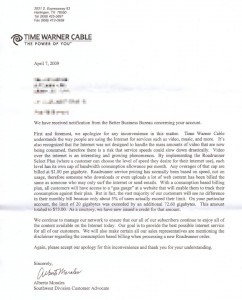
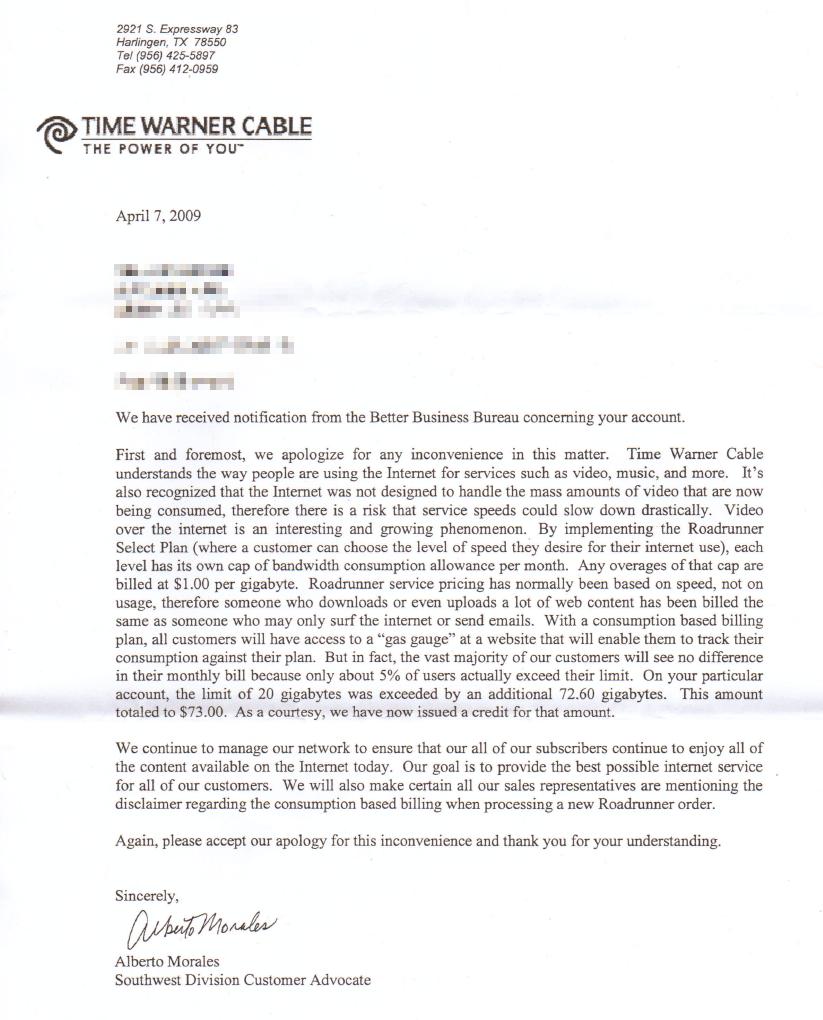
Time Warner Cable's 4/7/09 letter in response to a Better Business Bureau complaint regarding Internet Overcharging schemes implemented in the Golden Triangle, Texas (click to enlarge)

Time Warner Cable's 4/7/09 letter in response to a Better Business Bureau complaint regarding Internet Overcharging schemes implemented in the Golden Triangle, Texas (click to enlarge)

The most productive response came from Time Warner Cable, responding to the BBB complaint Mark had filed.  In addition to giving the standard talking points about Internet Overcharging schemes, Alberto Morales, Southwest Division Customer Advocate for Time Warner Cable, suggested the company would do a better job of training salespeople to disclose “the disclaimer regarding the consumption based billing when processing a new Roadrunner order.”  Morales also issued a one time credit for the $73 in overlimit fees charged to Mark’s account.

Mark recognized the language of the letter for what it was — propaganda from a cable broadband provider looking to cash in at the expense of their customers.  Among the dubious reasons given in the letter:

It’s also recognized that the Internet was not designed to handle the mass amounts of video that are now being consumed, therefore there is a risk that service speeds could slow down dramatically.  Video over the internet is an interesting and growing phenomenon.

So are Internet Overcharging schemes, but few would call them “interesting.”  Using the company’s own logic, Time Warner Cable should not be placing video on their own customer website, much less embark on a grand experiment called TV Everywhere to stream enormous amounts of video at broadband speeds to their customers.  Now that is interesting.  The “Internet brownout” theory of slowdowns and outages can occur when a provider chooses to pocket profits instead of keeping up with required investments to maintain their broadband network.  Time Warner Cable CEO Glenn Britt disputes there is a problem with Time Warner Cable’s network as-is, telling a conference sponsored by Sanford Bernstein in May that, “I’m very comfortable with our plant… I don’t see a need for a massive upgrade.”

By implementing the Roadrunner Select Plan (where a customer can choose the level of speed they desire for their internet use), each level has its own cap of bandwidth consumption allowance per month.

Of course, customers cannot choose the one plan that has been an outstanding success for Time Warner Cable since its inception – the one they have right now (or had in the Golden Triangle prior to the “experiment”), unless they were willing to pony up 300% more for the same level of service, based on the last proposal Time Warner Cable introduced before temporarily “shelving the plan” due to customer outrage.

In the Golden Triangle, the maximum amount of usage was 40GB per month, followed by “the sky is the limit” $1/GB overlimit penalties.

Morales claimed that only “5% of users actually exceed their limit.”  But 100% of the Golden Triangle’s customers were left waiting for the arrival of a “gas gauge” measuring their usage, something they would now be required to check daily if they wanted to be sure not to exceed the paltry level of “bandwidth allowance” they were granted.
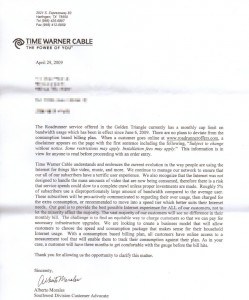
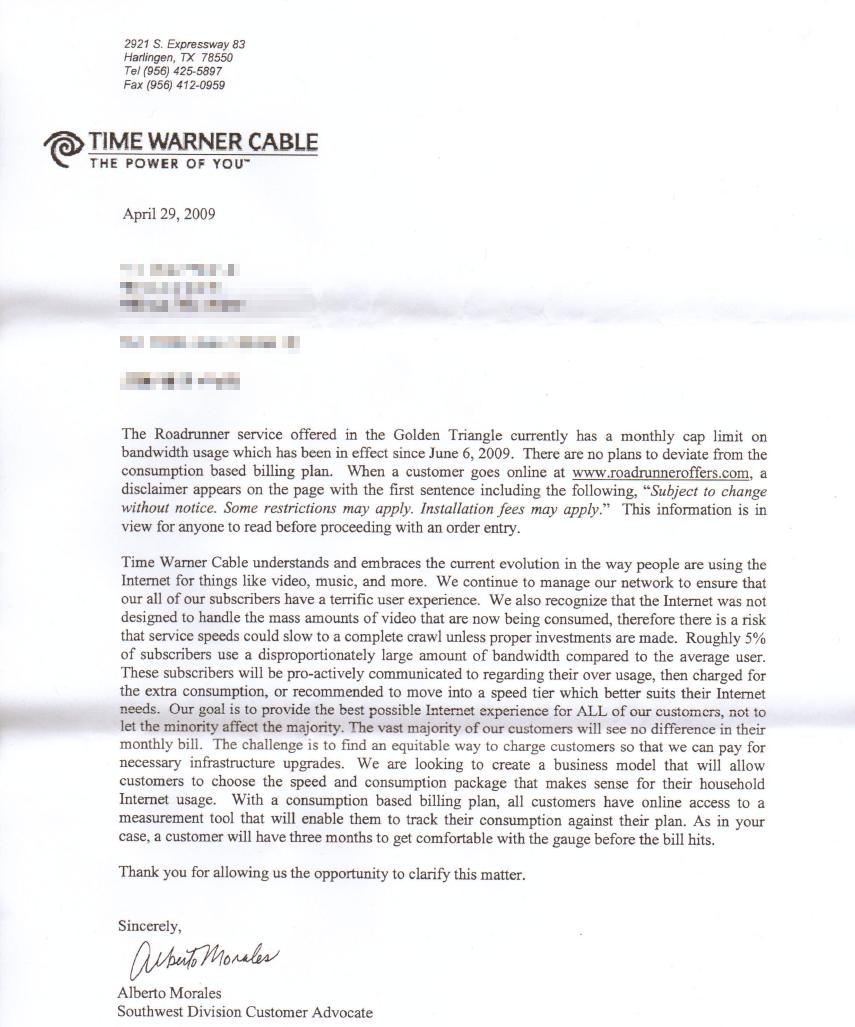
Time Warner Cable's follow-up letter of 4/29/09, in response to Mark's complaints that he was never told about the Internet Overcharging plan which subjected him to a 20GB monthly limit and $73 in overlimit penalties. (We assume the June 6, 2009 reference is a typo and should have read 2008) (click to enlarge)

Time Warner Cable's follow-up letter of 4/29/09, in response to Mark's complaints that he was never told about the Internet Overcharging plan which subjected him to a 20GB monthly limit and $73 in overlimit penalties. (We assume the June 6, 2009 reference is a typo and should have read 2008) (click to enlarge)

Mark wasn’t sold by any of the arguments Morales was making.  That’s because he read Time Warner Cable’s own shareholder documents, as he had been accustomed to doing since he bought shares himself.  They told a very different story — one he shared in a letter to Morales:

“In 2007, Time Warner made $3,730 million dollars on high speed data alone, and then had to turn around and spend $164 million to support the cost of the network,” Mark writes. “In 2007, total profit on high speed data was $3.566 BILLION dollars.”

He adds, “in 2008, Time Warner made $4,159 million dollars on high speed data alone, and then spent just $146 million to support the cost of the network, a decline from the year past.  Total profit in 2008 on high speed data: $4.013 BILLION dollars.”

Mark realized “it cost Time Warner 11% less money to keep their network running in 2008 than in 2007.”

He also knew Time Warner Cable’s experiment in his city was done where the only alternative was his AT&T DSL service, which hardly offered comparable competition.

In a follow-up letter responding to Mark in late April (after the four city experiment was shelved), Time Warner Cable made it very clear their position was firmly planted in the ground:

“There are no plans to deviate from the consumption based billing plan.”

The company also elected to blame the customer for not understanding that an Internet Overcharging scheme had been introduced in the first place.

“When a customer goes online at www.roadrunneroffers.com, a disclaimer appears on the page with the first sentence including the following, “Subject to change without notice.  Some restrictions may apply.  Installation fees may apply.” This information is in view for anyone to read before proceeding with an order entry.

The fact this kind of disclaimer is, in the company’s view, sufficient notice for implementing Internet Overcharging schemes, is hardly adequate.

“We eventually dropped them again,” Mark writes. “We thought a usable slower Internet was better than a faster one we were not going to use.”

Mark realized Time Warner Cable’s business practices and models aren’t a good fit for the way he feels companies should treat their customers, and he dumped his Time Warner Cable stock and did what so many customers have also chosen to do: use the one word Time Warner Cable did seem to understand during their Internet Overcharging experiment:  C A N C E L.

As long as broadband providers continue to believe that Internet Overcharging schemes are the best way to protect their business models and leverage even more profits from their broadband division, action on every front, from legislative to direct consumer protest and refusal to do business with such companies remain the best course of action.

Stop the Cap! will continue to help deliver that action, along with a consumer education campaign that doesn’t require focus group testing to sell, because it’s based on common sense and not dollars.

Still to Come: Mark takes his battle to AT&T and gets an upper level AT&T retention agent to mark his account “exempt” from Internet Overcharging fees and penalties.  Perhaps you can, too!

Share

VentureBeat Sucked Into Internet Overcharging Propaganda; Readers Revolt

When otherwise intelligent writers get sucked into industry propaganda and advocate against their own readers’ best interests, the blowback can become substantial.

VentureBeat is about to learn that principle firsthand as it bungled a piece about wireless carrier mobile data growth into a confusing article claiming “Net Neutrality” will be used by AT&T and Verizon to “drive Sprint and T-Mobile into the ground.”

What?

Authors Tim Chang and Matt Marshall then journey across the landscape of mobile data networks in the United States, regularly stopping to hammer home the requirement for limits on usage, blaming it mostly on online video.  The factual potholes litter the landscape, unfortunately:

What that means is the country’s major wireless carriers — Verizon, AT&T, Sprint and T-Mobile — are going to have to abort the all-you-can-eat mobile data plans most of us take for granted. It’s just getting too costly for them to give us the service on their networks for the pricing they offer today.

Video 'is the big problem' justifying Internet Overcharging for wireless mobile data, yet one of the nation's largest providers sees no problem providing its own video service on its network.

Video 'is the big problem' justifying Internet Overcharging for wireless mobile data, yet one of the nation's largest providers sees no problem providing its own video service on its network.

Actually, none of these carriers provide unlimited all-you-can-eat mobile data plans.  They either explicitly or implicitly (buried in the fine print) limit consumption, usually to 5GB of usage per month.  What happens beyond that does vary by carrier.  The big four impose overlimit penalties at punishing prices.  Some smaller carriers, like Cricket, simply throttle your connection or suspend service on a case-by-case basis.

The reasons for these limits:

  • Limited spectrum (the frequencies the provider operates on) may not sustain demand using currently available technology and network design. Could additional spectrum, new technology standards, and more localized delivery of data reduce network congestion?
  • Lack of competition.  The two primary carriers, AT&T and Verizon, have essentially provided nearly-equivalent pricing.  Their robust coverage areas make either a natural choice for most users who travel.  Sprint and T-Mobile have larger gaps in coverage.  Spectrum auctions, which is how carriers obtain new blocks of frequencies, raise huge sums for the government, but those costs inevitably do get passed down to customers.
  • Psychological: Consumers accustomed to limited wireless broadband from the outset are less likely to complain if it is taken away later.
  • Economical: Data packages with low limits produce profitable results, with the future possibility of earning even higher profits from subscribers who routinely exceed them and pay penalties and fees, or for carriers to create and market “additional usage packs.”

Jon Metzler, an industry consultant who has conducted research for the CTIA, says he’s heard estimates that a YouTube video of 3-5 minutes costs $1 for a carrier to handle. At this rate, a carrier would be killed when a typical user streams a mere two videos a day. That day is coming soon, because of the race by the smartphones to offer these cool video services.

Of course Metzler works for the CTIA-The Wireless Association, an industry trade and lobbying group.  They have a vested interest in pushing the “bandwidth flood” theory to preserve carrier pricing models.  The factual basis for this YouTube assertion has been challenged as well, once even by a VentureBeat reader.

Verizon doesn’t see wireless mobile video as the harbinger of doom — it sees it as a feature it can rake profits from, charging $13-25 a month extra for access to VCAST Mobile TV, a Verizon Wireless portal filled with video clips and streams.

It’s always ironic when carriers complain about the impact of services like video, while also heavily marketing their own services that, by their nature, impact their network.  YouTube bad, VCAST good.

… Continue Reading

Share

British Telecom: How Dare You Watch Online Video When Those People Don’t Pay Us!

Angry young business man on white backgroundThe United Kingdom is the latest country to face the downside of arrogant Internet service providers throwing hissyfits when people actually use their broadband connections.  When broadband service providers entice investors with promises of fat returns, assuming most people won’t actually use those high speed connections for anything except web page browsing and e-mail, they get mighty upset when they catch their users watching online video instead.

One of the benefits of broadband is that it provides fast speeds to let people do more than what they used to with dial-up access.  That happens to also be one of the major selling points to get customers to part with a significant sum of money each month for the service.

They just don’t want you to use it.

British Telecom (BT) is the latest ISP to complain that the BBC’s iPlayer, which allows British residents to stream TV and radio programming on demand, and YouTube are using their broadband pipelines, but not paying them anything to do so.

That conveniently ignores the fact that their customers throughout the UK are paying them to deliver that connectivity, providing them with a handsome return.

Internet Service Providers not content with earning money from one side, now increasingly want a piece of the action on the other.  It’s the equivalent of making a long distance call, but asking both the person calling -and- the person called to pay a fee.

Since the companies providing the content consider the payment demands ridiculous, ISPs have started singling out certain types of traffic on their network and slowing it down, ruining picture quality and annoying their customers trying to access the content.

BT implemented a “Fair Use” policy for one of their broadband packages which lets them cut the speed of online video from the normal 8Mbps down to 896kbps between 5pm-12am each day.  BT claims that’s enough to watch online videos, but that very claim would negate any benefit from slowing down the connection.  How many TV shows do people stream at the same time on the same connection?

In fact, BT’s policy does impact on the quality of the video streamed to the viewer.  The iPlayer is capable of sensing your broadband speed and reducing the quality of the stream to match the speed you have available.

Of course, should the BBC agree to pay BT some sort of transport fee, they might find their way clear to take the speed bumps out of their way.

A founding principle of Net Neutrality is to treat online content equally when transporting it.  Your stream from the BBC should not be hampered while a stream from someone else is not, just because they paid extra.  Are bandwidth costs increasing?  No, they are decreasing.  There is no compelling argument to prevent providers from keeping up with demand.  If they want to earn money from content, they can produce their own and provide it to subscribers on equal terms.

Share

The “Exaflood”: Another Month, Another Alarmist Report from Cisco

Phillip Dampier June 10, 2009 Broadband "Shortage", Internet Overcharging 5 Comments

internetCisco is back with their latest report about the “coming exaflood” set to alarmist headlines in the press.

In the spring, the prevailing theory of one “research group” was that bottlenecks would ruin the net’s usefulness by 2011.  That was the one adopted by Time Warner Cable’s unsuccessful efforts to convince residents in four cities that Internet Overcharging was a good idea.  Last month, Australian breakfast television viewers were dropping muffins back on their plates when they were told the Internet was going to be subjected to a massive traffic jam by 2012.  The date of the potential online apocalypse has been pushed forward to 2013 this month, the last year Cisco covers in their data model.

Of course, all such “exafloods” can be mitigated to some degree by purchasing Cisco products and services to handle the tsunami of traffic.

Companies that have a vested interest in doing such studies, in this case to help spur upgrades, always casts suspicion over the results.

The results of those studies are often sold to advocacy organizations (if not quietly funded by them outright) to integrate into lobbying campaigns.  In the push for “exaflood” panic, some of the lobbying groups seek government investment in broadband infrastructure on behalf of their clients, others want to use the Internet growth argument to prove there is a need to engage in Internet Overcharging to finance construction of improved networks (even at a time when some of those companies enjoy billions in profits and have systematically reduced investment in maintaining and expanding those networks).  Cisco’s interests may be closer to home — generating revenue for themselves.

One man who doesn’t have anything to gain from the results is Andrew M. Odlyzko, who runs Minnesota Internet Traffic Studies at the University of Minnesota, an ongoing project to soberly analyze Internet growth.  Unlike others who have repeatedly warned about Internet brownouts, crashes, and slowdowns, Odlyzko doesn’t have a “dog in this fight.”  Once you strip away the self-interests many others have in promoting an “exaflood” agenda, the simple fact remains: with growth in demand also comes growth in new technology and capacity to meet it.  Odlyzko continues to point towards slowing growth.

“In spite of continuing stories about a flood of video overwhelming the Internet, global wireline traffic shows no sign of moving up from its approximately 50 to 60% per year growth rate. If anything, the trend lines point down, not up,” according to the results posted on his website.  Cisco had to echo Odlyzko’s predictions during this past year, but the company blamed the global economic downturn in their report for the decline in the growth curve.

The Economist also debunks the panic attacks:

Talk of exafloods is nothing less than scaremongering and has no bearing on reality, even though video traffic is increasing substantially, says Grant van Rooyen of Level 3, a company based in Broomfield, Colorado. It operates network backbones that carry around a quarter of the world’s internet traffic. “We estimate that 50-60% of traffic today is video, but it’s been that way for the last three to four years,” he says. “We really don’t think we’re going to see a massive failing of the infrastructure.”

Level 3 has been regularly upgrading its capacity, and will continue to do so, says Mr van Rooyen. “This isn’t like building a toll-road with an inflexible infrastructure,” he says. “In the network world, we are able to scale infrastructure and capacity in real time.” When bunches of optical fibres are laid in the ground or on the seabed, for example, not all of them are immediately used, or “lit”. So the capacity of a link can be increased by lighting more fibres. Even when all the fibres are lit, capacity can be further increased by upgrading the equipment at each end of the fibre. Technological progress means the amount of information that can be squeezed down each fibre is steadily increasing.

Back in 1995 Bob Metcalfe, an internet guru and the founder of 3Com, a network-equipment maker, predicted in a magazine article that the internet would suffer “gigalapses” and grind to a halt by the end of 1996. He promised to eat his words if it did not. His gloomy prediction was proved wrong, and in 1997 he duly put the offending article in a blender with some water at an industry conference, and ate the resulting pulp with a spoon.

Share

Irony Department: Canadian Opinion Piece Opposes ‘Throttling the Net’ By Advocating Throttling

Marcel Boyer

Marcel Boyer

Marcel Boyer penned an opinion piece for Canada’s Financial Post this week attacking the virtues of Net Neutrality as short-sighted and potentially devastating to the Internet if codified into law.

Boyer, in a piece called “Don’t Throttle the Net,” advocates precisely that, applauding broadband providers for traffic shaping, which artificially slows non-preferred Internet traffic delivered over broadband networks.

There are many facets to the net-neutrality issue, including pricing and broadband allocation, which are central. Proponents of net-neutrality call for government intervention and regulation to prevent broadband providers from prioritizing or interfering with the data that flows in their networks. On the other hand, broadband providers are arguing that even though they continue to invest in their networks, their customers would still be affected by congestion during peak periods in the absence of traffic management measures. Other large networks face the same type of issues. New applications (video streaming and VoIP, among others) require a high quality of service assurance, making a more reliable network necessary.

Boyer delivers the usual talking points about bandwidth pricing and competition that Stop the Cap! readers are all too familiar with:

Making it illegal for broadband companies to offer a diversity of choices would destroy incentives to invest continually in improved Internet bandwidth, quality and security. Net-neutrality legislation would unnecessarily regulate a free and competitive market when there is no real evidence of consumer harm.

Let network owners and operators as well as service providers differentiate their offerings and price them the way they choose. Customers would benefit from more diversified offers by selecting the ones best suited to their needs. In such a competitive context, network operators and service providers would routinely aim to satisfy demand for Internet services most effectively while simultaneously aiming to manage the growth in peak demand.

It is to the advantage of consumers to allow competing vendors to experiment with various price and service combinations. From this discovery process, a portfolio of winning offerings will emerge. As long as competition is present and sufficiently intense, and assuming the level of information available and provided to consumers enables them to make informed choices between the various offerings, regulation of price schemes is neither necessary nor desirable as it would stifle innovation and obscure the best offerings and pricing schemes.

From an economic point of view, policies that would restrict the ability of broadband providers to manage their networks are likely to do more harm than good. Regulation of prices and offerings, products and services, has generally resulted in higher costs and lower benefits, especially when competition is present. The complexity of market dynamics poses particular problems in emerging industries. Instead of adopting regulations that could induce unwanted harmful effects, it is preferable to mandate the Canadian Competition Bureau to investigate when there is evidence of abuse or unlawful actions from broadband providers.

The impetus for the opinion piece was this week’s news highlighting Canada’s rapid decline in standing among top industrial nations’ broadband services.  The original report specifically called out the impact of draconian usage caps and throttles which reduce usage, limit innovative high bandwidth services’ entry into the Canadian market or bypass it entirely, and the potential economic and competitive impact on Canada’s economy as a whole.

Boyer’s premise presupposes there is a healthy competitive marketplace for broadband in Canada, a conclusion ridiculed by many.  Most Canadian cities have two primary choices for broadband, a usage capping phone company or a usage capping cable company.  Smaller independent providers typically resell bandwidth obtained from Bell or other similar entities at wholesale rates.

Despite pricing more than $15 a month higher in Canada than in the United States, and healthy financial returns among most of Canada’s providers for their broadband divisions, the “continual investments” in bandwidth Boyer claims are hardly eye popping.  Incremental speed increases, usually accompanied by rate hikes, and the imposition of often paltry usage caps has artificially reduced consumption, which also reduces the need to improve infrastructure.  Indeed, while fiber optics deployment is becoming increasingly common in the United States, it is not nearly as common in Canada.

Canadians find little diversity in pricing and service levels in a marketplace that nearly always imposes limits on consumption, doesn’t provide robust access in rural communities, and typically delivers slower speeds than their counterparts in the United States are providing customers today.  East York (near Toronto) residents, for example, can obtain “blistering fast” 10Mbps service from Rogers for about $60US per month, limited to 95GB of consumption.  Overlimit fees are $1.50/additional GB.  Bell offers “speed of light” Internet access at “up to 16Mbps” for $82.95 a month (100GB usage cap – $1.00/additional GB, billed in increments of 100MB, $30 monthly maximum applies.)

Head across Lake Ontario south to Rochester, NY and Time Warner Cable provides “Turbo” service offering 15Mbps, currently without any usage cap, for $50.00 a month.  Verizon FiOS pricing provides 20Mbps service with no cap for $54.99 a month.

In the absence of significant competition, duopoly-style pricing usually results, and that’s precisely what has happened in Canada.  Allowing the “wild west — hands off” approach Boyer advocates merely guarantees more of the same.  Providers in the United States, already enjoying phenomenal returns, would love to adopt the Canadian approach.  They’ve already been increasing rates, decreasing investment in their network infrastructure as a percentage of revenue, and enjoying the benefits of reduced bandwidth expenses.  The only components left are usage caps and throttling broadband applications they don’t own, control, or partner with.  Experiments are being attempted on some of these fronts now.

The end result: even higher profits and locking broadband into a rationed, expensive, and slow backwater.

Boyer should know that wired broadband competition beyond the aforementioned duopolies in most Canadian markets comes only from independent ISPs typically reselling wholesale bandwidth (which is now also being capped) and a few independent providers who may wire limited areas in large cities.  There will never be a free market paradise in cable television – the traditional one company per city approach is well rooted throughout North America.  Wireless is even more heavily capped and expensive than wired service.  And telephone companies, outside of Verizon in the United States, are loathe to aggressively deploy fiber optics unless required by local market conditions.

Broadband throttling and capping, particularly to discourage online video consumption, comes aggressively when companies have a vested interest in preventing erosion of their traditional video programming business model.  Both Rogers and Bell are in the business of delivering television entertainment to Canadians.  Should a sufficient amount of that entertainment be available online, some consumers may dispense with the video package and rely exclusively on the Internet.

Speaking of vested interests,  the Financial Press had plenty of space to print Boyer’s article, and even concluded it by noting his title:

Marcel Boyer is vice-president and chief economist of the Montreal Economic Institute.

Apparently things got throttled at that point, because they forgot to include one additional affiliation Boyer holds: Bell Canada Professor of industrial economics at the Université de Montréal.  How ironic.

Share

Cashing In On Usage Based Price Gouging

Phillip Dampier May 27, 2009 Broadband "Shortage", Issues 7 Comments

If you’re a broadband provider throwing a money party by charging top dollar for usage based Cap ‘n Tier rationing plans, why not spread some of that money around?  One company that wants a piece of the action is Highdeal, a German owned company that wants to sell providers the billing system to extract pay-per-byte-bucks from customer wallets.

Highdeal’s chief technology officer, Fergus O’Reilly talked to Telephony Online about how they’re going to market their products for usage based billing.

On moving beyond flat-rate broadband: Operators are realizing that the flat-rate model we had for broadband is no longer tenable. It’s hard to roll out [usage-based models] when subscribers don’t know how much a gigabyte is or what the term bandwidth means. Some [providers] have done better than others. In the Canadian market, for example, it’s getting to be accepted. Rogers has done a good job informing customers about their usage and charging them for overage with cap-and-overage-type schemes. In the US, it’s been a little more difficult. Time Warner Cable let slip that they were doing something and got negative press for it. It became difficult for them to roll that out — one step forward, two steps back. But overall throughout the market, pretty much everyone is equipping themselves with the policy management systems they need to measure and qualify bandwidth usage. The flat-rate model for broadband will change, and we will pay depending on usage, whether that’s measured in [quality of service], absolute bandwidth or a number of those factors.

The system that exists today (that is already very profitable) is always defined as ‘yesterday’ and something ‘we need to move beyond,’ while the highway robbery of overpriced tiers and overlimit fees is the ‘only tenable way forward.’  Not really, of course.  But this is an example of a company with a vested interest in that outcome — namely, a product/solution to sell that would not exist without these kinds of billing schemes.  They garner favor in industry circles by helping to throw the ball around, hopefully establishing the premise that usage based billing is conventional wisdom.

It’s tougher to sell cap-and-overage schemes. Unfortunately many of the charging systems operators have in place are relatively simplistic. And moving to these more sophisticated schemes — time-shifting and proposing a bandwidth boost — many times the blocking factor is, ‘Well, I don’t know how to do that.’ So we propose a very flexible charging system that makes that easy so you can have these dynamic business models that will make more sense for the consumer.

Actually, developing a billing system that pilfers the wallets of consumers, no matter how complex or simple, will not make any sense for customers.  What Highdeal proposes is a billing system that allows providers to rob customers in a sophisticated way, instead of the street mugging wallet extraction approach.  But whether it’s the Bernie Madoff system of billing, or the guy with the bat in the dark alley, consumers are still going to be victimized, and they’ll know it every time they get the bill.

Is Highdeal a raw deal entirely?  No.  Some of their models might actually represent some real world solutions to network congestion, particularly one that could communicate with bandwidth providers and software to schedule bandwidth intensive, but non-critical applications during off-peak usage times.  One such proposal would signal an online backup program to launch when network congestion is reported low by a provider.  Another model might allow consumers to pay more for faster connections to complete individual tasks.  Paying reasonable prices for reasonably faster speeds is not an issue for Stop the Cap!

But companies that buy into industry theories and claims in order to help score a sale have a considerable conflict of interest in being considered a credible source on what consumption and billing models are workable and which are not.

Share

Cisco Cashing In On Its Own “Exaflood” Theories

Phillip Dampier May 17, 2009 Broadband "Shortage" 4 Comments

Cisco, a networking equipment and service provider, has announced a joint effort with Flash Networks to provide a new Intelligent Traffic Management “solution” to “maximize data revenues, network utilization, and subscriber satisfaction.”

The “solution” is being sold primarily to wireless bandwidth providers to help manage the “explosion of mobile data traffic” expected in the next five years.

internet“Our successful partnership with Flash Networks enables operators to meet the challenge of maximizing revenues while protecting network assets by providing tiered services that ensure fair bandwidth usage and protect the network from traffic congestion,” said Sergey Belonozhko, Area Sales Manager for SP at Cisco.

The Intelligent Traffic Management solution supports personalized data plans where service providers can notify subscribers when they are near usage quotas, provide a temporary bandwidth boost, offer data plan extension to support additional IP services, or enable subscribers to set personalized usage caps that can be updated in real-time based on personal financial limits. This same solution is used to both insert targeted advertising based on subscriber browsing patterns, and to block inappropriate content for safe browsing.

It is being touted by Cisco as a way for operators to implement service tiers to maximize revenue while at the same time reducing traffic load on networks, reducing the capital investments required to grow them with demand.  Customers end up with “gauges” and warnings to get them to reduce their usage, or give the operator an incentive to up-sell the customer to another tier of service (or make the customer purchase additional bandwidth.)

A nice tidy arrangement for all concerned, except the customer, of course.  Cisco has been one of the more active “exaflood” promoters, with their talking points even turning up on Australian breakfast television.  They promote the “Internet is over-flooded and will brownout” scare tactics to establish that premise in the minds of consumers, sell the “solution” to help manage the traffic growth, give operators the tools to help them raise prices, limit usage, and provide gauges to customers to get them to be paranoid about their usage, and then take their earnings to the bank.

Consumers get notification that their access has been capped, are told to recall the mainstream media stories about Internet congestion, and go along with the plan.

It’s part of the grand scheme for uninformed customers to simply accept higher prices and service quotas and limits, all while companies providing the bandwidth earn higher revenue than ever.

Share

Why Xanax Was Invented: “Exaflood Panic”

Phillip Dampier May 11, 2009 Broadband "Shortage" 1 Comment

fiberThe nabobs of negativism, the panic-stricken shrieks about the Internet becoming full, the fear-mongering about broadband pipes becoming clogged because the kid down the street is running torrents again.  We’ve heard it all before, and as we’ve always said, technological advancement always seems to find a way to resolve the “crisis in bandwidth” before big businesses resolve it themselves by rationing, capping, or overcharging for access.

And so it has again.

AT&T, in association with Corning and NEC today smashed all prior records of fiber optic transmission capacity by successfully transmitting data at 114 Gigabits per second over a single strand of fiber for up to 580 kilometers over an optically amplified link.  The standard fiber optic cable AT&T used for the test contains 320 separate optical channels, meaning through the use of just a single optical cable, it is possible to sustain a transmission rate of 36480 Gigabits per second!

That exceeds by 25% the last record setting transmission rate test and effectively doubles the distance the cable can maintain data transmission rates without unacceptable loss.

AT&T announced the results as part of their technological solution for broadband growth — deploying 100 Gigabit networks across the country to accommodate growing demand for the Internet.

… Continue Reading

Share

The Popular Myths About Why Time Warner Cable “Failed”

Phillip Dampier May 9, 2009 Broadband "Shortage", Time Warner Cable 12 Comments

Todd Spangler, who we seem to spar with on a semi-regular basis here, has another blog entry up expanding on his views of why Time Warner Cable’s metered pricing experiment failed.  Of course, completely missing from the list is the fact most customers do not want it.  That’s dangerous to say in a cable industry trade publication like Multichannel News, however.

Todd still thinks it’s all about how they did it, not the fact they did it in the first place that created what even he admits was a “category five” storm of backlash.

Clearly, the company’s idea — given that these were trials — was to have the flexibility to tweak pricing, adjust specific cap levels, etc., and not have these things set in stone. But the ad-hoc communications on the usage trials was perhaps the biggest reason this blew up.

The only “trial” here was on the customer, and the jury was stacked with Time Warner Cable executives who already found themselves innocent of extortionist pricing and market abuse.  The “tweak” most customers wanted was none at all.  What was set in stone, until the groundswell finally achieved temporary results, was that the caps were coming no matter what customers had to say.  Just ask people in Beaumont, Texas.

… Continue Reading

Share

Search This Site:

Contributions:

Recent Comments:

  • David: Daniel, That is what I set up via my bionic droid smartphone. A WAP2 that acts as the hotspot for my computer. Currently running 8 mb/s on download...
  • Matt: If they don't like the broadband options that are available, they can start their own WISP. That is how most WISPs started out anyway!...
  • Scott: and who do consumers turn to to get away from metered low cap and high priced WISP's?...
  • David: Confirmed working on 2/8/2012....
  • Jared: I agree with Fred. After all these years everyone should have broadband at 1 gigabit upload and download. South Caralina will never progress at this...
  • Matt: Fixed wireless providers (WISPs) all over the country have a simple message for AT&T: "Don't worry bro, we got this" Visit the map at www.wisp...
  • Scott: Even with the FCC standard, if 3G cellular service is in the area they could argue it's 3mbit/512kb service constituted broadband coverage, as they li...
  • Scott: Thank you AT&T.. for once a honest quote we can reference in the future against your lobbyist paid for campaigns to stop community owned broadband...
  • Craig Settles: To get an abstract and full copy of the IEDC-sponsored survey report I wrote, go here - http://bit.ly/pyjSDc...
  • Jay: The Feds should override that with the FCC's 768k minimum standard....
  • Duffin: See, I really don't get that. Why isn't everything pretty much backward compatible? It used to be. It used to be that you could use Cupcake-level apps...
  • Tony: Not yet updated for Android 4.0.... driving me insane as well........

Your Account: