Home » Hawaiian Telcom » Recent Articles:

Telco’s Ethernet Over Copper Can Deliver Faster Speeds, If You Can Afford It

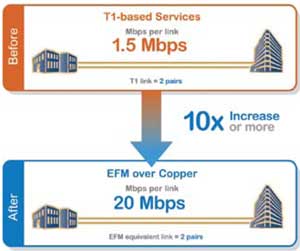
Ethernet over Copper is becoming an increasingly popular choice for business customers stuck in areas where companies won't deploy fiber broadband (Graphic: OSP Magazine)

With Verizon and AT&T effectively stalling expansion of their respective “next generation” fiber and hybrid fiber/coax networks, and independent phone companies fearing too much capital spent improving their networks will drive their stock prices down, telephone companies are desperately seeking better options to deliver the faster broadband service customers demand.

The options over a copper-based landline network are not the best:

  • ADSL has been around for more than a decade and is highly distant dependent. Get beyond 10,000 feet from the nearest switching office and your speeds may not even qualify as “broadband;”
  • DSL variants represent the second generation for copper-broadband and can deliver faster speeds, but usually require investment to reduce the amount of copper between the customer and the switching office;
  • Fiber networks are more expensive to build, and some companies are using it to reduce, but not eliminate copper wire in their networks. But companies traditionally avoid this solution in rural/suburban areas because the cost/benefit analysis doesn’t work for shareholders;
  • Ethernet Over Copper (EoC) is increasingly the solution of choice for independent phone companies because it is less expensive to deploy than fiber and can quickly deliver service at speeds of up to 50Mbps.

Unfortunately for consumers, EoC is typically way above the price range for home broadband.  Most providers sell the faster service to commercial and institutional customers, either for businesses that have outgrown T1 lines or where deploying fiber does not make economic sense.  Some companies have tried to improve on DSL by bonding multiple connections together to achieve faster speeds, but Ethernet is quickly becoming a more important tool in the broadband marketing arsenal.

With phone companies pricing EoC service from several hundred to several thousand dollars a month, depending on the speed of the connection, they hope to remain competitive players against a push by the cable industry to more aggressively target business customers.  In more rural areas, phone companies lack cable competition, so they stand a better chance of success.

Fierce Telecom‘s Sean Buckley published an excellent series of articles outlining the current state of EoC technology and what phone companies are doing with it:

  • AT&T: Inherited EoC from its acquisition of BellSouth, and barely markets it. Instead, AT&T uses it as a quiet solution for challenging customers who cannot affordably be reached by fiber.  AT&T will either deliver the service over copper, copper/fiber, or an all-fiber path depending on the client’s needs.
  • CenturyLink: No phone company is as aggressive about EoC as CenturyLink. When CenturyLink acquired Qwest, interest in the technology only intensified. EoC is a CenturyLink favorite for small businesses that simply cannot get the speeds they need from traditional DSL.  Most EoC service runs up to 20Mbps.
  • Verizon: Verizon’s network is the most fiber-intense among large commercial providers, so EoC is not the first choice for the company. However, it does use it to reach multi-site businesses who have buildings and offices outside of the footprint of Verizon’s fiber network/service area.
  • Frontier: In the regions where Frontier acquired Verizon landlines, EoC has become an important component for Frontier’s backhaul traffic. EoC has been deployed to reach cell tower sites and handles broadband traffic between central office exchanges and remote D-SLAMs, used to let the company sell DSL to a more rural customer base.  Frontier looks to EoC before considering spending money on fiber service, even for commercial and institutional users.
  • Windstream: EoC is the way this phone company gets better broadband speeds to business customers without spending a lot of money on fiber. Small and medium-sized customers are often buyers of EoC service, especially when DSL can’t handle the job or the company requires faster upstream speeds.  Windstream markets upgradable EoC capable of delivering the same downstream and upstream speeds and can deliver it more quickly than a fiber project.
  • FairPoint: Much of this phone company’s EoC efforts are in territories in northern New England acquired from Verizon.  FairPoint targets small and medium sized companies for the service, especially those who have remote offices or clinics that need to be interconnected. FairPoint has also gotten more aggressive than many other companies working with ADSL2+ or VDSL2 to deliver faster broadband to office buildings and complexes more economically than fiber.
  • SureWest: This company is strong believer in fiber to the premises service, so its interest in EoC has been limited to areas where deploying fiber makes little economic sense. In more out-of-the-way places, EoC is becoming a more common choice to pitch businesses who need more than traditional broadband.
  • Hawaiian Telcom: HawTel uses copper-based EoC to provide connectivity across the diverse Hawaiian Islands.  Speeds are generally lower than in mainland areas, partly because HawTel still relies heavily on traditional copper-based service. But fiber-based EoC is increasingly available in more densely populated areas.
Share

Hawaiian Telcom’s Top Secret Cable TV Service: How Much, Where Service is Available Company Won’t Say

If this is a new way to attract customers, it’s sure stumping marketing experts who are questioning Hawaiian Telcom’s launch of its new cable TV service to compete with Time Warner Cable’s Oceanic Cable.  Nobody knows where exactly the service is available for sale, or for how much, and HawTel officials are not saying.

“If you call Hawaiian Telcom and ask them about the service, they essentially say ‘don’t call us, we’ll call you’ and they are the phone company!” says Oahu resident and Stop the Cap! reader Dan Ho, who first discovered HawTel was getting into the cable business from Stop the Cap!  “I realize we’re talking about another form of U-verse here, but that could still be a good thing for Hawaiians who cannot get Oceanic Cable and are stuck with HawTel’s awful DSL service.”

HawTel’s new fiber-copper hybrid network tested successfully for 250 mystery families who participated in a secretive beta-test.  The new service is expected to be sold mostly in a packaged bundle with extra high speed DSL (presumably up to 25Mbps), a central DVR terminal that can record up to four shows off the company’s digital cable TV package concurrently, and unlimited phone service.

Lester Chu, a HawTel spokesman, wouldn’t tell reporters the prices for the new service, instead offering to accept bills from competing providers and allowing HawTel to competitively bid for your business.  The company also wouldn’t say where the service was for sale, “for competitive reasons,” added Chu.

But HawTel has been licensed to provide service on the island of Oahu, and intends to rollout the service in contiguous service areas, so once the first new customers do go public, we’ll be able to ascertain where the service is slated to be delivered next.

HawTel says they will begin targeted advertising to alert residents when the service will be available.  That traditionally means direct mailers, door hanger tags, and door-to-door visits from sales teams hired by HawTel.

“It’s a crazy way to build excitement for the product, by keeping it a secret,” Ho believes. “More important, I suspect their pricing is not going to be very good if they require customers to bring in a current bill from a cable competitor in order to get a quote.”

Ho should know, he’s a marketing professional himself.

“I suspect the company wants face time with a customer to explain away the lack of visible savings by instead talking up the features they will offer that Oceanic Cable does not,” Ho suggests.

Among those features – the four-recordings-at-a-time DVR, the 250-channel all digital lineup, and the presence of NFL Network, a network Time Warner Cable systems have perennially refused to carry on their basic digital tier because of its cost.

http://www.phillipdampier.com/video/KITV Honolulu Hawaiian Telecom Bring Cable Competition To The Islands 7-7-11.mp4

KITV-TV in Honolulu opened their newscast with the mysterious launch of Hawaiian Telcom’s new TV service.  (2 minutes)

http://www.phillipdampier.com/video/KHON Honolulu Hawaiian Telcom launches cable TV service in select location 7-7-11.mp4

KHON-TV in Honolulu covers HawTel’s introduction of cable competition on the island of Oahu, even though company officials won’t say where it’s available or for how much.  (Loud Volume Warning!) (1 minute)


Share

Hawaiian Telcom Wins Franchise to Provide Video Competition to Oceanic Cable

Phillip Dampier June 28, 2011 Competition, Hawaiian Telcom, Video 1 Comment

Hawaiian Telcom on Friday won a 15-year non-exclusive franchise to develop and market cable television service on the island of Oahu.

The telephone company will be the first major competitor to Oceanic Cable in at least a decade, at least where HawTel plans to provide service.

“We are very pleased to have reached this important milestone in the development of our exciting new video service and will have more details to share about our plans in the next several weeks,” said spokeswoman Ann Nishida Fry.

Many HawTel-watchers predict the phone company will choose an IPTV platform over a hybrid fiber-copper network to support the service, much like AT&T’s U-verse.  HawTel plans a gradual rollout as neighborhoods are “upgraded” to support the service.

Oceanic Cable president Bob Barlow said he wasn’t too concerned with HawTel’s entry into the market.  He told the Hawaiian Star-Advertiser customers should not expect any dramatic savings or price cuts.

“Most of our customers don’t bundle services, and more than 60 percent of our video costs come from programming,” he said.

Barlow expects the fiercest level of competition will come from who delivers the best customer service.

http://www.phillipdampier.com/video/KHON Honolulu Hawaiian Telcom to Offer Cable TV 6-24-11.mp4

KHON-TV in Honolulu leads their newscast with HawTel’s approval for a cable television franchise on Oahu.  (2 minutes)

Share

Why Verizon’s LTE/4G Network Will Never Replace Cable/DSL Broadband: Usage Caps

Lynch

Verizon’s ambitions to provide 285 million people with the option of ditching their cable or DSL broadband account for its new LTE/4G wireless network is a dream that will never come true with the company’s wireless Internet Overcharging schemes.  With a usage cap of 5-10GB per month and a premium price, only the most casual user is going to give up their landline cable or DSL service for Verizon’s wireless alternative.

Dick Lynch, executive vice president and chief technology officer at Verizon spoke highly of Verizon’s new next generation wireless network as a perfect platform to deliver broadband service to landline customers, including many of those the company sold off to Hawaiian Telcom, FairPoint Communications, or Frontier.

“[LTE] provides a real opportunity for the first time to give a fixed customer in a home, broadband service — wireless — but broadband service,” Lynch said. “In wireless, I see a great opportunity within the LTE plans we have to begin to service the customers who don’t have broadband today … They will be able to have mobile LTE and also to be able to have fixed broadband.”

Unfortunately, Verizon’s LTE network comes with usage limits and a premium price — $50 a month for 5GB or $80 a month for 10GB.  At those prices, rural America will have two bad choices — super slow 1-3Mbps DSL ($30-60) with allowances ranging from 100GB-unlimited or LTE’s 5-12Mbps (assuming the local cell tower is not overloaded with users) with a usage cap that guarantees online video will come at a per-view cost rivaling a matinee movie ticket.

Still, Verizon is likely to test market the service as a home broadband replacement, particularly in territories they no longer serve.  Verizon has done much the same thing pitching a home phone replacement product that works with their wireless network to residents of Rochester, N.Y., and the state of Connecticut, neither currently served with landlines from Verizon.

Despite the pricing and cap challenges, Deutsche Bank — one of the Wall Street players that follows Verizon — thinks the company’s DSL-replacement has merit, if:

  1. If you are a regular traveler that needs a wireless broadband service anyway;
  2. You use broadband exclusively for web browsing, e-mail, and very occasional multimedia access;
  3. You are wealthy enough not to care about the overlimit penalty.

For everyone else, sticking with traditional DSL service will continue to be the most affordable option, assuming usage caps are kept at bay.  Where available, cable broadband service from companies that serve smaller communities, including Comcast Cable, Time Warner Cable, and Cablevision, among others, will probably continue to deliver the most bang for the buck in rural America.


Share

Hawaiian Telcom Phone Lines and DSL Broadband Go Dead For Days Because It Rained

Phillip Dampier December 27, 2010 Consumer News, Hawaiian Telcom, Video Comments Off

Hawaiian residential and business customers relying on Hawaiian Telcom for phone and broadband service are not impressed with the phone company’s performance after rain disrupted scores of phone lines around the islands.  Some customers are reporting service outages extending for days as the company tries to cope with wet phone lines.

Hawaiian Telcom, which emerged from bankruptcy in October, has been trying to keep the Verizon landline network it bought in 2005 in working order, but heavy rains can create major problems for the phone company.

The outages started on Oahu two weeks ago, but yesterday’s heavy rains exponentially increased the number of customers with no service.

Businesses reported heavy static on their landlines, if they had service at all.  Many found processing credit card transactions an ordeal, often switching to manual methods to gain credit card approvals or requiring cash for purchases.

Hawaiian Telcom told Hawaii’s KITV-TV the prolonged wet weather caused water to seep into its cables and in some cases is short-circuiting them. The solution is either to replace the lines or to allow enough time for the cables to dry out.

So far, the phone company is taking a wait-and-let-dry approach.  Unfortunately, additional heavy rains are expected to impact the islands this week.

Hawaiian Telcom is providing service credits for the outages and is assisting area businesses by offering to automatically forward incoming calls to working numbers, including cell phones.

When the rains stop, some businesses may consider whether traditional landline service is the best choice for reliability.

“It’s a safe bet we’ll have a cellular account with wireless broadband to run credit cards in the future to cover these kinds of events,” reports Stop the Cap! reader Sam, who runs a convenience store on Oahu.  “I understand relentless rain can cause problems, but we are on day six with no service in our strip mall.”

Sam is currently relying on his personal cell phone to take business calls, but hasn’t been able to accept credit cards since the outage began.

http://www.phillipdampier.com/video/KITV Honolulu Wet Weather Blamed For Phone Outages 12-22-10.flv

KITV-TV in Honolulu covered the ongoing phone outages afflicting Hawaiian Telcom customers, especially on Oahu.  (2 minutes)

Share

Hawaiian Telcom Union Employees Get Theirs: Workers Finally Get Promised Performance Compensation

Phillip Dampier April 8, 2010 Hawaiian Telcom Comments Off

Typically, when a telecommunications company gets itself into a financial bind, large numbers of  office workers and technicians are shoved out the door, while senior management gets retention bonuses and special compensation packages if they can bail the company out of the mess they often created.

This time around, 845 employees of Hawaiian Telcom, the bankrupt Verizon spinoff purchased by The Carlyle Group, are getting promised compensation for meeting performance targets.  What makes them so special?  They are all members of the International Brotherhood of Electrical Workers, which collectively bargained a contract that included provisions no individual employee would ever get… unless they were senior management.

“The union has fought hard, and will continue to work hard, to improve the quality of life for the working men and women of IBEW Local Union 1357. We will do this by continuing to fight for job security, by continuing to negotiate better contracts, by continuing to give the members a voice in the workplace, and continuing to make sure that every employee has a safe, healthy work environment,” writes Scot Long, Business Manager for IBEW Local Union 1357.

Long

The Bankruptcy Court approved the $8.5 million package, which will be distributed to the unionized employees.

Seem like a lot?  Consider Hawaiian Telcom’s board of directors approved a financial incentive plan for 20 of its top executives for up to $2.3 million in retention bonuses and other benefits.  The executives were eligible for amounts ranging from $57,000 to $2.3 million, if the company met certain earning and revenue targets.  A few months later, the company decided that was too little and was back asking for even more for the top-20 executives who steered the company straight into bankruptcy in December 2008.

As the company moves to emerge from bankruptcy, Hawaiian Telcom also today announced it would be going public, hoping it will help the company become stronger and more competitive.  The company promises to have a new board of directors in place as part of the restructuring.

As part of the process to emerge from bankruptcy, Hawaiian Telcom is going public.

In a statement, the Hawaiian Telcom CEO said he hoped the move toward being publicly traded will help the company be stronger and more competitive.

As a part of the restructuring, there will also be a new board of directors.

Hawaiian Telcom filed for Chapter 11 protection in December 2008.

Share

Vandals Cut Major Hawaiian Telcom Cable in Waipahu Cutting Off 1,100 Customers from Phone, Internet Service

Phillip Dampier April 8, 2010 Consumer News, Hawaiian Telcom, Video 1 Comment

Waipahu, Hawaii

At least 1,100 Hawaiian Telcom customers were left without service Sunday when vandals cut a cable providing the community northwest of Honolulu with phone and broadband service.

“Sunday night we learned that two of our cables in the Waipahu area had been cut in several places,” said Hawaiian Telcom’s Ann Nishida.

It took nearly three days to restore service to every affected customer because each cable required splicing 3,600 individual copper wires back together.  The company says all 1,100 customers had service as of 1:00pm Wednesday afternoon.

Vandals sliced apart this cable. (Courtesy: Hawaiian Telcom)

Customers reported experiencing no dial tone and having no access to the Internet.

Even as service restoration work was underway, several residents reported broadband service remained intermittent until the repairs were completed Wednesday.

Although HawTel claims vandalism to their lines is uncommon, residents in Waipahu say vandals have struck repeatedly in the community, especially when street lights aren’t working in the neighborhood.

Customers subjected to the outage should contact HawTel customer service to verify a credit for the lost day(s) of service appears on their next bill.

The company filed a police report and asked Waipahu residents who may have witnessed the vandalism to report it to local authorities.

Hawaii has had several disruptions in phone service, the most recent happening in February when a damaged AT&T fiber cable cut off long distance service to HawTel and T-Mobile customers.

http://www.phillipdampier.com/video/KHON Honolulu Vandals Leave Hundreds in Waipahu with No Phone or Internet Service 4-7-10.flv

KHON-TV Honolulu reports many Waipahu customers are going for the third day without phone or Internet service.  (2 minutes)

Share

Dressing Up The Pig: Hawaiian Telcom’s Journey from Verizon to Bankruptcy is a Familiar Tale

Phillip Dampier January 12, 2010 Competition, Hawaiian Telcom, Public Policy & Gov't, Video Comments Off

Hawaii’s landline telephone company, Hawaiian Telcom (HawTel), is awaiting approval from the state’s Public Utility Commission for its $460 million, stand-alone reorganization plan. The company, launched in 2005 from assets acquired from Verizon Hawaii, Inc., by the politically connected global private equity investment firm The Carlyle Group, lasted less than four years before declaring bankruptcy.

http://www.phillipdampier.com/video/KITV Honolulu Hawaiian Telcom Takes Over Verizon 5-3-05.flv

KITV-TV in Honolulu introduced Hawaii to Hawaiian Telcom in this report from May 3, 2005 (1 minute)

The downfall of Hawaii’s dominant landline provider, despite decades of stable service from its progenitors — GTE/Hawaiian Telephone Company and Mutual Telephone came as no surprise to telecommunications analysts and consumer advocates who saw trouble right from the start.  The Carlyle Group and Verizon structured a deal that loaded $1.2 billion in debt onto Hawaiian Telcom’s balance sheet.  Critics of the deal weren’t impressed by the fact Carlyle had no experience running a telephone company either, and was likely to dump the company after “dressing up the pig” to inflate the company’s value and walk away with big profits from the sale, as one analyst predicted.

Long time Stop the Cap! readers know how this works only too well.  Anyone who followed the exhaustive coverage of the downfall of FairPoint Communications this past year will see plenty of familiar warning signs — piling enormous debt on the buyer, lots of promises made and broken, and plenty of billing and customer service problems that cause customers to flee to other providers.  By 2008, 21 percent of the company’s 700,000 customers did just that.  Remarkably, the only people who suffered from the failing business plan Hawaiian Telcom subjected on the islands were customers, lower-level employees, and company vendors.  The top management that made all of the bad decisions were insulated from the impact with fat bonuses, even as other employees were terminated.

http://www.phillipdampier.com/video/KITV Honolulu 9,000 Hawaiian Telcom Customers Overbilled 6-9-06.flv

Here come the all-too-familiar billing problems.  KITV reported 9,000 HawTel customers were overbilled in this report from June 9, 2006 (2 minutes)

http://www.phillipdampier.com/video/KITV Honolulu Hawaiian Telcom Problems Continue 3-21-07.flv

A year later, still more billing problems from HawTel, this time impacting more than 10,000 customers who can never sure what their monthly bill will look like.  (March 21, 2007 – 2 minutes)

It’s all a word to the wise as Frontier Communications journeys down the same road FairPoint and Hawaiian Telcom have already paved.

On the business side, Hawaiian Telcom’s future foreshadowed its post-mortem if only based on the players who far too often have been rewarded for failure:

The Carlyle Group: Attacked by incumbent competitors in Hawaii when it sought to purchase Verizon’s assets in the state.  Both Time Warner Telecom and Pacific LightNet warned Carlyle had little, if any experience running a telecommunications business, was going to mine the company for profits for its investors from rate increases, slash costs by reducing investment in their network and firing employees, and then try and resell the business at a profit just a few years later.

BearingPoint: Hired by Hawaiian Telcom to manage billing post-Verizon, the troubled firm managed to botch thousands of customer bills, double-charging them, crediting their accounts only to rebill them months later, and other irregularities.  In the end, BearingPoint had to pay $52 million to Hawaiian Telcom and drop an additional $30 million in outstanding invoices.  Like birds of a feather, BearingPoint itself collapsed in bankruptcy in 2009.

Ruley

Michael Ruley: Hawaiian Telcom’s CEO from October 2004 through February 2008, Ruley oversaw HawTel operations during the post-transition customer service nightmares.  During his last quarter at the company, HawTel lost $29.5 million, and his prescription was a massive cost-cutting program that accelerated company layoffs that began in 2007, resulting in the dismissal of more than 100 employees, 50 of which were cut during his last full month at the company.

Stephen F. Cooper: A so-called “turnaround expert,” Cooper was hired as a ” permanent interim” CEO on February 4, 2008.  His previous “success stories” included succeeding Kenneth Lay at the infamous Enron, and a stint as CEO of Krispy Kreme, which then promptly collapsed as a success story, with store closings and bankruptcies among its franchisees.  His “permanent interim” position as CEO of HawTel ended after three months. “In my view, Hawaiian Telcom is financially stable and has ample liquidity available,” Cooper said less than a year before the company went bankrupt.

http://www.phillipdampier.com/video/KITV Honolulu Hawaiian Telcom Filing for Bankruptcy 12-01-08.flv

KITV has three reports telling viewers HawTel has filed for bankruptcy, the first time in Hawaii’s history a major utility has sought bankruptcy protection.  (12/1 – 12/3 – 2008 – 7 minutes)

Bankruptcy As a Business Tool

The sale of Verizon Hawaii’s assets to Carlyle and its creature HawTel likely doomed the company from the start.  Saddled with massive debt from the $1.6 billion dollar sale in May 2005, HawTel had to manage its 700,000 customers, protect its flank from increasing wireless competition from Verizon Wireless and T-Mobile, and constant customer poaching by Oceanic Cable.  The cable operator offered “digital phone” service at prices lower than HawTel charged and broadband service far faster than the “up to 7Mbps” DSL service the phone company provided.

As customers continues to leave, the company’s bond values lost 65 percent of their value by the start of 2008.

The Wall Street Journal itself began to notice (subscription required) these telecommunications deals had enormous implications for consumers, particularly for those who depend on landline service:

Because major phone companies are reducing their exposure to the shrinking landline phone business, phone services in a growing number of U.S. states are being taken over by private-equity firms like Carlyle or by tiny telecom companies.

Verizon, for instance, has agreed to spin off its landline business in Maine, Vermont and New Hampshire to a small phone company, FairPoint Communications Inc. Alltel Corp., which services the Midwest, was recently taken private by private-equity firms TPG Capital and Goldman Sachs Capital Partners.

Many of these deals are raising concern among local regulators and consumer advocates, who are worried about the telecom savvy of the new buyers. “Why would a company one-10th the size and not nearly as deep of pockets as Verizon be able to make a success where Verizon hasn’t,” asks Rand Wilson, a spokesman for Verizon’s unionized workers, speaking of the Verizon-FairPoint deal, which is expected to close next week. A FairPoint spokeswoman says the company has plenty of experience taking over landlines in less dense regions of the U.S. and plans to offer new technologies and services to New England customers.

Yeaman

By December 2008, it was time to get HawTel’s lawyers in Delaware to walk into Bankruptcy Court.  At the time of the filing, the company said it had about $1 billion in debt, which includes $574.6 million in bank loans as well as about $500 million in bonds.

The company sought bankruptcy to reduce the debt load, and in a remarkable concession, HawTel president and CEO Eric Yeaman spoke prophetic words not heard when the original deal was on the table:

Our lenders all recognize that this business can’t support its debt load,” Yeaman said. “But they’re still figuring out what the magic number is. Whatever it is, it will affect different parties, especially investors who won’t get their initial investment back. That’s why it’s important that we increase in value going forward.”

In the nine months ending in September 2008, Hawaiian Telcom paid $68.2 million in interest to lenders, on top of a $35.7 million operating loss. The company has lost $425 million since it began operations in 2005.

http://www.phillipdampier.com/video/KHON Honolulu Hawaiian Telcom Bankruptcy Hearing Begins 11-9-09.flv

KHON-TV Honolulu covers the bankruptcy proceedings in this report from November 9, 2009. (1 minute)

BonusGate

Adding insult to injury, Hawaiian Telcom may have been bankrupt, but senior management were assured of being kept whole.  KITV-TV in Honolulu reported that three days before the company filed for bankruptcy, Hawaiian Telcom’s board of directors approved a financial incentive plan for 20 of its top executives for up to $2.3 million in retention bonuses and other benefits.  The executives were eligible for amounts ranging from $57,000 to $2.3 million, if the company met certain earning and revenue targets.

Regular employees were eligible to use a secluded back door to exit the company after being notified they were being laid off to “reduce costs.”

Just three months after declaring bankruptcy, HawTel officials were back asking for approval for even bigger bonuses.

Gov. Linda Lingle was outraged to learn HawTel was planning on paying bonuses to employees despite being mired in bankruptcy.

In a filing with the U.S. Bankruptcy Court, Hawaiian Telcom said it was seeking authorization to pay 1,418 employees a total of $6 million, a reduction of 24 percent from their original proposal to pay $7.9 million. Understanding how bad it would look for a president and CEO overseeing a company into financial failure, Yeaman gave up his $609,000 bonus and elected not to participate in the special compensation program.  Six of the company’s senior vice presidents were less generous, agreeing only to defer half of their scheduled bonuses.

Hawaii’s governor was outraged.

“The decision by Hawaiian Telcom to ask the bankruptcy court to approve $6 million in bonuses for its employees is unconscionable, and we will oppose it in court,” Gov. Linda Lingle said on March 19th. “Hawaiian Telcom is the critical communications backbone for our state, and its action to pay millions in bonuses puts the company in a precarious position that jeopardizes its long-term viability, as well as threatens Hawaii’s economic recovery.”

Bankruptcy can be a profitable business for more than just bonus recipients.

Fees billed by companies working on the bankruptcy reorganization also angered creditors and the U.S. trustee appointed to oversee the company’s restructuring:

  • Lazard Freres & Co. was being paid $2,527.38 per hour for its work in Hawaiian Telcom Communications Inc.’s bankruptcy case.  The company billed for 237.4 hours of work between April 1 and June 30 totaling an astonishing $600,000, an amount Acting U.S. Trustee Tiffany Carroll said was way out of line.  “Simply put, the amount of time Lazard is devoting to this case is not commensurate with its interim compensation,” she wrote in papers filed with the Honolulu bankruptcy court.
  • The Carlyle Group, despite its losses from piling on debt from the Verizon sale did manage a legislative win when it lobbied for and got passage of a nice deregulation package in the form of SB603, a state bill providing a deregulatory advantage to Hawaiian Telcom, now able to charge higher prices for competitors that connect with HawTel’s network to complete calls to customers.  Better yet, SB603 provides for no oversight or justification for the rates HawTel chooses to charge.  Hawaii’s legislature bowed to the lobbyists to deregulate a company that lost more than $1 billion dollars in bankruptcy.
  • Ernst & Young, LLP, a financial advisor hired by Hawaiian Telcom to advise on tax matters, would receive payment for services without as much scrutiny from the bankruptcy court, owing to HawTel’s lawyers seeking to have E&Y’s fees be subject to review only under the “improvident” standard, which would make it much harder to protest unreasonable fees.

The more money paid out to consultants, lawyers, secured creditors, and other advisors, the less money remains available to pay unsecured creditors — mostly suppliers and smaller companies hired as subcontractors to do the work HawTel farmed out.

What The Future Holds for HawTel & Customers

As the company works its way towards an exit to bankruptcy, it’s betting the company’s survival on Next Generation Television (NGTV), an “IPTV” service that delivers Internet, television, and phone service over a broadband network.  HawTel seeks to construct a faster broadband network using a fiber-optic based backbone network and integrate it with the ordinary phone lines that string through neighborhoods across the islands.  Similar to AT&T’s U-verse system, by reducing the length of copper wiring, HawTel can boost broadband speeds to at least 25Mbps, the bare minimum required to deliver a “triple play” package of phone, Internet, and cable-TV service to Hawaiians.  Relying on less than that can seriously degrade parts of the package if customers try to use them all at once (try making a phone call, download a file, and watch two different channels at the same time on a network with reduced bandwidth.)

HawTel realizes without being able to sell all three services to consumers, they have little hope of surviving in a state where consumers are dropping landline phone service in favor of Oceanic Cable’s own “triple play” service, or relying on one of the cell phone providers serving Hawaii.

Of course, such an undertaking will require millions of dollars of investment, something The Carlyle Group may not exactly be enthusiastic to provide.  Company observers suspect HawTel will instead come hat in hand to Washington looking for broadband stimulus funding so the company need not invest as much of its own money.

Why This Is Important To Millions of Potential New Frontier Communications Customers

Detailing the history of broken promises, bad customer service, billing problems, and the impact of more than a billion dollars of crushing debt, all hallmarks of two previous deals with Verizon — one with HawTel, the other with FairPoint Communications — illustrates just how risky the latest Verizon-Frontier deal could be to customers, suppliers, employees, and other creditors.  HawTel’s debt hampered the company’s potential and kept it from providing the kind of enhanced services it speaks of today.  What was once $1.1 billion in debt has been dramatically reduced by a Bankruptcy Court judge to just $300 million.  The better-looking balance sheet frees the company to invest in the services it will be required to provide to protect it from future obsolescence.

Why state utility commissions are willing to risk rolling the dice on another risky deal, and one that is largely tax-free thanks to loopholes in the law, is a question that must be asked.  Consumers, small businesses, and individual employees pay the price for the wrong decisions others make, all while those handful of executives who run the show have built-in insulation from the impact, earning bonuses and benefits that come regardless of their performance or lack thereof.

Share

Search This Site:

Contributions:

Recent Comments:

  • txpatriot: I agree that a bad POTS line will be less likely to support DSL than a good POTS line....
  • john h: the FM radio band is not used in broadcasting for anything other than FM radio. With outside interference a problem for cable plants the free up bandw...
  • Jeremy: Keep it up Crime Warner, Google will soon be a competitor of yours here in KC and then I can dump your internet and atrocious cable/cable box....
  • Mileena: Welp, just let us know when we have to start protesting......
  • Phillip Dampier: I love the industry argument that network builds in rural area just don't make sense. But they still manage to fund lobbying campaigns to keep munici...
  • Phillip Dampier: Verizon FiOS is deregulated. In fact, both Verizon and AT&T have fought for the ultimate in "hands off" telecom regulation: the statewide franchise f...
  • Phillip Dampier: I am more convinced than ever Genachowski is not going to stay as chairman during a second Obama administration. He was angling for a position at the ...
  • Phillip Dampier: You are evidently a new reader here. Service complaints, outages, and policy changes for TV, broadband, and phone service have all been covered here f...
  • Phillip Dampier: I think I answered your question. I don't have any problem with customers being able to roam on cable Wi-Fi networks. You are the one using the wor...
  • Scott: Last I checked Marriott and Cadillac dealerships weren't essential services that affect citizens access to public online services, education, and gene...
  • Jordan Kratz: Genachowski is just as Corrupt as the rest of this Government.Within 5 - 20 years i am more and more believing a real revolution or a complete falling...
  • Jeremy: "It just depends on who has his ear the most." It's definitely not us little American consumers....

Your Account: