

 Subscribe
As much as 90 percent of your monthly broadband bill represents pure gross profit for your phone or cable provider, according to the Wall Street Journal:
Cable executives and analysts say that about 90% of the money cable operators charge for broadband goes straight to gross profits, since there are minimal operational costs for providing Internet service.
Most of the expenses incurred by cable operators that today dominate the broadband market came from cable system upgrades that began in the early 1990s to accommodate the introduction of digital cable television and other services like digital cable radio, expanded pay-per-view and on-demand features, home security, telephone service, and the launch of cable broadband.
Most of those upgrades were paid off years ago, and the costs of bandwidth and network upgrades to handle increased data demands are proving to be both incidental and declining.
What has not declined is the price consumers pay for service.
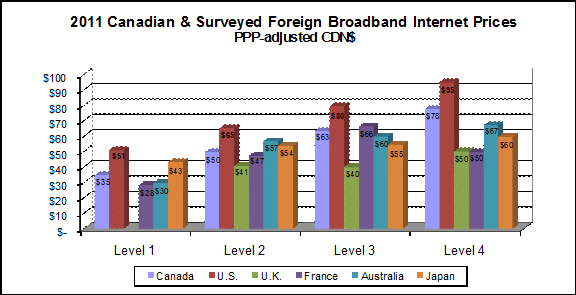
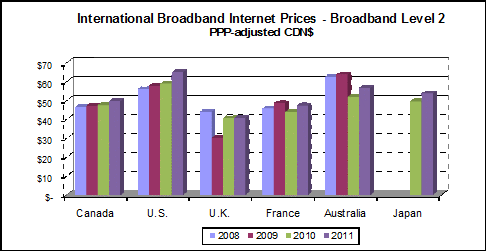
Among Canada, the USA, Japan, the United Kingdom, France and Australia, Americans pay the highest prices and are seeing the largest rate increases for Internet access, especially after 2011, according to the Canadian Radio-television and Telecommunications Commission which tracks global broadband pricing.

This is exciting to have something like this published. Unfortunately, the video won’t play for me. Also, it’s harder to use a video for reference than an article. Can you direct us to a transcript?
There is no video attached to this article. All videos here are in the Flash format until we switch to HTML5, which means iPad owners will be able to see our videos as well.
Phillip, am I missing something then? You appear to be linking to a full article at
https://www.wsj.com/articles/SB10001424127887324073504578109513660989132
but this is apparently a page with an auto-starting video segment. It does not work with FF, IE or GC on my PC. Depending on the browser, the video either never starts, or there is missing content.
Bah. So the article is subscriber-only, and it’s an ad or some web gadget that is timing out. 🙁
Here is a trick around the paywall. Google the exact title of the article you want to read and then click on that link. You will get a “free preview” of the original article in full.
Thank you, Phillip. It didn’t work earlier, but now I can read the article through the Google Cache!
Part of the reason broadband has good gross profit is because the video business does not, especially for smaller service providers. There is very little margin in video (if any for some — in fact some lose money on video), thanks to programming costs primarily. Broadband is seen as a way to even things out a bit.
ISPs want the Internet customers to help pay TV programming costs, even if they only use Internet. If the Obama administration is serious about promoting affordable broadband, they would break up this racket.
Gross profit is not the same as net profit. Gross profit is generally defined as gross revenue less cost of goods sold. For cable TV that would cable revenue less programming costs. It’s possible that Internet access doesn’t have an analogue to programming costs. But so what? You still have to account for marketing, operating costs, taxes, overheads, etc. So the net profit is almost certainly much less than 90% but specifics are probably confidential. In a perfect world, how much gross (or net) profit is enough? And who should determine that? You may not like it, but in a… Read more »
Pro-industry commenters always speculate that costs are high, pro-consumer commenters always speculate that costs are low. It’s opinion either way as long as the industry is allowed to hide it’s statistics. What is important to remember is that most clues point to costs being extraordinarily low, and which do not adequately explain existing prices. The best arguments for the high prices are when the industry points out that they have agreements to pay so much for this and that, suggesting that these are costs to them; never mind that there are further arrangements that exempt them from these bills. The… Read more »
So how much profit is enough? And who decides?
The current business model is likely “as much as we can get away with” and “we, the Internet Monopoly Industry”. Assuming the decision is brought up to the market, I cannot define that myself. The market tends to pay as much for a thing as it is worth to them, or more if it it is indispensable. The industry appears to think we’re willing to pay more each year, and since our culture is increasingly dependent on Internet services, they may be poised to extort as much as any life-supporting utility. However, the market’s perception of the value of their… Read more »
So what do you suggest be done about it?
Personally, I’d like to see last-mile providers (especially cable) be required to sell wholesale access to third party ISPs at cost-based rates. I would not preclude the facility providers from providing retail Internet access but they could do so only on the same terms as third-party ISPs.
But I doubt if the FCC has enough Congressional support to overcome the inevitable industry opposition to such a plan.
I do what I can afford to do. I shout about it, lol! I agree that telcos should share the lines at-cost, since they’re still using the cables that public taxes paid for years ago. Unfortunately, our government has essentially agreed to gift this equipment to the telcos, and now they won’t share them. In the days when they were temporarily sharing them, the telcos resold their access at a sliver below RETAIL cost. This is what drove all the small ISPs out of business, and why those that linger on claim, semi-correctly, that bandwidth is “expensive”. I guess we’ll… Read more »
In a perfect free market model with a level playing field, competition will guide how much profit is enough. If there was more competition, the gouging would attract more players who would be happy as can be to walk home with only 75% gross profit, forcing the incumbents to match pricing and potentially trigger a price war and a new paradigm for margin expectations. But guess what, we have a protected racket in place here. 1) Wall Street treats competition in broadband as anathema. Bankers won’t loan money to non-sure things these days, and broadband competition sure isn’t a sure… Read more »
I guess one could say, and I hate to admit it, but the market is faithfully holding Internet access at a price which the public is willing to pay.
An ignorant and outrageously manipulated public, though.
In the long run (hopefully not too much longer), I see this as another tech bubble. When word gets out, people will bring the pressure to bear on the monopolies, FCC, congress, et al, to slash prices. It would be nice to dream about a series of “60 Minutes” style segments, but remember who owns the TV networks such shows would be airing on…?