

 Subscribe
 The Federal Communications Commission has granted cable operators permission to completely encrypt their television lineups, potentially requiring every subscriber to rent set top boxes or CableCARD technology to continue watching cable-TV.
The FCC voted last week 5-0 to allow total encryption, a reversal of an older rule that prohibited encryption of the basic tier, allowing cable customers to watch local stations and other community programming without the expense of extra equipment.
The cable industry said the decision is a victory against cable theft, claiming that nearly five percent of all cable television hookups are illegally stealing service, at a cost estimated at $5 billion in lost revenue annually.
But some third party companies offering alternatives to costly set top boxes with endless monthly rental fees claim the industry move towards encryption is more about protecting the cable monopoly than controlling signal theft.
Current licensing agreements do not allow third party set top manufacturers to support scrambled channels without an added-cost, cable company-supplied set top box or card. That means a would-be customer would have to invest in a third party set top box and a cable company-supplied set top box to manage scrambled channels. That may leave customers wondering why they need the third party box at all.
This presented a problem for Boxee, which manufactures third party set top boxes, some with DVR capability. If cable systems completely encrypt their lineups, Boxee customers will need to rent a cable box and work through a complicated procedure to get both to work together.
 Boxee officials suggest both an interim and long term solution to the dilemma — both requiring the goodwill of the cable industry to work out the details.
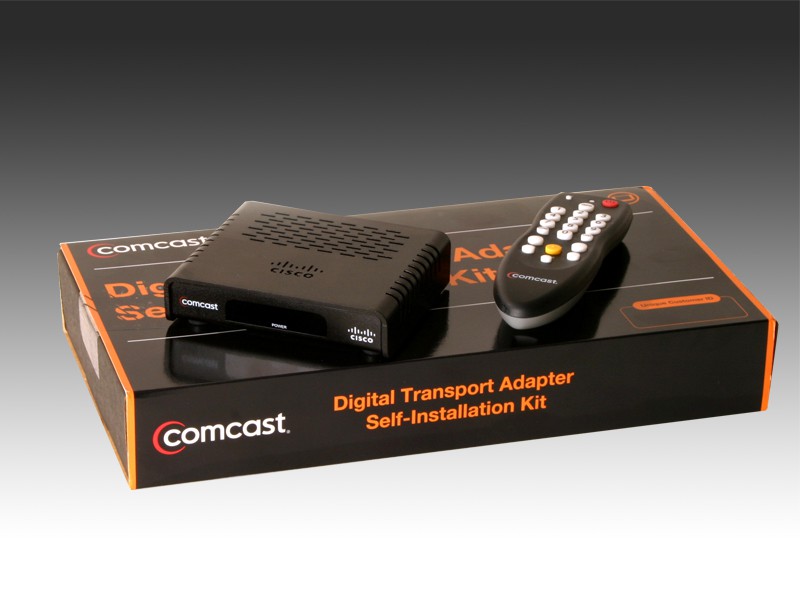
For now, Boxee and Comcast have agreed to work together on an HD digital transport adapter (DTA) with built-in Ethernet (E-DTA). A Boxee user would then access basic tier channels directly through an Ethernet connection and change channels remotely using their enhanced set top via a DLNA protocol.
A longer term solution would be to create a licensing path for an integrated DTA solution included inside third party set top boxes. This would eliminate the need for an added cost E-DTA box.
Cable operators planning to encrypt their entire television lineup will soon begin notifying customers of their plans. Under an agreement with the FCC, those with broadcast basic service will get up to two boxes for two years without charge (five years if the customer is on public assistance). Those who already have a cable box or DVR will get one box for two years at no charge. The cable company can impose monthly rental fees on additional boxes and begin charging for every box after two years.
Former FCC chairman Michael Powell, who now presides over the nation’s largest cable lobbying group, called the FCC decision “pro-consumer” despite the added expense and inconvenient many customers will experience.
“By permitting cable operators to join their competitors in encrypting the basic service tier, the commission has adopted a sensible, pro-consumer approach that will reduce overall in- home service calls,” said Powell, president of the National Cable and Telecommunications Association. “Encryption of the basic tier also enhances security of the network which reduces service theft that harms honest customers.”
Comcast is a leading proponent of total encryption, because it would allow them to start and stop service remotely, without having to schedule a service call to disconnect service. Cablevision already encrypts its entire lineup in certain areas under a previously-obtained waiver from the FCC. The company said it saved money reducing labor costs associated with service calls to physically connect and disconnect service.

This is outrageous. The FCC is bought and paid for.
“The company said it saved money reducing labor costs associated with service calls to physically connect and disconnect service.”
For some reason I get this feeling that those savings will NOT be passed on to the consumer and prices will continue to increase. This just gives cable companies another way to charge consumers a fee to rent equipment because we won’t be able to buy our own from a third party for a reasonable price.
Exactly. All of the benefits will accrue in the industry’s pockets. Consumers will gain nothing from this except a bigger bill.
Everything the cable companies have stated is just misdirection and an attempt to cover up the truth. This plan is being pushed solely to force their captives, er, customers to rent a box for $10 to $20 per tv per month. Just like their plans to charge $4 month for a $40 modem. Think about the additional revenue they will make from that. Now they can pay off politicians and FCC members and still make a nice profit from these charges.
Jeremy,
While I am not in favor of this move, the charge for the DTA required to receive basic channels will be around $3 (that’s the price currently being charged AFTER the 2 to 5 year FREE period has expired. As for your supposed $10-$20/month charge: That would be for a full functioning cable box, or DVR – not the limited function DTA that would be needed here.
That is not what the articles from Engadget and other sites are stating. I have read 3 articles, and all are pretty much the same as below. I might qualify for 1 free one for 5 years. If there is a might involved, that means the cable operator will do all they can to limit or deny it. https://www.engadget.com/2012/10/14/fcc-to-allow-encryption-of-basic-cable-with-a-few-strings-that/#comments “…The other, less interesting stipulation, is that you might be entitled to at least one free set-top box or CableCARD for up to five years, depending on what package you subscribe to or if you are on Medicaid. The free hardware… Read more »
While cable companies are free to extend the “free period,” the terms of the FCC decision are elaborated for everyone below: {http://www.fcc.gov/document/commission-relaxes-cable-encryption-prohibition} — begin quote: To limit the costs that affected consumers may face due to encryption, we adopt our proposed consumer-protection measures that require a cable operator that chooses to encrypt the basic service tier to: (i) offer to existing subscribers who subscribe only to the basic service tier and do not use a set-top box or CableCARD, the subscriber’s choice of a set-top box or CableCARD on up to two television sets without charge for two years from… Read more »
One MAJOR reason that some folks might not want a DTA, even if it is free, is that DTA is clutter. I have one relative who has beautifully clean living room with a flat screen mounted over the fireplace. No place for a DTA. Another is that DTAs can be a pain in the Ass to use.- particularly for Senior Citizens. As the DTA is a separate device it has to be turned off and on separately. While the remote that is usually supplied turns both the DTA & TV on and off at (almost) the same time often the… Read more »
Time Warner’s comes with Velcro strips designed to let you affix the box to the back of the television itself. It is small enough that it might just work for people in this situation. BTW, mounting a television above the fireplace has always been not recommended. The extra heat from the fireplace shortens the life of the television, and viewing angles are supposed to be straight-on, to avoid neck strain. We considered doing something similar until we realized manufacturers were issuing memos to retailers urging people not to do this because sets began failing after 3-5 years from the excess… Read more »
Interesting on the velcro. Might work in some situations – but I wonder if the IR will work.
RE: Fireplace mounting. I’m with you but in the case I referred to the WAF (Wife Acceptance Factor) RULES! That’s the only way she finds it acceptable to have a TV in the living room. And it is a lovely living room!!
If you position your IR device on a lower bottom edge of your TV just right it is possible for the IR signal to bounce/hit the device behind the TV. It’s something you just need to test and try at the normal standing and sitting area from the TV. I did this in a conference room with a large 55″ touch screen and an Apple TV I velcro’d behind it, the Apple remote is still able to operate the device from most areas in the room. I do agree though, I’m a bit of a minimalist and purist now in… Read more »
What about locals that are sent in clear QAM now? I pay for locals only just to get the triple play and have a HTPC with multiple tuners in it that can get clear QAM channels. I realize that this rule change allows the encryption of basic service but there was nothing about encrypting the local stations.
It is my understanding local stations can be encrypted as well, since the decision renders the old prohibition against encrypting the broadcast basic tier moot. That tier was primarily for the carriage of local stations. Clear QAM is definitely an endangered species. The cable industry thinks it represents a major target for signal pirates.
Why is the FCC allowing encryption of Public television? It is public and should be freely accessible by the public! I already pay for the basic package and only to watch public television with my kid. Now we have been deprived from the stations that are public and we used to watch. Irony is that I sponsor public television and I can’t watch it.
Public television is public and should not be encrypted!
“Public television is public and should not be encrypted!”
Its available over the air, if you are getting it from a third party then they should be able to do whatever they want with it.
Hire vandals to destroy TV equipment in those areas to save the electric grid.
http://www.avsforum.com/t/1475637/are-all-your-qam-channels-scrambled
Now these cable companies are probably stealing electricity from non subscribers. How many these lines are hooked up to amps and may cause possible interference to public safely equipment including (Cell Phones, Police Radios, Airport Radios, and others) and causing noise pollution.
http://wireless2.fcc.gov/UlsApp/UlsSearch/searchAdvanced.jsp