

Home » Consumer News »Editorial & Site News »Public Policy & Gov't » Currently Reading:

Fun Fact #721: Where Your Cable Dollar Is Going

Phillip Dampier July 19, 2012 Consumer News, Editorial & Site News, Public Policy & Gov't 7 Comments

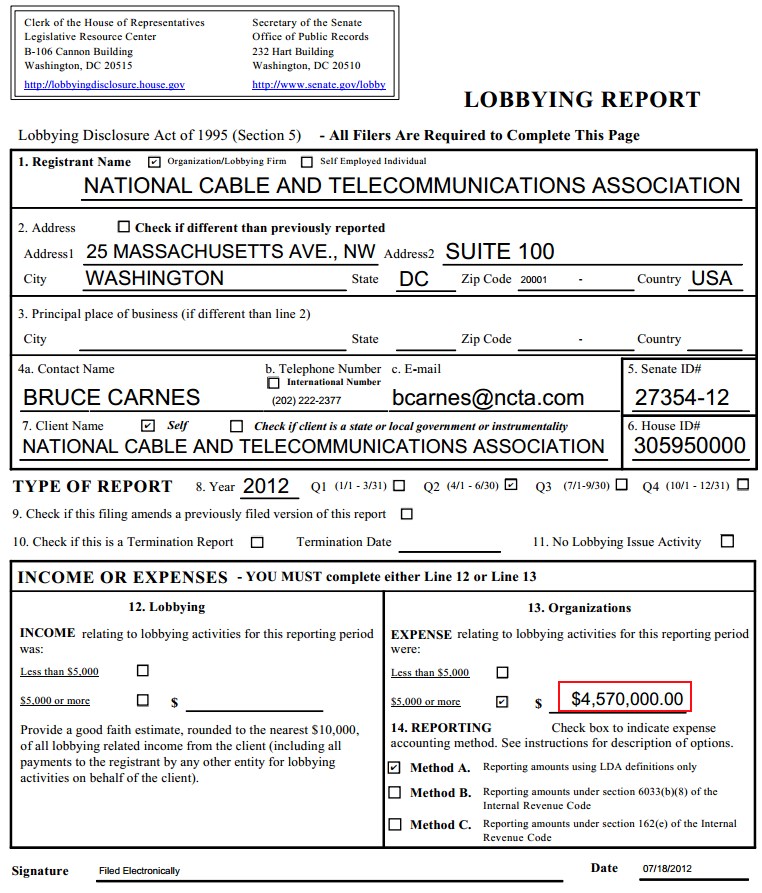
Susan Crawford points us to this fun fact: While the cable industry wants to raise your prices to cover increased costs, one of the things they forgot to mention is more than $8,900,000 (so far this year) of your money was shipped straight to Washington to hand out to lawmakers. In the last quarter alone, the National Cable & Telecommunications Association has spent more than $4.5 million lobbying Washington on everything from repealing the Dodd-Frank Wall Street Reform and Consumer Protection Act to the Internet Freedom Act. If consumers are for it, the NCTA is against it. The ironic part of it is they put your money to work against your interests.

Imagine what you could do with $8.9 million — bringing broadband to the unserved, making service better for those who already have it, and keeping your broadband bill in check. Just sayin’.

Share

Currently there are 7 comments on this Article:

  1. txpatriot says:

    Lemme get this straight: when you pay your monthly cable bill, the money is STILL yours, even though you have “consumed” the cable service for a month that you just paid for?

    Is that what you mean by “your” money?

    • Your cable bill is $85. Let’s say $80 of that went to pay for the cable service and another five of your hard-earned bills didn’t actually pay for the “increased programming costs” and other excuses the industry hands you whenever your bill goes up. It went straight into a lobbyist’s checking account to dole out to bought and paid for elected officials.

      The industry complains about the costs of doing business (which aren’t as horrific as they make you believe when you read their balance sheets) and then throw nearly $9 million down a rathole in DC. That nine million didn’t pay for USA, TNT, and ESPN. It effectively paid for the people you see every day on C-SPAN.

      • txpatriot says:

        Phillip: I don’t know what you do when you’re not running this website, but let me assume you for the sake of argument that you are a business owner.

        You sell a product or service of some kind. Once a buyer uses whatever product or service you sold them, they pay you for it. And once they pay you for it, what was “their” money now becomes YOURS, to do with as you see fit. They paid you for something; if they didn’t see the value in it or thought it was overpriced, they would not have agreed to the transaction in the first place.

        So if you choose to spend some of your profit on lobbying, why should that be an issue for your customer?

        • The telecommunications marketplace is, by the design of intense lobbying, barely competitive. With services like broadband now becoming a utility service, consumers have every right to assert the slush funding of corporate lobbying campaigns with their subscriber dollars is unacceptable, especially when that money is used to lobby to keep the anti-competitive status quo.

          Cable rates go up, lobbying spending goes up, consumer choice goes down.

          When you need a product or service and do not have much of a choice for it, you can’t simply walk away because you think it is overpriced. Once a service becomes a practical necessity, either it must be sold unregulated on the free market with robust competition -or- reasonably regulated to check and balance the zeal to wring monopoly/duopoly profits. We effectively have neither. When these companies lobby against would-be competitors, the Money Party can run forever.

          I’d also remind you I didn’t invent this line of reasoning. From the late 1980s forward, phone companies like AT&T and Verizon were using it against cable operators, and cable fired right back, demanding that captive telephone ratepayers should not have to fund the whims of the phone companies, including lobbying.

          More than 100 years ago, we were dealing with almost exactly the same problem. Instead of telecom, it was railroads. Today it’s agencies like the FCC, beholden to pressure from Congress. Back then it was the Interstate Commerce Commission (ICC), beholden to pressure from Congress.

          In both cases, lobbying cash (and more or less directed bribes) got the job done whenever pesky regulation threatened their respective fiefdoms. Lesson learned: the ICC/FCC is regulation by, for, and of the regulated.

          One railroad executive said of the ICC at the time:

          “The Commission…is or can be made, of great use to the railroads. It satisfies the popular clamor for a government supervision of the railroads, at the same time that the supervision is almost entirely nominal…The part of wisdom is not to destroy the Commission, but to utilize it.”

          That could easily have been said by Randall Stephenson at AT&T, who has Julius Genachowski on his speed dial. Or anyone at Comcast (including the always charming and delightful Meredith Atwell Baker, a former Commissioner from the FCC now enjoying Comcast’s fruits generated in part by her labor ((on their behalf.))

          Consumers don’t want their money spent on lining the nest of politicians, who many presume to be on the take already.

          But don’t worry… corporate influence extends into the heads of more than few justices on the Supreme Court who truly believe corporations are people, and limiting them from flushing endless buckets of cash would be restraint of their constitutionally-protected “free speech.”

          • txpatriot says:

            So what is the solution?

            • As we managed to achieve in 1992 with pro-consumer reforms that promulgated the development of satellite-delivered television competition:

              a new law and/or regulatory reform that guarantees access to broadband networks at fair wholesale rates by third party competitors who can market competitive service, policies that encourage and support new entrants into a lightly regulated marketplace, guarantees of unimpeded community-owned broadband development, rural broadband subsidies for development of rural Internet solutions including WISPs, rural fiber/DSL, etc., and a regulatory framework that defines broadband as a telecommunications service, giving regulators a clearly defined role in its development, oversight and operation when a player goes out of bounds.

              The alternative, In the absence of sufficient competition, is a regulation framework that controls access and pricing to the same reasonable degree other utilities have operated under for more than 100 years.

              If that fails, we should consider Australia’s approach which nationalized broadband under a publicly owned fiber-to-the-home network on which all players can operate and compete. Australia pulled it off with Telstra appealing to their greater sensibilities — namely piles of cash to buy them out. But that investment in the future will guarantee long term savings and a national broadband network that eliminates usage caps and will make us look like we’re still in the dial-up era in comparison.

              Shareholders won’t care where the money comes from, as long as it is theirs to keep.

              • txpatriot says:

                OK maybe I misunderstood the point of your original post.

                You just posed a “solution” that addresses the lack of competition in the broadband last-mile market, but every one of those competitors could still spend a ton of their money on lobbying, which is the problem I THOUGHT we were talking about, and which was the topic of your original post.

                Thanx


Search This Site:

Contributions:

Recent Comments:

  • James R Curry: I wonder if TWC will start offering some irresistibly cheap cable promos in Austin soon, together with a two-year agreement?...
  • Scott: I am so happy I live in Austin and can rid myself of Time Warner Cable when Google Fiber appears in 2014. I am counting the days....
  • James Cieloha: Every Verizon customer should be ashamed of Verizon for choosing to abandoned wireline service in favor of the Voice Link wireless service very severe...
  • txpatriot: Here is yet another love letter from the NY Times to Susan Crawford: http://www.nytimes.com/2013/05/20/business/media/telecoms-big-players-hold-bac...
  • txpatriot: Oh I'm not complaining -- you do a great job. Thanx...
  • Phillip Dampier: I usually try and get away from the computer on the weekends, so I don't usually wipe these out until Monday. Some increased security measures have he...
  • Phillip Dampier: My nomination list is a wasted effort since neither you or I have any power to change the current one. I'd say in general, the benefits that accrue...
  • txpatriot: Looks like the spammers are back...
  • FrankM: AT&T also needs to follow Google's lead of NO DATA CAPS!...
  • Report Them - It's Easy!: Bills with the new Administrative fee are being received by customers by now. Some momentum is growing at forums.att.com to have a mass of customer...
  • Michael Elling (@Infostack): Phil, first, suggest 3 people you think are more qualified and we'll do an objective analysis. Second, are you aware of the personal expense Mr. Wh...
  • Danny Lampley: "As we’ve reported before, Tom Wheeler has said almost nothing on his blog about consumer interests . . . ." Expecting a bit much aren't we? After ...

Your Account: