

 Subscribe
Sen. Linda Runbeck, a dues-paying member of ALEC, a corporate funded pressure group that advocates for legislation advantageous to ALEC's corporate sponsors.
Rural Minnesota is facing a full frontal assault on community broadband, courtesy of a state representative so proud of her involvement in a corporate front group, she’s actually a dues-paying member.
State Sen. Linda Runbeck (R-Circle Pines) introduced HF 2695, a bill to prohibit publicly-owned broadband systems:
A bill for an act relating to telecommunications; prohibiting publicly owned broadband systems; proposing coding for new law in Minnesota Statutes, chapter 237.
BE IT ENACTED BY THE LEGISLATURE OF THE STATE OF MINNESOTA: Section 1. [237.201] PUBLICLY OWNED BROADBAND SYSTEM; PROHIBITION.
(a) Notwithstanding section 475.58, subdivision 1, other state law, county ordinance, or any authority granted in a home rule charter, a city or a county may not use tax revenues raised within its jurisdiction or issue debt to construct, acquire, own, or operate, in whole or in part, a system to deliver broadband service.
(b) Notwithstanding sections 123A.21, 123B.61 to 123B.63, 125B.26, and 475.58, subdivision 1, no school district or service cooperative may use state revenues, tax revenues raised within its jurisdiction, or issue debt to construct, acquire, own, or operate, in whole or in part, a system to deliver broadband service.
(c) For the purposes of this section, “broadband service” means a service that allows subscribers to access information from the Internet by means of a physical, terrestrial, non-mobile, or fixed wireless technology.
(d) This section applies to a system to deliver broadband service whose construction begins after the effective date of this section, but does not apply to:
- the city of Minneapolis, St. Paul, or Duluth; or
- the maintenance or repair of a system delivering broadband service whose initial construction began before the effective date of this section, provided that the geographical area in which the system delivers broadband service is not expanded as a result of the maintenance or repair.
EFFECTIVE DATE. This section is effective the day following final enactment.
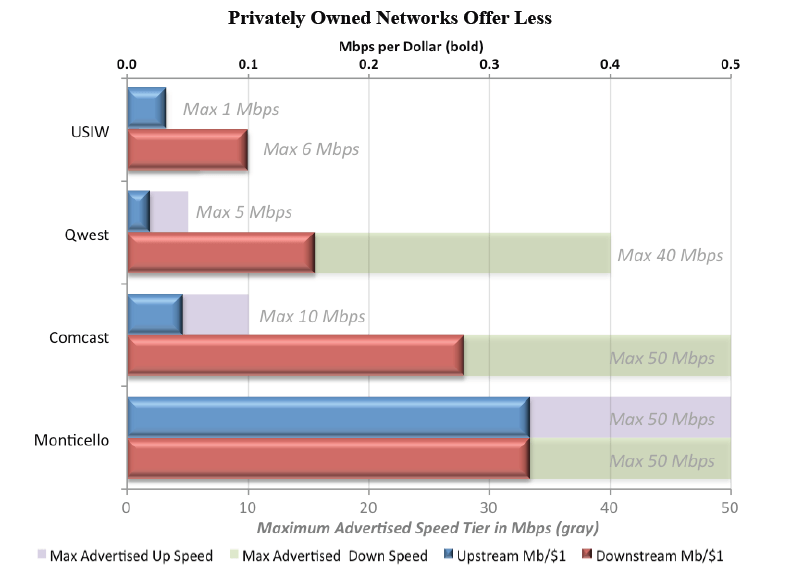
The public broadband option delivers the most bang for the buck, which is why some providers want to see it banned.
Runbeck is a dues-paying member of the American Legislative Exchange Council (ALEC), a secretive corporate front group that lobbies lawmakers to introduce business-friendly legislation, often on the state level. Runbeck told the Minnesota Independent via email that she paid $100 for a two-year membership in the organization, and says she’s never used ALEC’s “model legislation,” bills that are sometimes written by corporate members of the group and that pop up in state capitols across the country.
But Runbeck’s sudden interest in banning community broadband coincides with similar efforts in states like Georgia and South Carolina backed by big cable and phone companies. Runbeck’s bill would directly target rural Minnesota, where broadband is the least robust, while exempting Minneapolis, St. Paul, and Duluth (and incumbent phone and cable companies) from the bill’s provisions. Runbeck’s bill also constrains existing public broadband services from expanding, an important matter for providers still rolling out service to additional neighborhoods in their communities.
Community broadband is already hampered in Minnesota by laws that make such projects difficult to approve and build. When projects do break ground, incumbent providers do everything possible to throw up roadblocks to delay or abort the progress being made. In Monticello, TDS Telecom filed nuisance suits against that city’s public broadband network before finally deciding to upgrade service themselves. Mediacom and Charter, two major Minnesota cable operators, have objected to public broadband projects that don’t even serve communities they’ve wired.
When the networks are in operation, providers like Charter work to undercut them by selling service at prices so low, they’re predatory. But when competitors are driven out, prices rise… quickly.
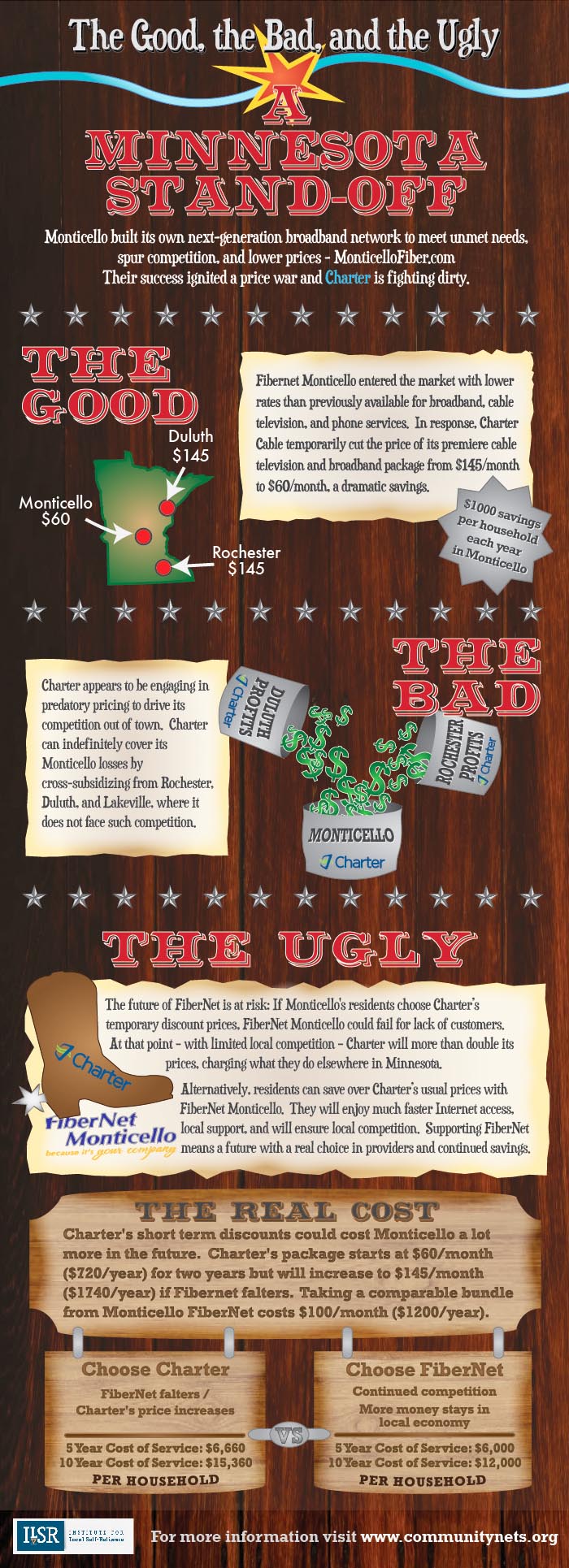
Runbeck’s $100 membership in ALEC is paying dividends, if you are a big incumbent cable or phone company. Consumers will pay much more than that if broadband competition is curtailed.

Sickening.