

 Subscribe
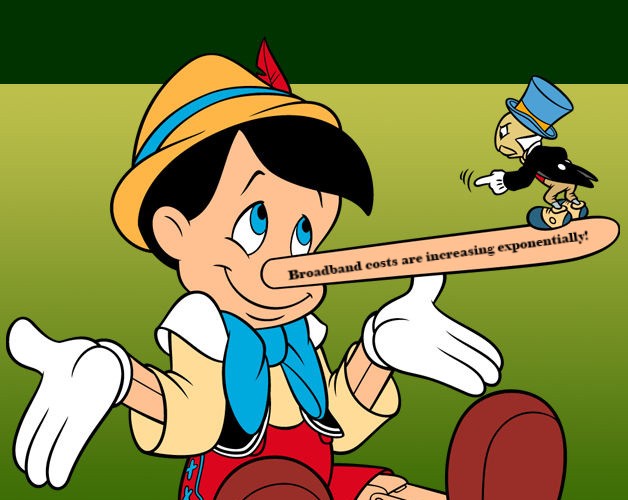 Internet Service Providers who use “increasing bandwidth costs” as an excuse to raise prices or implement an Internet Overcharging scheme like usage limits or usage-based billing are being dishonest.
That’s the conclusion of a new British report that found providers grossly overestimating the costs of meeting increasing usage demands of their customers. In some cases, providers are inflating the price of usage by 1,000 percent or more over their own costs.
“Traffic-related costs are a small percentage of the total connectivity revenue, and despite traffic growth, this percentage is expected to stay constant or decline,” claims the report, commissioned by the British Broadcasting Corporation, Britain’s Channel 4, and Skype. “Studies in Canada and in the UK put the incremental cost of fixed network traffic at around €0.01-0.03 per GB.”
That represents a cost of pennies per gigabyte, yet many providers charge anywhere from $0.20-10.00 or more to residential customers, an incredible markup.
The study further concludes ISP claims of “ballooning costs” are simply “a myth,” and points to company financial reports which clearly show “for fixed networks, traffic-related costs are low, falling on a unit basis and likely to fall overall given declines in traffic growth and on-going cost-reducing technical progress.”
In fact, most broadband providers are reporting decreasing costs and investment in their broadband product line, while enjoying unprecedented increased profits.
As broadband traffic increases, the technology to sustain that traffic has improved, and brought unit costs for broadband traffic to an all-time-low.
The report admits that costs for wireless technology are higher, primarily because of limited airwaves, a shared usage infrastructure, and initial expenses in delivering improving connectivity with cell or wireless radio towers. But with the advent of 4G technology, providers can sustain increased speeds, traffic, and revenue from selling wireless service that can handle higher bandwidth applications.

Plum Consulting authored the new report.
Plum Consulting, which wrote the report, concluded that even in more expensive wireless service areas like the United Kingdom, smartphone data tariffs amounting to around €10 per GB are not justified on 4G networks.
“The cost to the mobile network operator is under €1 per GB,” Plum Consulting found.
Predictably, service providers are dismissive of the report’s findings.
Trefor Davies, CTO of communications provider Timico and a member of the board at the Internet Service Providers’ Association (ISPA) says bandwidth costs are a real problem, especially for smaller ISPs that rent access on a usage-based, wholesale access plan.
“Bandwidth is by far the greatest proportion of cost for an ISP,” Davies told PC Magazine. “It’s very much you pay for what you use,” he said. “If you use twice as much bandwidth, you’re going to be paying twice as much.”
[Thanks to Stop the Cap! reader Bill H. for sharing the news.]

Except that customers don’t get to pay exactly for what they use, they pay high flat rates PLUS per Gig charges in the hundred or thousand times multiple over the ISP’s actual costs. “Bandwidth is by far the greatest proportion of cost for an ISP,” Davies told PC Magazine. “It’s very much you pay for what you use,” he said. “If you use twice as much bandwidth, you’re going to be paying twice as much.” If Davies whats to charge $4/gig, then don’t charge a monthly fee, or only charge an ‘administrative billing fee’ for an account at a reasonable… Read more »
Big telecom companies scam us and they are liars. Time for a revolution, and I mean to kick them out of the country and let’s create a new market for new ISP with competitions in prices.
Nationalize the Internet backbone.