

 Subscribe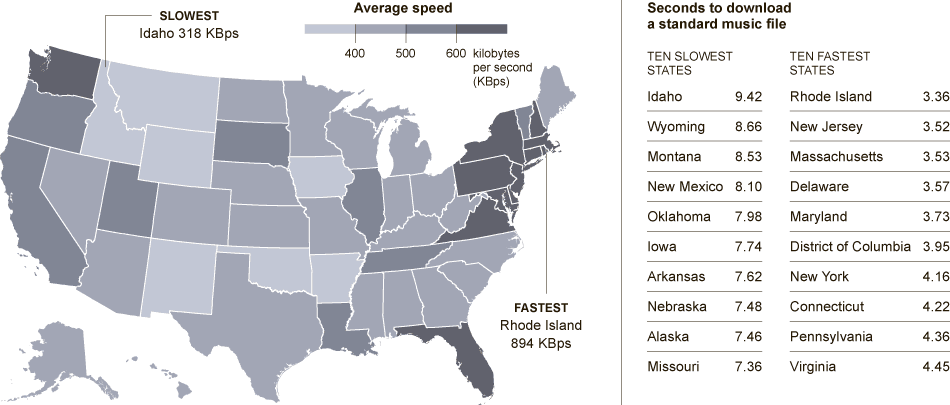
(Courtesy: Pando Networks)
Bears who fancy a good rub up against wireless Internet transmission towers were blamed for knocking out service for customers in the Potlatch area one day, a problem unique to rural communities who make due with whatever broadband access they can find.
Such is life in rural Idaho, deemed by Pando Networks to be America’s slowest broadband state, with average Internet speeds of just 318kbps.
Stop the Cap! reader Jeff in Pocatello is happy the big city New York Times has noticed Idaho’s online challenges.
“Please take notice of this newspaper article about our online experience here in Idaho,” Jeff writes. “While it underplays the near-total failure of our state legislature to recognize there –is– a broadband problem here, at least the rest of the country will understand just how bad Internet access remains in rural America.”
Jeff should know. Pando Networks calls Pocatello America’s slowest Internet city. It’s no surprise why. Pocatello residents are stuck between a rock — the infamous Internet Overcharging leader Cable ONE (incidentally owned by NY Times‘ rival The Washington Post), and a hard place — Qwest/CenturyLink DSL.
Nobody does Internet Overcharging better than Cable ONE, which baits customers with high speed access and then ruins the deal with an $8 monthly modem rental fee, infamously low usage caps and a two-year contract plan that subscribers call a ripoff.
“Cable ONE never heard of a square deal because they break every consumer rule in the book,” Jeff says. “Although the company pitches speeds up to 50Mbps, they tie it to a two-year contract that only delivers one year at that speed. After 12 months, they reduce your speed to just 5Mbps for the entire second year, and if you cannot convince the customer service representative to renew and reset your 50Mbps contract for an additional year, there is nothing you can do about it.”
THE Internet Overcharger
Cable ONE has written the book on usage limits. Customers paying for “blazing fast 50Mbps speed” get to consume a maximum of just 50GB per month (100GB for triple play customers) before overlimit fees of $0.50/GB kick in. Other Cable ONE plans include daily usage limits of just 3GB, which can make Netflix viewing difficult.
“Cable ONE makes you ration your Internet like satellite providers do, and it’s very irritating because they tease you with fast speeds you literally cannot use unless you are willing to pay a lot more,” Jeff says.
The alternative for most Idahoans is DSL, if Qwest/CenturyLink provides it. In many areas, they don’t.
“You can be a mile out of Pocatello’s city center and be told there is no DSL, and those that do get it often find it working at 1-3Mbps,” he adds.
In a country now rated 25th in terms of Internet speed, Idaho is comparatively a bottom-rated broadband disaster area. The state secured 11 federal broadband grants to deliver some level of service in communities across the state, at a cost of $25 million.
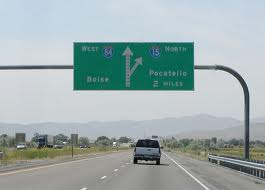
The Slow Lane
But ask some local officials about the quality of broadband in Idaho and you find a lot of denial there is even a problem.
The Times got a brusque response to their inquiries about broadband service from the executive director for the Bannock Development Corp., a business development group. Gynii Gilliam told the newspaper things were just fine, at least for large businesses in cities like Pocatello.
“The last thing I need is a report that says we don’t have the capacity and speed, when I know it exists,” Gilliam said. She noted that Allstate Insurance was opening a $22 million call center in Pocatello and that the Federal Bureau of Investigation has a service center there. “We have not lost any business because of Internet speeds,” she said.
Which proves the old adage that you can have just about anything, for the right price. The disparity between residential and business broadband — urban and rural — is particularly acute in mountain west states like Idaho. Verizon was considering rural Wyoming for a multi-billion dollar high speed Internet data center, until it found it could purchase an alternative already up and running elsewhere. Meanwhile, much of the rest of Wyoming has no Internet, slow speed wireless or DSL, or limited cable broadband in some larger communities.
Even Gilliam admitted her home broadband account was nothing like the service Allstate Insurance was likely getting.
“It feels like it’s moving in slow motion,” she told the Times. “A lot of times I’ll start downloads and not complete them.” She said she was happy as long as she could get e-mail.
But not everyone is satisfied with an Internet experience limited to occasional web browsing and e-mail.
Qwest (now CenturyLink), is Idaho's largest Internet Service Provider.
“With countries like Latvia getting better broadband than we have, it’s only a matter of time before we start to lose even more jobs in the digital economy over this,” Jeff says. “This is one more nail in the coffin for rural economies in the west, which are being asked to compete with bigger cities and eastern states that have much better infrastructure.”
Pando found the northeast and mid-Atlantic states, excepting Maine, New Hampshire, and Vermont, have the best broadband speeds in the country. The mountain west has the worst.
Rural states like Montana, the Dakotas, eastern Oregon, Idaho, Wyoming, and Utah are the least likely to have widespread access to cable broadband, which can typically offer several times the Internet speed found in smaller communities with DSL service from dominant provider Qwest (now CenturyLink). CenturyLink claims 92 percent of their customers have some access to broadband, but didn’t say at what speeds or how many customers actually subscribe to the service.
In Idaho, cost remains a factor, so CenturyLink is planning to sell low-income households a discounted DSL package. Speeds and pricing were not disclosed.
Jeff says the real issue is one of value.
“Some in the Times article blame lack of access, while others claim it’s all about the cost, but it’s really more a question of ‘is it worth paying this much for the service we actually get’,” Jeff says.
“Cable ONE is simply deal-with-it Internet, with usage caps and contract traps that leave customers feeling burned, but their only other choice is Qwest, and they show few signs of caring about delivering fast broadband in this state,” Jeff says.
“I believe CenturyLink Idaho’s vice president and general manager Jim Schmit when he says, ‘We’re in business to make a profit,’ Jeff concludes. “There isn’t a lot of profit in selling Internet service in rural mountain states, so the company simply doesn’t offer it where they won’t make back their investment quickly.”
“The question is, should profit be the only thing driving broadband deployment in the United States? If you answer ‘yes,’ Idaho is the result. If you answer ‘no,’ and think it is an essential utility, profit shouldn’t be the only consideration.”
[flv width=”640″ height=”380″]http://www.phillipdampier.com/video/Cable ONE Countdown High Speed Internet.flv[/flv]
Cable ONE’s ad for 50Mbps leaves out a lot, including the 50GB usage cap and two-year contracts that downgrade service to just 5Mbps for the entire second year. (1 minute)
