AT&T to First Responders: Buy Your Own Darn Cell Towers

Phillip Dampier April 26, 2011 AT&T, Public Policy & Gov't, Rural Broadband, Wireless Broadband Comments Off

AT&T has a deal for first responders.

Where cell service is wiped out in a natural disaster (or doesn’t provide adequate coverage even when it does work), the phone company is willing to sell emergency officials their own AT&T mini-cell-tower site — for up to $45,000, not including ongoing monthly service fees.

The Remote Mobility Zone is a briefcase-sized portable cell tower that will typically provide service for a dozen or more concurrent callers over AT&T-licensed spectrum.  The company sells the equipment, but buyers still have to pay a monthly service charge, users must have a qualifying AT&T voice plan, and the data service that comes with it operates at slower-than-3G speeds.

“In the pivotal first minutes of a natural or man-made disaster, AT&T Remote Mobility Zone provides a solution to help maintain critical mobile communications,” said Chris Hill, vice president, Advanced Mobility Solutions, AT&T Business Solutions.  “With AT&T Remote Mobility Zone, users can set up a cell site in less than 30 minutes.”

That’s much faster than AT&T can fix their own cell sites when they go offline in a disaster.

A consultant to first responders, Jim Davis, tells Stop the Cap! the portable cell tower may sound like a good idea, but will meet resistance because of the “optics” of taxpayers paying for private cell phone company equipment.

“You are effectively asking taxpayers to pay for AT&T cell towers, and that is going to present a political problem in a lot of areas,” Davis tells us.  “What is even harder to justify is the fact AT&T charges monthly service fees from the moment the device ships, whether you use it or not — and the service only works with AT&T GSM cell phones, which is fine as long as fire and EMS rescue services are equipped with those phones, and many are not.”

Davis tells us Sprint/Nextel has a significant portion of the cell-phones-for-emergency personnel-market, especially in the east.

“Sprint aggressively prices their services to this market, and their phones won’t work on AT&T’s cell site.”

Davis says the Remote Mobility Zone is likely to present a better fit in the corporate world, especially in the energy sector.

“This device makes sense if you are hydrofracking for natural gas in Pennsylvania, or drilling for oil in Wyoming, or even on an oil drilling platform,” Davis says.  “Those installations are up and running for longer periods of time and are in relatively narrow spaces, perfect for AT&T’s half-mile service area using this device.”

“AT&T is going to have to market this very carefully, because the company is effectively selling a product to cover gaps that AT&T has created themselves either through inadequate coverage or damaged cell towers they should be responsible for fixing fast enough to negate the need for this product.”

Share

FCC Chairman Julius Genachowski’s Roadshow: Now He’ll Headline the Cable Industry’s Big Splash

Phillip Dampier

Federal Communications Chairman Julius Genachowski is racking up those frequent flier miles as he travels from one telecom industry trade show to another.  In addition to less-than-thrilling appearances at industry events run by the wireless industry and broadcasters, the chairman is now scheduled to be the headline act at the cable industry trade show to be held June 15 in Chicago.

Instead of devoting time and attention to provider profiteering and the ongoing concentration of the wireless marketplace, Genachowski will be shaking hands with big cable executives, sharing the stage with former FCC chairman Michael Powell, who now runs the National Cable and Telecommunications Association.  (Powell is a classic example of Revolving Door Syndrome: Start a career in public service and finish it using your government connections to cash in with a six figure salary working for the industry you used to oversee.)

While the current FCC chairman gets to bloat his expense account, his performance on behalf of the American people leaves plenty to be desired:

  1. His vision of our broadband future is all talk and little action, with National Broadband Plan goals seen as increasingly anemic when contrasted with broadband development abroad;
  2. Genachowski has caved on important consumer protections for broadband consumers, most notably with a very-industry-friendly Net Neutrality policy that won him little thanks (Verizon sued anyway);
  3. His “white space” broadband plan to carve up UHF broadcast spectrum for mobile broadband comes poorly conceived, infuriating broadcasters who promise to spend millions in a lobbying death match;

Julius Genachowski has plenty of time for speeches, but never enough time to protect consumers who want better broadband, more competition, and lower prices..

At the NCTA convention, Genachowski is likely to deal with the hot potato retransmission consent issue — the one that pits you in the middle of million-dollar squabbles over what pay TV provider gets to carry what networks (and how much you will pay for them).  Also on the agenda: CableCARD 2: Electric Boogaloo, also known as AllVid, the almost certainly Dead on Arrival replacement for the first generation CableCARD set top box replacement that practically nob0dy uses.

Although Google loves AllVid, the powerful entertainment and cable industry is less impressed.  The Motion Picture Association of America considers it a piracy gateway because it lacks sufficient copyright protection mechanisms, and the cable industry has always been wary of standardized set top equipment that could tie down on-demand programming, signal theft protection, and future innovations.

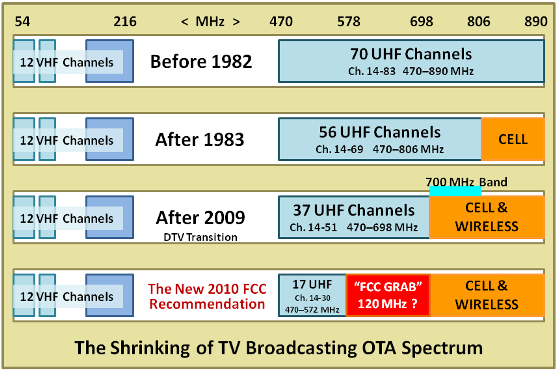
Genachowski is sure to get a warmer reception at the cable show than he got from broadcasters earlier this month, who were downright hostile over his proposal to carve up the UHF TV dial (channels 14-51), selling off “extra” channels for wireless broadband.

The National Association of Broadcasters is starting to get a little worried, not feeling the love the Commission has bestowed on big cable and phone companies who got their lobbying wish-lists largely granted.  Instead, a year after being dragged into an expensive digital TV conversion, the FCC is back for more from television broadcasters, taking back perhaps a dozen or more channels for “white space broadband,” a vaguely-explained plan to enhance the amount of space available for wireless data.

Unfortunately, with thousands of television stations, the FCC will have to find enough channels for everyone to share without interfering with each other.  The FCC still hasn’t released a definitive plan about how to accomplish this, and with big wireless interests suggesting TV stations should slash their transmitter power and share the same or adjacent channels, a lot of stations fear they will be crammed together like a Japanese train at rush hour.

But the wireless industry wants it, even if it drives some stations in densely populated areas off the air completely.  In many other areas, especially in the northeast and southern California, stations might have to cut their signal coverage areas to avoid interfering with stations sharing the same channel in an adjacent city.  Rural residents relying on over the air television could be out of luck, even with a rooftop antenna.

In a bidding war, who would likely win the spectrum up for sale?  AT&T, Verizon, and perhaps some large cable companies looking for enhanced wireless services to sell.  No wonder the NAB is worried.  The FCC could favor selling spectrum out from under your local stations and sell it to their biggest competitors in the pay television business.

Consumers should be concerned as well.  Should today’s biggest wireless carriers scoop up “white space” frequencies, it will do nothing to bring enhanced competition or lower prices.  It will just lock up even more spectrum for a wireless industry that threatens to become a duopoly.

Instead of flying all over the country to attend trade shows and shake hands with industry leaders, Chairman Genachowski should be spending more of his time looking for creative, effective solutions to enhance competition and protect consumers, not simply throw them under the bus for the benefit of a handful of industry players already too large for the common good.


Share

Trapped With AT&T DSL and Don’t Want Usage Caps? Consider Business Class Service

While many AT&T residential customers continue their exodus from the company’s forthcoming Internet Overcharging scheme, there are many rural Americans who have just one choice for broadband service — AT&T DSL.  For them, escaping usage caps is not as easy as calling the local cable company and arranging for new service.

While consumers continue to register their displeasure with AT&T over capping Internet usage at 150GB for DSL or 250GB for U-verse, there appears to be a way to get away from the usage limits while still maintaining your AT&T DSL service — switch to a usage-cap-free business account.

AT&T sells business broadband service to at-home, small, and medium-sized businesses at a substantial discount for the first year — $30 a month for up to 6Mbps.  A one year term commitment is required, but that likely won’t present any problems for customers who don’t have any other option for service.  With an AT&T modem/router already in place, making the change should just require a phone call to AT&T.

The company may offer different pricing and service plans depending on the region where you obtain service.  Former BellSouth customers may get different promotions than former Ameritech customers do.  We also found a few customers who still were able to access AT&T’s “usage measurement tool” on their business accounts, but business customers have not been notified usage caps apply to them, and we suspect that will continue to be the case.  AT&T promotes business class service at $25-30 a month in one offer we found, and service was even available to those who don’t want a business phone line.

After the first year, rates increase substantially, but we’re hopeful AT&T will learn the error of their ways and rescind their unjustified usage limits before the year is up.

Thanks to Wayne in Madison, Wisconsin for capturing these screen shots from AT&T's website.

If you are going to switch to AT&T’s business class service, share your experiences in our comment section to help other readers.


Share

AT&T Takes Over Remaining Alltel Territories: Customers Share Their Phone Swapping Experience

Verizon Communications formally closed its acquisition of Alltel in January 2009, but some former customers are only now feeling the impact as they transition to… AT&T.

That’s right, AT&T.

Although Verizon acquired the bulk of Alltel’s national customer base, the federal government ordered Verizon to sell off its future Alltel customers in communities where the company would likely be the overwhelmingly dominant player.  Verizon sold off most of these orphaned customers, numbering over a million, especially in the Mountain Time Zone, to AT&T.

The transition from Alltel to AT&T would be a bumpy one because the two companies use different wireless technologies, meaning every customer would have to be provided with a new phone.  Alltel’s customers remaining with Verizon didn’t experience this, because both companies use CDMA technology.

AT&T agreed, as part of the deal, to supply every one of its new postpaid/contract Alltel customers with brand new GSM phones (although AT&T was unwilling to provide free advanced smartphones like Apple’s iPhone).  Prepaid customers were less lucky — they only received discounts off new phones.

Stop the Cap! has talked with more than a dozen affected customers in Arizona, New Mexico, Michigan, Utah, Wyoming, Iowa and Colorado about their experiences as they transition to AT&T service.  With AT&T now proposing to merge with T-Mobile, which could also mean some new phones for T-Mobile customers, we wanted to learn what customers thought about being moved from one carrier to another, what their experience was before the transition and after, and whether they intend to stay with AT&T.

Our panel included a young man from Utah who used his phone at home and outside of the state as he performed mission work for the Mormon Church in rural Florida.  We also spoke with a retired couple living in Arizona who chose Alltel because of their unlimited calling circle option to stay in touch with friends and family in Minnesota.  Also participating: a travel agent in Michigan, a realtor in New Mexico, a self-employed contractor in Colorado, a farmer in Iowa, and several others who shared their stories with us in e-mail.  By mutual agreement, we’re keeping their last names private because some have pending disputes with AT&T.

Breaking the News: Alltel Sells Out Their Customers to Verizon

When Karen, a realtor from New Mexico first heard word that Alltel was selling out to Verizon, she wasn’t sure exactly what that meant.  There was considerable confusion in her part of southern New Mexico mostly because the local media does a poor job of covering telecommunications stories.

“In New Mexico, everything in the media is centered around what is going on in Albuquerque and everything else is given little attention, except in the local newspaper,” Karen says.  “But whether you are in Las Cruces or Roswell, the quality of the story depends on the quality of the poorly paid reporter.”

Karen was not worried about the sale at first, because she was aware Verizon had a good reputation for cell phone service.  She had originally selected Alltel because they had good rates and friendly customer service.

“If I ever had a problem with my phone, Alltel would always fix it, even if it was out of warranty,” Karen explains.  “That meant a lot to me because they didn’t have to do that, but it was why I always renewed my contract.”

Heath, who runs a home-based contracting business in southern Colorado, didn’t like what he was hearing from the start.  Neither did Marion and Will, a retired couple living outside of Phoenix.

“We had our dealings with Verizon back in Minnesota when we lived there and we never liked them because they cost too much,” Will says.  “Alltel was a great choice for us because they had a calling circle plan that let you make unlimited calls to certain numbers, and we talked with our daughter back in Minnesota daily using our cell phone.”

Confusion about the deal only got worse when Alltel (and in some cases Verizon) notified our panel members they would not be Verizon customers after all — they were being sold off to another cell phone company.

Alltel -> Verizon -> AT&T -> Frustration

Micah, our reader in Utah first contacted us more than a year ago to express his confusion about why he was not only losing his Alltel account, but now he was somehow ending up as a customer of AT&T, a carrier he definitely wants nothing to do with.

“I figured I could at least live with Verizon because they are everywhere, but as I started performing my mission work for the church in rural central Florida, I learned from my parents I was actually going to end up a customer of AT&T, something I definitely never wanted,” Micah says.  “AT&T is terrible in Utah and worse here — nobody wants AT&T unless you are in Orlando or Daytona Beach.”

Alltel Markets Sold to AT&T (click to enlarge)

“At first we thought, cool, new phones for everyone,” Shanie told Stop the Cap! from her home in Muskegon, Mich. “AT&T has been promising major expansion of service here in western Michigan since they notified us they were taking over for Alltel, but then we started learning the details.”

While Shanie’s family of four would be given four new phones, their choices of new phones were limited, although AT&T called them “comparable.”  Many of AT&T’s smartphones were not covered, even if families already owned smartphones purchased from Alltel.

“We also discovered if you wanted one of these advanced phones, it meant a new two-year contract with AT&T, effectively forcing us to stay with them longer,” Shanie says.

Jed, a farmer outside of Sioux City, Iowa says AT&T did a poor job keeping him informed.  Jed stopped receiving all communication from Alltel (other than a bill) and never heard a word from AT&T.  Instead, one of his neighbors warned him that his Alltel phone was going to quit working by the middle of May.  Jed was upset because the deadline for him to choose a new free phone had passed and he never had the opportunity to make a choice, never having been notified about any of the changes.

“The newspaper might have said something about it, but we don’t get the paper here and nobody has much time to spend watching television,” Jed shared.  “We would have thought AT&T would have notified us, but they apparently forgot we were here.”

Last week, a new phone arrived from AT&T in the mail, unsolicited.

“What a way of doing business — we thought at first it was some sort of fraudulent purchase and we almost didn’t accept it from the driver,” Jed said.

AT&T has been sending out new phones all month to customers across several states, encouraging them to call and activate them on AT&T’s network.  Once customers do that, their old Alltel phones will quit working.  That was a problem for Shanie’s daughter at college in Grand Rapids.  When mom activated her phone, the primary one on the account, her daughter’s Alltel phone stopped working.

“AT&T has you call a toll-free number to activate the phone, but first they require y0u to accept the terms and conditions for doing business with AT&T, which can include contract extensions for some people,” Shanie said.  “I had no idea activating my phone would end service on all of the other Alltel phones on the account.”

Alltel customers in these states had new AT&T phones shipped to them on this schedule.  The second date refers to the service transition cutoff date:

Arizona January 27, 2011
February 10, 2011
Southern New Mexico February 7-8, 2011
March 2-3, 2011
Michigan and Montana February 16-21, 2011
April 6-12, 2011
Colorado, Northern New Mexico February 23-28, 2011
April 13-18, 2011
Iowa and South Dakota March 4-14, 2011
April 19-28, 2011
North Dakota March 15-21, 2011
April 29-May 5, 2011
Utah and Wyoming April 1-6, 2011
May 9-12, 2011

Bailing Out for Alternatives

Jody, a soon-to-be-ex AT&T customer in New Mexico, says there was plenty of fine print to wade through when he prepared for the switch from Alltel, and he didn’t like what he saw.

“AT&T is very tricky about how they handle customers who want to depart Alltel and avoid becoming an AT&T customer,” Jody says.  “You cannot cancel your Alltel contract and avoid an early termination fee, but you can cancel AT&T within 30 days of switching and escape a hefty exit fee.”

Indeed, AT&T’s transition website says Alltel customers who want to switch providers will face an early exit penalty as long as their Alltel phones remain active.  Those who switch and activate their new AT&T phones get a 30 day window to drop AT&T and avoid an ETF:

If, after moving to AT&T service, you choose to discontinue your AT&T service, you will have a 30-day period to opt out of your AT&T contract without an ETF. After that 30-day period, standard AT&T terms apply including any applicable ETF.

Old name, New Company

Jody got his new phone and promptly canceled his AT&T service.  He switched to CellularOne, a company with a legacy name but a very local network.  It has its own cell towers only in northern Arizona and parts of New Mexico.  For everywhere else, it depends on a roaming agreement with… AT&T.

Jody’s CellularOne plan still offers completely unlimited calling, texting, and data for around $80 a month, and that includes AT&T’s nationwide network.

“CellularOne offers a much better deal than AT&T, but you can only choose from three lower end smartphones — no iPhone to be had here,” Jody says.

Heath in Colorado wants out of AT&T as well.

“They drop calls all the time and their network strength is awful in my neighborhood, and I depend on my cell phone and don’t have a landline,” Heath says.  “I don’t know why we had to be stuck with AT&T who apparently de-commissioned Alltel’s towers, which used to deliver a rock solid signal here.”

But not everyone is heading for other carriers.  Sam in Farmington, New Mexico says AT&T is bringing 3G to his community and mobile broadband speeds have been much faster than what Alltel used to deliver.

“AT&T’s data plans are overpriced, but if you can hang onto your existing Alltel plan but use it on AT&T’s network, it’s not so bad,” Sam says.  “Unfortunately, you cannot upgrade to an iPhone and keep Alltel’s plans — you have to pick one of AT&T’s.”

The Future for T-Mobile Customers

Although T-Mobile shares the same GSM network technology AT&T uses, the two companies have different frequency allocations for their respective networks.  T-Mobile customers seeking access to AT&T’s network will probably need new phones to access it. While AT&T claims T-Mobile’s own largely urban network will supplement AT&T’s own coverage, customers may need new equipment for that to be true as well, unless AT&T co-locates their own cell antennas on T-Mobile towers.

Former Alltel customers tell Stop the Cap! AT&T didn’t offer the latest and most popular phones for their swap, and some customers too far away from an AT&T store had to get a new phone without being able to try it.  AT&T allowed customers to exchange phones within 30 days, which helped some of our readers, but most felt the entire idea of being forced to switch to AT&T an inconvenience.  Most were also disturbed that one of the competitors in their area was disappearing, and considering Alltel served largely small cities and rural areas, there was already a lack of choice for most.  In total, three of our readers are staying with AT&T, two left for CellularOne, one chose to switch to a prepaid plan, and the rest went with Verizon after all.  If Alltel were still around, every customer we talked with for this piece would have stayed with them.

Share

Shaw Increases Broadband Speeds You Can’t Use For Long Because of Data Caps

Phillip Dampier April 20, 2011 Broadband Speed, Canada, Internet Overcharging, Online Video, Public Policy & Gov't, Shaw Comments Off

Shaw Communications today announced they are boosting speeds on one of their popular broadband tiers — Shaw Extreme, from 15/1Mbps to 25/2.5Mbps.  The current price for the Extreme plan remains the same.  So does the monthly usage limit of 100GB.

Customers appreciate the faster speed, but are not impressed Shaw has continued to limit customers to how much service they can use.

“Now I can hit my 100GB usage cap that much faster,” shares Shaw customer Dan Peek, who lives in Calgary.  “Shaw just completed dozens of listening tours, but they are obviously not listening at all.  What good are the faster speeds when you are effectively limited from using your broadband account to full advantage?”

Shaw claims the new broadband speeds are part of an effort to unveil new Internet packaging anticipated for early summer.

“It’s an exciting time at Shaw as we begin to create a world-class Internet product, giving our customers the ultimate experience in connectivity and entertainment,” said Peter Bissonnette, President, Shaw Communications Inc. “The Shaw Extreme speed upgrade is just the first spark of a whole new world of entertainment and offerings to come. We’re building the network of the future and our customers are at the very heart of it.”

Shaw also plans to introduce new equipment options, including a new box that will allow customers to access files stored on personal computers on their television set.  Shaw’s efforts suggest the company recognizes customers are increasingly interested in accessing multimedia content with their broadband connections.  Unfortunately, the company’s usage caps preclude customers from doing more than dabbling.

“It’s a PR effort made for the Canadian government and the Canadian Radio-television and Telecommunications Commission,” offers Peek.  “This summer they will be in Ottawa promoting their new broadband speeds as evidence the Canadian ISPs are not the backwater players they’ve always been, all while hoping their usage-based billing schemes will get a pass.”

Peek suggests broadband speed is not Canada’s biggest broadband challenge — the usage caps are.

“If you asked most Canadians if they would prefer 10Mbps service with no cap or 20Mbps service with caps starting at 40GB per month, people will take the slower speed,” Peek says.  “Shaw doesn’t seem to understand that basic message.”

Shaw's usage billing shark is still circling western Canada. The company may have increased speeds, but their 100GB usage cap on the Extreme tier remains.

Shaw’s listening tour across western Canada brought “summaries” from company officials that are being criticized by several Shaw customers who were at the meetings.

“I was at one of the Calgary meetings and the “summary” that showed up after the fact was the work of one of Shaw’s marketing hacks,” says Steve, a Stop the Cap! reader.  “The one thing they left out of the summary is the fact we do not want these caps and that they are not justified by the facts.”

Steve claims Shaw left customer demands for the end of usage caps out of their summaries, even though many customers brought up how much they hated usage-based billing and caps.  But there was plenty of room for customers who asked, “why should low usage customers pay for usage,” something Shaw’s customers in fact don’t do.  Another frequent meme from Shaw — “[customers] rejected the idea of subsidizing high bandwidth consumers.”

“That’s Shaw propaganda designed to fix a pre-determined conclusion around their distorted facts,” Steve says.  “The company presented charts and graphs with their world view and asked customers to comment on them in a focus group-like setting.  If you didn’t know those ‘facts’ were actually company ‘positions,’ you end up debating their numbers on their terms.”

Steve thinks Shaw’s version of “fair” is unique to Canada and would never be accepted in the United States.

“When you have media types parroting Shaw’s claim that practically nobody exceeds their usage limits, it quickly allows the cable company to claim heavy users are abusing the system, necessitating the caps,” Steve says.  “Now that Netflix is here, we’re all going to be heavy users now.”

Marie from Burnaby, B.C. confirmed Shaw’s new Extreme speeds were active as of this evening, noting speed test results of 20Mbps downstream and just over 2Mbps upstream once she reset her cable modem.  But she considers it of little value because of the usage cap.

“This will help our family when we’re all sharing the connection after school and at night, but since the 100GB cap remains unchanged, those faster speeds invite more usage, which will also eventually bring a higher bill,” she writes.

Share

Sprint vs. AT&T: Dan Hesse Declares War on AT&T/T-Mobile Merger

Sprint CEO Dan Hesse has declared war on the proposed merger of AT&T and T-Mobile, suggesting it would result in a nationwide cell phone duopoly that will stifle innovation and eliminate competition.

“If AT&T is allowed to swallow T-Mobile, competition will be stifled, growth will be stifled and wireless innovation will be jeopardized,” Hesse told attendees at the Commonwealth Club of California Friday.

Sprint’s announced opposition to the proposed merger came during a speech that was supposed to be about the company’s environmental initiatives, but Hesse opened his remarks warning of the dire implications should the nation’s second largest wireless carrier absorb the fourth — T-Mobile.

Sprint CEO Dan Hesse delivers remarks at the Commonwealth Club of California – Friday, April 15, 2011. This edited clip covers Hesse’s remarks regarding the proposed merger of AT&T and T-Mobile. (12 minutes)
You must remain on this page to hear the clip, or you can download the clip and listen later.

Sprint has signaled it is willing to spend lobbying dollars to fight the merger in Washington, where it faces a review by the Justice Department and the FCC.  The declaration of war by Sprint did not go over well at AT&T, where the company’s top lobbyist Jim Cicconi trotted out Hesse’s prior statements to use against him in a company blog post:

As recently as last October, Mr. Hesse said the wireless industry is ‘hyper competitive‘.  The month prior, his CFO talked about how ‘tough‘ retail competition is in the wireless market, citing at least six major competitors.  In February of last year, Mr. Hesse said, “M&A is absolutely a way to get the growth in the industry, if a particular transaction makes sense for anybody.”  He went on to say, “I think consolidation will be healthy for the industry, some consolidation. It is, needless to say, very competitive.”  And in January of last year at a Citi Global Conference, Mr. Hesse said, “Well, there is no question that we have an extremely competitive wireless industry in this country and that the pricing is getting much more aggressive.”

Given that Sprint is a major competitor to AT&T in the hyper competitive wireless market Mr. Hesse describes, no one should be surprised that they would oppose this merger.  But it is self-serving for them to argue that the highly competitive wireless market they cited only months ago is now threatened by the very type of transaction they seemed prepared to defend previously.

Sprint was reportedly interested in pursuing a merger with T-Mobile before AT&T sealed their own deal with the German telecommunications company.

Hesse

Cicconi’s remarks about a “hyper-competitive” marketplace conflict with marketplace reality:

  • A combined AT&T/T-Mobile enterprise would control 42 percent of the American wireless marketplace;
  • Verizon Wireless would control 32 percent;
  • Sprint would maintain third place with a distant 17 percent;
  • Every other carrier combined (Cricket, MetroPCS, Alltel, and other regional players) would have just 9 percent.

In fact, after Sprint, other carriers AT&T routinely cites as “serious competition” individually have just three percent or less of the American market.

Hesse told his audience that besides concerns about innovation and price, also-ran carriers other than AT&T and Verizon are likely going to get stuck with less advanced handsets and face little or no access to latest generation iPhone and Android smartphones, often made available exclusively to larger carriers.

“Whoever the supplier is, you can say, ‘Hey, I’ll take all of your production,’” Hesse said. “They could restrict our access to some of the cool devices.”

Hesse predicts his company will ultimately not be the only one opposing the merger.  But smaller carriers have had little to say since the merger was announced.

Share

Comcast Informally Marketing Unlimited 12/2 Business Class Service to AT&T Residential Customers

Some AT&T customers unhappy about the company’s forthcoming implementation of usage caps are being offered an uncapped alternative from Comcast — Business Class service.

More than a few customers facing AT&T’s imminent 150/250GB usage caps who live in a Comcast service area are informally being pitched cap-free Business Class service as an alternative.  Jim, a Stop the Cap! reader near Chicago, tells us Comcast sales representatives are rushing to sign up customers coming back to the cable company.  Although he is not served by U-verse, he points us to messages on AT&T’s own message boards from customers sharing their experiences as they pull the plug on the phone company.

“Comcast is offering us unlimited access at 12/2Mbps speeds for $59.95 per month, which is more expensive than the company’s residential broadband service, but potentially cheaper than getting a bill from AT&T with overlimit fees on it,” Jim says.

For now, Jim is heading back to Comcast residential service because he doesn’t use more than the cable company’s current limit – 250GB per month.  But he appreciates there is an alternative service available that comes without a usage limit, something he’ll keep in mind for the future.

“I feel sorry for AT&T customers stuck with them as their only broadband provider, and I think customers should continue to call and complain about the unjustified limits,” Jim offers.  “The best way AT&T customers can tell the company it has gone too far is to take their business somewhere else.”

Comcast does not normally market business products to residential customers, but many sales representatives will offer the service if a consumer expresses concern about the residential service’s usage limit.

Share

Commentary: Plans to Expand EPB’s 1 Gigabit Fiber Network Shelved After a Festival of Lies

Commercial providers and their pals in the legislature will go to any length — even lie — to protect their cozy duopoly, charging high rates for poor quality service.

That fact of life has been proven once again in the state of Tennessee, where an effort to expand EPB Fiber — a community owned fiber network — to nearby communities outside of Chattanooga, was killed thanks to a lobbying blitzkrieg by Big Telecom interests.

The “Broadband Infrastructure for Regional Economic Development Act of 2011,” supported by chief sponsor House Majority Leader Gerald McCormick, (R-Chattanooga), is dead after telecom industry lobbyists unleashed a full court press to stop the legislation from passing into Tennessee law.

The bill would have permitted EPB and five other municipal electric services that have or are developing broadband infrastructure to expand service up to 30 miles outside of their service area, where appropriate, to meet the needs of businesses or consumers.

With the legislation, EPB could bring its 1 gigabit fiber broadband service to Bradley County, home to a future Amazon.com distribution center.  Amazon already operates a huge warehouse in Hamilton County, where it was able to obtain EPB’s super-fast broadband service.  According to Harold DePriest, EPB President and CEO, Chattanooga’s fiber network is helping sell the city as a high-tech mecca for business, where broadband connectivity is never a problem.

DePriest says EPB’s network has been a proven job-creator, and Amazon.com’s ongoing expansion in the region is just one example.

Chattanooga residents and businesses now have the fastest broadband service in the southern United States, at prices often far less than what the competition charges.  Expanding EPB’s success to other parts of Tennessee represents a major threat to the likes of Comcast and AT&T, the state’s dominant telecom companies.

EPB provides municipal power, broadband, television, and telephone service for residents in Chattanooga, Tennessee

Lobbyists fought the bill off with some whopper tall tales about the “horrors” of community broadband.

Some Republican lawmakers friendly to Comcast and AT&T’s point of view have bent their philosophical positions on government and regulation into logic pretzels.  One has even called for EPB to be regulated by Tennessee’s Regulatory Authority, a body many state Republicans feel is about as helpful as a tax increase.

Despite that, there was Rep. Curry Todd (R-Collierville) at a recent hearing telling fellow lawmakers EPB and other community providers should be regulated by the TRA to protect ratepayers from the “loss of tremendous amounts of money coming out of taxpayers’ pockets.”

Does Todd think Comcast and AT&T should also be regulated?  Of course not.  Nobody should protect consumers from AT&T’s and Comcast’s relentless rate hikes.  Todd cannot even get his facts straight.

After 19 months, EPB has 25,500 customers — far ahead of its projections, and is well ahead of its financial plan, according to DePriest.  So much for being a “financial failure.”

Rep. Curry Todd has trouble with the facts, but has no problem counting campaign contributions amounting to more than $12,000 from Comcast, AT&T, the state cable lobby and other telecom companies

On cue, the same cable industry that tried to sue EPB Fiber out of existence is now comparing the Chattanooga fiber network to Memphis Networx, a disastrous effort by that city to build a public-private wholesale fiber optic network only business and institutions could directly access.  It’s hard to earn critical revenue from consumers when you run a wholesale network.  Even harder when you build it just before the dot.com crash.

EPB sells its service directly to business and consumers, so it gets to keep the revenue it earns, paying back bondholders and delivering earning power.

Stop the Cap! reader John Lenoir notes some of the local tea party groups are also being encouraged to oppose EPB’s efforts to expand.

“Just as Americans for (Corporate) Prosperity is lying about North Carolina’s community broadband, these corporate front groups are also engaged in demagoguery over EPB in Tennessee,” Lenoir says.  “In addition to the usual claims EPB represents ‘socialism,’ the locals are also being told EPB wants to use their fiber network to run smart meters, which some of these people suspect are spying on them or will tell people when they can and can’t use their electric appliances.”

Lenoir in unimpressed with the telecom industry arguments.

“AT&T’s opposition is downright laughable, considering this company raised its rates on U-verse and will slap usage limits on every broadband customer in a few weeks,” Lenoir adds.  “We thank God EPB is here because it means we can tell AT&T to stick their usage limits and Comcast can take their overpriced (and usage limited) broadband somewhere else.”

Lenoir thinks EPB should embarrass both AT&T and Comcast, but since neither company feels any shame in his view, it’s more about business reality.

“Why do business with AT&T or Comcast and their gouging ways when you can sign up for something far better and support the local community,” Lenoir asks.

AT&T spokesman Chris Walker complains that the phone company is somehow faced with an unlevel playing field in Tennessee, despite the legislature’s repeated acquiescence to nearly every AT&T-sponsored deregulatory initiative brought before it.  The company wants a “level playing-field” statute like the very-provider-friendly (it should be — it was written by them) one currently before the North Carolina state Senate.

Comcast questions whether anyone needs 1 gigabit service, but the cable company’s Chattanooga vice president and general manager Jim Weigert told the Times Free Press it could deliver 1 gigabit service… to business customers… assuming any asked.

DePriest questions that, noting Comcast tops out its broadband service at 105Mbps, and only for downstream speeds.  Comcast upload speeds top out at 5Mbps.  EPB can deliver the same upstream and downstream speeds to customers and do it today.

Share

Time Warner Cable Blames Pole Fee Increases They Won’t Pay for Future Rate Hikes

Phillip Dampier April 19, 2011 Public Policy & Gov't, Rural Broadband, Time Warner Cable Comments Off

Time Warner Cable is blaming an increase in pole attachment fees in upstate New York for increasing the cost of doing business, despite the fact those increases will not apply to the cable company.

National Grid, which also does business as Niagara-Mohawk, is raising rates for third-party companies to attach new lines to the poles the electric utility owns.  The power company says it is the first rate increase since 2007, and covers the cost of engineering, safety reviews, and ongoing infrastructure costs.

The Albany Times-Union quotes Time Warner Cable spokeswoman Lara Pritchard’s reflexive complaints about the rate increases.

“Inevitably, any price increase to poles will impact our costs to bring service,” Time Warner spokesman Lara Pritchard said Monday. “At this time, we have no plans to adjust fees. We periodically assess all of our associated costs to do business, as any company would, and this would factor into that assessment.”

If so, it should be by a factor of zero because the pole attachment fee increases apply only to companies seeking to place new lines on utility poles, not those maintaining or replacing existing cables.

The New York Public Service Commission approved the utility’s request for a change in their “Make Ready” rates, which cover costs associated with new projects. Existing companies, including Time Warner Cable will continue to pay a locked-in rate of $11.13 per pole, which represents no change.

Verizon acknowledged as much, noting the company’s existing fiber and copper wire lines are exempt from the rate hike.

But not every company is being held harmless from the rate increases.

Major projects to extend fiber broadband service to rural Franklin and St. Lawrence counties in upstate New York could be at risk because Niagara Mohawk, the dominant power provider in the region, is raising the rates to place fiber on some 22,000 poles required for the network.

Slic Network Solutions, the Development Authority of the North Country and Ion HoldCo LLC are facing at least $3.5 million in higher pole attachment expenses the utility said nothing about when they reached an agreement with National Grid in December.

Taxpayer grant money is backing the projects, including Slic’s 136-mile network covering parts of Franklin County and another 660-mile project in St. Lawrence County.  Ion operates a fiber optic broadband backbone that extends throughout upstate New York.

Keith J. Roland, an attorney with the Herzog Law Firm representing the three companies, has filed a formal complaint with the N.Y. State Public Service Commission, calling the rate increase “unjust, unreasonable, excessive, and unlawful.”

Roland says the increased costs, which he calls “arbitrary,” could threaten the viability of the projects.

“Without access to those poles, SLIC, DANC and Ion and almost any other telecommunications, cable TV and Internet provider in rural area of Niagara Mohawk’s territory would be driven out of business or effectively be precluded from doing business,” the complaint states.

Share

Don’t Meet Me in St. Louis — AT&T and Charter’s Internet Overcharging

One of America’s largest midwestern cities is being victimized by not one, but two major Internet Service Providers with Internet Overcharging schemes that will limit broadband use by customers.

Charter Communications, which calls St. Louis home, delivers cable service to much of the city, and has lightly enforced arbitrary usage limits on its cable broadband customers since last November.  AT&T, the major telephone provider, plans to limit its DSL and U-verse customers starting in early May.

“Now we get to choose between Charter’s usage cap or AT&T’s,” says Reginald, a Stop the Cap! reader in St. Louis.  “As usual, AT&T is always the bigger ripoff — this company hasn’t done one consumer-friendly thing in at least a decade.”

Reginald is currently a U-verse customer who fled Charter around the time the cable company went bankrupt.

“Charter was, is, and will always be abysmal in providing good service and accurate bills, and I was not about to pay for their business mistakes,” Reginald writes.  “When U-verse became available I told AT&T I was signing up because they were offering unlimited use plans and Charter was playing games with their usage cap.”

When AT&T’s cap is in place, St. Louis residents will get to choose between the lesser of two evils:

Usage Limits

  • AT&T DSL Customers:  150GB per month
  • AT&T U-verse Customers:  250GB per month
  • Charter Lite/Express: 100GB per month
  • Charter Plus/Max: 250GB per month
  • Charter Ultra 60: 500GB per month

AT&T will deliver three warnings and then a higher bill — $10 for each 50GB of “excess usage.”  Charter sends out occasional warnings, then reserves the right to terminate your service.

“It stinks, and if I had my way I would not do business with any provider who has a usage cap,” Reginald says.  “I would rather pay a few dollars more a month and not have to worry, and I can’t imagine I’ve ever used over 100GB in a month.”

Jess, another St. Louis resident, pulls the plug on AT&T U-verse May 2nd.

“I almost wanted them to charge me an early cancellation fee so I could pound them with their sudden change of terms,” Jess says.  “I am switching back to Charter on May 2nd, the day AT&T starts their crap.  AT&T acted all surprised about why I would possibly ever not do business with them over this issue.”

Jess says she would rather deal with warning letters from Charter than a higher AT&T bill.

“Every penny more AT&T gets from us goes right into their lobbying to screw consumers more, and here are the results for everyone to see,” Jess says.  “If Charter wants to pull their games with me and my family, the next step is to declare war on the politicians who let this stuff happen.”

Bill says AT&T offered him a discount to stay with the company — he is canceling his U-Verse service May 1st.  But he refused, telling AT&T he will not do business with a company that engages in Internet Overcharging.

“I’m not too worried about Charter,” Bill writes Stop the Cap! “If they try and threaten me, I’ll let them cut me off and then we’ll sign up under my wife’s name, and bounce from account to account.”

Your money = Their Money

For all three of our readers, none of whom claim they will exceed the allowance, it’s a matter of principle.

Reginald, Jess, and Bill all feel strongly usage caps and overlimit fees are unjustified, and are more about protecting video packages than “unclogging” providers’ networks.

Bob Zimmermann, an AT&T customer in Richmond Heights, tells the Post-Dispatch he doesn’t like the new limit either. He watches an occasional Internet movie, and sometimes downloads video to his iPad. He doubts he’ll exceed the cap, but he doesn’t want to worry about it.

He is shopping for alternatives.

“I’ll see if I can negotiate a better deal,” he told the newspaper.

Jess wishes him luck finding someone else in St. Louis.  She suggests customers like Zimmermann play AT&T and Charter off each other to get a lower bill, at least temporarily.

“What is most important right now is to tell AT&T you are leaving them because they are abusive, and then sign up with a new customer discount with Charter,” Jess suggests.  “Then if and when Charter cuts you off, go back to AT&T and see if you can get them to waive any fees after the third warning or else you are switching back to Charter.”

Another alternative is to sign up for Charter’s business service, which has no usage cap, but comes at a significantly higher price than residential service.  Their starter package includes unlimited Internet at 16/2Mbps speeds, a domain name, and a business phone line with unlimited long distance and calling features.  It runs a steep $120 a month.

“If Charter didn’t offer a 500GB allowance on their 60Mbps tier, I might consider a business package if I used my connection a lot,” admits Bill.  “Isn’t it ridiculous when someone wants to sell you a super fast package you cannot really use because of usage limits?”

Bill partly blames the state legislature for letting AT&T get abusive with customers.

“AT&T shows up with a lot of cash to dole out in the Missouri legislature and in return they get to abuse customers,” Bill notes.  “You notice Verizon cannot get away with this in the more consumer-protection-friendly northeast.”

Jess says the whole thing is a mess.

“It really shows how the midwest is getting screwed once again — this time for Internet access,” she notes. “There is no Verizon fiber here, and even Google showing up in Kansas City won’t be enough to shame the likes of AT&T.”

Share

Search This Site:

Contributions:

Recent Comments:

  • Scott: You're partly correct about a new access point or router helping them. The problem with consumer or lower quality wireless access points is they do...
  • txpatriot: I was just yanking your chain (and being an @$$)....
  • Phillip Dampier: I take your point, but honestly have not considered Panera Bread's Wi-Fi problems as part of the fight against broadband caps....
  • txpatriot: "You should not read into every story written here as an effort to prove some point." Of course not -- that's why the website is titled "Stop the C...
  • James R Curry: Hey Phillip, It's a thorny subject. There are a lot of coffee shops that set themselves up as places for people to come and meet and work and stud...
  • Phillip Dampier: I don't have any position to take regarding Panera. It's a free Wi-Fi service. If I go into Panera Bread, I am honestly there to buy their food, not t...
  • Alex Perrier: Another option is speed caps. i've experienced speeds of anywhere from 1 Mbit/s to 6 Mbit/s at Bell Wi-Fi hotspots. i think this is reasonable. Tho...
  • George Douglas: Cisco had nothing to do with this. Verizon Network Integration is the vendor. Gianato was told five days prior to the contract being signed that these...
  • Smith6612: True. All of the above works fine. Even then though, I don't think they need to spend money replacing their current gear with something from Meraki fo...
  • Tk: Perhaps Phillip is blaming the wireless phone company caps for this situation at Panera. "The problem has gotten even worse since wireless phone co...
  • txpatriot: Interesting situation. The commenters providing suggested solutions are even more interesting, but what I find MOST interesting is that, provided...
  • AP: No surprise here. Traditional TV has NOTHING on except for stupid reality shows and unfunny sitcoms. I do most of my TV watching online but for sports...

Your Account: