2 of Every 3 AT&T Customers Paid Early Termination Fees Just to Switch to Verizon

Verizon Wireless wins bragging rights this month as a new study shows fleeing iPhone owners on AT&T’s network were willing to put up money just to get out of their contracts and switch to Verizon. Two of every three departing customers paid AT&T up to $300 to break-up with the carrier and bought new iPhones that work on Verizon’s network.

The study, produced by Mobclix, found reception on AT&T’s network was by far the biggest issue cited by exiting customers, followed by Verizon’s offer of a personal hotspot add-on, and the perception Verizon runs a more robust network.

Mobclix found Verizon’s newest customers may have a point about who runs the stronger network.  Many AT&T customers are accustomed to relying on the company’s broadening Wi-Fi network to cope with 3G reception woes.  At least 53 percent of AT&T customers rely on Wi-Fi regularly for data connectivity.  On Verizon’s network, just 38 percent do.

But predictions of a stampede away from AT&T to Verizon have turned out not to be true, either.  Just 14 percent of America’s iPhone owners are on Verizon’s network.  AT&T serves the rest.

Analysts suspect the reason for this is that AT&T’s worst problems are in certain major metropolitan areas, but the carrier does respectably well providing service in many smaller and medium-sized cities.

Mobclix produced a map which may bear this out.  It shows the largest concentration of Verizon iPhone owners in the cities that are routinely cited as problem areas for AT&T:  San Francisco, New York, Seattle, Chicago, Boston, and Los Angeles.

“Based on our survey findings today, it’s clear that consumers are taking control of their mobile destinies by evaluating carrier criteria such as Wi-Fi usage, reception issues and reputation as part of their decision to remain with their carrier or make a switch,” said Krishna Subramanian, Mobclix co-founder.

(click to enlarge)

Share

Bell CEO: Bandwidth Usage Charges Are About Monetizing Video Traffic for Shareholders

Cope

In another example of providers telling the public (and lawmakers) one thing, while saying something very different to their own shareholders, Bell Canada’s CEO made a remarkable admission about why the company imposes Internet Overcharging schemes on its customers:

“As we see a growth in video usage on the Internet, making sure we’re monetizing that for our shareholders through the bandwidth usage charges,” CEO George Cope told listeners in a financial conference call last autumn.

That is a far cry from the story Mirko Bibic, Bell’s government affairs representative tells to anyone who will listen. Michael Geist, a Canadian syndicated columnist on technology law issues notes Bibic has told a different tale while appearing before Parliament’s Standing Committee on Industry to answer questions on usage based billing held in February.

For Bibic, usage-based billing is about “fairness” and solving alleged congestion issues.

“As for small businesses, which are generally on the same network as residential users, what you have is really a case where the congestion during peak periods is largely a residential phenomenon. It’s in that area that we’ve addressed the usage-based billing issue, and all we’re asking the CRTC for is to follow a fundamental principle of fairness,” Bibic told MPs. “If we asked 97% or 98% of Canadians if they would be prepared to pay more so that the 2% of heaviest users pay less, I’m pretty sure of what the answer would be.”

Bibic

Bibic’s argument has been repeatedly undercut by his own bosses, Geist notes.

In August, Cope told shareholders “our data revenue growth was 3.8% for our Residential Services business, particularly driven through an increase in Internet ARPU of 3.3%. And interesting, almost all that increase now coming from usage based billing as the demand for Internet use explodes through the use of video services, and we’re continuing to see an increase in the revenue per customer.”

By November, Cope was turning Bibic’s bandwidth “fairness and congestion” lemons into lemonade, celebrating data revenue growth of 5 percent, “driven principally by the bandwidth usage revenue being up 83% year-over-year.”

Cope not only decapitates his company’s arguments for usage-based billing, he also shines the light on who they will impact: if providers are to be believed that usage caps will only affect a tiny percentage of customers, how can data revenue be up a whopping 83 percent year-over-year. Are a handful of Canada’s “heavy” broadband users responsible for this growth, or are an increasing number of Canadian consumers finding themselves over the “generous” limits Bell has established because they used their broadband connections to stream movies and television shows.

As Geist notes, “no one should be under the illusion that UBB is anything other than a revenue maximization strategy in a market with limited competition, not one premised on fairness or network congestion.”

Share

AT&T’s Plans to Auto-Enroll Modified Phones in Data Tethering Plan Under Fire

Phillip Dampier March 24, 2011 AT&T, Internet Overcharging, Wireless Broadband 9 Comments

AT&T customers using modified phones to share their 3G wireless connection with other devices are complaining about the company’s warning that if they don’t cease tethering their phones, they will be automatically enrolled in the company’s premium $45 a month DataPro for Smartphone Tethering plan next week.

An attorney tells Stop the Cap! if the company does that, his firm will consider filing a class action lawsuit against the company for forcing customers into service plans they did not enroll in themselves.

This controversy comes to those who have been using “jailbroken” phones, modified to restore features blocked at the factory by North American cell phone carriers.  Among the most coveted restored features is turning your phone into a mini Wi-Fi hotspot or allowing the phone to connect directly to other equipment, sharing your 3G connection with other devices, such as a laptop, iPad, or iPod.  While many phones include this capability, most carriers in the United States and Canada disable it for those not enrolled in an extra cost add-on plan covering “tethering.”  AT&T offers two such plans — $45 a month for 4GB of usage, or $25 a month for 2GB.

For several years, some AT&T customers have used tethering as a convenient way to bring connectivity to devices out of reach from Wi-Fi or a home broadband connection.

Jonathan in San Francisco shares with Stop the Cap! he is grandfathered in on an unlimited use data plan from around the time the first smartphones entered the marketplace.

“AT&T even sold me the tethering equipment at the same time they sold me the data plan, which they promised was unlimited,” Jonathan says.  “I don’t buy their subsidized phones — I buy my own unlocked phones at full retail price every few years, and AT&T has allowed me to keep my plan the way it is.”

Until he received a notification message from AT&T claiming his account “may need updating.”

AT&T says customers tethering their phones must pay for both a data plan -and- a tethering plan if they want to use the feature, a condition not part of Jonathan’s plan.

“My plan with AT&T says nothing about an extra tethering plan; it says I have unlimited data — something I do not abuse,” Jonathan says.

He is particularly upset that if he uses his phone as he always has, AT&T will slap a $45 additional monthly fee on his phone bill.

“Even worse, when I called AT&T to complain, they told me my plan is so old, they would automatically ‘upgrade’ my service plan to one that costs more and delivers less, effective Monday,” he tells us.

It turns out some customers on legacy plans cannot easily add the tethering option without abandoning the plans they have carefully held onto for years.

“The lady I spoke with said their computer billing system cannot add the feature to my account because it is so old,” he said.

Janie, one of our readers in Seattle, noticed AT&T “‘graciously’ wants to auto-enroll you in their most expensive tethering plan, not the cheaper $25 one.”

“My cousin is lucky enough to still have their $30 a month plan which provided 5GB a month, but they discontinued it for new customers so they could raise prices,” Janie writes.

Janie is upset because it was an AT&T reseller that charged her $30 extra to enable the feature AT&T now wants her to pay even more to use.

“I have no idea what ‘jailbreaking’ is, or that I was doing anything wrong — I bought the phone from an AT&T authorized retailer and had no idea there was even a problem until I called and they lectured me about ‘stealing’ service,” Janie says.  “The company disgusts me and I have never been accused by anyone of stealing, so I am canceling with them when my contract is up.”

Janie is not the only customer to have had her phone modified by someone representing the company.

We found another customer who paid an employee at an official AT&T store to modify his phone.  The employee told him if he keeps monthly usage under 10GB per month, no red flags would be raised, a statement that some might consider a red flag itself.

Just how AT&T tracks down its tethering customer-underground remains a mystery, but some have speculated usage may have been the major contributing factor.  Not everyone who quietly tethers their AT&T phone has gotten the notification message, while many of those using tethered phones as their only Internet connection have.

“If you are using your tethered AT&T phone on a laptop and running up 25GB of usage, AT&T will notice if they look,” an employee tells us privately.  “AT&T can run an audit on data usage and discover considerable amounts of money being left on the table by customers not enrolled in the appropriate plan.”

One lawyer that has targeted AT&T in the past said his firm is carefully watching to see if AT&T follows through on its auto-enrollment threat.

“We’ve found judges and government officials take a very dim view on automatically enrolling customers in anything that costs money without their direct, informed consent,” the attorney who is not authorized to speak publicly on behalf of his firm tells us.  “We are obviously taking a close look at this.”

AT&T’s e-mail notification text is below the jump.

… Continue Reading

Share

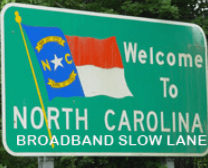
Editorial Cartoon on North Carolina Broadband Situation

Sent in by one of our readers (click to enlarge)

Share

An Open Letter to Content Producers: Netflix, Hulu, Valve, Microsoft, Sony, and Nintendo

Dear Content Producer:

Your money train is leaving the station.

Customers are about to start making some very important choices about what they do on the Internet. AT&T announced this month they are going to start capping their DSL customers at 150GB per month and their fiber-to-the-neighborhood U-verse customers at 250GB per month, with overlimit fees for those who exceed them.

Comcast already has a 250GB per month cap, currently loosely enforced. Time Warner Cable has strongly advocated usage-based billing for years. Other telecommunications companies are all either supporting or considering these Internet Overcharging schemes for one reason, and one reason only:

It makes them absolute boatloads of cash.

Canada already lives with this reality. So does Australia, although they’re backing away from it. South Korea? Japan? Europe? Nope. Flat-rate Internet service is the norm there.  In Europe, mobile customers are demanding the removal of bandwidth caps American providers are still trying to attach to customers’ bills.

So how does this impact you? 250GB a month is a lot, and you’ll be fine? Sure. For now.

But what happens when Sony introduces the Playstation 4, or Microsoft announces the Xbox Next? Games aren’t exactly going to get smaller, and online distribution is far and away the future of games and software in general. Right now a game for the 360 or PS3 can be as large as 20GB. PC game enthusiasts routinely cope with 10-12GB game upgrades, and woe be unto you if you have to reinstall your Steam library and have 20-30 (or more) games to restore.

Internet Overcharging schemes make providers, and the lobbyists who do their bidding, very wealthy.

For the “Massively Multiplayer Online” game universe, incremental software updates and upgrades often come through BitTorrent, which exposes users to peer-to-peer traffic well beyond the size of the update itself.  In fact, as games increasingly turn towards Cloud storage and distribution, the traffic adds up.

For online video companies, your very business model could be at risk.  Netflix? Hulu? People are no longer satisfied with grainy, compressed video.  They want HD content, and you’ve answered the call.  But as consumers increasingly face 8-10GB per movie (at 720p, 15GB+ for 1080p), the usage racked up is going to blow past all of these caps.

Who knows what happens in the next five years, or ten.  Considering Canada, where a similar duopoly of broadband providers have lowered usage allowances, do you really expect anything different down here?  The only thing likely to be raised is the monthly price, which remains higher here than in most places around the world.

Google has the right idea with their experimental 1Gbps fiber-to-the-home network. The problem is, that’s only going to serve one (or perhaps a few) communities in the U.S.  The rest of the country will have to survive with ‘Ultra’ cable broadband packages serving up 10-20Mbps service or DSL that barely manages 6Mbps.  If you don’t live in an urban area, tough luck.  You will be lucky to get 3Mbps service.

Broadband service upgrades come painfully slow in the absence of robust competition.  Time Warner Cable and other providers are slowly starting to roll out DOCSIS 3, which allows speeds up to 100Mbps, assuming the average consumer can afford the Cadillac price that comes with it.  Many phone companies continue to bet the farm on their DSL service, which can also be expensive when it’s the only broadband service in town.

Against this backdrop, the rest of the world marches on, and beyond, North America.

South Korea? They’re promising national speeds of 1Gbps by 2013 — for $27 a month!

How has this happened?  Where have we gone wrong?

For starters, the broadband providers have very powerful lobbyists — quite a few of which are ex-legislators. Together, they wage their public policy battles on both the state and federal level, often writing the bills a compliant legislator is willing to introduce as their own.

Washington regulators take a "see no evil, hear no evil" approach to regulating super-sized corporations who can cause them trouble.

The Federal Communications Commission has adopted a “see no evil, hear no evil” approach to broadband, capitulating when a chairman occasionally strays too far into the industry minefield laid to protect their business agenda.  As a result, the agency is a toothless dog.  It recently adopted a “Net Neutrality” policy all but written by Verizon, who ironically is now spending money to fight the rules they helped write.  As a backup, virtually every Republican and several Democrats have teamed up to pass a Resolution of Disapproval seeking to overturn the weak-kneed Net Neutrality rules the FCC adopted.  Lobbyists are well paid to cover every contingency.

Consumers — your customers — can’t do much about this beyond writing their members of Congress and complaining.  But because they did not enclose a check or money order made payable to the respective politician’s campaign fund, the result will be a form letter response weeks, if not months later… after the corporate agenda is enacted into law.

We just cannot fight this battle all by ourselves.  Recognizing the realities of today’s politics, we need your help to fight money and power with money and power.

The video game industry earns billions yearly. You have already faced battles in Washington, so you know how this works. You can fight for your interests while protecting ours by ensuring broadband service is cheap, plentiful, and unlimited. The same story applies to other content producers, such as online video, software, and any other company that wants to move to online distribution to power their business. You cannot succeed if customers are too afraid of using your service because of a bandwidth cap.

The remarkable thing is that countries many Americans cannot find on a map are now beating the United States with better and cheaper broadband while we hand over our digital economic future to a duopoly. That will not buy us better service, just bigger bills for “fast enough for you” Internet access.

So that’s it. Act now. Act strongly. If you cannot stand up for your customers, you may not have any.

Signed: A gamer. A movie watcher. A music listener. An enjoyer of entertainment. A lover of the Internet.

Broadband consumer and reader Jason Ballew penned this guest editorial, with some editing and additions from Stop the Cap! editor Phillip M. Dampier.

Share

Travesty: North Carolina’s Telecom Companies Oppose 4Mbps Broadband Service in Rural Areas

Despite today's setback, North Carolina's broadband hero is Rep. Bill Faison, who stood up for rural broadband.

In the North Carolina legislature’s Finance Committee, a one week timeout “to hear views from the public” actually means giving breathing room for cable and phone lobbyists to strip away surprise amendments not to their liking.  This morning, in a catastrophe for consumers, the state’s largest phone and cable companies got legislators to wipe out a provision that would have helped guarantee rural North Carolina at least 4Mbps broadband service, either from existing providers or new ones that develop in their absence.

During debate of H.129, the anti-Community Broadband bill, North Carolina consumer interests were kept out of sight and mind as lobbyists worked their magic to get rid of Rep. Bill Faison’s (D-Caswell, Orange) amendment that would set the state’s minimum acceptable definition of broadband at 4Mbps with a 1Mbps upload speed.  With the help of several flip-flopping representatives, they got their wish.

Faison’s amendment was designed to open the door to someone — anyone – to bring broadband into rural areas of the state.  While Time Warner Cable, AT&T, and CenturyLink dawdle, large numbers of rural residents simply go without any broadband service.  Faison’s amendment was simple and reasonable — if at least half of an area is not served with 4/1Mbps service, provisions should be made to allow local communities, if they wish, to establish service themselves to get the job done.

Last week, when Faison’s amendment appeared to be headed for incorporation into the bill, industry lobbyists blanched and fled the room, raising vocal objections and demanding a week timeout before a vote was taken.  After winning their reprieve, they managed to get the Republican majority in line to throw rural North Carolina under the bus, uniformly opposing Faison’s amendment.  Two Democrats, one representing the city where Time Warner Cable’s regional division is headquartered, joined them.

Hall of Shame: Rep. Carney does not care about North Carolina's digital divide.

In its place, they substituted a new amendment which defined broadband in the state of North Carolina as any service occasionally capable of achieving 768kbps downstream and 200kbps upstream.  That represents “well-served” among these industry-friendly legislators.

Among the worst offenders that stood out today were Reps. Jeff Collins (R-Nash) and Becky Carney (D-Mecklenburg).  Last week, they were standing with North Carolina consumers.  This week, they are voting for the interests of the cable and phone companies.  Rep. Carney, who lists her occupation as “homemaker”, voted to guarantee North Carolina families years of slow, expensive and erratic broadband service, if available at all.  Collins supported an amendment that says Nash County residents should do just fine with broadband speeds that don’t even manage to break 1Mbps.

The bill next moves to the floor of the House for consideration.

What is missing from this debate is a realization on the part of the legislature cable and phone lobbyists do not want anyone delivering basic broadband service in rural North Carolina unless it comes from them, and to date they have shown no interest in delivering it.

After all the debate, here is a fact no one can ignore.  The only networks in the state capable of delivering world class 100Mbps broadband are two fiber based community-owned networks in Wilson and Salisbury.  The companies that want to see them out of business see 768kbps as more than adequate to define broadband availability in North Carolina.  When members of the Finance Committee agreed, it helps explain how the state has managed to rank 41st in broadband excellence.

It’s time to ask your legislators what side they are on.  Yours or the state’s cable and phone companies.

Share

AT&T Data Caps: Gizmodo’s Joe Brown In Over His Head on G4TV’s Attack of the Show

Joe Brown was obviously not the right person for G4TV’s Attack of the Show to talk to about the issue of Internet Overcharging.

As AT&T begins notifying their DSL and U-verse customers they are about to face usage limits on their broadband service, G4TV sought out reaction from the features editor of Gizmodo.com, who was wholly unprepared to inform viewers about the facts behind AT&T’s usage caps and their implications for customers.

While Brown and G4TV were joking about users having to curtail game downloads, for millions of AT&T customers, it’s no laughing matter.

AT&T’s announced 150-250GB limits will eventually cost customers $10 or more for each extra 50GB allotment, on top of their already-expensive broadband service package.

“It really had to happen eventually I think,” Brown told viewers.  “People are using a lot of bandwidth.”

Gizmodo's Joe Brown talks with G4TV's Attack of the Show

But Brown’s observation conflicts with AT&T’s own claim “only a tiny minority of customers” will use more than the company wants to allow, with the average AT&T customer consuming 18GB per month.  AT&T isn’t telling the full story about that either.

For those “heavy users” AT&T wants to restrict first, the implications go well beyond curtailing Netflix and playing online games.

“As a software developer who works under a Linux environment and is forced to telecommute from home one week per month, these caps would absolutely kill me,” writes Joe Stein from Sparks, Nev.  “If you are a retired person using your computer to check e-mail and browse the headlines, you will obviously never exceed AT&T’s caps, but for technology innovators and those like me in the software development field, 150GB is nothing.”

Stein downloads regular updates for Linux, exchanges software back and forth with the office several times a day, and uses video conferencing regularly when he works from home.

“Not all online video is about adult entertainment or downloading movies,” Stein says.  “Usage caps hurt anyone who has to work with large files or business-related video, and after the events this week, AT&T can afford to leave off the caps.”

Brown claims AT&T conducted “a study” in two cities which found that 98 percent of their customers used far less than the usage caps would allow.  What Brown does not know is that those two cities are Beaumont, Texas and Reno, Nevada — hardly superstars in the tech revolution.

“Nobody moves to greater Reno to be a software superstar, which is why I am in San Jose, Calif., all the time,” Stein says.  “But there is more to this area than casinos.”

Stop the Cap! has been helping consumers in both cities avoid AT&T because the company’s “study” came at the same time it was experimenting with an Internet Overcharging scheme that limited customers to as little as 20GB of usage per month — a strong incentive for customers to avoid high bandwidth services,  or better yet AT&T.  So it’s no surprise broadband users who know better chose an alternative provider, including Stein.

“I first became aware of the usage cap debacle a few years ago when AT&T tested usage caps in the Reno area, which covers Sparks,” Stein says.  “I saw the impact first hand when customers started getting notified they would have to pay substantially more for basic Internet service.”

Lvtalon

AT&T first limited their broadband customers to as little as 20GB of usage per month, then claimed the average customer only uses 18GB, making their 150GB DSL cap "generous."

Stein left for the cable company — Charter Communications, and they have usage caps too, but they are rarely enforced and much higher than what AT&T offers DSL customers, Stein says.

Brown claims AT&T is trying to “get out ahead of people using too much,” a point in conflict with the fact AT&T is willing to sell consumers additional bandwidth on its “overcongested” network.

Brown’s suggestion that “bandwidth costs money” is partially true, but not in the context of AT&T’s usage limits.  The company that can afford fiber optic upgrades to deliver limitless television and telephone service apparently cannot afford the pennies in bandwidth costs customers consume as part of their broadband service, which can run $50 a month or more.

Pondering broadband usage “fairness” is a losing proposition for consumers… and reporters, too.

Once someone blindly accepts the premise AT&T needs data caps, with no evidence usage presents a technical or financial challenge for the company, the debate is quickly reduced into a numbers game about “how much usage is fair.”

Clearly for Brown and his friends, who admit they are dangerously close to reaching or exceeding AT&T’s limits, the answer to Brown wondering aloud if the caps would “do it for him” should be no.

Stop the Cap! believes no cap is worth living with, especially on AT&T’s enormous-sized broadband network, now increasingly designed to handle the multimedia rich Internet and their U-verse platform.

It is doubtful many will be assuaged by Brown’s comments that “AT&T sounded pretty cool” about how they will deal with those who exceed their arbitrary usage limits.  Why?  Because after the “fair warnings” AT&T will provide customers on its artificially limited network, they will drop the sledgehammer of higher bills on top of customers’ heads.

Brown should know better, especially after finding AT&T unwilling to discuss how often it intends to revisit its usage cap levels.  AT&T’s counterparts in Canada have already foreshadowed the answer.  Once the cap regime is in place, several companies lowered them, sometimes repeatedly, to further monetize broadband usage.  They also raised the prices of overlimit fees, often substantially.

AT&T depends on uninformed consumers and reporters not understanding the true facts about Internet Overcharging schemes.  It’s not too late for reporters like Joe Brown to undo the damage, however.

Stop the Cap! strongly encourages everyone to examine the evidence we have compiled here over the past two and a half years.  It’s not hard to discover AT&T’s usage caps have nothing to do with fairness, are arbitrary and unnecessary, and come as a result of providers seeking higher profits in an undercompetitive marketplace.

If we do not uniformly and loudly oppose usage limits, America’s broadband rankings, digital economy innovation, and high technology jobs are all at risk, just to satisfy AT&T’s insatiable appetite for higher profits.

(P.S. – Joe: How did you miss Comcast has been capping their customers at 250GB for two years now.  Say it ain’t so, Joe!)

http://www.phillipdampier.com/video/G4TV Attack of the Show ATT Caps Their Data Usage 3-15-11.flv

G4TV’s ‘Attack of the Show’ misses the boat on AT&T’s Internet Overcharging scheme.  They did better covering Time Warner Cable’s attempt at Internet Overcharging in 2009.  It’s time to revisit this issue and get involved in the fight that could hurt the very audience watching this show.  (6 minutes)

Share

NC Politician Under Fire for ‘Pay to Play’ Telecom Politics; Demands TV Camera Be Shut Off During Interview

"I wish you'd turn the camera off now because I am going to get up and leave if you don't," said Rep. Julia Howard. (WNCN-TV)

Rep. Julia Howard (R-Davie, Iredell) threatened to get up and leave an interview with a Raleigh television reporter if the NBC station didn’t “switch the camera off” after she was questioned about her support of an anti-consumer, anti-broadband bill written by the same telecommunications companies that donated more than $7,200 to her political campaign.

Howard was being interviewed by WNCN-TV in Raleigh about her strong support for legislation that would likely end community-owned broadband in one of America’s least-wired states.  The reporter asked Howard to explain her support for H.129, the so-called “Level Playing Field” bill that has received a considerable push from the state’s largest telecommunications companies, including Time Warner Cable, AT&T, and CenturyLink.

At first, Howard tried to defend her support for the bill, despite claims from the watchdog group Democracy North Carolina that the legislation raises ethical questions about the influence of money in state politics.

“I don’t care what they say. That’s not who I am,” she said. “As long as I’m here, I’m going to do what I feel like is right for the people of the state.”

But moments after being confronted with the fact she has received considerable financial support from all three companies, Howard demanded the reporter turn the cameras off.

“I wish you’d turn the camera off now because I am going to get up and leave if you don’t,” Howard told the reporter.

Bob Hall, director of Democracy North Carolina called the bill a classic example of “pay to play” politics — where large companies pay to get legislation favoring their businesses before the state legislature.

“The relationships that are built because of money that’s given, that then warps the whole discussion,” Hall said.

The Raleigh NBC affiliate uncovered pages of campaign contributions to lawmakers supporting H.129 from the state's largest cable and phone companies. (WNCN-TV)

Howard chairs the Finance Committee that will hear the bill tomorrow morning after a week’s delay.  Surprise amendments that would help hold existing networks exempt from the onerous provisions of the legislation and an easing of the bill’s requirements for unserved areas upset cable industry lobbyists.  In the interim, a growing number of media reports have called attention to the corporate contributions that seem to be helping drive the bill forward.

“There are a handful of politicians in the legislature that are either on the take or wear blinders when it comes to the real interests of voters like myself,” writes Raleigh resident Susan, who follows Stop the Cap! “Watching Julia Howard squirm in her chair when being asked pointed questions serves her right.”

Susan, who notified us of tonight’s news report, doesn’t believe for a moment Howard’s “feigned shock” over questions being asked by the reporter.

“Anyone pushing H.129 is a shill for Time Warner Cable, because there is not one single part of this bill that brings one new Internet connection, it just guarantees we will all pay higher rates so the cable company can donate more money to Howard’s campaign.”

Stop the Cap! continues to recommend North Carolina residents contact members of the Finance Committee and tell them to vote NO on H.129.  Tell Rep. Howard and others it is not too late to do the right thing and withdraw this bill from further consideration.  Explain to her that if her word is her bond, she can prove her honorable intentions by asking Rep. Avila to pull the bill because it is a mistake and won’t bring better broadband to anyone.  We want Rep. Howard to retain the goodwill of the people of North Carolina, but that becomes increasingly difficult if she can’t even defend what she is doing to a reporter asking if there is a connection between her support and the thousands of dollars of campaign contributions she has received from the industry that wrote the bill.

WNCN-TV caught Rep. Julia Howard off guard when she was confronted with thousands of dollars in campaign contributions from large telecommunications companies and asked if this played a role in her support for their custom-written proposal to abolish community-owned networks in the state.  (2 minutes)

Finance Committee Members

(click each name for contact information)

Senior Chairman Rep. Howard
Chairman Rep. Folwell
Chairman Rep. Setzer
Chairman Rep. Starnes
Vice Chairman Rep. Lewis
Vice Chairman Rep. McComas
Vice Chairman Rep. Wainwright
Members Rep. K. Alexander, Rep. Brandon, Rep. Brawley, Rep. Carney, Rep. Collins, Rep. Cotham, Rep. Faison, Rep. Gibson, Rep. Hackney, Rep. Hall, Rep. Hill, Rep. Jordan, Rep. Luebke, Rep. McCormick, Rep. McGee, Rep. Moffitt, Rep. T. Moore, Rep. Rhyne, Rep. Ross, Rep. Samuelson, Rep. Stam, Rep. Stone, Rep. H. Warren, Rep. Weiss, Rep. Womble
Share

Same Story, Different Countries: Whether It’s Bell or AT&T, Usage Billing & Caps Are Nonsense

http://www.phillipdampier.com/video/UBB is Nonsense.flv

François Caron produced this video succinctly smashing the myth that “usage-based billing” and “usage caps” are about fairness or fight congestion.  In this case, Caron refers to Canadian providers, but the story is much the same south of the border.  These Internet Overcharging schemes are nothing more than an effort to control what you can do with your broadband connection.  AT&T wants a 150-250GB usage cap on broadband, but has limitless capacity for television and telephone service.  They also have $39 billion to buy T-Mobile, but need to overcharge you for broadband service.  Bell in Canada wants -every- broadband user in Canada to pay this ripoff pricing.  Share with anyone who thinks paying for usage is anything like paying for water, gas, or electricity.  It’s not!  (6 minutes)

Share

FCC Chairman Opens Wireless Industry Convention Mouthing AT&T Talking Points

Genachowski

Federal Communications Commission Chairman Julius Genachowski spent this morning in Orlando delivering a keynote address opening the wireless industry’s annual trade show.

Stop the Cap! spent part of the morning following the event over a live stream that most wireless customers would never dare to watch — fearing they’d blow past their monthly usage limits.  Genachowski steered well clear of commenting on yesterday’s merger announcement between AT&T and T-Mobile.  But then AT&T must have hacked their way into the tablet the FCC chairman was reading from, because he suddenly launched into a series of talking points that could have come right off of AT&T’s government affairs website.

“Mobile broadband is being adopted faster than any technology in history, but there’s a catch,” Genachowski said. The chairman said the demand for wireless broadband is overwhelming the country’s wireless infrastructure. “The coming spectrum crunch threatens America’s leadership in mobile,” Genachowski said.

It appears Julius has been listening to AT&T executives who have made the spectrum crunch and “America’s leadership in wireless broadband” bullet points a hallmark of their argument for a merger with T-Mobile.

In fact, although T-Mobile delivers AT&T additional mobile broadband capacity in selected major cities, the company is likely to find many of T-Mobile’s cell sites redundant, and some of T-Mobile’s spectrum is incompatible with AT&T’s network unless customers are handed new devices.

America’s “leadership in mobile broadband” can be judged in many different ways.  For example, we feel many in Washington are helping AT&T lead the way to a mobile duopoly.  We are also leading with some of the most expensive mobile broadband service in the world, a fact of life that will never change in America’s shrinking competitive landscape.

Spectrum issues are solvable by the FCC without destroying competition with yet another colossal merger.  The chairman’s telegraphing of AT&T’s talking points can only be seen as an encouraging road map by which the huge telecom company can sell its deal to regulators by selling out consumers.

Share

Search This Site:

Contributions:

Recent Comments:

  • Smith6612: I always avoid the hype about super antennas. They don't do much besides induce more noise which really puts you back at square one anyways with digit...
  • Smith6612: Do you have any proof that they are in fact messing with VPN connections and what not? I'd like to see that myself, personally. If you don't use VP...
  • Smith6612: It seems there is still some work to be done to the comment editor, unfortunately. For some reason I can edit others' comments and I'm not even an adm...
  • James R Bivins: I live on a budget and cable is in that budget,but if you don't have cable or the speeds for the these sevices.You are out of luck when is comes to ru...
  • James R Bivins: People in rural area are not been offered the better option for true broadband.Cable is faster,cheaper,and has the GB's.They offer 1 to 3 services an...
  • Fred: Bruce Edward Walker and Dr. Joseph P. Fuhr, Jr are two frauds who no one needs to listen to....
  • nolan: antenna did not work, i have a outside antenna with a digital converter box that pulled in 31 channels.and clear cast only got 12, also have 2nd tv w...
  • David Smith: AT&T's bandwidth capping is akin, in my opinion, to trampling on free speech. The Internet and today's technology makes us realize that there is ...
  • Michelle: How can I file a lawsuit against Cricket broad spying on my service. Every time I connect to the internet, I am bombard with a VPN connection of a rou...
  • Theresa Reid: I just got my Clear Cast today I was able to get only 4 channels. It WILL be going back....
  • Alex Perrier: Ultra-Lite discontinued! :|...
  • Greg: Sonic.net will do 1Gbps for $70/month in their limited FTTH service area. They are a private company too. Admittedly they are a very awesome priva...

Your Account: