

 Subscribe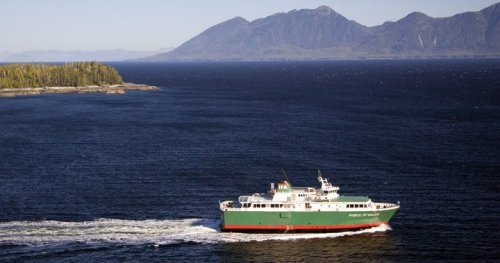
The 'Prince of Wales,' one of Inter-Island Ferry Authority's boats that connect the island to the mainland (Courtesy: Inter-Island Ferry Authority)
Providing broadband to 6,000 residents of Prince Wales Island, located along the western strip of Alaska that borders on British Columbia, Canada is the ultimate challenge. Parts of the island don’t even have access to traditional landline phone service, relying instead on fixed wireless service.
Residents have complained loudly about the poor quality of phone service on the island for years, particularly when it is provided to the 1,000 residents of Klawock, Craig, and several adjacent communities served by Alaska Communications Systems (ACS). Ten percent of ACS customers are stuck with fixed wireless, which guarantees no Internet access, and sub-standard phone service. What perturbs many of them is the fact another phone company’s landlines are within the sight of their homes and communities, but they can’t get service from that company. Those lines are owned by ACS competitor Alaska Power & Telephone (AP&T), an employee owned utility that serves many areas ACS doesn’t.
Friends and neighbors served by AP&T are happy with their telephone service. Residents served by ACS are not.
The Alaska Dispatch tells the story:
Every three months Ron Fitch drives five miles down a state highway so he can use a friend’s telephone to monitor his pacemaker.
Fitch, who lives on Price of Wales Island, has a phone at home, but he gets his service via fixed wireless, which is similar to a cell phone signal but is routed through a box mounted in the house. Since you can’t recalibrate a pacemaker over a wireless signal, Fitch makes the drive four times a year.
“Times have changed, and it doesn’t seem right that we can’t get Internet or a fax or anything over our phones,” said Eric Packer, a builder who lives outside Klawock. “It’s like living in the dark ages.”
ACS customers on the island have been complaining about their phone service for years, and for some the frustration is sharpened by the view of lines — owned by ACS competitor Alaska Power and Telephone — running near their homes. Two years ago the Regulatory Commission of Alaska opened an investigation into ACS service on the island, citing numerous customer complaints and a request from Sen. Lisa Murkowski.
With all of the negative press focused on ACS, the company relented, telling the Regulatory Commission it will offer to connect those fixed wireless customers to landline service, but will only pay for up to 1,000 feet of wiring between the nearest ACS junction box and the customer’s home. ACS will bill customers the balance of costs beyond 1,000 feet if a customer insists on landline service.
ACS is a major recipient of universal service funds which subsidizes phone service in rural areas to keep it affordable. ACS receives about $4 million a year. ACS fixed wireless customers on the island pay about $26 a month.
ACS customers perennially without broadband have complained to the Regulatory Commission, according to the Dispatch, suggesting it hurts the island’s economic development. Some customers have managed to switch to cell phone service and dropped landline/fixed wireless service, and a select few are trying to rely on satellite Internet service, which customers characterize as expensive and slow.
Pricing for landline DSL service from either ACS or AP&T is itself slow and expensive, and AP&T service is usage limited:

| 3 Mbps / 512 Kbps | $89 |
| 1 Mbps / 320 Kbps | $69 |
| 320 Kbps / 240 Kbps | $49 |
ACS promotes the fact their service is unlimited. Includes local and long distance telephone service. One year contract term required. Pricing may be higher in rural areas not specified on the ACS website.

| 64 kbps with 2GB of data transfer per month | $29.95 |
| 256 kbps with 10GB of data transfer per month | $49.95 |
| 512 kbps with 20GB of data transfer per month | $59.95 |
| 1 Mbps with 30GB of data transfer per month | $79.95 |
The 1Mbps service tier is currently available in select areas dependent upon local infrastructure. Each additional gigabyte of usage is pro-rated at $5.00/GB. AP&T provides wireless broadband in selected rural areas.

I always thought copper phone service in the US was a mandate.
I use to work for ACS.
As far as the fixed wireless service those residents have been provided, that’s a common setup ACS uses all across Alaska even in larger communities of up to 50,000 or more where they don’t want the expense of running lines to homes.
The company has been going through major cost cuts and slashing of jobs over the last 10 years and it hasn’t been getting any better.
IMO they’ve been trying to hold out long enough for a large telecommunication provider like AT&T to buy them out but I seriously doubt that’ll ever happen.
Residents at Edna Bay are able to get high speed internet which is enabling a high tech company to locate there provided the Sealaska Lands Bill S 881 dies in the Senate Resources Committee.
Call Senator Murkowski and tell her to kill this bill in committee. It is a very bad bill for Prince of Wales island.
I am the person who wishes to establish a high-tech internet-based company in Edna Bay Alaska. My vision for Southeast Alaska is to have our economy quit being based on the harvesting of natural resources and base it instead on non-polluting, low-resource-requirement technology jobs. There are hundreds, if not thousands, of very well qualified technical people who would love to relocate tomorrow to a beautiful place like Southeast Alaska if tech jobs were available here. I know because I happen to be one of them who has already made the move, but I had to bring my own “job” with… Read more »