

 Subscribe
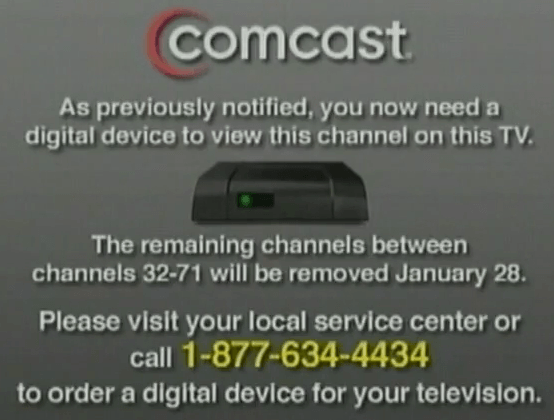 City by city, Comcast is continuing its quest to make the switch to digital cable for an increasing portion of its cable programming lineup. Although the majority of subscribers will encounter letters from Comcast switching only a portion of the analog cable lineup, it’s a safe bet Comcast is looking to an all-digital future sooner or later.
Coming less than a year after the switch to digital broadcast television, the march to digital cable is causing confusion for subscribers who don’t understand the difference.
Analog cable television has been around for more than 20 years in most American cities. It’s the kind of cable television that doesn’t usually need a converter box on top of the TV. Just plug the cable line into the back of your television set, let the TV find and map available channels, and you can use your standard TV remote to enjoy basic or enhanced basic cable television. Of course, if you subscribe to premium channels like HBO or Showtime, a box is required to descramble the encrypted signal.
Cable operators began launching “digital cable” in the 1990s, expanding the lineup of programming with hundreds of new channels that are compressed into a digital format, with a half dozen or more digital channels fitting in the same space used by just one analog channel. Space on the cable line is getting increasingly crowded as cable systems launch new HD channels, support telephone service, and expand broadband service and speeds.
To make room, several of those old school analog channels have to go… digital. If you already have a set top cable box — you probably won’t even notice the changeover. But if you don’t have one of those boxes in your home, and your television doesn’t support CableCARD technology, Comcast has some bad news for you. Sooner or later, you’ll either have to get a set top box or lose an increasing number of channels on your cable dial.
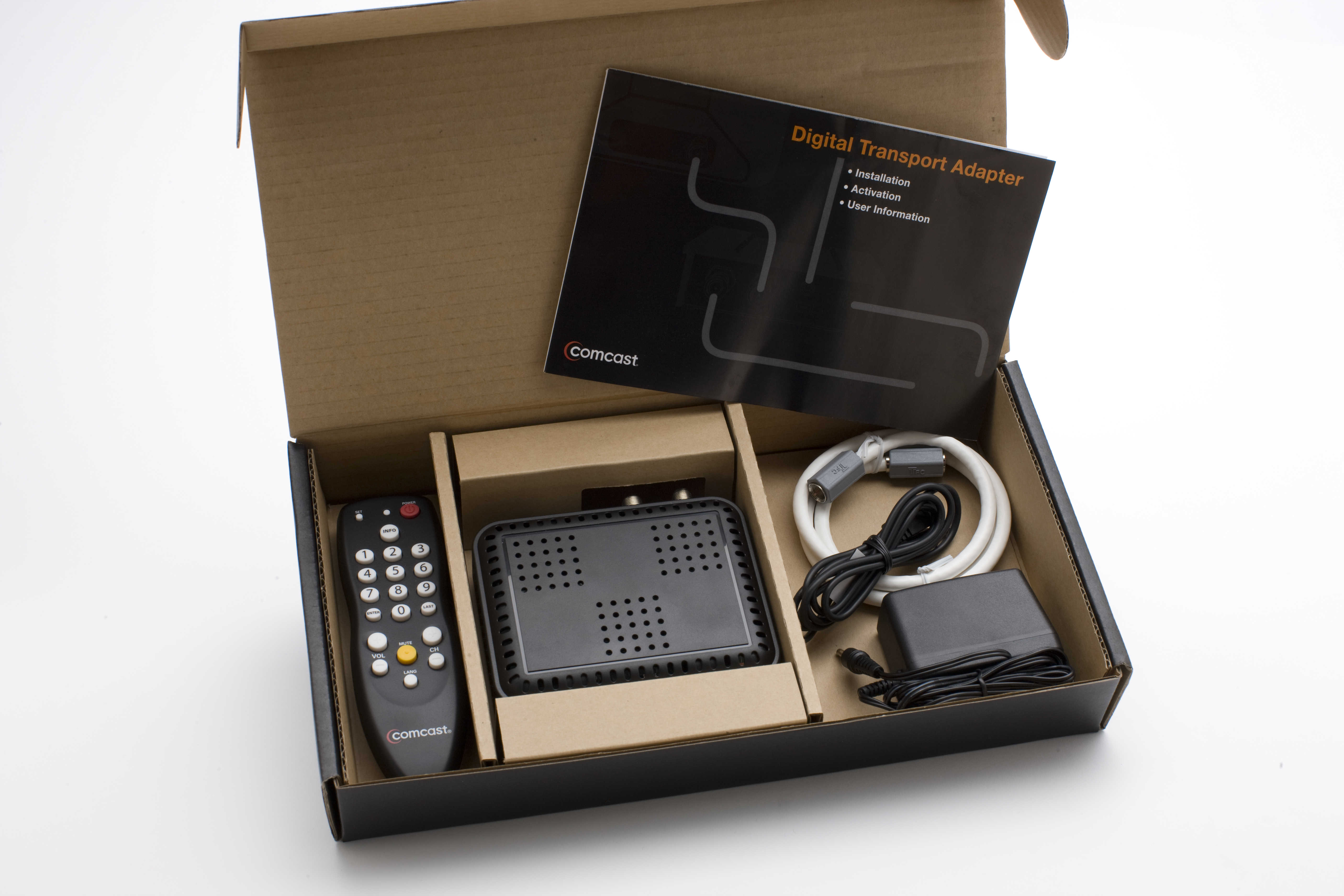
Comcast's digital adapter doesn't support HD channels
Comcast’s digital cable expansion is their solution to the traffic jam on their cable lines. Some other cable companies take a different approach. Knowing that many customers hate cable boxes, they’ve left analog channels alone, instead transmitting digital channels only to those homes actually watching them. If nobody in your neighborhood is watching Current or Fox Business News, why waste the space to send those signals down the line to… nobody. Time Warner Cable doesn’t for many of their digital channels. If one lives in an eclectic viewing neighborhood, there are problems with this approach. Potentially, if enough homes want to watch these lesser-viewed networks, and Time Warner runs out of the space it sets aside to carry a certain number of these channels, the subscriber will see a video busy signal — a message stating the channel is temporarily not available, at least until someone nearby changes channels, making room for the network you want to watch.
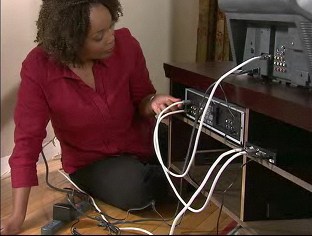
Comcast's digital solution is a problem for those who hate "the box" for weaving a rat's nest of cables behind one's television.
In most communities, Comcast will provide up to three digital adapter boxes at no charge, if you install them yourself on each television in your home. Additional boxes are usually $1.99 per month. That’s fine if you are still using an older television set and don’t care about HDTV programming — the digital adapters Comcast provides don’t support HD. If you do want HD channels, you’ll need Comcast’s traditional converter box, which runs about $7 a month per television, or a CableCARD, if your television supports it. Comcast also has elaborate instructions for customers with multiple TV inputs to support both standard and high definition signals, some through the digital adapter, others not, but it requires a lot of cables.
Customers who loathe boxes and don’t want to pay for them are upset by all of the changes, and either must cope with the new box, or gradually lose more and more analog channels as the conversion continues. Broadcast basic customers getting only local channels from Comcast are unaffected by all of this, at least for now. Owners of modern HD television sets aren’t impressed either — their sets, capable of receiving QAM digital cable channels without a box are no help because Comcast encrypts its digital cable lineup in many areas.
But the company still thinks of the project as a service upgrade for its customers, even dubbing it Project Cavalry on their company blog. When one customer wondered why the new equipment wasn’t available in his area yet, a company blogger responded, “We will not be “cherry picking” … all our systems will get the benefits. The Comcast Cavalry just hasn’t swept through your area yet, stay tuned.”
When asked why the devices don’t support HD channels, the response:
The DTA was designed as a low-end, basic device to do one thing and one thing only … convert digital signals back to analog for display on an analog TV. That’s all, no higher end outputs, no VOD, no HD, no interactive guide. Keeping the device simple as described is what kept the price down enough that we can provide so much free equipment to our customers. Also, the RF output makes it compatible with the absolute maximum number of TVs, which is critical to the program. As a digital device, however, it does offer dramatically-improved picture quality over analog even through the RF output.
[flv]http://www.phillipdampier.com/video/Comcast DTA Tutorial.flv[/flv]
Watch Comcast’s tutorial on installing their Digital Adapter. (4 minutes)
[flv width=”640″ height=”500″]http://www.phillipdampier.com/video/Comcast Digital Migration.flv[/flv]
Watch a coast-to-coast series of news reports detailing the Comcast transition to digital, starting with the message customers see on their now-missing favorite channels. (15 minutes)

Several comments here: “Cable operators began launching “digital cable” in the 1990s, expanding the lineup of programming with hundreds of new channels that are compressed into a digital format, with a half dozen or more digital channels fitting in the same space used by just one analog channel.” Actually it is 12-15 SD channels per QAM (the space of one analog channel). 2-3 HD channels per QAM. “If one lives in an eclectic viewing neighborhood, there are problems with this approach. Potentially, if enough homes want to watch these lesser-viewed networks, and Time Warner runs out of the space it… Read more »
In regards to one of the Comcast’s statements: “As a digital device, however, it does offer dramatically-improved picture quality over analog even through the RF output.” BULLSHIT, absolute BULLSHIT!!!! The process of converting analog SD channels to digital REDUCES quality. Further, the quality of the mdoulators used in these boxesss is substandard. Comcrap (like a lot of folks) trys to claim that “digital is better” – NOT! You are absolutely correct my friend and unfortunately one of the few that can see past the BS. Folks, digital is NOT superior to analog. The reason why digital formats are being adopted… Read more »
Tim, I’m glad that you agree with me on the BULLSHIT angle: but I must take some exception to your statement: “I hear this argument all the time on the audio side. People think CD’s are better than vinyl which they are dead wrong. CD’s are just more durable and convenient than vinyls. CD’s being digital are limited in depth and sampling rate. Analog, there are no limits like that. The best example of analog superiority, would be you eyes and ears.” If you had confined your statement to analog tape recordings, I might agree. But NOT vinyl. Vinyl discs… Read more »
I have pretty good ears. My wife says I hear stuff she can’t in music. My brother and I have done several tests comparing his records to their CD counterparts. All I can say, vinyl had more dynamic range than the CD counterparts. All in all, they sounded superior to CD to both of us. Even a conversion to digital, we heard degradation in the music when comparing it to the original. Although, it still sounded better than the CD version. I guess equipment plays a part in it. If you don’t have a good needle and table, you probably… Read more »
I wish that the FCC would make it mandatory to allow consumers to use their QAM tuners to receive all entitled broadcast, eliminating the need for Set-Top-Boxes.
Enhanced services such as PPV, VOD and the like understandably require additional hardware, but shold not be required for tuning a channel.
“I wish that the FCC would make it mandatory to allow consumers to use their QAM tuners to receive all entitled broadcast, eliminating the need for Set-Top-Boxes.”
They do. No local Broadcast channels are encypted.
Sure they do for the “local” broadcast stations, but they should put all of the channels that they can(including hd) on the QAM channels so I don’t have to have a cable box at both of my digital hdtv’s. I dont’ subscribe to anything but the basic tier with hd, no HBO or Starz channels to worry about, why then can’t I get all of my hd channels on a tv without a cablebox? They say it’s included for free with the basic tier anyways, so anybody that has any tier of cable with Crime Warner should be able to… Read more »
Jeremy/PreventCAPS: The problem is how do they handle things like TNT HD? They are part of expanded basic – not the “lifeline” basic (at $10/month). They can’t use traps – as traps are not efficient from a spectrum standpoint. The only thing that they can do is encrypt. Further, these HD channels take a lot of bandwidth. There are two ways to deal with that: 1) Do what Comcrap did (and the subject of this piece): Convert everything to digital, forcing viewers to get digital terminal adapters. 2) Do what TW is doing: use SDV (Switched Digital Video), which Phillip… Read more »
It’s that the cable companies taking advantage of the fact that they can override standards put in to place and force the use of proprietary equiptment and their outragous rental fees. I have a device designed to be able to tune a HDTV signal from a cable company, but the cable company won’t serve it to it’s potential.
Jermey gets it – the key was all entitled broadcast. A QAM tuner should be able to dial in any channel that I subscribe to with out a set top box.
Extra features like pay-per-view, video on demanand and interactive program guides etc are another story as they requite two way communication and a client side computer. It makes sense to have a set top box. But if I just want to dial in a channel number and watch, I shouldn’t need any extra hardware and associated rental fees.
The problem with “I should be able to tune into any channel that I want” is that we’re talking about a one-way medium. It’s not like a different channel portfolio is getting pushed down your wire if you’ve got UltraPlusHD versus basic cable…
Ian,
This like describe spectrum traps used togate-keep premium content.
http://www.dewtronics.com/tutorials/descramblers/notchfilter/hist.pdf
Traps would be even easier in the digital world because you just need to make the signal digitally unviable, vs with analog, the signal needs to be totally eliminated.
Ian,
With TW and SDV we ARE talking about a TWO WAY medium – they only push the channel down your wire if you tune to that channel. Your set needs the capability send a signal to ask for that channel.
QAM is not a two way medium. We as consumers are protesting mandatory SDV (and associated STBs) because it simply isn’t necessary for basic viewing. For premium services such as PPV and VOD, we concede that two-way communication is necessary.
WE the consumers does not include ALL of US!!!! I’ll bet that given all the facts that the majority of US consumers do prefer SDV.
What is YOUR alternative to SDV:
Reduce the number of HD channels?
Switch all of the analog channels to digital (the subject of Phillip’s post)?
User higher compression rates to jam more HD signals in a QAM? (perhaps 4 HD channels per QAM)?
I’m not saying that SDV is a bad thing… Propritary STBs and the outragious rental fees (the subject of phillips post) are. This paragraph from the article does a decent job as describing me as a consumer: “Customers who loathe boxes and don’t want to pay for them are upset by all of the changes… Owners of modern HD television sets aren’t impressed either — their sets, capable of receiving QAM digital cable channels without a box are no help” A few side notes: QAM can alleviate the congestion as it can carry multiple programs in the same space of… Read more »
I wish Comcast would go all digital in all their markets like in Augusta, GA
I’ve bee through 2 of the DTA adapters now, with multiple resets and I am missing many channels, including local channels that I can receive without an adapter. Just get a temporary loss of service screen, which is permanent.
Now, I’ve read on another site that Comcast admits the DTAs are incompatible with some modern digital TV tuners.
I’m reluctant to bother trying to rewire after I read this.
What a mess. Support is always nice and thanks me for choosing Comcast. If I had a choice for cable broadband, I would be trying someone else.
I believe comcast has just performed the digital migration (not!) in my area, 03842. A couple of weeks ago, all channels (basic and expanded cable) were broadcast on digital channels. I rescanned my QAM tuner and “hid” all the analog channels (since that hadn’t stopped broadcasting them. I also got the DTA’s and Settop box (the “free” one with composite video output and channel guide support). Late last week, nearly all the digital broadcast channels disappeared (the exception being over the air digital channels and the religious and shopping channels of course) I had to rescan my QAM tuner and… Read more »
My area is currently suffering through the Comcast digital overhaul. I have not received any information online or in my billing that indicates when the actual switch over will occur but I am constantly annoyed by a message scrolling across the top of my screen telling me to contact Comcast online or at their toll free number. The messages used to appear for a few minutes each hour but are now onscreen for half of each hour. The constant scrolling makes anything I want to watch unwatchable as it is always in my field of view and causes anxiety. Fine,… Read more »
Yeah, here in 46530 that change is present. The problem that most of us face is 2 fold: 1) the way that communistcast has bundled the TV+Internet package, not being able to divide the service separately. Always claiming that if you got just High Speed Internet that cable is also transmitted down the cable and folks would be getting both. 2) The cost for subscribing to the most basics of cable service require some kind of convaluted and complicated setup in the home (DTA, DVR boxes) that take up room in my hometheatre cabinet hjst for basic regular good ole’… Read more »