

Recent Headlines
October 2, 2009
Be Sure to Read Part One: Astroturf Overload — Broadband for America = One Giant Industry Front Group for an important introduction to what this super-sized industry front group is all about.
Members of Broadband for America
Red: A company or group actively engaging in anti-consumer lobbying, opposes Net Neutrality, supports Internet Overcharging, belongs to an astroturf [...]
October 2, 2009
Astroturf: One of the underhanded tactics increasingly being used by telecom companies is “Astroturf lobbying” – creating front groups that try to mimic true grassroots, but that are all about corporate money, not citizen power. Astroturf lobbying is hardly a new approach. Senator Lloyd Bentsen is credited with coining the term in the 1980s to [...]
September 27, 2009
Hong Kong remains bullish on broadband. Despite the economic downturn, City Telecom continues to invest millions in constructing one of Hong Kong’s largest fiber optic broadband networks, providing fiber to the home connections to residents. City Telecom’s HK Broadband service relies on an all-fiber optic network, and has been dubbed “the Verizon FiOS of [...]
September 23, 2009
BendBroadband, a small provider serving central Oregon, breathlessly announced the imminent launch of new higher speed broadband service for its customers after completing an upgrade to DOCSIS 3. Along with the launch announcement came a new logo of a sprinting dog the company attaches its new tagline to: “We’re the local dog. We better be [...]
September 23, 2009
Stop the Cap! reader Rick has been educating me about some of the new-found aggression by Shaw Communications, one of western Canada’s largest telecommunications companies, in expanding its business reach across Canada. Woe to those who get in the way.
Novus Entertainment is already familiar with this story. As Stop the Cap! reported previously, Shaw launched [...]
September 22, 2009
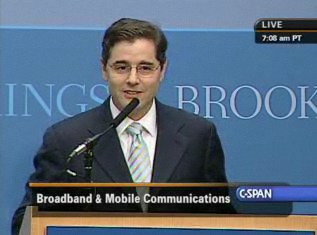
The Canadian Radio-television Telecommunications Commission, the Canadian equivalent of the Federal Communications Commission in Washington, may be forced to consider American broadband policy before defining Net Neutrality and its role in Canadian broadband, according to an article published today in The Globe & Mail.
[FCC Chairman Julius Genachowski's] proposal – to codify and enforce some general [...]
September 21, 2009
In March 2000, two cable magnates sat down for the cable industry equivalent of My Dinner With Andre. Fine wine, beautiful table linens, an exquisite meal, and a Monopoly board with pieces swapped back and forth representing hundreds of thousands of Canadian consumers. Ted Rogers and Jim Shaw drew a line on the western Ontario [...]
September 11, 2009
Just like FairPoint Communications, the Towering Inferno of phone companies haunting New England, Frontier Communications is making a whole lot of promises to state regulators and consumers, if they’ll only support the deal to transfer ownership of phone service from Verizon to them.
This time, Frontier is issuing a self-serving press release touting their investment of [...]
September 7, 2009
I see it took all of five minutes for George Ou and his friends at Digital Society to be swayed by the tunnel vision myopia of last week’s latest effort to justify Internet Overcharging schemes.
Until recently, I’ve always rationalized my distain for smaller usage caps by ignoring the fact that I’m being subsidized by the [...]
September 1, 2009
In 2007, we took our first major trip away from western New York in 20 years and spent two weeks an hour away from Calgary, Alberta.
After two weeks in Kananaskis Country, Banff, Calgary, and other spots all over southern Alberta, we came away with the Good, the Bad, and the Ugly:
The Good
Alberta is like [...]
August 31, 2009
A federal appeals court in Washington has struck down, for a second time, a rulemaking by the Federal Communications Commission to limit the size of the nation’s largest cable operators to 30% of the nation’s pay television marketplace, calling the rule “arbitrary and capricious.”
The 30% rule, designed to keep no single company from controlling more [...]
August 27, 2009
Less than half of Americans surveyed by PC Magazine report they are very satisfied with the broadband speed delivered by their Internet service provider.
PC Magazine released a comprehensive study this month on speed, provider satisfaction, and consumer opinions about the state of broadband in their community.
The publisher sampled more than 17,000 participants, checking their actual [...]
In regards to Julius Genachowski:
I like how he mentioned that back in the dial-up days, there was competition. But as people move to broadband, that just isn’t the case.
Also, I like how he said, “People will either view this as pro-consumer or pro-business. I reject that. It will benefit consumers as well as businesses.”
I hope this isn’t just all talk. I hope they act on what he said.
Lastly, we are the United States of America. We should be leading the world in innovation not trailing it in something like 17th place.
I agree, Tim. This is very pro-business for all of those 21st century economy businesses already out there and those to come. Nobody expects broadband providers to lose money constructing and expanding their networks, and guess what, they are not. In fact, the more compelling their service is, and the more variety in speeds offered, the more subscribers they will get.
I am ready and willing to pony up more money myself for a premium level of Time Warner’s Road Runner service if it means faster uploads and mildly faster downloads. I spent 45 minutes yesterday uploading the video you see above because TWC maxes out their Turbo customers at 1Mbps upload speed in Rochester. It’s 2Mbps or greater in markets where they face more than just a DSL competitor. I don’t need 150Mbps service, but would gladly pay a premium for, say, 3-5Mbps upload service. That makes my life easier and helps me get content on here sooner.
Businesses trying to service customers can maximize benefits from faster broadband as well, especially to do things like file backups, online video, software distribution, remote monitoring, and applications I can’t even dream of right now.
ISPs could easily be in the web hosting business much more than they are right now. I could then purchase hosting space from TWC or another provider and they’d earn money from me as a content producer as well, if their package was attractive enough.
There is plenty of money to be made by providers in a Net Neutral world. Unfortunately, the tendency to try and control and manage everything reduces innovation and ends up hurting them (and us) in the end.
