

 Subscribe
Stop the Cap! reader Jeremy received a reply to a communication he sent to his senator, Sam Brownback (R-Kansas). Brownback has signed on for big telecom’s “nickle, dime, and dollar subscribers” project and thinks it’s great news for an Internet controlled by profit leveraging corporations charging top dollar while promising to expand services later.
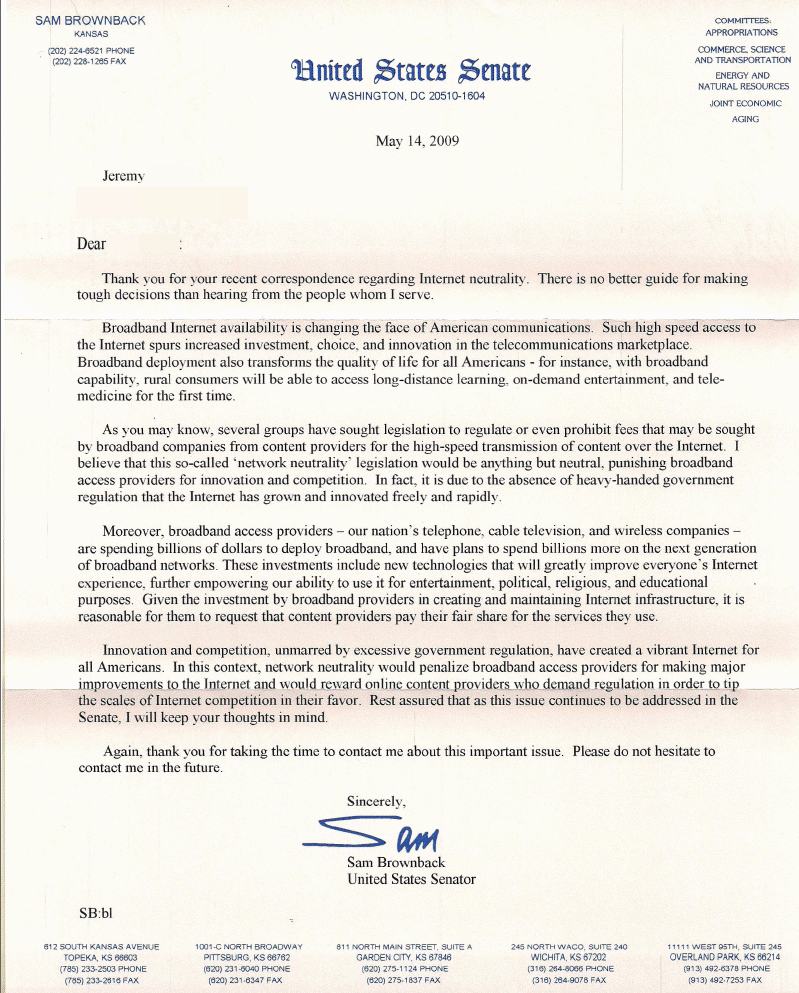
Full text of letter from Sen. Sam Brownback (R-Kansas) (click to enlarge)
As you may know, several groups have sought legislation to regulate or even prohibit fees that may be sought by broadband companies from content providers for the high-speed transmission of content over the Internet. I believe that this so-called ‘network neutrality’ legislation would be anything but neutral, punishing broadband access providers for innovation and competition.
In fact, it is due to the absence of heavy-handed government regulation that the Internet has grown and innovated freely and rapidly.
Moreover, broadband access providers – our nation’s telephone, cable television, and wireless companies – are spending billions of dollars to deploy broadband, and have plans to spend billions more on the next generation of broadband networks.
These investments include new technologies that will greatly improve everyone’s Internet experience, further empowering our ability to use it for entertainment, political, religious, and educational purposes. Given the investment by broadband providers in creating and maintaining Internet infrastructure, it is reasonable for them to request that content providers pay their fair share for the services they use.
Brownback is confusing the broader argument about Net Neutrality, allowing data equal access on a network, regardless of its source, affiliation, or potential competitiveness with a provider’s own products and services, with the bandwidth Cap ‘n Tier problem Jeremy wrote about. But Net Neutrality and Cap ‘n Tier are effectively kissing cousins: they go hand in hand. As we’ve seen in Time Warner Cable’s Subscriber Agreement, they exclude their own Digital Phone product from Cap ‘n Tier while subjecting other competitors to it, if/when implemented. They also reserve the right to throttle speeds, limit consumption, or impose overlimit fees for exceeding usage allowances.

Sen. Brownback (R-Kansas)
We’ve also seen a direct link between the growth of online video, the cable industry’s concern they will lose cable TV subscriptions to online free video, and attempts to charge higher prices and/or limit use of the net as a way to address the online video “problem.” Scaring subscribers away from watching online video without fear of overlimit fees is a fine way to “keep the lid on.”
What America has come to discover in the last year is that free market competition is fine, but the absence of common sense oversight and regulation means runaway profiteering and customer abuse, often in markets that lack competitive choice on equal terms.
Brownback may also not realize that cable companies often have an ownership interest in the content producers, and they have a vested interest in retaining control over that content. Unlike content producers like Hulu, who do not charge any fees to access their content, the broadband provider itself does, raking in billions in profits using today’s broadband model. Consumption based billing with paltry tiers of service simply guarantees a Money Party of even higher profits, leaving consumers with unaffordable broadband, limited access to innovative online content, and vague, potentially empty promises to perform those revolutionary upgrades Brownback writes about, ‘sometime later.’
Brownback, despite events in the news showing telecom companies throwing rural customers under the bus (Verizon in particular), still believes the only way rural Kansans will obtain broadband is letting the providers do whatever they want:
We must keep the Internet free of unnecessary government regulations. Our current approach of allowing market forces to operate has benefitted all Americans with rapid broadband deployment, and Internet speeds that were unimaginable just several years ago. The Congress and the Federal Communications Commission should not harm progress by allowing the government, rather than the competitive market, to choose business models. Keeping the Internet free of the heavy-hand of government promotes innovation and broadband deployment by giving our nation’s cable, telephone, and satellite companies much needed flexibility to invest in their networks and meet the demands of consumers. It is this approach that will bring broadband to rural communities and will ensure that all Americans have the best online experience possible.
Kansas is hardly the cutting edge of America’s broadband. In Brownback’s own state, broadband backwaters are common with very slow speeds, heavily capped and expensive providers like Sunflower in Lawrence, or an attitude in most of the state’s cities that “this is good enough, they don’t need more.” Large swaths of the state remain stuck with dial-up. If this is the broadband celebration Brownback is throwing for his own constituents, voters should just remember he spends most of his time in Washington, which does fine online, with several competitive choices and very fast speeds.
Perhaps at the next election, should he not revise his position, voters may want to see to it that Sen. Brownback spends a lot more time at home in Kansas with 1.5Mbps DSL for $44 a month, and find someone else to represent their interests.

Yea those “free” markets are really working here in the US. (rolls eyes)
http://www.websiteoptimization.com/bw/0905/
Japan is kicking our butts while the US lags behind the Czech Republic of all things in implementation of fiber optics.
And if you really want to get your blood boiling, check this out. It is a few years old but still very pertinent.
http://www.websiteoptimization.com/bw/0711/
Take note of the average broadband price for the US and also take note of Japan, which offers the fastest in the world.
Yep, those “free” markets at work. Gotta love it!
I’ve heard TWC and other Telco/cable puppets throw around Canada’s broadband market as a success story for cap ‘n tier……..yeah right! Look at their numbers!
“Given the investment by broadband providers in creating and maintaining Internet infrastructure, it is reasonable for them to request that content providers pay their fair share for the services they use.”
I’ve paid my share and it ended up in over a billion dollars in profit, not DIOSIS3.0
I’m all for free market, but anyone ever notice how advocates of complete deregulation and absolute laissez-faire free market economics attribute benevolent and altruistic characteristics to businesses and people? It’s as if just because we have a free market we won’t have greed and corruption and people looking to take the most advantage of the situation at the least cost to themselves. Free market works where there’s competition; stiff competition at that. Duopolies don’t foster competitive behavior because both parties are satisfied with their market segment. Businesses, like people, need motivation to improve themselves and the products they have to… Read more »
The free market types in the US aren’t for free market, they’re pro-rich. Brownback is pretty much as far right as you can get. (Not trying to make this political, but he’s too right-wing for even most of what’s left of the Republicans)
They conveniently ignore that free markets require near-perfect competition, otherwise you get externalities due to market power inequality. The natural compensator for such externalities is the government- at a cost of efficiency but a benefit to equity.
Liberals tend to ignore the efficiency aspect of free markets, so it works both ways.