Subscribe
 Frontier Communications’ new simplified pricing with no equipment fees or surprise contracts was well-timed for the phone company as it picked up a growing number of disgruntled Comcast and Time Warner Cable customers fed up with increasing modem rental fees.
Frontier depends a great deal on its residential broadband service to win back revenue the company has lost from years of landline cord-cutting. The company reported slowing revenue losses, now down to less than one percent for the quarter ending Sept. 30. Frontier’s profits reached $35.4 million this quarter, reduced by increased investment in broadband upgrades and pension fund-related expenses.
The independent phone company is still losing residential and business phone customers, but those losses have begun to stabilize. Frontier has 2.82 million residential customers and 275,000 business customers. While Time Warner Cable lost customers during the recent quarter, Frontier picked up 27,000 new ones. For all of 2013, Frontier added 84,500 new broadband customers. Nearly 84 percent of them added broadband as part of a bundle, which leads analysts to suspect most of Frontier’s new broadband customers are located in rural areas that never had access to broadband speeds before.
Frontier’s greatest opportunity is in the rural residential broadband business, and the company’s investment in improved broadband speeds has made a major difference in growing market share especially where it has a cable competitor. Currently, Frontier has 20-25 percent market share in most of its service areas. It wants 40%, but is unlikely to achieve it selling broadband speeds that often top out at around 10Mbps. Winning customers back to a landline provider has also proved difficult without an attractive bundled offer. In all but a few cities, Frontier bundles landline service with DSL broadband and a satellite television package.

Wilderotter
In rural markets, Frontier has had better success, particularly in areas formerly served by Verizon.
With help from the federal government’s Connect America Fund (CAF), Frontier invested over $21 million to expand rural broadband service in 2013. In the third quarter, the company expanded service to another 37,000 possible homes and businesses, with 30,000 more on the way in the fourth quarter. The company applied for $71.5 million in CAF funding for 2014.
Broadband speeds have also gradually increased in an expanding number of communities. As of today, 45 percent of homes can receive 20Mbps or better, 58 percent are capable of 12Mbps. A year-end commitment to offer at least 3Mbps speeds to 85% of customers in the most rural areas also appears within reach. Customers can upgrade to the next speed level in $10 increments.
But not every customer has gotten speed upgrades. In their largest legacy market — Rochester, N.Y., DSL speeds have remained unchanged in many areas. At the headquarters of Stop the Cap!, Frontier pre-qualified us this afternoon for the same 3.1Mbps DSL speed they offered in 2009, despite being blocks away from the city line.
Those increasing speeds have led to more traffic on Frontier’s broadband network, but the company says it has enough capacity to handle it.
“The average usage of all our customers across both fiber and the copper has grown to about 24GB per month at this point, and we see that increasing and people are comfortable with [our] facilities as well as our backhaul to support that growth,” said chief operating officer Dan McCarthy. “We’ve seen that grow virtually every month as we move forward.”
Frontier analyzes what customers do with their broadband connection and found 30 percent of customer usage is online video. That number is growing. Customers upgrading to the fastest speeds are often telecommuters or have a home full of avid broadband users.
“On the residential side [these high-end customers] are usually working at home, they are VPNing, they are gamers, and they are very active on video services and social media as well,” said CEO Maggie Wilderotter.
The average Frontier DSL customer still subscribes to 6Mbps service, which Wilderotter said was adequate for Netflix, web surfing, and e-mail. But the company is preparing to market speed upgrades to these customers to earn extra revenue.
So far, Frontier’s broadband growth has gone relatively unnoticed by their cable competitors.
“We really haven’t seen any sustainable programs that cable has put against us in the market and we do know that several cable operators have said they’re going to do more in those areas,” said Wilderotter. “We are very well prepared for that. We are giving everyday low pricing to the customer that’s simple and predictable and there are no add-on fees or modem rental costs.”
Most Frontier customers are offered $19.99 or $29.99 broadband pricing that can be bundled with other products for discounts. There is no term contract.
“Time Warner Cable has increased their modem fees [to] between $6 and $9 a month,” said Wilderotter. “That’s a huge price increase for a lot of customers. You compare that with Frontier which has no modem cost and customers understand where price value lies.”
Wilderotter noted Comcast has raised rates as well. Frontier intends to remind cable customers they have a choice, and will tailor offers to continue to increase market share.
 Time Warner Cable’s nationwide channel realignment, gradually rolling out across all Time Warner Cable systems,
  The channel changes are causing some controversy in Albany because Time Warner is moving adult networks including Hustler TV, Penthouse On Demand, Manhandle, and Outrageous TV to channel positions that will soon be vacated by Albany’s local broadcast stations.
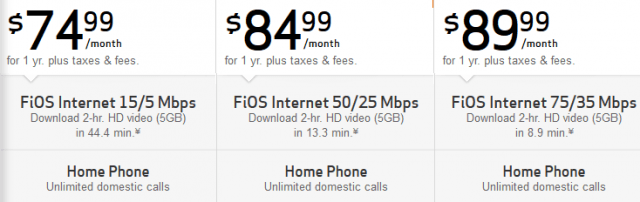
 Although cable and phone companies love to declare themselves part of a fiercely competitive telecommunications marketplace, it is increasingly clear that is more fairy tale than reality, with each staking out their respective market niches to live financially comfortable ever-after.
 That means Time Warner Cable has an 80 percent market share. Actually, it is probably higher because that total number of households includes those who either don’t want, need, or can’t afford broadband service. Some may also rely on limited wireless broadband services from Clearwire or one of the large cell phone companies.
 Rochester remains a happy hunting ground for Internet Overcharging schemes because the only practical, alternative broadband supplier is Frontier Communications, which Time Warner Cable these days dismisses as an afterthought (remember that 80 percent market share). Without a strong competitor, Time Warner has no problem experimenting with new “usage”-priced tiers.
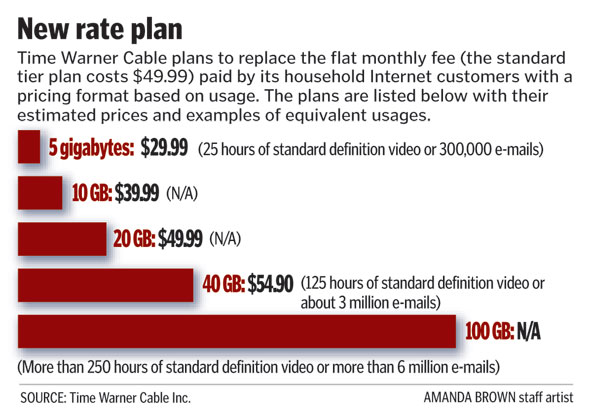
 In nearby Ohio, the average broadband user already exceeds Time Warner’s 30GB pittance allowance, using 52GB a month. Under both plans, customers who exceed their allowance are charged $1 per GB, with overlimit fees currently not to exceed $25 per month. That 30GB plan would end up costing customers an extra $22 a month above the regular, unlimited plan. So much for the $5 savings.
 In addition to an August