Home » NBC » Recent Articles:

Comcast-NBC Deal: Hulu’s Free Online Video Days Could Be Numbered

Phillip Dampier October 13, 2009 Comcast/Xfinity, Online Video, Video 12 Comments

huluTM_355The reported deal between Comcast, the nation’s largest cable operator and NBC-Universal, part owner of Hulu, could have serious consequences for the Internet’s most popular destination for online television shows and movies.

In just a year, Hulu has enjoyed a quadrupling of visits well into the millions, streaming dozens of network television series, specials, and movies, all supported by commercial advertising.  Devised to help combat online video piracy and earn additional advertising revenue from web watchers, Hulu partners NBC, Fox and Walt Disney Co., have been successful at drawing scores of Americans to the video website.  Program distributors have also been pleased, earning money from shows like Lou Grant that haven’t been on network television in decades.  But after the economic crash of 2008, the venture has proven costly for the partnership, challenged by an advertising marketplace on life support and outright hostility by broadband providers, cable operators, and Wall Street investors, upset that the service is giving it all away for free.

Among the loudest to complain is Comcast, which is now angling to acquire NBC, and its 30% ownership stake in Hulu.

Comcast CEO Brian Roberts has repeatedly complained about the implications of giving away online video, which for some have begun to replace cable television subscriptions.

“If I am any one of these programmers, not just ESPN but the Food Network and I have a business in that 50 percent, 60 percent, 70 percent of my business comes from subscriptions, I want to think long and hard before I just put that content out there for free and not think through what it is going to mean to my business,” Roberts said at an investors conference in May.

Roberts view was shared by the CEO of the nation’s second largest cable operator, Glenn Britt of Time Warner Cable.

“If you give it away for free, you’re going to forego that subscription revenue,” Britt said. “And if you actually think the ad revenue can make up for that, then God bless you and go on your way. But I don’t think that’s the case, and (networks) don’t really think that’s the case either.”

The difference between Comcast and Time Warner Cable is that the former could gain part ownership in the largest service now giving it all away for free, and that has major implications for Hulu’s future.

“Would Comcast put an end to the Hulu model of using the Web to distribute free TV content?” asked Michael Nathanson, senior media analyst at Sanford C. Bernstein & Co. “Will Comcast continue to support Hulu?”

The Los Angeles Times reports there is already a precedent for Hulu limiting content for online viewers in response to complaints:

Hulu already has limited users’ access to certain cable programs, including FX’s “It’s Always Sunny in Philadelphia,” in response to an outcry from the TV producers and cable companies that object to paying TV programmers hundreds of millions of dollars each year for shows that are offered free online.

“Arguably, their ability to shape online content distribution, and to recast windows for video on demand, would be an important attribute of any deal,” wrote Craig Moffett, a cable industry analyst at Sanford C. Bernstein.

Comcast’s interest in NBC Universal would dramatically expand its entertainment portfolio with such attractive cable channels as USA Network, MSNBC and CNBC as well as the Universal Pictures movie studio. The proposed Comcast-NBC Universal venture also would give the cable operator a greater role in deciding how and when TV shows and movies are distributed online and at what price to consumers.

Comcast’s influence would primarily be felt in cable network programming streamed online, as Comcast has a vested interest from the millions it currently pays those programmers to carry their networks on Comcast cable systems nationwide.  Comcast could advocate Hulu become a partner in the TV Everywhere cartel, providing video content only to “authenticated” pay television subscribers, or it could limit the number of episodes available for free, or when those episodes appear on the service.

Soleil Securities media analyst Laura Martin thinks an even more likely possibility would be charging a fee for some of its more popular content.  Martin points to Hulu’s own financial problems, a consequence of the crash in the advertising market.  Soleil estimates that the three partners subsidize $33 million of the losses at Hulu even after earning $123 million this year from advertising.  Even worse, Martin says, is the cannibalizing of the networks’ own advertising earnings from broadcast runs of those shows now available online.  She told the Times that for every viewer who migrates to the Internet, the companies forfeit $920 a year in ad revenue.

But not everyone believes the Comcast-NBC deal is such a great idea.

Time Warner CEO Jeff Bewkes today told an industry conference in Manhattan that large media mergers have had a lousy track record.  Still, he said the merger would probably benefit the cable industry as a whole, because broadcast networks content with giving away content for free online will now be a part of the very industry hurt by that formula and will be more friendly towards arguments to stop it.

“We love to see our competitors taking risks,” Bewkes said.

[flv width=”400″ height=”300″]http://www.phillipdampier.com/video/CNBC Hulu 9-7-09.flv[/flv]

CNBC’s Julia Boorstin talked with Hulu CEO Jason Kilar in September about the desire for the company to partner with the cable industry’s TV Everywhere project.
Breaking News: Comcast in Talks to Buy Major Stake In NBC-Universal: Cable Subscribers Effectively Foot the Bill

Phillip Dampier October 1, 2009 Comcast/Xfinity, Online Video 11 Comments

The Wrap last night reported that Comcast, the nation’s largest cable company, was deep in talks to purchase a [potentially controlling interest in NBC-Universal, a report Comcast was disputing as of late last night.

Comcast, the nation’s leading provider of cable, entertainment and communications products and services, is in talks to buy the entertainment giant NBC-Universal from General Electric, according to knowledgeable individuals.

Deal points were hammered out at a meeting among bankers for both sides in New York on Tuesday, executives familiar with the meeting said.

Two individuals informed about the meeting said that a deal had already been completed at a purchase price of $35 billion.

A spokeswoman for NBC-Universal had no comment. Comcast responded with this statement: “While we do not normally comment on M&A rumors, the report that Comcast has a deal to purchase NBC Universal is inaccurate.”

Bloomberg News also reported interest by Comcast in a deal with two of NBC-Universal’s owner-partners: GE and Vivendi of France.  But they noted that three unnamed people with knowledge of the deal claimed Comcast would acquire only a 50% stake in the company, not 100% control, contingent on Vivendi selling its 20% stake to Comcast.

If such a deal were concluded, the NBC television network, two cable news channels, The Weather Channel, and Universal Studios would effectively be under the Comcast umbrella.  Comcast, already the nation’s largest cable company, would have a major ownership interest in a large television content-producing family of companies.  Cable companies have recently feared being owners of “dumb pipes” in an increasingly concentrated entertainment marketplace, and a deal with NBC-Universal would allow Comcast to have ownership of a significant amount of the content they distribute over their cable television and broadband networks.

TV Everywhere, a pet project of Comcast and Time Warner, leverages video content from cable networks distributed to “authenticated” cable or pay television subscribers over broadband networks.  Content owners have had the liberty to govern the terms and conditions of the distribution of their content within the scope of the project.  Outright ownership or control of the content by cable companies provides a much more predictable outcome.

Who foots the bill for an estimated $35 billion dollar investment in a completed deal for NBC-Universal?  Comcast customers, of course.

NBC Plans to Stream NFL Football This Fall: A False Start Called for Capped Customers

Phillip Dampier August 4, 2008 Broadband "Shortage", Data Caps, Frontier, Online Video Comments Off on NBC Plans to Stream NFL Football This Fall: A False Start Called for Capped Customers

NBC has announced plans to stream its National Football League games live online this fall, with exclusive access to extra camera angles and multiple video streams, in near high definition broadband bitrates.   Viewers will also have access to live blogging from NBC sports announcers and game highlights and live statistics. Plus, fans can stay updated on their NFL Game Line picks, making the online experience even more engaging and interactive.

NBC & The National Football League plan to stream pro football this fall, but those with usage capped broadband will probably have to stick with old fashioned TV to watch.

NBC & The National Football League plan to stream pro football this fall, but those with usage capped broadband will probably have to stick with old fashioned TV to watch.

Unfortunately, broadband customers on usage capped services need not apply – the video quality will consume too much bandwidth and will drive many customers well over their monthly caps before the season comes to an end.   So while Verizon FiOS customers will be able to sit back, popcorn in hand, Frontier DSL customers will need to stick to the live blogging, text based web pages,  and hope their favorite game is on local television.

NBC has also warned metered broadband customers to avoid the 2,200 live hours of Olympics coverage starting in the next few days.   It will simply be untenable for a usage capped customer to spend time viewing live coverage without quickly exceeding their usage cap.

It’s just another example of the impact usage caps bring to Americans trying to take advantage of the latest benefits the broadband platform can provide.   Virtually every day, customers will find another application they simply cannot afford to access, all because of unjustified bandwidth limitations.

The NBC logo is a registered trademark of NBC/Universal.   NFL and the NFL shield design are registered trademarks of the National Football League.   Their use does not constitute approval of the content herein.

NBC Olympics: On the Go… Somewhere Else

Phillip Dampier August 3, 2008 Broadband "Shortage", Data Caps, Online Video 1 Comment
Viewers may have to stick with TV to watch the Olympics for free.

Viewers may have to stick with TV to watch the Olympics for free.

While the rest of the wired world gets ready to sit back and enjoy Olympics coverage from China, Americans are being told you can have the Olympics online, but you better not have metered broadband access.

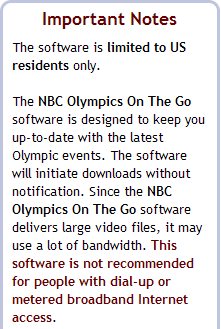
When NBC partnered with TVTonic to provide NBC Olympics On The Go,  it had to specifically warn viewers with metered broadband access not to bother.   Streaming high quality video feeds can consume a significant amount of bandwidth, and can easily allow unassuming viewers to win the the gold in the Biggest Bandwidth Overlimit Fee competition.

TVTonic's warning to broadband users to not use the service if they are using a broadband provider with usage caps.

TVTonic's warning to broadband users to not use the service if they are using a broadband provider with usage caps.

Content providers are starting to wake up to the real threat of the imposition of usage caps across the United States, limiting cable and DSL broadband customers from accessing content that was developed specifically for the broadband platform.

TVTonic is just one of several online services that could effectively be shut out of doing business in the United States because of broadband usage caps.   The company provides access to over 100 broadband Internet TV feeds, many transmitted in “high definition” quality, all of which would bring viewers ever closer to hitting their monthly limit.

Other providers such as Hulu and Joost provide legal access to hundreds of TV series, movies and specials at no charge to viewers.   But with bandwidth usage caps, will you be willing to spend your limited bandwidth watching?

Suspiciously, the “bandwidth crisis” that the industry continues to blame for the imposition of unreasonable usage caps stops at the water’s edge.   Customers in Japan and Korea enjoy broadband connections often a hundred times faster than what is available in the United States, at much lower prices and no restrictive caps.   In fact, outside of North America, nobody has heard of a bandwidth crisis.

While many broadband providers continue to reap handsome profits from their broadband services, demands for higher shareholder returns and struggling quarterly results from their other product lines in a stagnant economy have led many to decide investing in a lobbying scare campaign is a better use of their money.   It’s easier to try and convince Americans they are the problem, and limit service accordingly.

Search This Site:

Contributions:

Recent Comments:

Your Account:

Stop the Cap!