

Home » NBC » Recent Articles:

Never Loan NBC’s Richard Engel Your Phone or Laptop; Inside the Phony ‘Sochi’ Hack Story

A prominent story airing last week on the NBC Nightly News with Brian Williams suggested visitors to the Sochi Olympic Games in Russia should expect their Android smartphone or laptop to be infiltrated by hackers moments after being switched on. A closer examination of the story suggests NBC News reporter Richard Engel had to go out of his way to get infected with malware.

[flv]http://www.phillipdampier.com/video/NBC News Hackers at the Olympics 2-4-14.flv[/flv]

Is it really too late to protect your electronic device if you power it on at the Sochi baggage claim facility at the airport, as NBC News’ Brian Williams claims? (3:35)

Trend Micro security expert Kyle Wilhoit, who helped design the experiment based on Engel’s usage habits, admitted security holes were left wide open on the tested devices:

On all of the devices, there was no security software of any type installed. These devices merely had standard operational programs such as Java, Flash, Adobe PDF Reader, Microsoft Office 2007, and a few additional productivity programs.

When considering this experiment, there were some basic things to be considered. First was mimicking the user behavior of Richard Engel. Since these were going to be machines with fake data, it was important to accurately imitate his normal activities. I had to investigate Richard’s user habits. In addition to other information, I needed to understand what he actually did on a daily basis, and sites he commonly visits. Also, I needed to understand where he posted. Did he post information on forums? Did he post on foreign language sites?

NBC’s story implied that three new devices, including an Apple MacBook Air, an Android phone, and a Lenovo laptop running Windows 7 were all hacked within minutes of being switched on for the first time, right out of their respective boxes.
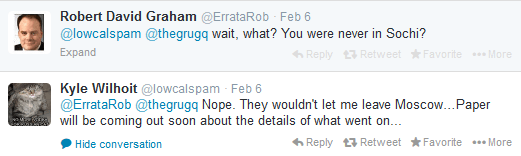
A story about hacking at the Olympics in Sochi, Russia was recorded largely in Moscow, more than 1,000 miles away.

A story about hacking at the Olympics in Sochi, Russia was recorded largely in Moscow, more than 1,000 miles away.

Careful observers will notice Wilhoit is wandering around Moscow, more than 1,000 miles away from Sochi. Wilhoit would later clarify in a tweet he never visited Sochi at all. A closer look at shots of computer screens show the reporter clicking on suspicious links and visiting obviously phony Olympics-oriented websites. With no virus or malware protection and Engel’s apparent willingness to click on anything suggests you should never loan him your laptop or phone.

NBC News went over the top getting their Android phone hacked. In fact, Engel not only had to manually find and download the infected app that let the hackers in, he had to navigate a set of menus to disable Android’s built-in security, turning on permission to download apps from unknown or third-party websites not affiliated with the Google Play store. Installing a security-compromised app also brings multiple additional warning messages advising users not to proceed. Under these circumstances, Aunt Sue can rest easy her Galaxy S4 is not accidentally open season for hackers while she watches the downhill skiing events.

Media sensationalism makes for good ratings but requires a lot of truth dodging to make the story real. This is an example.

A $200 Million Money Party: Comcast-Owned NBC Stations Demand Growing Fees from Comcast Cable

Phillip Dampier September 12, 2013 Comcast/Xfinity, Consumer News Comments Off on A $200 Million Money Party: Comcast-Owned NBC Stations Demand Growing Fees from Comcast Cable
comcast negotiations

Steve Burke is CEO of NBCUniversal and an executive vice president at Comcast.

Comcast is in the enviable position of negotiating with itself for permission to carry Comcast-owned NBC stations over Comcast Cable, earning the company hundreds of millions in retransmission consent fees paid by cable subscribers.

Comcast executive vice president Steve Burke, who also oversees the Comcast-owned NBCUniversal, said retransmission fees are changing the broadcast business, and makes Comcast a ton of money along the way.

“NBC made virtually nothing on retransmission consent two years ago,” Burke told investors at the Bank of America Merrill Lynch 2013 Media, Communications & Entertainment Conference. “This year we’ll make about $200 million.”

Since acquiring NBCUniversal, cable subscribers cannot help but find themselves watching at least one channel owned by the entertainment and cable conglomerate. Burke said in addition to owning NBC local stations in the largest U.S. cities, Comcast also owns or controls an impressive number of popular cable channels including USA, Syfy, Bravo, E!, MSNBC, CNBC, The Weather Channel, and a variety of sports networks. Seven Comcast-owned cable networks earn the company more than $200 million annually, providing almost two-thirds of the programming division’s operating cash flow.

But Burke isn’t satisfied with those earnings, claiming cable companies undervalue the networks’ true worth by 20-25 percent.

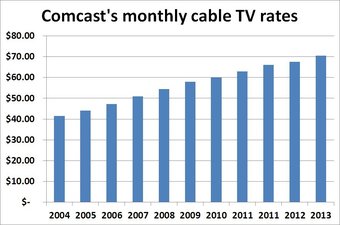
comcast cable rates“There is a monetization gap between how those channels are doing and how they should be doing measured by how peer cable channels are doing,” Burke explained. “In other words we are not paid as much as we think we should be given our ratings and our positioning by cable and satellite companies.”
Burke told investors the company is positioning to capitalize on the growth of retransmission consent fees that will deliver more revenue to the broadcast and cable programming divisions of Comcast that will be eventually reflected on subscribers’ bills.

“The key to retransmission consent is to have contracts expire with the big distributors that allow you to reopen the existing retransmission consent contracts,” Burke said. “One thing that we really hadn’t figured on when we did the deal was how rapidly retransmission consent was going to establish itself. We underestimated that frankly. That’s a very good thing for NBCUniversal, but not so good I think for Comcast Cable.”

Although Comcast has been very vocal about unreasonable price increases for broadcast and cable television programming owned by other companies, it expects comparable compensation for its own stations and networks.

“As our contracts come up, we will get those revenues the same way CBS, ABC and FOX have,” Burke argues. “I see no reason why we won’t […] get paid in a similar fashion to the way that they get paid in the future.”

Comcast’s Meteoric Rise and Market Power Parallels the Decline of U.S. Internet Service

Phillip Dampier February 25, 2013 Broadband Speed, Comcast/Xfinity, Competition, Public Policy & Gov't Comments Off on Comcast’s Meteoric Rise and Market Power Parallels the Decline of U.S. Internet Service
Cohen

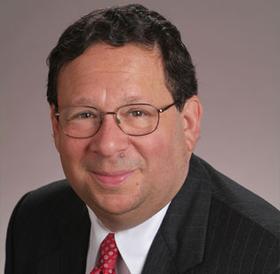
Comcast’s David Cohen

Comcast is an American success story, but Americans that do business with the cable giant are getting slighted by overpriced, too-slow broadband service.

In a commentary piece in the Financial Times, Edward Luce indicts the company that bought NBC-Universal for pay-for-play campaign contributions that have kept the company from much  regulatory scrutiny and free to charge whatever it likes for a service now increasingly considered a necessity.

Comcast’s key employee as far as Washington is concerned is its senior vice-president, David Cohen, who also happens to be one of President Barack Obama’s largest fundraisers.

The revolving door between Comcast in Philadelphia and the federal government in Washington is always spinning.

Of Comcast’s 121 lobbyists, 85 are former government employees, according to Open Secrets, which monitors money and politics.

“Comcast employs the royalty of K Street [lobbyists],” says Sheila Krumholz, head of Open Secrets.

In 2011, the year the FCC approved Comcast’s merger with NBCU, the company spent more than $14 million on lobbying – the ninth-highest of any US company (it ranks 49th on the Fortune 100 list).

Luce adds Meredith Atwell-Baker, a former Republican FCC commissioner, took an executive position at Comcast shortly after voting to approve the merger-buyout between the cable operator and NBC.

This month Comcast acquired the 49 percent of NBC-Universal it did not already own in a $16.7 billion transaction that got less attention at the FCC than the lunch menu at the Chinese takeout down the street.

So while Comcast enriches itself, customers are left with Internet service that is nothing to brag about.

While only 7% of the U.S. is wired for fiber broadband, more than half of South Korea and Japan can buy fiber-fast broadband service from a range of broadband suppliers. Back home, Comcast and the local phone company have built a comfortable duopoly:

The company’s meteoric rise in the past decade parallels the relative decline of Internet service in the US. In the late 1990s the US had the fastest speeds and widest penetration of almost anywhere – unsurprisingly given that it invented the platform. Today the US comes 16th, according to the OECD, with an average of 27 megabits per second, compared with up to quadruple that in countries such as Japan and the Netherlands.

The contrast on price is just as unflattering. The average US cost for 1 Mbps is $1.10 compared with $0.42 in the UK, $0.34 in France and $0.21 in South Korea. It is not only places such as Hong Kong that put the US into the shade. Countries such as Estonia, Portugal and Hungary offer a significantly better Internet service. South Koreans joke that when they visit the US they are taking an Internet vacation. Yet bringing the US up to speed appears to be low on Mr Obama’s list of priorities (it did not even get a mention in his State of the Union address last month).

Network Makeover: G4 Dumps Videogames, Young Men for Upscale “Esquire” Audience

Phillip Dampier February 11, 2013 Consumer News 4 Comments

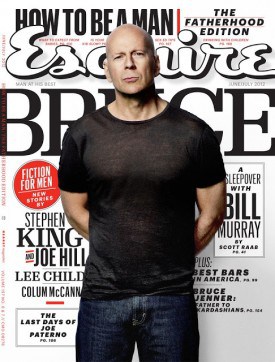
esquireNBCUniversal is scrapping the decade-0ld G4 network catering to videogames, extreme sports, COPS reruns, and young men in favor of programming targeting a more upscale older male-targeted audience.


The Esquire Network will launch April 22 in partnership with Esquire magazine.

G4 has never attracted a mainstream audience. Its ratings average around 130,000 viewers during primetime, making it one of the lesser-watched basic cable networks.

NBCUniversal is reportedly examining the performance of its second-tier cable networks which include G4, Cloo, Style, Sprout, TV One, and Chiller. Low-rated cable networks are at an increasing risk of being dumped by cable operators looking for cost savings. Most of these lesser-watched networks made it to the cable dial as part of broader agreements to carry NBC local affiliates or more popular cable networks including Bravo and USA.

The Esquire Network will rely heavily on inexpensive original reality shows including Knife Fight — a cooking competition — and travel shows created for the network by personalities from the Travel Channel.

Only American Ninja Warrier will survive the transition from G4 to Esquire Network for certain. Most of the rest of the network lineup will include reruns of shows like Parks & Recreation or off-premium cable shows like Starz’ Party Down.

Cable operators like Time Warner Cable are likely to take a second look at the network on news it will relaunch under new branding and a new format. Time Warner Cable CEO Glenn Britt said in December the company is closely examining low-rated cable networks to control escalating programming costs and the rate increases that result.

Media Consolidation in the Morning: The All-New Comcast Peacock

Phillip Dampier December 11, 2012 Comcast/Xfinity, Consumer News, Editorial & Site News Comments Off on Media Consolidation in the Morning: The All-New Comcast Peacock

Comcast has unveiled its new logo, showing a cleaner, sans-serif font capped with the NBC peacock. The new logo showed up on Comcast’s website yesterday and will gradually appear on the company’s bills, on-air, and on cable trucks. XFINITY fans have nothing to worry about: the company will continue to brand itself that way for the foreseeable future.

Search This Site:

Contributions:

Recent Comments:

Your Account:

Stop the Cap!